
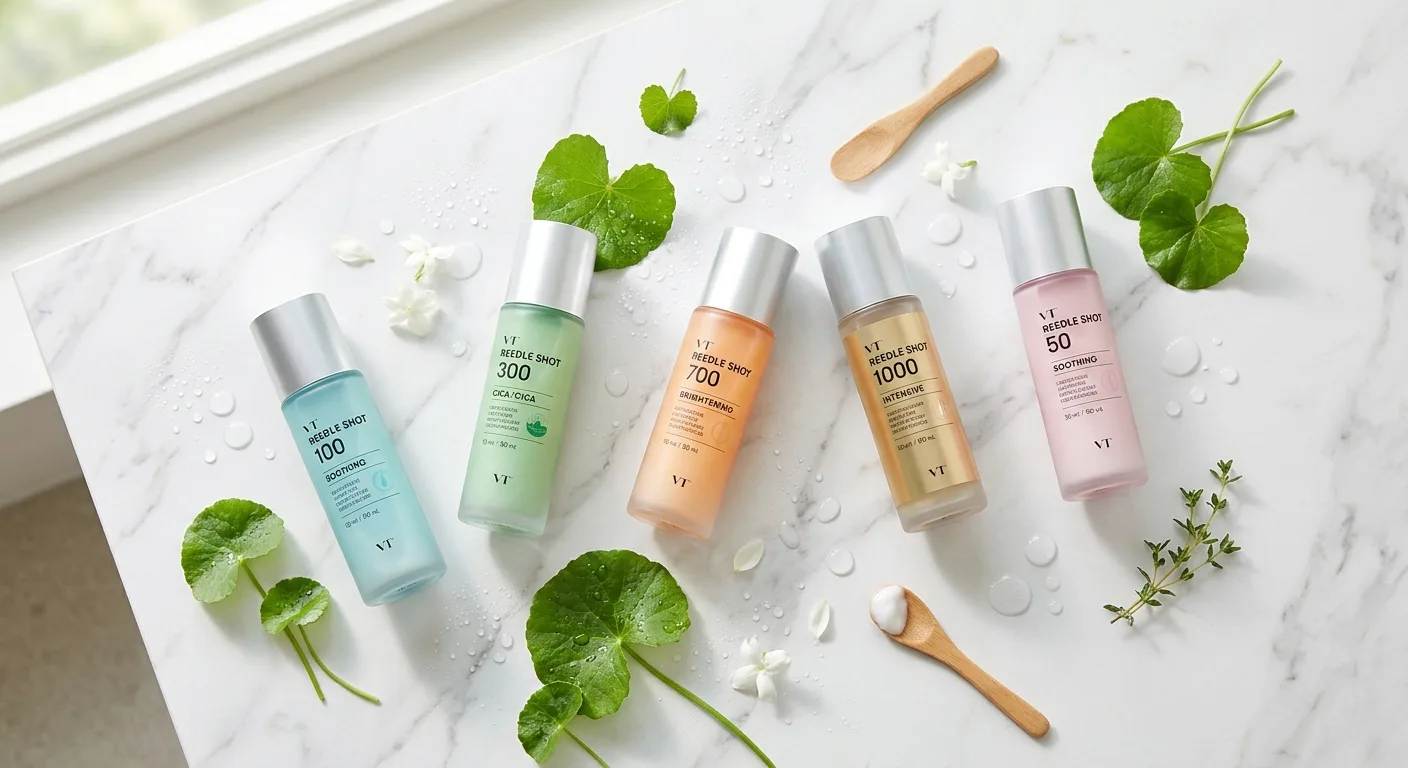
Most Reedle Shot problems are not product problems. They are sequencing problems: the wrong level on day one, a retinoid on the same night, a device or a peel too close by, or a “tingle equals results” mindset that keeps pushing frequency up. This is the practical protocol in our Reedle Shot series — how to introduce it, how to space it, what to layer over it, what never to combine with it, how the masks, eye and PDRN variants fit, and how to read the warning signs. For what the numbers mean, start with the level-by-level guide; for why it works at all, read the spicule science explainer.
One principle organizes everything below. Reedle Shot is a physical penetration enhancer, and enhancement is not selective: whatever you apply after it is delivered more efficiently, including the ingredients you would rather kept out. Every rule in this protocol follows from that.
Before the first use: who should wait
Because the mechanism is barrier disruption, the contraindications mirror those for any physical exfoliant, only stricter. VT’s own pages set three hard stops on every level: do not use with a beauty device, do not use immediately after dermatological procedures, and avoid wounded skin. Add the following from ordinary dermatology practice:
- Active inflammatory acne, eczema, perioral dermatitis or a rosacea flare. Spicules on inflamed skin add insult to injury and deliver everything on top of them deeper.
- The first six to eight weeks of a prescription retinoid, or any period when your skin is visibly flaking from tretinoin, adapalene or retinal.
- Within a week of a chemical peel, laser, microneedling, extraction facial or waxing. The barrier is already compromised.
- Sunburn, windburn or fresh irritation from a new product.
- Known sensitivity to Centella asiatica — rare, but the coating is centella-based.
- Known sensitivity to sponge-derived materials. VT lists the reedle as silica plus centella; the wider spicule raw material appears in the EU COSMILE ingredient database as Hydrolyzed Sponge, an animal-derived skin-conditioning agent, which matters to some shoppers.
If none of these apply, patch test. VT’s FAQ suggests the inner arm; the angle of the jaw is a better proxy for facial reactivity. Apply a small amount, leave it overnight, and look for anything beyond faint pinkness at 24 hours.
The application method, step by step
- Cleanse, then dry completely. Water on the surface dilutes the essence and makes the particles slide instead of lodge. Wait a minute after patting dry.
- Dispense a modest amount — a pump or two for the whole face. More product does not mean more channels; it means more friction.
- Apply as the very first step. VT’s directions: take the product “on the bare face after cleansing and apply it gently with your fingers.” Nothing goes before it, including toner or mist.
- Press and hold; do not rub. Rubbing drags rigid particles across the skin and produces redness without more useful channel formation. Use flat fingers and gentle pressure across cheeks, forehead, chin and nose. Skip the eyelids and the immediate lip line unless you are using the dedicated eye or lip products.
- Wait until it is fully absorbed — one to three minutes — before the next layer, exactly as VT specifies: “after Reedle Shot 100 is absorbed, apply moisturizing skin care.”
- Layer hydration and barrier support on top. A hyaluronate serum, a ceramide or panthenol moisturizer, or a plain occlusive if your skin is dry.
- Wash hands. Residual particles on fingertips can end up in the eyes.
Evening use is the default in VT’s guidance. Morning use is possible at the 50 and 100 levels, but it competes with sunscreen and makeup for the same skin and raises the odds of stinging under SPF.
The frequency ladder: ramp by frequency first, level second
VT’s label and FAQ give two different numbers for the 100, and both are right. The label says it “can be used everyday” — that is the ceiling. The FAQ says to “start with 2–3 times per week in the evening” and build up “after the first two weeks” — that is the ramp. Follow the ramp.
| Phase | Level | Frequency | Move on when | Step back when |
|---|---|---|---|---|
| Weeks 1–2 | 50 or 100 | 2–3 evenings per week | No lingering flush next morning; tingle fades within minutes | Tightness, stinging under water, redness lasting into the next day |
| Weeks 3–6 | 100 | Every other night, then nightly if comfortable | Tingle has largely disappeared and you have a specific texture goal | Any sign of dryness, flaking or new sensitivity to other products |
| Months 2–3 | 300 | Every 3 days (VT’s stated interval), on its own night | Consistently comfortable for several weeks | Flush that persists more than a few hours |
| Established users | 700 | Every 7 days (VT’s stated interval) | Rarely necessary to go further | Persistent sensitivity: return to 300 |
| Targeted, occasional | 1000 / 1300 | Localized areas only; 1300 needs a 24-hour to 3-day recovery period | Not a routine product | Tingling beyond 3–4 days: stop and let skin recover fully |
Two of VT’s rules deserve repeating. Levels are never combined on the same day — the 300 page says “do not use with reedle shot 100 and 700 at the same day,” and the 700 page mirrors it. And the stated intervals are minimums keyed to recovery: research-grade sponge spicules were still present in porcine skin at 72 hours, which is exactly why a three-day gap for the 300 makes physiological sense.
What to layer on top: the “boost list”
Reedle Shot’s value is that the products applied after it work harder. Choose those products for that reason. On a Reedle Shot night, the ideal follow-up layers are simple, water-based and barrier-supportive:
- Hyaluronate and glycerin-led hydrators. Multiple molecular weights of hyaluronic acid are the classic pairing, and VT’s own bases are built the same way.
- Centella, madecassoside, panthenol, allantoin, beta-glucan. Soothing agents that offset the mechanical stimulus.
- Ceramides, cholesterol and fatty acids. A ceramide moisturizer or a barrier cream closes the routine and supports recovery.
- Niacinamide at moderate levels (2–5%). Generally well tolerated and a sensible target for improved delivery.
- Peptides and PDRN. Large, water-loving molecules that struggle to pass the barrier on their own — the category that benefits most from a physical enhancer. See our guide to choosing a peptide serum.
Fragrance-free is not a preference here; it is a rule. Essential oils, denatured alcohol in high positions and fragrance compounds are the ingredients whose enhanced delivery you least want.
What not to combine, and how to schedule the rest of your actives
VT’s FAQ is explicit on retinoids: “alternating nights when introducing Reedle Shot alongside strong actives like retinol,” with vitamin C “in the morning and Reedle Shot in the evening” once adjusted. Expand that into a weekly map rather than a nightly negotiation.
- Retinoids (retinol, retinal, tretinoin, adapalene): different nights, never the same routine. The Reti-A Reedle Shot variant already contains a retinoid-type ingredient; on those nights, no additional retinoid at all.
- AHAs, BHAs, PHAs and exfoliating pads: different nights. Chemical plus physical exfoliation in one evening is the fastest route to a damaged barrier. If you use exfoliating pads, our pads versus scrubs guide covers how to space them.
- L-ascorbic acid and other low-pH vitamin C: mornings, not on top of Reedle Shot. The Vita-Light variants use gentler derivatives for this reason.
- Benzoyl peroxide, azelaic acid, prescription topicals: ask the prescriber; do not layer over spicules without advice.
- Devices — LED, RF, microcurrent, heated wands, cleansing brushes: not the same day. VT warns that heat or light with reedles can cause “severe irritation.”
- Physical scrubs, cleansing brushes, sheet-mask “peeling” steps: not the same day.
A workable week for an established 300 user looks like this: Monday Reedle Shot 300 plus hydration; Tuesday retinoid; Wednesday rest with barrier cream; Thursday Reedle Shot 300; Friday retinoid or acid; Saturday rest; Sunday Reedle Shot 300. Beginners on the 100 should simply alternate Reedle Shot nights with everything else.
Masks, sticks and the compact set: same logic, different format
VT sells the reedle in two-step sheet masks at the 50, 100, 300 and 700 densities, in single-dose sticks, and in a compact set of the three main levels. The density rule does not change with the format: a “700” mask is a weekly treatment, not a weekly-plus-essence treatment, and it should replace — not join — the essence on the night you use it. The two-step masks put the reedle in the first (ampoule) step and a hydrogel or sheet in the second, which is a convenient built-in way to follow the enhancer with hydration.
The compact set — travel sizes of the 100, 300 and 700 — is the most efficient way to run the ladder above without committing to three full bottles. Use the sizes in order; do not “sample” the 700 first because it is in the box.
The eye lifter, PDRN and other variants in a routine
The PDRN Reedle Shot Eye Lifter pairs a lower reedle load with sodium DNA and a vibrating applicator, and it is the only Reedle Shot that belongs near the orbital bone. It should not be applied on the mobile lid or the lash line, and it should not be used on the same night as a facial 700. Treat it as its own once- or twice-weekly step.
The PDRN Reedle Shot 300 is scientifically the most coherent variant in the line: PDRN is a large, negatively charged polynucleotide that barely crosses intact skin, so a physical enhancer is precisely what it needs. Use it exactly like a standard 300 — every three days, on its own night — and follow with a simple hydrator rather than a second PDRN product; our PDRN cream versus serum guide explains why doubling up adds cost without adding delivery.
The Reti-A Reedle Shot 300 is the one that most often goes wrong. It combines the enhancer with a retinoid-type ingredient, so it counts as your retinoid night. Beginners should not start with it; established 300 users should introduce it once a week, then build to the three-day interval only if there is no dryness or flaking.
Sunscreen, seasons and travel
Reedle Shot is not photosensitizing in the pharmacological sense, but skin whose outer layer is being repeatedly disturbed has less margin for UV. Wear a broad-spectrum SPF every morning without exception — our no-white-cast Korean sunscreen guide covers finishes that sit comfortably over a freshly treated face. In dry winter air or on long flights, drop one frequency step and add an occlusive on top. During beach or high-altitude weeks, pause the 300 and above entirely.
Troubleshooting: reading the signals
- Tingle fades in one to five minutes, skin looks normal next morning: correct dose. Hold the current frequency for two weeks before changing anything.
- Tingle is intense but gone by morning: tolerable, but do not increase frequency. Check that you are pressing, not rubbing, and that skin was fully dry.
- Warm, pink or tight the next morning: too much, too soon. Skip the next scheduled use, add a barrier cream nightly, and resume at a lower level or longer interval.
- Stinging when you apply plain moisturizer or water: barrier is compromised. Stop Reedle Shot for at least a week, strip the routine to cleanser, moisturizer and sunscreen, and restart at the 50.
- Small bumps or breakouts in the first two weeks: usually a turnover response or a reaction to a product you layered on top. Simplify the follow-up layers before blaming the reedle; if it persists beyond three weeks, stop.
- Hives, swelling or spreading rash: not a normal response. Stop and seek medical advice.
- Tingling that persists for days after a 1000 or 1300: expected by VT’s own warning for those densities, but it means no further application of any level until it has fully resolved.
The best long-term sign that the protocol is right is boring: a face that looks slightly smoother and more even under makeup, with no drama in between. If you find yourself chasing the tingle, you have started using the sensation as the metric, and that is the moment to step back a level.
Sources
- VT Cosmetics official: Reedle Shot 100 — directions, daily use and cautions
- VT Cosmetics official: Reedle Shot 300 — every-3-days interval and same-day exclusions
- VT Cosmetics official: Reedle Shot 700 — weekly interval and device warning
- VT Cosmetics official: Reedle Shot 1300 — recovery window and tingling duration
- VT Cosmetics official FAQ: patch testing, frequency ramp and use with retinol and vitamin C
- Molecular Pharmaceutics (2017): Sponge spicule retention in skin and recovery of barrier disruption
- Experimental Dermatology (2000): The 500 Dalton rule for skin penetration
- U.S. FDA: Microneedling devices — contraindications and risks of skin penetration
- U.S. FDA: Is it a cosmetic, a drug, or both?
- COSMILE Europe: Hydrolyzed Sponge — INCI entry, origin and function
Frequently Asked Questions
Do I apply Reedle Shot before or after toner?
Before everything. VT's directions place it on the bare face immediately after cleansing, once the skin is completely dry, and only after it has absorbed do you continue with toner, serum and moisturizer. Water or toner underneath dilutes the essence and lets the particles slide rather than lodge, which weakens the effect and increases friction.
Can I use Reedle Shot with retinol or exfoliating acids?
Not in the same routine. VT's FAQ recommends alternating nights when introducing Reedle Shot alongside strong actives like retinol, and using vitamin C in the morning. Because the reedle enhances delivery of whatever follows, layering a retinoid or acid over it raises irritation without adding benefit. The Reti-A variant already contains a retinoid-type ingredient and counts as your retinoid night.
How many nights a week should a beginner use it?
Two or three evenings a week for the first two weeks at the 50 or 100 level, per VT's FAQ, even though the 100 label allows daily use. Increase frequency only when the tingle fades within minutes and there is no flush the next morning. Move to the 300 only after several comfortable weeks, and keep it to every three days on its own night.
Can I use a Reedle Shot mask and the essence on the same night?
No. The masks carry the same density tiers as the essences, so a 300 or 700 mask replaces the essence that night rather than adding to it. VT states that different levels should never be combined on the same day. Use the two-step masks as a built-in way to follow the reedle step with hydration, and count them in your weekly frequency.
What should I do if my skin is red or stinging the next day?
Skip the next scheduled use, apply a fragrance-free ceramide or panthenol moisturizer nightly, and restart at a lower level or a longer interval once the skin is calm. If plain water or moisturizer stings, stop Reedle Shot for at least a week and reduce the routine to cleanser, moisturizer and sunscreen. Hives, swelling or a spreading rash are not normal and need medical advice.
Can I use Reedle Shot with an LED mask or other device?
Not on the same day. VT warns on every product page not to use Reedle Shot with a beauty device because heat or light on freshly disturbed skin can cause severe irritation. The same applies to cleansing brushes, heated wands and radiofrequency or microcurrent tools. Schedule device sessions on rest nights, and never within a week of a clinic procedure.