
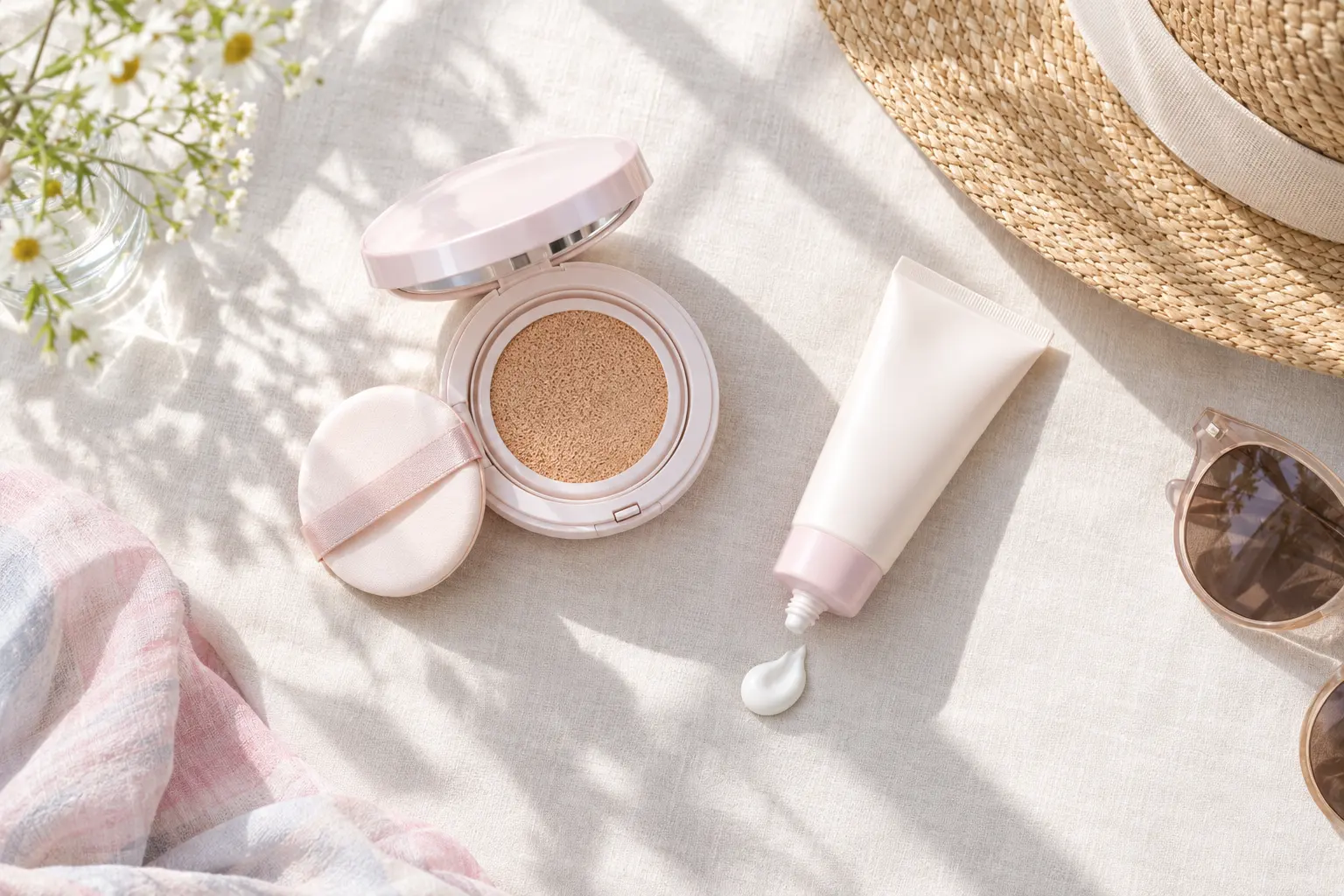
The Korean sun cushion vs sunscreen question usually starts at the mirror at 8 a.m.: you have a lotion that takes time to sink in and a compact that promises SPF50+ in ten pats. It is tempting to let the compact do both jobs. For most days, it should not.
Here is the useful answer up front. A dedicated sunscreen is your protection; a sun cushion is your top layer, your tone-up and, above all, your reapplication tool. That is not a knock on cushions. It reflects how much product a puff actually deposits, and once you understand that mechanism, choosing the right compact becomes much easier.
Korean sun cushion vs sunscreen: the short answer and the rule
Think of the two formats as having different jobs rather than competing for the same one. A bottle or tube of sunscreen is designed to be spread in a generous, even film across the face. A cushion is a liquid or balm soaked into a sponge, picked up with a puff and pressed onto the skin, which is fast and neat but deposits a thinner, more variable layer.
So the decision rule is simple. If a single product is all that stands between your skin and the sun, it should be a dedicated sunscreen applied at a full dose. A cushion earns its place on top, and especially later in the day, when re-spreading lotion over makeup is impractical.
Three situations where the rule plays out
- The office commuter. You wear light base makeup, sit near a window and walk twenty minutes each way. Sunscreen first, then a tone-up cushion instead of foundation, then a quick cushion touch-up before the evening walk home.
- The outdoor day. A picnic, a hike, a theme park. Full sunscreen at home, reapplication on a schedule, and the cushion used as a supplement rather than a substitute for proper reapplication.
- The oily-by-noon worker. Your morning sunscreen held up, but by lunch your T-zone is shiny and you have no wish to add more lotion. A shine-controlling cushion over makeup addresses the finish, and if its box carries a rating you have confirmed, it can contribute to a top-up too.
What changes the recommendation? Not your skin type, and not the SPF number on the compact. What changes it is how long you will be exposed and whether a full base layer is already on your face. With a proper base, the cushion choice becomes a question of finish and convenience. Without one, the cushion is being asked to do a job it was not built to do reliably.
Why a sun cushion rarely delivers the SPF on its lid
Every SPF figure is a measurement taken at a specific dose. That dose is the part almost nobody talks about at the beauty counter, and it is the whole story here.
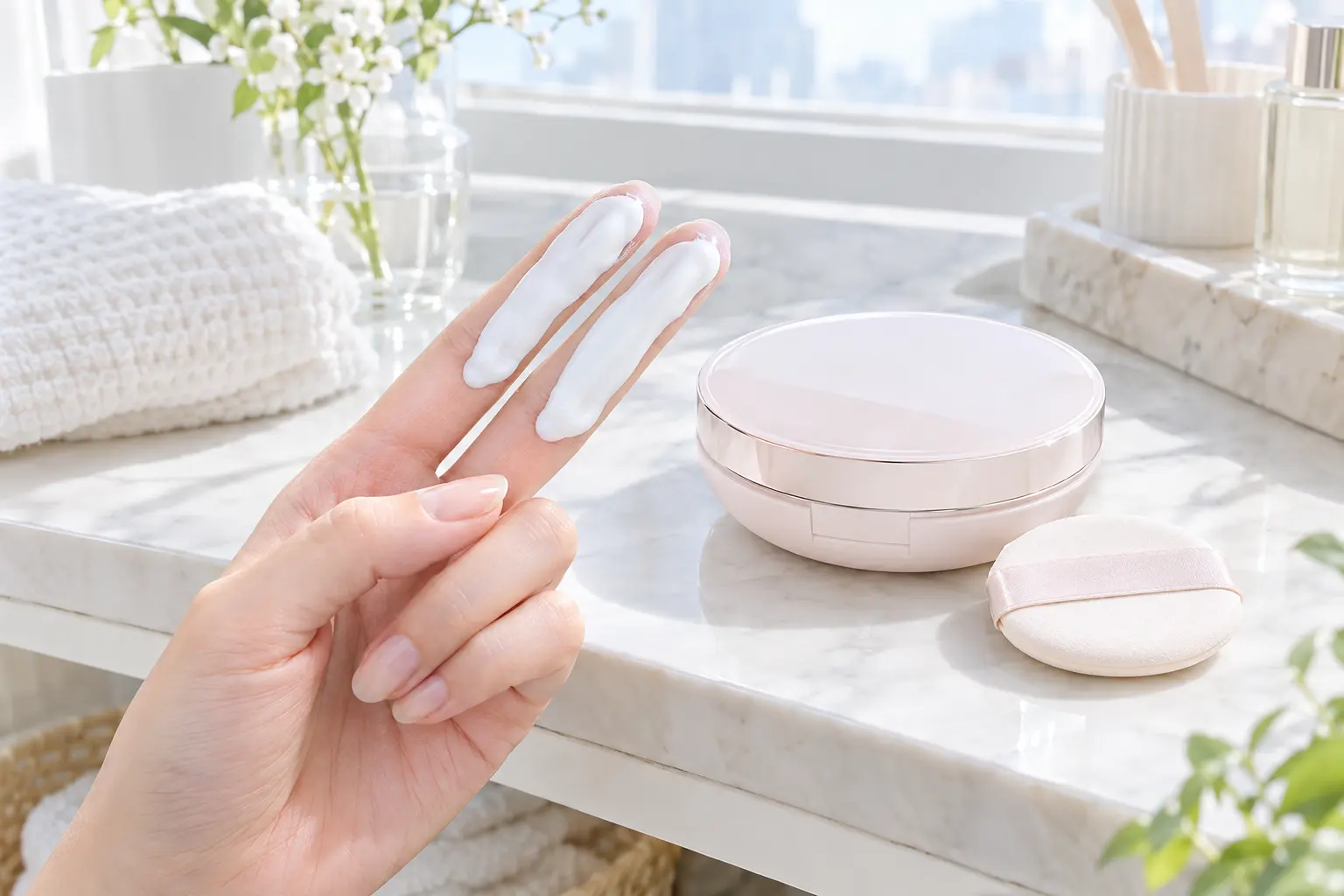
SPF testing uses a standardized, generous application of roughly 2 mg per square centimetre of skin, about a quarter teaspoon for the face with a dedicated sunscreen [4]. A board-certified dermatologist who focuses on sunscreen notes that almost nobody applies that much cushion product, because a typical cushion application is meant for light, buildable coverage [4]. Her conclusion is that the labeled number is real for the formula at the tested amount, but the protection at typical application is meaningfully lower [4].
The thin-film problem
A dermatologist quoted by a cancer-prevention charity says studies show most people apply one-half to one-quarter of the tested amount in daily use [8]. She adds that people wearing makeup with SPF may effectively get an SPF equivalent of only 5 or 10 [8]. In other words, a thinner layer does not deliver a slightly reduced version of the label; it can land far below it.
That finding was about makeup in general, not cushions specifically, and no measured data was found on how much product people actually pick up from a cushion sponge. Still, the logic transfers. A puff is engineered to deposit a little and blend it out. That is exactly why cushions look so natural, and exactly why they under-deliver as a lone sunscreen.
Coverage gaps, not just thinness
The second issue is where the product lands. Pressing and patting tends to favour the flat planes of the cheeks and forehead. The sides of the nose, the hairline, the jawline, the upper eyelids and the area around the ears are easy to skip. A lotion massaged in with fingers is not immune to misses either, but it is easier to work into contours deliberately.
None of this means a cushion is useless. It means its label SPF is best understood as a property of the formula, while your real-world protection depends on dose and coverage. Treat the compact as a top-up and that gap matters far less.
Layering a cushion over sunscreen: what adds up and what does not
A common hope is that stacking products will multiply protection: SPF50 sunscreen plus SPF50 cushion equals something heroic. It does not work that way.
A dermatologist quoted by the Skin Cancer Foundation explains that SPF 30 moisturizer plus SPF 30 foundation does not equal SPF 60, and you will more likely benefit from the highest-SPF product you use [7]. She also points out that applying multiple products with sunscreen ingredients helps make sure your whole face is covered and you do not miss a spot [7]. A second dermatologist makes a related point: layers are not additive, but two layers can help the overall thickness of protection and help you reach the SPF you actually want [8].
Why layering still matters
Put those ideas together and you get the honest case for a cushion. It will not raise the ceiling set by your base sunscreen. What it can do is patch the floor: thin areas, missed contours and spots where your morning layer has worn down from touching your face, wearing a mask or blotting oil.
- Base layer: sets the protection level. Choose a broad-spectrum formula you will actually apply generously.
- Cushion layer: evens out coverage, adds tone-up or finish, and replaces some of what has worn off.
- Reapplication: the cushion’s strongest role, because it can go over makeup without dissolving it.
The UVA question
There is one more reason not to let a cosmetic product carry the load. A Chicago dermatologist quoted by the Skin Cancer Foundation says most cosmetic formulations lack enough protection against UVA rays, which are present year-round and can travel through window glass [7]. Dermatologist guidance from a cancer-prevention charity is to apply broad-spectrum SPF 30 or higher first, followed by any makeup [8].
Korean products help here because they print a PA grade for UVA protection, covered in the next section. A cushion marked PA++++ is a stronger UVA candidate than one with no PA marking at all. But a high PA grade still only applies at the tested dose, so the base-first order does not change.
How to read a Korean sun cushion label before you buy
Korean sun-care labels carry more information than many shoppers use. Reading them properly tells you what a product claims, how strong its UVA rating is, and when you should double-check what you received.
SPF and PA
SPF is an index of UVB blocking, while PA is a UVA protection grade used predominantly in Asia [5]. On Korean packaging, SPF tops out at the label “50+” and PA is graded with plus signs, with PA++++ the highest. Two products both marked SPF50+ may still differ in actual measured protection above 50, which the label cannot show. The PA grade is the more useful tiebreaker if UVA, the wavelength linked with tanning and photoaging, is your concern.
How those numbers are tested, and what is changing
Under the current Korean system, SPF and PA for sunscreen functional cosmetics may only be determined through human application tests [5]. In August 2026, the Ministry of Food and Drug Safety published draft amendments that would add the in vitro ISO 23675 method for SPF and ISO 24443 for PA alongside the existing human tests, with public comments due by September 18, 2026 [5]. The same draft would clarify that SPF and PA claims may be labeled or advertised only with substantiation from human or in vitro tests [5].
For a shopper, the practical meaning is modest. It is a draft about how numbers are generated and substantiated, not a change to how you should apply them. The 2 mg per square centimetre assumption still sits behind the figure on the lid.
Why the box is the final word
Brands renew formulas and packaging, and a compact can carry a different rating or filter list from an older version you remember. The TE Grass Chorok35 Tone-Up Sun Cushion, for example, is listed here as a 14g, SPF50+ PA++++ tone-up cushion with mineral (inorganic) UV filters. Whatever you buy, the rating and ingredient list printed on the outer carton you receive are what you should plan your routine around.
A quick label checklist
- SPF and PA printed on the outer box.
- Whether the filter list is mineral only (zinc oxide, titanium dioxide) or includes organic filters, especially if you have reactive skin.
- Fragrance and essential oils, if your skin dislikes them.
- Opened shelf-life symbol and any age guidance.
Matching the sun cushion to the job: tone-up, matte or balm
Once you accept that the cushion is a second layer, the buying question shifts. You are no longer asking which compact protects best. You are asking which finish solves the problem you have at 8 a.m. and again at 3 p.m.
The featured cushions fall into three broad families. Tone-up cushions add a sheer colour correction so you can skip foundation. Powder-finish cushions are designed to control shine and set makeup. Balm-style cushions sit between skincare and base. The table below sorts them by their stated purpose; it reflects product descriptions, not head-to-head performance testing.
| Cushion | Size and stated rating | Stated finish and role | Best fit |
|---|---|---|---|
| Cell Fusion C Toning Sun Cushion | 13g, SPF 50+ PA++++ | Moist, adherent soft-pink tone-up; foundation-free glow; described as mask-resistant | Light-makeup days over sunscreen |
| rom&nd Back Me Tone Up Sun Cushion | 11g, SPF 50+ PA++++ | Dual-tone peach correction plus brightening cream; vegan compact | Dull or uneven tone wanting a radiant base |
| TE Grass Chorok35 Tone-Up Sun Cushion | 14g, SPF50+ PA++++ | Mineral tone-up for daily wear; compact with puff | Those who want a mineral-filter tone-up layer |
| TOCOBO Blur Finish Sun Cushion | Shades 00 Pure, 01 Cotton Blue; confirm rating on box | Hydrating essence that sets to a matte, pore-blurring powder; sets makeup | Oily skin wanting a shine-control finish |
| THE WHOO Gong Jin Hyang Jin Hae Yoon Cushion Sun Balm | 13g, SPF50+ PA++++ | Foundation-like moisture with powder-soft finish; sebum control; wrinkle and whitening functional claims | Portable touch-ups for skin wanting comfort and polish |
The tone-up pick for foundation-free mornings
If your daily base is sunscreen plus something to even out redness and dullness, a toning cushion is the most efficient second step. The Cell Fusion C Toning Sun Cushion is described as a moist tone-up formula that adheres well to the skin, comes in a natural pink colour intended to brighten all skin tones, and is recommended for foundation-free makeup and for keeping a tone-up even under a mask. Its directions place it at the last step of skincare: press the sponge with the puff and spread evenly. Its listing notes that the finish varies by skin tone, so deeper skin tones should expect a pink cast to read differently than on fair skin.
If peach correction suits you better than pink, the rom&nd Back Me Tone Up Sun Cushion takes a dual-tone approach in an 11g compact. Choose between the two by the undertone of what you want to neutralize: pink tends to brighten sallowness, peach is traditionally used against dullness and shadow. If mineral filters are your priority, the TE Grass Chorok35 is the one of the three described with mineral (inorganic) filters.
The best sun cushion for reapplication over makeup
This is where cushions are genuinely hard to beat. The dermatologist advice is consistent: apply a full layer of broad-spectrum sunscreen before makeup and reapply every two hours during extended time outdoors [8]. The trouble is that a second round of lotion over foundation tends to pill, streak or lift your base. That practical friction is the main reason people skip reapplication entirely.
The Skin Cancer Foundation’s guidance suggests a powdered sunscreen on top of foundation for reapplying through the day [7]. A pressed-on cushion follows a similar logic in a forgiving format: it goes on without smearing your base. The deciding factor is a confirmed SPF and PA rating on the compact you choose.
For skin that wants a rated touch-up with comfort
If you want one compact that carries a stated rating and is designed for portability, THE WHOO Gong Jin Hyang Jin Hae Yoon Cushion Sun Balm is the clearest fit among these. It is a 13g compact rated SPF50+ PA++++ and described as combining a moisturizing, foundation-like finish with a powder-soft feel and lasting sebum control. Its directions are to apply an adequate amount, reapply as needed and keep the puff clean. It also carries wrinkle-improving and whitening functional claims, which in Korea are regulated cosmetic claim categories rather than evidence of dramatic results. Balm comfort suits skin that looks tight or flaky under powders by afternoon.
For oily skin: a shine-control finish
The TOCOBO Blur Finish Sun Cushion is described as a moisture-locking powder cushion that applies like a hydrating essence and finishes like a soft-focus powder, with water-holding powders that leave a matte finish, blur pores, set makeup and reduce shine. It comes in 00 Pure and 01 Cotton Blue. Treat it primarily as a finishing and shine-control step; whether it can also serve as a sun top-up depends on the SPF and PA printed on the box of the shade you buy, so check before counting on it for protection.
Making reapplication actually count
- Blot first. Pressing a cushion over a layer of oil dilutes the new product and slides it around.
- Use more than one pickup. Press the puff into the sponge, apply, and go back for a second pass on cheeks, nose and forehead.
- Press, do not swipe. Swiping drags off the makeup and sunscreen underneath.
- Do the forgotten zones deliberately: sides of the nose, upper lip, hairline and jaw.
Sun cushions for children and reactive skin
Cushions appeal to parents for an obvious reason: a puff is quicker than chasing a wriggling child with lotion. The same dose and coverage logic applies to small faces, though, and children’s products deserve the closest label reading of all.
A cushion positioned for children
The GREEN FINGER Fresh Mild Sun Cushion 12g is positioned for sensitive children’s skin, described as a mineral-based, plant-derived formula that has passed skin irritation testing and is free from 33 listed harmful ingredients. Those are brand claims; irritation testing reduces some uncertainty, but it is not a guarantee that a particular child will not react. Another retail listing for an SPF50+ version describes aloe vera extract and centella asiatica in the formula [3]. That same listing describes the finish as both natural and dewy and as matte [3]. It also directs application evenly over the face as the final step of skincare, with reapplication as needed [3].
Because descriptions vary, confirm three things on the box before buying: the SPF and PA grade, the filter list, and any minimum age printed on the packaging. For babies, especially very young infants, ask your pediatrician before using any sunscreen, and rely on shade, hats and clothing as the main protection. A cushion format is convenient, but no evidence shows it is safer for children than other formats.
For adults with reactive skin
Two variables matter more than the cushion versus lotion question: which UV filters are in the formula and whether fragrance is present. Not every tone-up cushion is purely mineral, so read the ingredient list rather than assuming a tone-up tint means zinc oxide and titanium dioxide only. If you have already worked out which filters your skin tolerates, our guide on matching sunscreen filters to sensitive-skin flare-ups walks through that choice for your base layer, which is the product that matters most.
- Patch test a new cushion along the jaw for several days before full-face use.
- Stop use if stinging, redness or itching appears.
- Keep a separate, clean puff for anyone who shares a compact, or better, do not share.
How to build a sun cushion routine that actually protects
A good cushion routine is less about the compact you pick and more about order, dose and habit. Here is a sequence that fits most mornings.
- Skincare first, lightly. A thin, quick-absorbing moisturizer keeps the base from pilling. If your current one is heavy, browse our moisturizers for a lighter daytime texture.
- Dedicated sunscreen at a full dose. One dermatologist-cited guideline is about two finger lengths of sunscreen for the face [8]. Let it set for a few minutes so the cushion does not drag it.
- Cushion as the base or finish. Press in two or three thin passes rather than one heavy one, which gives more even coverage and fewer patches.
- Reapply on a schedule. On outdoor days, the two-hour reapplication rhythm applies regardless of what is printed on your compact [8].
Common mistakes
- Counting SPFs together. Your protection is set mostly by the strongest product you applied properly, not the sum of numbers.
- One dab of cushion as sunscreen. Pleasant to wear, unconvincing as protection.
- A grimy puff. Sebum and makeup build up on the puff and transfer back into the sponge. Wash or replace puffs regularly; some product directions specifically ask you to keep the puff clean.
- Ignoring the open date. Cushions are exposed to air and fingers every time you open them; respect the opened shelf-life symbol on the box.
Your next decision
If you do not yet own a base sunscreen you enjoy enough to apply generously, solve that first; the cushion is the second purchase. If you already have one, pick the cushion by your afternoon problem: pink tone-up for dullness with the Cell Fusion C, a rated balm touch-up with THE WHOO, or a matte shine-control finish with the TOCOBO once you have confirmed its rating. And since sun exposure shows over time as dryness and uneven texture, it pairs naturally with a steady hydration routine, which our piece on why hydration beats the hype covers in more depth.
Frequently Asked Questions
Can a sun cushion replace sunscreen?
Not as your only protection. SPF is measured at a generous dose that a puff rarely delivers, so real-world protection from a cushion alone is lower than its label suggests. Apply a dedicated sunscreen first and use the cushion as a top layer and for reapplication. On a short indoor day the stakes are lower, but the order stays the same.
Does SPF50 sunscreen plus SPF50 cushion give me SPF100?
No. SPF values do not add together; you mainly get the protection of the highest-SPF product you applied properly. The second layer still helps by covering spots you missed and thickening thin areas. That is a coverage benefit, not a bigger number.
How often should I reapply a sun cushion?
On days with extended time outdoors, dermatologists advise reapplying about every two hours, and sooner if you sweat heavily or wipe your face. Blot oil first, then press on two thin passes rather than one swipe. Follow any specific directions printed on your product, since label instructions take priority.
Is a tone-up sun cushion always a mineral sunscreen?
No. A tone-up tint does not tell you which UV filters are inside; some tone-up cushions combine mineral and organic filters. If you need mineral-only, read the ingredient list for zinc oxide and titanium dioxide and check whether any organic filters are also listed. This matters most for reactive skin.
What does PA++++ mean on a Korean sun cushion?
PA is a UVA protection grade used mainly in Asia, while SPF measures UVB protection. PA++++ is the highest grade on Korean labels. Like SPF, it reflects testing at a standardized dose, so a PA++++ cushion applied thinly still protects less than its grade implies.
Is a sun cushion safe for my baby?
Check with your pediatrician before using any sunscreen on a baby, and rely on shade, hats and clothing as the main protection for young infants. Irritation-tested and mild claims reduce some uncertainty but do not guarantee your child will not react. Always confirm the SPF, filters and any age guidance printed on the box.