

If you are shopping for Korean supplements for skin health, the honest short answer is narrower than most marketing suggests. Among wellness products, collagen peptide sticks are the main category with a real skin rationale. The research behind them is encouraging in places and openly disputed in others.
This piece is about one decision: whether a drinkable or powdered collagen stick deserves a place in your routine, and if it does, which formula to choose. The working rule is simple. Buy collagen as a timed experiment aimed at hydration, choose the formula whose dose you can actually verify, and never let it replace sunscreen or a good moisturizer. The rest of this article explains why that rule holds and when it changes.
What a Skin Claim on a Korean Supplement Really Means
Korea treats supplements with health claims differently from ordinary snacks. A product registered as a health functional food goes through the regulator’s review. A drink sold as a general food usually cannot make a functional claim at all. That difference matters more than any adjective on the box.
The line has softened somewhat. Since December 2020, the regulator’s notification system has allowed general foods made with scientifically substantiated ingredients to carry functional labelling that was once reserved for health functional foods [2]. In 2024, a low-molecular collagen peptide ingredient that had already been individually recognized was cleared to carry its skin claims, including help with skin moisturizing and help maintaining skin health against UV-induced damage, on general foods too [2]. Collagen approvals in Korea are therefore tied to specific raw materials, not to collagen as a whole.
In practice, two collagen sticks can look alike on a shelf while only one of them uses an ingredient with an approved skin function. Retail copy rarely tells you which.
What to look for on the pack
- The category wording. Look for the words health functional food, or a stated functional claim for a named collagen ingredient. Generic food categories mean no approved function sits behind the skin language.
- The functional ingredient and its daily amount. An approved claim depends on the approved ingredient being present at the approved dose.
- HACCP is about hygiene. A HACCP-certified facility tells you about food-safety controls in manufacturing. It says nothing about whether the product affects your skin.
Neither skin-focused product reviewed below states health functional food status in its catalog description. That doesn’t make either one unsafe or useless. It means you are buying a nutritional formula with a skin rationale, not a regulator-endorsed skin claim. Check the box for the category line if that distinction matters to you.
What the Research on Oral Collagen Honestly Shows
The theory is reasonable. Collagen is broken down into small peptides before it is sold. Some of these short chains survive digestion, enter the bloodstream and appear to signal the cells in the dermis that make collagen and hyaluronic acid. The real question is whether that signal produces a difference you can measure in skin.
The pooled evidence cuts both ways
A 2025 meta-analysis in The American Journal of Medicine pooled 23 randomized trials with 1,474 participants and found gains in hydration and elasticity and fewer wrinkles when every study was counted [4]. When the authors looked only at trials without pharmaceutical or supplement-company funding, or only at higher-quality studies, the benefit disappeared [4]. They concluded that there is currently no clinical evidence that collagen supplements prevent or treat skin aging [4].
Industry groups pushed back. They pointed to apparent misclassification of funding sources, dose-reporting errors, and a failure to separate pure collagen from multi-ingredient blends [4]. Those groups have a commercial stake, so weigh their critique with that in mind. One of their points is still useful to you as a shopper: 17 of the 23 trials were run in Asia at relatively low daily doses of around 3 g [4]. Doses in the trials vary widely, so do not assume every stick on the market matches a studied amount.
A representative Korean trial
A 2025 randomized, double-blind trial gave 70 healthy adults either 1,650 mg a day of a low-molecular collagen peptide or a placebo for 8 weeks [5]. The supplement group improved in wrinkle depth, elasticity, surface and deep hydration, and dermal density, and no adverse events were reported [5]. The results also held during a 2-week washout after supplementation stopped [5].
Read the fine print before generalizing. Sixty-six of the 70 participants were women, the mean age was about 47, and most had dry or normal-to-dry skin [5]. Several authors worked for the company that makes the ingredient [5]. The study tested its own peptide, not any stick sold here.
Editorial read: hydration is the most consistently reported outcome and the most realistic expectation. Firming and wrinkle claims are more contested. If you are in your twenties with an oily, well-hydrated complexion, the trials offer little evidence that you will notice anything.
Reading a Collagen Stick Formula: Peptides, Daltons and Cofactors
A collagen stick usually combines three layers: the peptide itself, a molecular-weight claim, and a group of supporting ingredients. Each layer deserves a different level of trust.
Molecular weight in daltons
Daltons (Da) measure molecular size. Hydrolysis cuts long collagen chains into smaller peptides, and low-molecular products advertise small averages because di- and tri-peptides are absorbed efficiently. That much is mechanistically sound. What has not been shown is that a 300 Da product beats a 3,000 Da one on your face. No published trial compares the specific products discussed here. Treat a stated molecular weight as transparency, not as a ranking.
Vitamin C: a cofactor, not a booster
Vitamin C is needed to hydroxylate collagen, the step that makes the protein stable outside the cell [6]. Oral vitamin C raises skin levels, but once blood levels are saturated, skin concentrations stop rising [6]. In two human studies, oral vitamin C alone did not improve a standard measure of UV protection; benefits appeared only when it was combined with vitamin E [6]. So vitamin C in a collagen stick is a sensible inclusion. It is not a sun-protection feature, and it does not mean more is better.
Hyaluronic acid taken by mouth
A meta-analysis of 7 randomized trials of oral hyaluronic acid found significant improvements in hydration, elasticity and wrinkle depth [7]. Effects on firmness, wrinkle volume and transepidermal water loss were not statistically significant, and the authors called for larger trials [7]. Those trials tested dedicated hyaluronic acid doses, so a small amount added to a collagen blend should not be credited with the same results.
Elastin, milk ceramide and biotin
- Elastin and milk ceramide appear in small amounts in some blends. No product-level evidence was found for them in these formats, so treat them as minor extras.
- Biotin is common in beauty supplements. If you have blood work scheduled, tell your clinician about every supplement you take, biotin included, so they can judge whether timing matters for your tests.
The practical takeaway is that the collagen dose carries the formula. A stick that discloses its collagen amount per serving gives you something to compare against the studied range. A stick that only lists the ingredients makes you take the dose on trust.
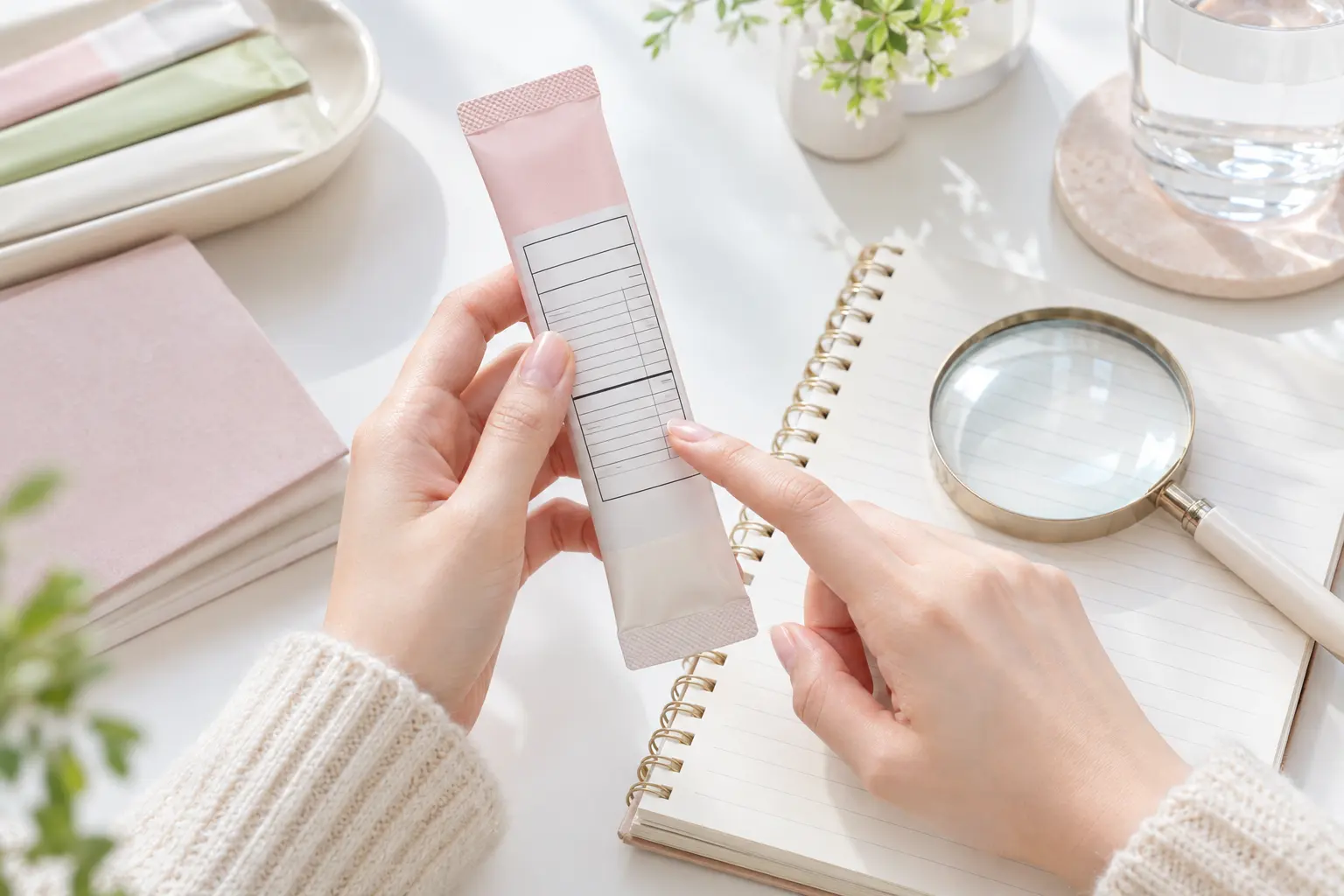
Comparing Collagen Sticks Side by Side
Two products in this selection are built around skin: a powder stick and a liquid stick. They answer the same question in different ways, and the differences that matter are disclosure, format and how long a box lasts.
| Factor | Cevitol Marine Collagen Peptide | Ownist Triple Collagen Orange |
|---|---|---|
| Format and pack | Powder stick, 3.3 g × 30 sticks | Liquid stick, 20 g × 14 sticks (280 g) |
| Collagen disclosed per stick | 2,000 mg marine collagen peptides, average 300 Da | Low-molecular fish collagen from Canada; amount per stick to be confirmed on the box |
| Supporting ingredients | Vitamin C 100 mg, biotin 100 μg, hyaluronic acid 10 mg, milk ceramide 10 mg, elastin 10 mg | Hyaluronic acid and elastin (the “triple” concept), organic orange juice flavor |
| Taste and sweetening notes | Berry flavor; no artificial sweeteners or added sugar stated | Orange flavor from organic orange juice |
| Best for | Readers who want a verifiable dose and a one-month supply | Readers who prefer a ready-to-drink format and a shorter first trial |
The table points to one clear editorial position. If you want to compare a product against the research, the Cevitol stick gives you more to work with because its collagen amount and molecular weight are printed in the product description. The 2,000 mg per stick sits close to the 1,650 mg dose in the Korean trial above and below the roughly 3 g typical of many Asian studies. That is a useful reference point, not a guarantee.
The Ownist stick’s strengths are format and convenience. A liquid stick needs no mixing, which matters if a powder you have to stir is the habit you will drop by week three. Its weakness, on the information available, is that you need the physical box to learn how much collagen you are getting. Read the nutrition panel before comparing value.
What would change the call
- Taste and adherence beat formula details. A stick you skip half the time delivers half the dose. If the powder habit fails for you, the liquid wins.
- A published per-stick dose for Ownist would make the comparison closer to even.
- Allergen and diet needs can override everything. Both use fish-derived collagen, and Cevitol also contains a milk-derived ceramide.
Who the Cevitol Marine Collagen Stick Suits
This is the stick for a reader who wants to know what they are swallowing. Each 3.3 g stick lists 2,000 mg of low-molecular marine collagen peptides with an average molecular weight of 300 Da, plus 100 mg vitamin C, 100 μg biotin, and 10 mg each of hyaluronic acid, milk ceramide and elastin. The box holds 30 sticks, so one a day gives you about a month.
The product description also lists testing by SGS for molecular weight and heavy metals, manufacture in a HACCP-certified facility, berry flavoring, and no artificial sweeteners, synthetic coloring or added sugar. The heavy-metal testing is a reasonable quality signal for a marine-sourced ingredient. Remember that HACCP covers hygiene, not efficacy.
A good fit if
- Your main complaint is dry, tight skin rather than acne or pigmentation. Hydration is the outcome the collagen research reports most consistently.
- You want a dose you can hold up against the studies. The disclosed 2,000 mg makes that possible.
- You prefer to avoid added sugar in a daily habit.
- You would rather commit to a full month than run a two-week trial that is too short to judge.
Think twice if
- You have a fish or seafood allergy. Marine collagen comes from fish. Check the box’s allergen statement for cross-contact with other allergens too.
- You avoid dairy. Milk ceramide is milk-derived.
- You are pregnant or breastfeeding. Collagen trials, including the Korean one cited here, excluded pregnant and lactating women, so there is no trial safety data for you. Ask your clinician first.
- You already take a biotin or vitamin C supplement. Add up your totals rather than stacking blindly.
Consider a hypothetical reader in her forties with dry skin who already wears sunscreen daily and uses a solid moisturizer. She is the profile closest to the trial populations and the one with a realistic chance of noticing a change in comfort. A twenty-something with oily skin looking to fix breakouts is a poor match, and the money would be better spent on topical care.
One mechanical tip: powder sticks are easier to take consistently when they are tied to a fixed moment, such as the morning glass of water. The product notes the stick can be taken anytime. What matters is taking it daily, not finding a perfect hour.
Who the Ownist Triple Collagen Liquid Stick Suits
The Ownist stick is built around a simple idea from dermal biology: collagen, hyaluronic acid and elastin are three major components of the dermis that decline over time, so the formula delivers all three in one serving. It uses low-molecular fish collagen sourced from Canada, comes as a 20 g liquid stick, and is flavored with organic orange juice. The box holds 14 sticks (280 g).
That framing is honest about intent but should not be read as proof of effect. Eating elastin does not deliver elastin to your cheeks intact. Like collagen, it is digested into smaller fragments, and the evidence for oral elastin is far thinner than for collagen peptides. Hyaluronic acid has its own modest clinical support when taken at dedicated doses [7]. Whether the amount in this stick matches those doses is something only the label can tell you.
A good fit if
- You hate mixing powders. A liquid stick removes the friction that ends many supplement habits early.
- You want a shorter first commitment. Fourteen sticks let you test taste and tolerance before buying more. Fourteen days alone is too short to judge skin, so plan for a second box if you continue.
- Elasticity and sagging are the concerns you mention most. The brand targets them, though the strongest evidence still points to hydration.
Check before you buy
- The collagen amount per stick and the serving direction on the box. Use these to compare cost per gram of collagen with the Cevitol stick.
- The sugar and calorie content. A juice-flavored liquid can differ meaningfully from an unsweetened powder, and that matters if you track intake.
- The allergen statement, given the fish-derived collagen.
The brand also lists thin, weak hair among the concerns it targets. No hair evidence was found for this formula, so treat that as a stated purpose rather than an expected result.
Here is a hypothetical case where this stick wins. You have tried powders before and abandoned them, you mainly want more comfortable skin through a dry winter, and you will reliably drink a pre-mixed sachet in the car or at your desk. In that situation, the format you will finish matters more than a slightly more detailed label.

Why Ginseng, Fiber and Joint Products Aren't Skin Supplements
Many Korean wellness products are sold alongside beauty items, and gift-box packaging can make them look interchangeable. They aren’t. Buying one for your complexion is the most common way to waste money here.
Red ginseng and Manuka honey
The Jung Kwan Jang Ginseng Manuka sticks combine 6-year Korean red ginseng with UMF10+ New Zealand Manuka honey, ginger and quince. They come in 15 g sticks, 30 per box. The product is positioned for daily vitality, which is an honest description. Red ginseng’s recognized functions in Korea center on areas such as immunity and fatigue, not skin. Nothing in the evidence reviewed here shows that this blend improves skin, so it belongs in a wellness or gifting decision, not a skincare one.
Fiber, tea and joint products
- Newty Psyllium Husk Dietary Fiber delivers 7,800 mg of psyllium husk per stick and is described as recognized by Korea’s regulator for supporting smooth bowel movements and helping improve blood cholesterol. It is a digestive product.
- FOODOLOGY Coleology Tea Pro is a pomegranate-flavored powdered tea containing Coleus forskohlii, banaba leaf, fructooligosaccharides and ginkgo, sold for general wellness and digestive balance.
- Chondroitin 1200 provides 1,200 mg a day of bovine-derived chondroitin and carries a recognized joint-cartilage function. It shares a vocabulary with collagen (cartilage, connective tissue) but not a skin purpose.
Notice that two of these, the psyllium and the chondroitin, make their regulatory status explicit in their descriptions. That is the kind of label clarity worth expecting from any functional product, including collagen.
One adjacent point: Cevitol mentions joint comfort alongside skin. Collagen is studied for both, but this article only weighs the skin evidence. If joints are your main goal, a product with a recognized joint function and a stated daily dose is the more direct choice.
The decision rule here is simple. Match the product to the function it is actually built for. If a box is sold for vitality, digestion or joints, judge it on that job and leave your skin to collagen and topical care.
Running a Fair Collagen Trial Alongside Your Skincare Routine
Collagen is the slowest, least certain tool in your kit. Treat it like an experiment with a start date, a measure and an exit, and pair it with the topical steps whose effects are better established.
A simple 12-week protocol
- Freeze the rest of your routine. Do not add a new serum or device in the same window, or you will not know what changed anything.
- Take a baseline. Photograph your face in the same window light, with no makeup, and note how tight your skin feels after cleansing. That tightness is the most practical stand-in for hydration.
- Take it daily for at least 8 weeks. The Korean trial measured at 10 days, 4 weeks and 8 weeks [5]. Judging a supplement after two weeks is guesswork.
- Reassess at 12 weeks. If you notice nothing, stop. Effects in the Korean trial held through a 2-week washout [5], so a short pause will not erase a real benefit, but there is no evidence for continuing indefinitely without one.
Where the topical work happens
Sunscreen does more for collagen preservation than any stick. Oral vitamin C on its own did not raise UV protection in human studies [6], so a drinkable product never replaces daily SPF. If your skin is reactive, our guide to choosing a Korean sunscreen for sensitive skin matches filter type to flare-ups.
For hydration you can feel the same day, a topical humectant works on the surface while a supplement works slowly from inside. Our hyaluronic acid serum guide explains why molecular-weight marketing matters less than formula design, a lesson that applies to collagen sticks too. If you like the idea of collagen on the skin as well, the collagen mask comparison covers what topical collagen can and cannot do.
Safety boundaries, stated once
- Pregnant or breastfeeding, managing a medical condition, or taking prescription medication: speak to your clinician before starting any supplement.
- Fish allergy: avoid marine and fish collagen unless a clinician advises otherwise.
- Stop if you develop digestive upset, a rash or any reaction, and follow the label’s serving direction over any general advice.
If your next decision is between spending on a supplement or on a better moisturizer, start with the moisturizer and the sunscreen. Add collagen when those are already in place and you still want to see whether drinking your hydration support makes a difference.
Frequently Asked Questions
Do Korean collagen supplements actually work for skin?
The evidence is mixed but not empty. Pooled trials show improvements in hydration, elasticity and wrinkles, but a 2025 meta-analysis found the benefit disappeared in non-industry-funded and higher-quality studies. Industry groups dispute that analysis. Hydration is the most realistic expectation, so treat any collagen stick as a time-limited trial rather than a guaranteed fix.
How long should I take a collagen stick before judging it?
Plan on at least 8 weeks and reassess at about 12. The Korean trial cited here measured results across 8 weeks of daily intake, and two weeks is too short to tell anything. Keep the rest of your routine unchanged during that time so you can attribute any change to the supplement. If you see nothing at 12 weeks, stop.
Is 300 Da collagen better than higher-molecular-weight collagen?
Not proven. Smaller peptides are absorbed efficiently, which is why brands advertise low daltons, but no trial compares the specific products sold here. A stated molecular weight is a sign of transparency, not a performance ranking. The collagen dose per serving is the more useful number to compare.
Can I take marine collagen if I have a fish allergy?
Avoid it unless a clinician says otherwise. Marine and fish collagen are derived from fish, and both skin-focused sticks reviewed here use fish-sourced collagen. Also check each box's allergen statement for cross-contact with other allergens, and note that the Cevitol formula includes a milk-derived ceramide.
Will red ginseng improve my skin?
No skin benefit is documented for the ginseng and Manuka honey product discussed here. Red ginseng's recognized functions in Korea center on areas such as immunity and fatigue, not skin. Buy it for its intended vitality purpose or as a gift, and rely on collagen and topical care for skin goals.
Should a collagen supplement replace my serum or sunscreen?
No. Oral vitamin C alone did not improve UV protection in human studies, and no supplement substitutes for daily sunscreen. Topical humectants and moisturizers act on the skin's surface immediately, while collagen works slowly and uncertainly from within. Use a supplement as an addition to a solid routine, never as a replacement.