
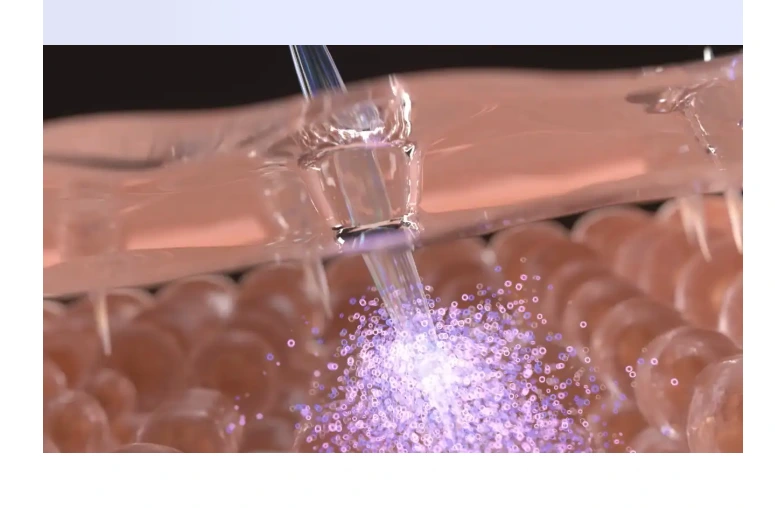
“The needle you can apply” is a good slogan and a slightly misleading description. A Reedle Shot contains no needles in the medical sense. What it contains is a suspension of microscopic, rod-shaped silica particles — the cosmetic descendants of marine sponge spicules — coated in a Centella asiatica complex. Spread on dry skin, those particles lodge in the outermost layers and briefly disturb the barrier that normally keeps most of what you apply on the surface. The tingle is that disturbance. The absorption effect is what the disturbance allows.
This article is the science explainer in our Reedle Shot series. It covers what the particles are, how they change skin permeability, what the peer-reviewed literature actually measured, why the sensation is physical rather than chemical, and where the evidence stops. For choosing a level, read the level-by-level buying guide; for a day-to-day routine, read the usage and layering protocol.
Why skin needs a physical “assist” in the first place
The stratum corneum is a 10–20 μm sheet of flattened, keratin-packed dead cells cemented by lipid bilayers. It exists to keep water in and everything else out, and it is remarkably good at the second job. A widely cited analysis in Experimental Dermatology argued for a “500 Dalton rule”: compounds above roughly 500 daltons essentially cannot pass the corneal layer by passive diffusion. The argument rests on three observations — virtually all contact allergens are under 500 Da, the standard topical drugs used in dermatology are under 500 Da, and every drug in a transdermal patch is under 500 Da.
That rule is the reason so much of skincare is, biologically, surface work. Hyaluronic acid at cosmetic molecular weights, collagen fragments, most peptides, growth factors and polynucleotides such as PDRN are far above 500 Da. They can hydrate, film and condition the surface, and low-molecular fractions may reach the upper epidermis, but the bulk of the molecule stays outside. Physical penetration enhancers — microneedles, iontophoresis, sonophoresis and, in this case, spicules — exist to change that arithmetic by bypassing the barrier rather than dissolving through it.
What a spicule is, and what VT puts in the bottle
Marine sponges build their skeletons from spicules: rigid, needle-like elements of hydrated silica (in demosponges such as Haliclona) or calcium carbonate. Cosmetic chemists harvest, wash and hydrolyze sponge tissue to isolate these spicules; the resulting raw material appears on ingredient lists as Hydrolyzed Sponge, which the European COSMILE database records as animal/synthetic in origin with a “skin conditioning” function. Korean “spicule” products have used this material for years, most famously in salon peels.
VT’s own disclosure is narrower. Its global product pages describe CICA REEDLE™ as “Silica, Centella Asiatica Extract,” and its marketing describes the particles as naturally derived silica formed into needle-like shapes and impregnated with a centella complex. Whether a given batch is sponge-derived silica or otherwise refined silica is not something the brand specifies publicly, and it does not need to be: what matters mechanically is that the particles are rigid, elongated, and far smaller than a pore. The centella coating is not incidental. Madecassoside, asiaticoside and the related triterpenes in Centella asiatica are well-characterized soothing agents, and pairing them with a mechanical irritant is an obvious formulation decision.
The mechanism: transient micro-channels, not exfoliation
A spicule does not remove dead cells the way a scrub or an acid does. It is pressed into the stratum corneum by the act of spreading, where its sharp ends and rigid body create tiny openings in and between corneocytes. Because the rods are rigid and lodge in the tissue, they act as what one 2026 pharmaceutics paper calls “dispersed microneedles” — thousands of minute, randomly oriented entry points rather than a single roller’s grid.
The important variables, borrowed from the microneedle literature, are particle length, rigidity, quantity per area and the pressure applied. Reedle Shot’s density tiers vary the third of these. The pressing motion VT recommends varies the fourth. This is why “press, don’t rub” is more than a comfort tip: rubbing drags particles across the surface, which increases friction and redness without increasing useful channel formation.
Two downstream effects are plausible from this mechanism and appear in the spicule literature. First, molecules applied afterward can move through the channels into the viable epidermis and upper dermis. Second, the mild, controlled disruption triggers the skin’s ordinary repair response — accelerated turnover of the outer layer and a temporary increase in transepidermal water loss that returns to baseline. The second effect is what produces the smoother, more even-textured surface people describe after a few weeks. It is a wound-healing-lite response, not a demonstrated increase in dermal collagen.
What the peer-reviewed studies actually measured
The clearest data come from a research group that has studied sponge Haliclona sp. spicules (abbreviated SHS) as a delivery platform. The table summarizes the studies most relevant to a cosmetic reader.
| Study | Model | Payload | Key measurement | Relevance to Reedle Shot |
|---|---|---|---|---|
| Molecular Pharmaceutics, 2017 | Porcine skin in vitro; mouse and guinea pig in vivo | 10 kDa fluorescent dextran | ≈33-fold higher skin penetration; ≈62-fold more reaching the dermis; spicules retained ≥72 h; irritation and TEWL recovered over time | Establishes that rigid siliceous rods can carry large hydrophilic molecules past the barrier, and that disruption is self-limited |
| Drug Delivery and Translational Research, 2025 | Skin models plus rabbit ear acne model; small clinical arm | Antimicrobial peptide (Sph12–38) | 6.1-fold higher peptide penetration; a 1% SHS gel alone reduced lesion counts by 51.4% in 14 days in the clinical arm | Shows the spicule itself has a measurable effect on congested skin, separate from any payload |
| Drug Delivery and Translational Research, 2026 | In vitro skin, in vivo anesthesia model, pilot clinical trial | Lidocaine hydrochloride | ≈10-fold higher total absorption; onset time halved in the pilot trial | Confirms the “dispersed microneedle” model with a small, water-soluble drug |
Three caveats keep these results honest. The spicules were laboratory-prepared SHS at defined doses, not a commercial essence. The payloads were research probes and drugs, not cosmetic ingredients. And the outcomes were delivery and lesion counts, not wrinkles or “collagen.” What the studies show, robustly, is that the mechanism class is real, dose-dependent and recoverable. What they do not show is that any particular VT level produces any particular facial result.
Why it tingles — and what the tingle is not
The prickling sensation is mechanoreceptor and nociceptor stimulation from thousands of rigid particles contacting nerve endings near the surface. It scales with particle density and with pressure, which is why the 700 feels sharper than the 100 and why pressing hard makes any level feel sharper. It is not pH-driven (Reedle Shot essences are not acids), not an allergic reaction (silica is inert and non-sensitizing), and not evidence that ingredients are “activating.”
Because the particles lodge in the skin, some residual sensitivity can persist. The 2017 study found spicules still present at 72 hours in porcine skin, and VT’s own 1300 page warns that tingling “may persist for 3–4 days” at that density. That is the physical explanation for the brand’s rest intervals — every three days for the 300, weekly for the 700 — and the reason stacking sessions before the sensation has fully cleared is a mistake. A tingle that fades within minutes is expected. Heat that builds, redness that lasts into the next day, or stinging when you apply plain water are signs the barrier has been disturbed more than it can comfortably repair.
What the mechanism can and cannot justify
The cosmetic outcomes that follow logically from a recoverable barrier disruption are: a smoother surface after the repair cycle, a temporarily more even look to pores, faster spread and absorption of the next product, and — for water-soluble actives applied afterward — more of the ingredient reaching the living epidermis. Those are the claims VT’s pages make in various phrasings (“softens rough skin,” “removes dead skin cells for deeper and more efficient product absorption”).
Claims the mechanism does not justify on current evidence include dermal collagen synthesis, scar remodeling, treatment of hyperpigmentation disorders and equivalence to clinic microneedling. Professional microneedling penetrates the living epidermis and dermis with needles of defined length under controlled pressure; the FDA regulates those devices, authorizes them for specific indications such as facial acne scars, and lists bleeding, bruising, pigmentation change and infection among the risks. A 7 μm-wide spicule pressed by a fingertip is a different intervention with a different depth and a different risk profile — which is also why it is sold as a cosmetic.
One implication deserves emphasis. If spicules genuinely enhance delivery, they enhance delivery of everything applied on top, including fragrance, preservatives and irritating actives. That is the pharmacological reason VT warns against pairing Reedle Shot with strong retinoids on the same night, against using it with devices that add heat or light, and against applying it to broken skin. Penetration enhancement is not selective.
How this compares with other Korean “shot” products
The spicule category is not unique to VT. Medicube, Coreana and several clinic-adjacent brands sell spicule essences and peels, and some newer “shot” products use exosome- or PDRN-led formulas with no physical enhancer at all. The distinction matters: a product that tingles because of spicules is doing something mechanical; a product that tingles because of alcohol, menthol or a low-pH acid is doing something chemical. Only the first is a delivery enhancer. VT’s own PDRN Reedle Shot 300 combines both ideas — a sodium DNA payload with the spicule carrier — which is scientifically coherent, since PDRN’s high molecular weight and negative charge are exactly the properties that limit its passive penetration.
For a closer look at why PDRN struggles to cross the barrier on its own, and what that means for choosing a cream or a serum, see our Korean PDRN cream versus serum guide.
Regulatory status in the US and Korea
In the United States, the FDA separates cosmetics from drugs by intended use: cosmetics are for “cleansing, beautifying, promoting attractiveness, or altering the appearance,” while anything intended to “affect the structure or any function of the body” or treat a condition is a drug. Texture and absorption claims are cosmetic; “stimulates collagen” or “treats scars” are not. In Korea, the Cosmetics Act designates functional cosmetic categories — wrinkle improvement, whitening, UV protection and others — that require MFDS notification or evaluation before the claim may be made. A Reedle Shot that carries a functional claim does so on the strength of an ingredient such as adenosine or niacinamide, not on the reedle. Understanding that keeps expectations aligned with what the product is legally allowed to be.
Reading a Reedle Shot label like a formulator
- Silica near the top of the list confirms the mechanical component; its position gives a rough sense of load.
- Centella asiatica extract, madecassoside or asiaticoside are the soothing counterweights; a spicule product without them is harder to tolerate.
- Multiple hyaluronate forms (sodium hyaluronate, hydrolyzed hyaluronic acid) hydrate the surface and improve slip so the product spreads with less friction.
- Niacinamide and adenosine are the ingredients that may carry Korean functional claims; the reedle carries none.
- Retinal, bakuchiol or vitamin C derivatives in a variant mean the enhancer is now delivering an active — treat frequency more conservatively.
- Fragrance and essential oils are the ingredients you least want enhanced; sensitive skin should prefer variants without them.
Seen this way, Reedle Shot is neither a gimmick nor a clinic procedure in a bottle. It is a cosmetic application of a well-documented physical delivery mechanism, dosed by particle density and controlled by frequency. Used at the right tier and interval, it can make the rest of a routine work harder; used as if the tingle were a measure of results, it becomes an easy way to over-treat healthy skin.
Sources
- Molecular Pharmaceutics (2017): Skin delivery of hydrophilic biomacromolecules using marine sponge spicules
- Drug Delivery and Translational Research (2025): Topical Sphistin12-38 with sponge spicules for acne
- Drug Delivery and Translational Research (2026): Topical delivery of lidocaine using spicules
- Experimental Dermatology (2000): The 500 Dalton rule for the skin penetration of chemical compounds and drugs
- COSMILE Europe: Hydrolyzed Sponge — INCI entry and function
- VT Cosmetics official: Reedle Shot 100 — CICA REEDLE composition, directions and cautions
- VT Cosmetics official: Reedle Shot 1300 — tingling duration and recovery guidance
- U.S. FDA: Is it a cosmetic, a drug, or both?
- U.S. FDA: Microneedling devices — regulation, indications and risks
- ChemLinked: Decoding South Korea’s functional cosmetic regulation
Frequently Asked Questions
Are there real needles in Reedle Shot?
No. The product contains microscopic, rigid silica rods, the cosmetic form of marine sponge spicules, coated in a centella complex. Research-grade sponge spicules are about 120 micrometres long and 7 micrometres wide, far smaller than any needle. They lodge in the outermost skin layer and create transient channels; they are not inserted to a controlled depth the way a microneedling device's needles are.
What does the research on sponge spicules show?
A 2017 Molecular Pharmaceutics study found Haliclona sponge spicules raised penetration of a 10 kDa molecule into porcine skin about 33-fold, stayed in the skin for at least 72 hours, and caused disruption that recovered on its own. Later studies showed a 6.1-fold increase for an antimicrobial peptide and roughly tenfold for lidocaine. These used research materials, not VT products.
Why does Reedle Shot tingle, and is that a sign it is working?
The tingle is nerve endings registering thousands of rigid particles pressed into the skin surface. It scales with particle density and pressure, which is why the 700 feels sharper than the 100. It is not an acid or allergic reaction. A brief prickle is expected; a tingle that persists into the next day means the barrier was disturbed more than it can comfortably repair, not that results are stronger.
Does Reedle Shot stimulate collagen like microneedling?
The spicule literature measures delivery of molecules and recovery of the barrier, not dermal collagen synthesis in people. Professional microneedling penetrates the living epidermis and dermis with regulated devices and is authorized for indications such as facial acne scars. A cosmetic spicule essence pressed in by fingertip is a different intervention at a different depth, and collagen claims are not supported for it.
Does it make other products absorb better, and is that always good?
Physical penetration enhancement is not selective. If spicules help a hyaluronate or a peptide reach the living epidermis, they also help fragrance, preservatives and irritating actives get there. That is why VT warns against using strong retinoids on the same night, against beauty devices that add heat or light, and against application to broken skin. Choose what you layer on top carefully.
Is Reedle Shot a cosmetic or a medical product?
It is a cosmetic in both the United States and Korea. The FDA classifies products by intended use, and texture, appearance and absorption claims are cosmetic; claims to change skin structure or treat a condition would make it a drug or device. In Korea, any functional claim such as wrinkle improvement rests on a registered ingredient like adenosine, not on the reedle particle itself.