
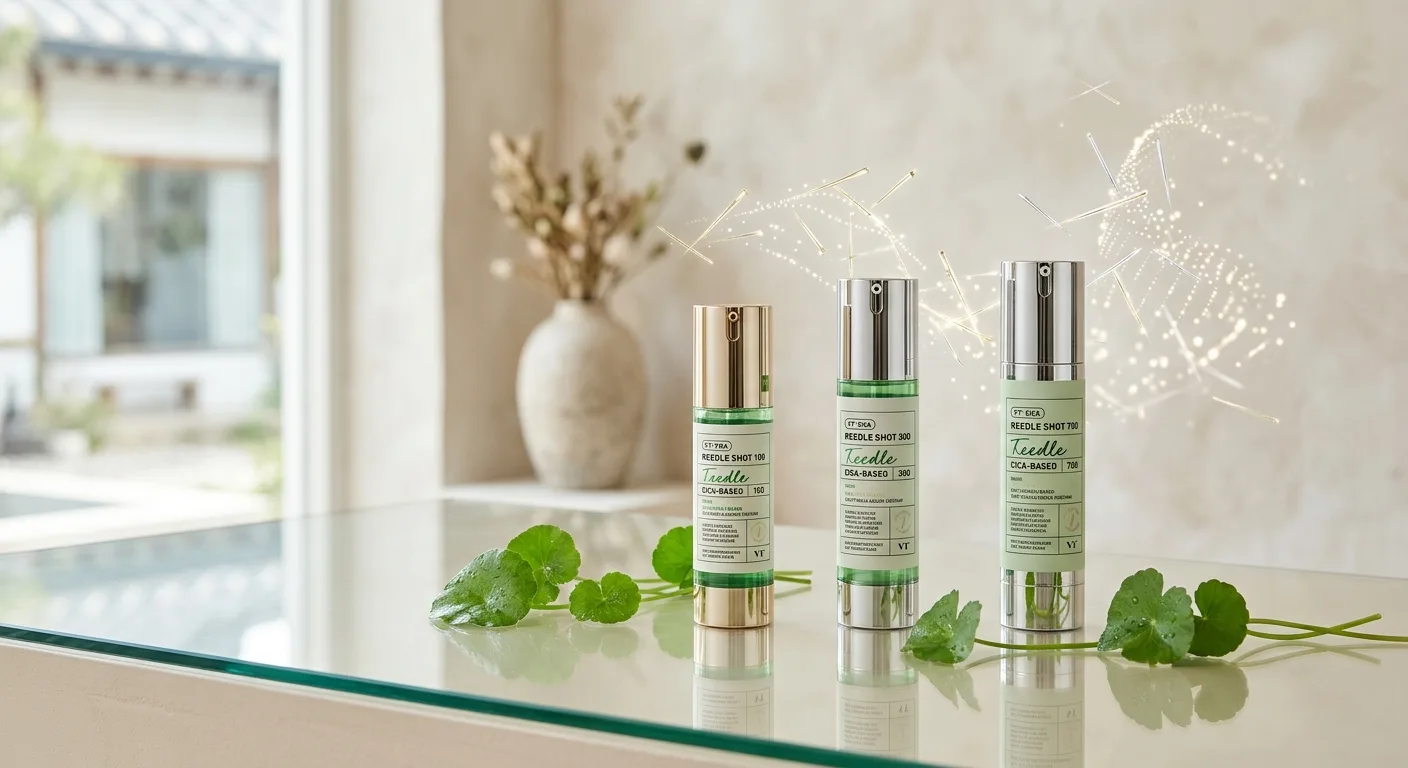
VT Cosmetics Reedle Shot is a family of leave-on essences built around one idea: suspend microscopic, needle-shaped silica particles in a soothing centella base, apply it as the first step after cleansing, and let those particles disturb the outermost skin layer just enough to improve how the next products absorb. The number on each bottle — 50, 100, 300, 700, 1000 or 1300 — is not a strength of an active ingredient. It is a relative density of those particles, which VT calls CICA REEDLE™, and it governs how much tingling you feel, how often you can use the product, and who it suits.
This guide explains how the levels differ, what VT actually discloses about each one, where the sponge-spicule science that inspired the category comes from, and how to choose a starting point without over-treating your skin. Two companion articles go deeper on the spicule science behind the tingle and on a step-by-step usage and layering protocol.
What the number on a Reedle Shot actually means
VT’s own product pages describe CICA REEDLE™ as two things: silica and Centella asiatica extract. The silica is present as fine, rod-shaped particles; the centella complex coats and surrounds them. When the essence is spread on dry skin, the particles lodge in the outermost layers, and the brief prickling most users notice is the physical sensation of that contact. Nothing dissolves into the skin the way a chemical exfoliant does — the effect is mechanical.
Because the effect is mechanical, the sensible dial to turn is how many particles are delivered per application. That is what the level numbers encode. VT quantifies two of them directly: the Reedle Shot 300 page states “237,500 shots of micro CICA REEDLE,” and the Reedle Shot 700 page states “570,000 shots.” The 100 page does not publish a count, and the 1300 page describes an “ultra-high concentration of CICA REEDLE™” rather than a figure. The ratio between the disclosed numbers (roughly 2.4×) is close to the ratio between the level names (700 ÷ 300 ≈ 2.3), which is why treating the labels as proportional density tiers is reasonable — but it remains a brand convention, not a standardized unit.
Two practical consequences follow. First, the number tells you nothing about the concentration of centella, hyaluronic acid, niacinamide or any other ingredient; those vary by variant, not by level. Second, a higher number does not deliver a “stronger” result in a linear way. It delivers more surface disruption per session, which is why VT pairs each level with a longer rest interval.
The official frequency ladder, level by level
The clearest guidance comes from VT’s product pages and FAQ. Read together, they form a ladder in which frequency falls as density rises. The table below consolidates what the brand states; where VT is silent, the cell says so.
| Level | Disclosed CICA REEDLE™ count | VT’s stated frequency | VT’s positioning | Typical bottle |
|---|---|---|---|---|
| 50 (Mild) | Not published | Daily, gentlest tier | Sensitive, reactive or first-time skin | 50 ml |
| 100 | Not published | “Can be used everyday” | Standard daily booster; most first-timers start here | 50 ml |
| 300 | 237,500 shots | “Every 3 days,” not with 100 or 700 on the same day | Building tolerance; texture and pore-appearance focus | 50 ml |
| 700 | 570,000 shots | “Every 7 days,” not with 100 or 300 on the same day | Experienced users; weekly intensive | 30 ml |
| 1000 | Not published | Not stated on the global page | Small-format intensive treatment | 15 ml |
| 1300 | “Ultra-high concentration” | 24-hour recovery, up to 3 days depending on skin | Night focus care on specific areas; “only for users already accustomed” to Reedle Shot | 8 ml with applicator |
Three rules appear on every product page and matter more than the level itself: do not use Reedle Shot with a beauty device (VT cites the risk of severe irritation from heat or light), do not use it immediately after dermatological procedures, and do not apply it to wounded skin. The brand also states that “a tingling sensation upon application is a natural occurrence,” and its FAQ adds the corrective: if stinging or redness persists, “reduce frequency or step down to a lower density.”
Level 50 and 100: where almost everyone should start
The Mild Reedle Shot 50 exists because a meaningful share of people find even the 100 too lively at first. It carries the lowest particle density VT sells in a full-size bottle and leans on the same centella-plus-hyaluronic base. If you have rosacea-prone, barrier-compromised or freshly retinized skin, this is the tier to test tolerance with — and it is a legitimate end point, not merely a stepping stone. Plenty of users never need more than the 50 to get the smoother morning texture and better serum spread they were after.
The Reedle Shot 100 is the product most people mean when they say “Reedle Shot.” VT lists Centella asiatica extract, triple-molecular-weight hyaluronic acid, green propolis extract, an amino-acid complex, niacinamide and macadamia seed oil in its formula, and states it “can be used everyday.” Its FAQ nonetheless recommends beginning “with 2–3 times per week in the evening” and building toward nightly use after two weeks of comfortable adjustment. That is the protocol to copy: the label describes a ceiling, the FAQ describes a ramp.
How do you know you are ready to move up? Not by the calendar. Move up only when the 100 no longer produces a noticeable tingle, your skin shows no lingering flush the next morning, and you have a specific texture goal the lower tier is not meeting. If any of those is untrue, the 100 is still the right product.
Level 300: the tolerance-building tier
The 300 is where the density becomes tangible: 237,500 disclosed shots per bottle and a stated interval of every three days. VT positions it for people “building tolerance,” and its surrounding formula adds adenosine — a Korean MFDS-listed wrinkle-improvement functional ingredient — to the standard centella, hyaluronic acid, propolis and niacinamide set. The adenosine is not what makes the 300 feel different; the particle load is.
Two cautions are specific to this tier. First, the same-day exclusion is explicit: the 300 should not be used with the 100 or 700 in one routine. Second, three-day spacing is a minimum, not a target. If your skin is still slightly pink or tight on day three, wait. The mechanical disruption a spicule causes is self-limiting and recovers with time — the research below shows that — but stacking sessions before recovery is how a booster turns into an irritant.
Level 700, 1000 and 1300: intensive tiers with real recovery windows
The 700 more than doubles the 300’s disclosed density to 570,000 shots and comes in a smaller 30 ml bottle, a signal that VT expects it to be used sparingly. Its page says it “can be used every 7 days.” This is the tier for people who have used the 300 comfortably for weeks and want a single, stronger weekly session rather than a more frequent mild one.
The 1000 (15 ml) and 1300 (8 ml) are different animals. The 1300 ships with an applicator, is described as “a professional-grade night treatment” for focused areas — texture, fine lines and post-blemish marks — and carries the plainest warning in the range: it is “recommended only for users who are already accustomed to REEDLE SHOT products,” it “may cause a strong tingling sensation,” and VT advises a “24-hour recovery period” that may extend to three days. Tingling “may persist for 3–4 days” depending on the individual. Treat it as a localized, occasional treatment, never as an all-over essence, and do not begin the range here. The Reedle Shot 1300 is listed separately from the everyday essences for that reason.
The sponge-spicule science VT is drawing on
The category did not appear from nowhere. Marine sponges build skeletons from siliceous spicules, and pharmaceutics researchers have studied those spicules as “dispersed microneedles” for more than a decade. A 2017 study in Molecular Pharmaceutics characterized Haliclona sp. spicules as sharp-edged, rod-shaped siliceous oxeas roughly 120 μm long and 7 μm in diameter. Applied topically to porcine skin in vitro, they raised penetration of a 10 kDa fluorescent dextran by about 33-fold versus control, remained in the skin for at least 72 hours, and — importantly — produced skin disruption that was “self-limited” and recovered with time on transepidermal water loss and irritation measures.
Later work from the same field used the same spicules to enhance topical delivery of an antimicrobial peptide (a 6.1-fold increase in penetration) and of lidocaine (roughly tenfold higher total skin absorption, with a pilot clinical trial showing faster onset). None of that research tested a VT product, and VT’s own ingredient disclosure names silica and centella rather than a sponge species, so the literature should be read as the mechanism class Reedle Shot belongs to, not as evidence for a specific bottle. What it does establish is that siliceous micro-rods can measurably change how large, water-loving molecules cross the stratum corneum, and that the disruption is temporary when dosing is sensible.
That framing also explains the sensation. The prickle is physical contact, not an allergic or chemical reaction. It should fade within minutes at the lower tiers. A burn that builds, spreads or lasts into the next day is a stop signal, not proof the product is “working.”
What Reedle Shot is — and is not — allowed to promise
Regulatory status matters here because the marketing language around spicule products often borrows from clinic treatments. In the United States, the FDA distinguishes cosmetics from drugs by intended use: cosmetics are “articles intended to be rubbed, poured, sprinkled, or sprayed on … for cleansing, beautifying, promoting attractiveness, or altering the appearance,” whereas claims to treat disease or “affect the structure or any function of the body” make a product a drug. Smoother-feeling texture, a refined look to pores and better absorption of the next product are cosmetic claims. “Collagen stimulation” and scar or pigmentation treatment are not — and the FDA’s microneedling page reserves scar and wrinkle indications for authorized medical devices used by trained providers on patients 22 and older.
In Korea, the Cosmetics Act carves out functional cosmetics — wrinkle improvement, whitening, UV protection and a handful of other categories — that must be notified to or evaluated by the MFDS before those claims can be made. A Reedle Shot variant that lists adenosine or niacinamide can carry the corresponding functional claim if it is registered; the reedle particle itself is not the basis of any functional category. Read every Reedle Shot as a cosmetic booster with a physical delivery mechanism, and be skeptical of any listing that calls it “at-home microneedling” in the medical sense.
Variants: same ladder, different formula around the reedle
VT now sells the reedle in several formula families, and the naming can be confusing because the level number is reused. The level still governs frequency; the prefix tells you what is in the base.
- Hydrop (hL): a more water-rich, hydration-led base, offered at 100hL, 300hL and 700hL.
- Vita-Light: vitamin-C-derivative and niacinamide-led brightening base at 100 and 300.
- Collagen: low-molecular collagen and niacinamide in the base, mainly at 100.
- Reti-A: retinal/bakuchiol-type retinoid base at 100 and 300 — the one variant where stacking a separate retinoid the same night is a clear mistake.
- PDRN: sodium DNA (salmon-derived polynucleotide) added at 300, plus a separate PDRN eye lifter; PDRN’s own limitations as a topical are covered in our PDRN cream versus serum guide.
- Red Booster and Black Truffle: richer, “nourishing” bases positioned for dull or dry skin at 100–700.
The compact set bundles travel sizes of the 100, 300 and 700 and is the most economical way to test the ladder before committing to a full bottle of any one level.
How to choose: a short decision sequence
- Screen yourself out first. Active acne lesions, eczema flares, open or freshly extracted skin, a recent peel, laser or microneedling appointment, or a nightly prescription retinoid you are still adjusting to are all reasons to wait.
- Patch test. VT’s FAQ recommends the inner arm; the jawline is a more realistic proxy for facial tolerance. Wait 24 hours.
- Start at 50 or 100, two or three evenings a week. Apply to clean, dry skin as the very first step, press rather than rub, and follow with your normal hydrating layers once it has absorbed.
- Hold for two weeks before changing anything. Judge by next-morning skin, not by the intensity of the tingle.
- Step up one tier at a time, and lengthen the interval as you go. 300 every three days, then 700 weekly, with the same-day exclusions VT specifies.
- Reserve 1000 and 1300 for targeted, occasional use only after months of comfortable 700 use, and honor the recovery window.
- Wear sunscreen every morning. The product does not make you photosensitive in a pharmacological sense, but freshly disrupted skin has no business being unprotected.
If the primary goal is hydration rather than texture, a Hydrop variant at the lowest comfortable level will serve you better than a higher-numbered original. If the goal is a slightly brighter look, Vita-Light 100 makes more sense than jumping to 300. The number is the last decision, not the first.
Sources
- VT Cosmetics official: Reedle Shot 100 — ingredients, directions and cautions
- VT Cosmetics official: Reedle Shot 300 — 237,500 CICA REEDLE shots, every-3-days guidance
- VT Cosmetics official: Reedle Shot 700 — 570,000 CICA REEDLE shots, weekly guidance
- VT Cosmetics official: Reedle Shot 1300 — night focus treatment, recovery window and warnings
- VT Cosmetics official FAQ: densities, tingling, frequency and use with actives
- Molecular Pharmaceutics (2017): Skin delivery of hydrophilic biomacromolecules using marine sponge spicules
- Drug Delivery and Translational Research (2026): Topical delivery of lidocaine using spicules
- U.S. FDA: Is it a cosmetic, a drug, or both?
- U.S. FDA: Microneedling devices
- ChemLinked: Decoding South Korea’s functional cosmetic regulation
Frequently Asked Questions
Which Reedle Shot should a beginner start with?
Start with the Mild Reedle Shot 50 if your skin is sensitive, reactive or recently irritated, and with the Reedle Shot 100 otherwise. VT's FAQ recommends two or three evenings a week for the first two weeks before moving toward nightly use. Only consider the 300 once the 100 no longer tingles and your skin shows no next-morning flush.
What does the number on a Reedle Shot mean?
It is a relative density tier of VT's CICA REEDLE™ silica particles, not the percentage of any ingredient. VT discloses 237,500 shots in the 300 and 570,000 in the 700 and calls the 1300 its highest concentration. Higher numbers mean more surface disruption per session, which is why VT pairs them with longer rest intervals between uses.
How often can I use Reedle Shot 300, 700 and 1300?
VT states the 300 can be used every three days and the 700 every seven days, and that neither should be combined with another level on the same day. The 1300 is a localized night treatment with a recovery window of 24 hours to three days, and VT recommends it only for users already accustomed to the range. Treat these as minimum intervals.
Is the tingling normal, and when should I stop?
A brief prickling on application is expected; it is the physical contact of the silica micro-rods and usually fades within minutes at the 50 to 300 levels. Persistent stinging, redness that lasts into the next day, or burning that spreads are signals to stop, extend the interval or step down a level. Never apply it to broken skin or after a clinic procedure.
Can Reedle Shot replace professional microneedling?
No. Reedle Shot is a cosmetic with a physical delivery mechanism; its legitimate claims concern texture feel, the look of pores and better absorption of the next product. Professional microneedling uses regulated medical devices operated by trained providers for indications such as facial acne scars, and the FDA warns that those procedures carry their own risks. The two are not interchangeable.
Which variant should I choose: Hydrop, Vita-Light, Collagen, Reti-A or PDRN?
Choose by the base formula, then pick the lowest comfortable level within it. Hydrop is hydration-led, Vita-Light is brightening-led, Collagen adds low-molecular collagen, Reti-A carries a retinoid-type ingredient and should not be layered with another retinoid the same night, and PDRN adds sodium DNA. The level number, not the variant name, sets how often you can use it.