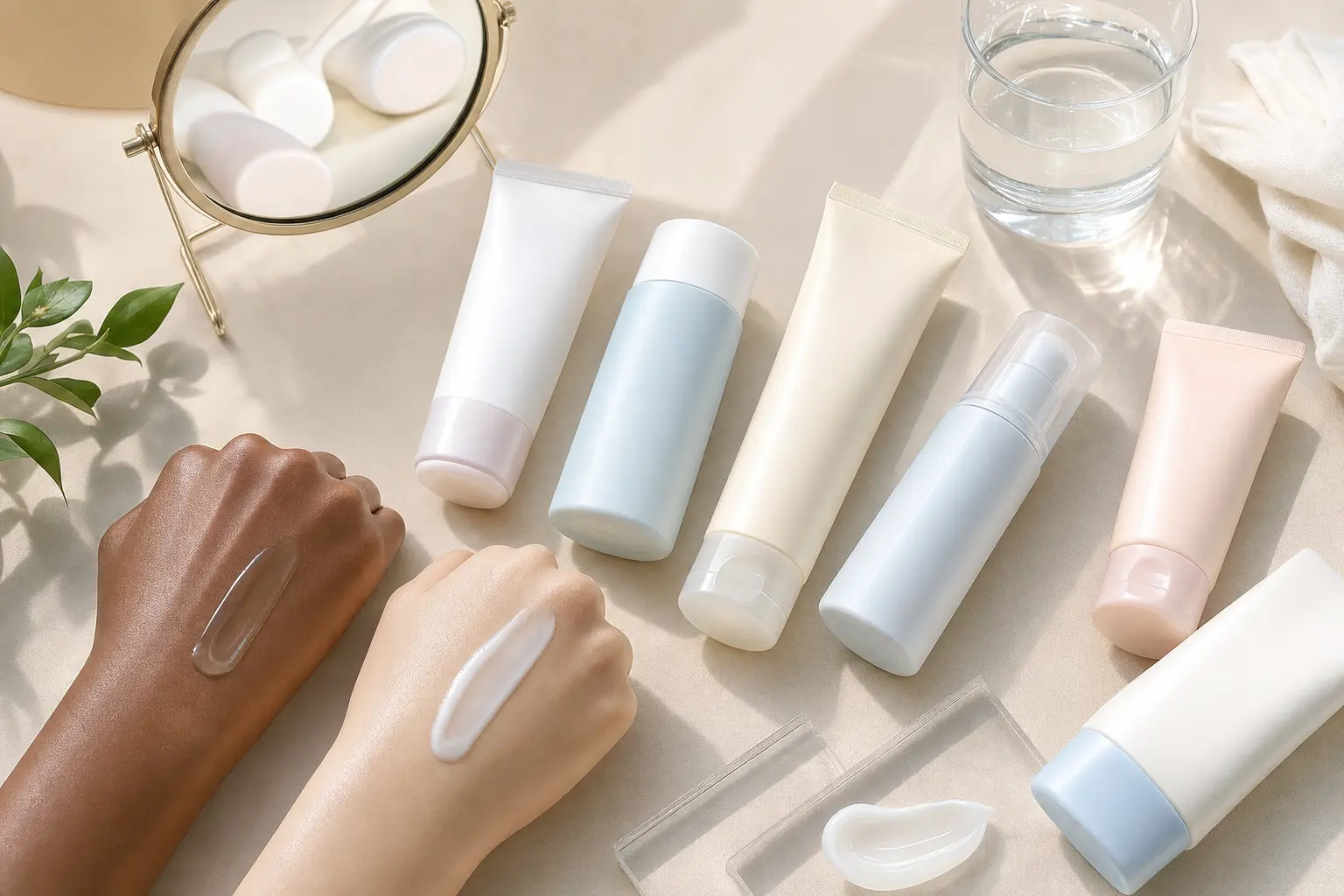
“No white cast” is the most searched phrase in Korean sun care for a simple reason: the cast is the main thing that stops people from applying enough sunscreen and reapplying it. When a product turns a medium or deep complexion grey, the instinct is to use less, blend it away, or skip it. Korean formulas earned their reputation by solving that problem at the chemistry level rather than with marketing.
This guide explains what actually causes white cast, which UV filters Korean brands use to avoid it and why those filters are only now reaching the US market, how SPF and PA numbers are measured, and how to choose a finish that disappears on your skin tone. It ends with current products from our catalog that fit different needs, and the application details that decide whether any sunscreen works.
What white cast actually is
Zinc oxide and titanium dioxide protect skin by absorbing and scattering ultraviolet radiation. The problem is that particles in the size range that scatters UV most efficiently also scatter visible light, and scattered visible light is what the eye reads as a white or grey film. As the review by Smijs and Pavel explains, particles become transparent once they are smaller than roughly half the wavelength of visible light; visible light is then transmitted rather than reflected, while UV attenuation continues. That is why “micronized” or nano-scale grades, typically tens of nanometers, look far sheerer than the pigment-grade minerals used in older formulas.
Three other variables change how much cast you see. The concentration of mineral filter matters: a formula relying on 15 to 20 percent zinc oxide for its entire SPF will always look whiter than one using 5 percent titanium dioxide as a UVB booster alongside organic filters. The coating and dispersion matter: silica, alumina or silicone coatings and good dispersants keep particles from clumping into larger, more visible aggregates. And your skin’s depth matters because the same amount of scattered white light is far more visible against a deep complexion than a fair one.
Tone-up sunscreens are a separate category. They contain titanium dioxide or iron oxides deliberately, as pigment, to lighten and even the complexion. On fair to light-medium skin they read as a soft brightening; on medium-deep to deep skin they read as cast. If you are searching for no white cast, the word “tone-up” on a Korean label is the first thing to screen out.
Why Korean sunscreens are transparent: the filter list
Organic UV filters work by absorbing UV photons and releasing the energy as a small amount of heat. They do not scatter visible light, so a sunscreen that gets its whole SPF from organic filters is transparent no matter how much you apply. Korean brands formulate under rules that accept the same modern filter set as the European Union’s Annex VI, which lists maximum concentrations for each. The ones you will meet most often on a Korean ingredient list are below.
| Filter (INCI name) | Trade name | Protects against | Max in Korea / EU | US monograph status | Why formulators like it |
|---|---|---|---|---|---|
| Bis-ethylhexyloxyphenol methoxyphenyl triazine | Tinosorb S, bemotrizinol | UVA and UVB, broad | 10% | Added June 2026 at up to 6% | Photostable, stabilizes avobenzone, oil-soluble and elegant |
| Methylene bis-benzotriazolyl tetramethylbutylphenol | Tinosorb M, bisoctrizole | UVA and UVB, broad | 10% | Not approved | Micro-fine particulate that both absorbs and scatters UV, transparent on skin |
| Diethylamino hydroxybenzoyl hexyl benzoate | Uvinul A Plus, DHHB | UVA, especially long UVA | 10% | Not approved | Photostable UVA absorber that does not need a stabilizer |
| Ethylhexyl triazone | Uvinul T 150 | UVB | 5% | Not approved | Very high UVB absorbance per gram, so less filter is needed |
| Diethylhexyl butamido triazone | Uvasorb HEB, iscotrizinol | UVB and short UVA | 10% | Not approved | Photostable, oil-soluble, pairs with DHHB for light textures |
| Terephthalylidene dicamphor sulfonic acid | Mexoryl SX, ecamsule | UVA | 10% as acid | Only in specific approved products | Water-soluble UVA filter, useful in gel and essence textures |
| Butyl methoxydibenzoylmethane | Avobenzone | UVA | 5% (3% in US) | Approved | Strong UVA absorber but degrades in light unless stabilized |
| Zinc oxide, titanium dioxide | Mineral filters | UVA/UVB (ZnO), UVB and short UVA (TiO2) | 25% each | Approved | Inert and well tolerated, but the source of white cast at high loads |
The regulatory gap explains why the “Korean sunscreen feels different” observation is real. Until 2026 the US over-the-counter monograph allowed sixteen active ingredients, and its only strong non-mineral UVA absorber, avobenzone, breaks down under UV unless it is paired with stabilizers such as octocrylene, which add weight and can sting the eyes. Korean and European formulators have been able to reach SPF50+ PA++++ with photostable triazine and benzotriazole filters at moderate percentages, leaving room in the formula for water, humectants and light emollients. In June 2026 the FDA finalized an administrative order adding bemotrizinol at up to 6 percent for ages six months and up, the first new filter added in about twenty years; the editorial in JAAD International notes that eight other filters submitted under the 2014 Sunscreen Innovation Act remain unapproved, largely because US testing requirements are not harmonized with international standards.
How SPF and PA are measured, and what the numbers mean
SPF is a ratio measured on human volunteers: the UV dose needed to produce minimal redness on sunscreen-protected skin divided by the dose on unprotected skin, with the product applied at 2 milligrams per square centimeter. The international method is ISO 24444, which is what Korean testing laboratories use; the US monograph uses a closely related protocol. SPF 30 filters roughly 96.7 percent of erythemal UVB, SPF 50 roughly 98 percent, which is why regulators including Korea’s Ministry of Food and Drug Safety cap labels at “SPF50+” and say the practical difference above that level is small.
PA is the East Asian UVA grade. It is based on persistent pigment darkening, the tanning response triggered by UVA, and reports a UVA protection factor: PA+ for a factor of 2 to 4, PA++ for 4 to 8, PA+++ for 8 to 16 and PA++++ for 16 or higher. Korean brands frequently publish their measured values; two products in our catalog state tested results of SPF 55.6 with a UVA protection factor of 19.5, and SPF 51.4 with a factor of 17.6, both comfortably inside the SPF50+ PA++++ label.
The number most people ignore is the application density. Two milligrams per square centimeter on an adult face is roughly a quarter teaspoon, or the two-finger-length rule printed on Korean packaging. Studies consistently find real users apply 25 to 50 percent of that, and because SPF falls faster than proportionally with thinner films, an SPF50+ applied at half density can deliver protection closer to the teens. This is the strongest argument for a no-white-cast texture: a formula you can apply generously without looking grey is a formula that reaches its label.
Chemical, mineral or hybrid: which finish is most invisible
Organic-filter (chemical) formulas
Transparent by mechanism. Essences, fluids, gels and serums built on bemotrizinol, DHHB, ethylhexyl triazone and their relatives look like a light moisturizer on every skin depth. The trade-offs are a fifteen-minute wait before sun exposure, occasional eye stinging with water-soluble filters, and, for the most sensitive skin, a small chance of contact irritation. Look for “organic UV filter” or “유기자차” on Korean packaging.
Mineral (physical) formulas
Zinc oxide and titanium dioxide, labeled “무기자차”. Best tolerated by reactive and post-procedure skin and preferred for children, but the finish depends entirely on particle grade, coating and load. Modern micronized grades in a well-dispersed emulsion can look sheer on fair to medium skin; on deep skin most still leave a faint grey veil, and tinted mineral formulas rarely offer enough shades.
Hybrid formulas
A small amount of titanium dioxide as a UVB booster with organic filters carrying the UVA load. The mineral portion is usually low enough to avoid visible cast while improving photostability and finish; these are often the “soft matte” or “no sebum” Korean sunscreens for oily skin. Check the ingredient list: titanium dioxide near the end is a booster, titanium dioxide near the top is the main filter.
Choosing a no-white-cast Korean sunscreen for your skin
- Confirm the filter type first. An organic-filter formula guarantees no cast; a mineral or tone-up formula guarantees some pigment. Everything else is secondary.
- Match the base to your skin. Watery essence or gel for oily and combination skin, cream or “moisture” sun cream for dry skin, fragrance-free and alcohol-light for sensitive skin.
- Check the label numbers. SPF50+ PA++++ is the Korean daily standard; SPF40 PA+++ sticks are fine for top-ups.
- Decide on water resistance honestly. Most daily Korean essences are not water-resistant and rinse off with a single cleanse; choose a labeled water-resistant product for sport or swimming and accept a slightly heavier film.
- Plan reapplication. If you wear makeup, add a transparent stick or cushion for pressing over base.
The Dr. Althea Green Tea Fresh Sunscreen is a straightforward organic-filter essence: tested SPF 55.6 with a UVA protection factor of 19.5, a 50,000 ppm green tea leaf water base, and no white cast by design. It is vegan and excludes oxybenzone and octinoxate, which matters if you swim in reef areas. It suits normal to oily skin that wants a fresh finish under makeup.
The Banobagi 4 Defense Sunscreen Water Barrier takes the “watery cream” route: about 80 percent moisturizing essence, SPF50+ PA++++, a 0.00 skin irritation index in its published test and suitability testing on acne-prone skin. It is the pick for sensitive or breakout-prone skin that still wants an invisible finish, and it is registered with three Korean functional claims, UV protection, wrinkle care and brightening.
The allNATURAL Houttuynia Cordata Moisture Sun Cream is the dry-skin option: an organic-filter cream with ceramide NP, hyaluronate and more than 59 percent moisturizing ingredients, measured SPF 51.4 and a UVA factor of 17.6, no artificial fragrance and, usefully, a stated single-cleanse removal because it is not water-resistant.
For reapplication, the Dr.Jart+ Every Sun Day Ultra Sheer Priming Sunscreen Stick is a transparent SPF40 PA+++ balm that presses over makeup without transfer. Treat sticks as top-ups rather than the base layer: they deposit less product per pass, so use two slow passes across each area.
Application details that decide whether it works
- Amount: two finger-lengths for the face, or about a quarter teaspoon; a full ounce for the body according to the American Academy of Dermatology.
- Timing: apply as the last skincare step, at least fifteen minutes before going out, before makeup.
- Layering: let hydrating layers absorb first; pilling usually comes from applying sunscreen over a still-wet serum or over a silicone primer.
- Reapplication: every two hours outdoors and immediately after swimming or sweating; indoors by a window, once at midday is a reasonable compromise.
- Removal: non-water-resistant essences rinse with a mild foam; water-resistant formulas need an oil first cleanse, as our cleansing oil versus foam cleanser guide explains.
- Storage: keep it below 30 degrees Celsius and out of the car; organic filters and emulsions degrade with heat, and use within twelve months of opening.
Common myths about no-white-cast sunscreens
“Chemical filters are absorbed and dangerous.” Regulators in Korea, the EU and the US evaluate systemic absorption before approval; the FDA specifically noted bemotrizinol’s low skin absorption when it added the ingredient. The question worth asking is whether a filter is photostable and used at an approved level, not whether it is organic or mineral.
“A higher SPF number is always better.” Korea’s regulator has said the opposite for the range above 50: apply enough, reapply, and choose a texture you will use, rather than chasing a number.
“Korean sunscreens are not water-resistant, so they are weaker.” Water resistance is a labeled property, not a quality grade. Daily essences prioritize comfort and are removed easily; sport formulas exist when you need them.
“Mineral sunscreen is always safer for deep skin.” Tolerance and cast are separate questions. A well-formulated organic-filter essence is both invisible and, for most people, comfortable; a mineral formula is gentler for reactive skin but almost always more visible on deeper complexions.
Where this fits in a Korean routine
Sunscreen is the final morning step and the reason the night routine begins with an oil cleanse. If your concern is oil control rather than cast, our guide to Korean sunscreens for oily skin compares matte finishes; for the broader question of what makes a sunscreen easy to wear every day, read Sunscreen smarts: how to pick a Korean sunscreen you will use daily. Browse the full range in our Korean sunscreen collection, where ingredient lists are shown so you can check the filter system before you buy.
The practical conclusion is short: choose an organic-filter Korean sunscreen in the texture you like, apply it generously enough to matter, and reapply. The cast problem has been solved by chemistry; the remaining variable is you.
Sources
- U.S. Food and Drug Administration, June 2026: FDA expands sunscreen options for the first time in 20 years
- JAAD International 2026: Bemotrizinol and the modernization of US sunscreen regulation
- Smijs and Pavel, Nanotechnology, Science and Applications 2011: Titanium dioxide and zinc oxide nanoparticles in sunscreens: focus on their safety and effectiveness
- Regulation (EC) No 1223/2009 on cosmetic products, Annex VI: List of UV filters allowed in cosmetic products
- Seoul Economic Daily, June 2026: Higher SPF isn’t always better, Korea’s drug safety agency says
- American Academy of Dermatology: How to apply sunscreen
- U.S. Food and Drug Administration: Sunscreen: how to help protect your skin from the sun
Frequently Asked Questions
Why do some sunscreens leave a white cast and others do not?
The cast is caused by zinc oxide and titanium dioxide particles that are large enough to scatter visible light back to the eye. Once particles fall well below the wavelength of visible light, roughly under 100 nanometers, they transmit visible light and look transparent while still attenuating UV. Organic filters such as bemotrizinol or DHHB absorb UV and convert it to heat without scattering, so a purely organic-filter sunscreen has no cast at all, regardless of how thickly it is applied.
Are the UV filters in Korean sunscreens legal and safe in the United States?
Korea, Japan and the European Union approve a wider set of UV filters than the US over-the-counter monograph does. In June 2026 the FDA finalized an order adding bemotrizinol, sold as Tinosorb S, as generally recognized as safe and effective at up to 6 percent, the first new filter in about two decades. Other filters such as bisoctrizole and DHHB remain outside the US monograph, not because of a safety finding but because the applications are still pending. Personal imports for your own use are routine.
Which Korean sunscreen finish is best for deep skin tones?
An essence, fluid or gel built on organic filters with no tone-up pigments. These formulas are transparent by chemistry, so there is nothing to blend away. Avoid products labeled tone-up, whitening or brightening finish, which contain titanium dioxide or iron oxides intended to lighten the complexion. If you want a mineral formula, choose one labeled sheer or tinted to your depth, and test it on the jawline in daylight before committing.
How much sunscreen should I apply to my face?
Laboratory SPF is measured at 2 milligrams per square centimeter, which for an adult face and neck works out to roughly a quarter teaspoon, or the two-finger-length method Korean brands print on their packaging. Studies repeatedly find real users apply a quarter to half of that amount, which cuts the delivered protection well below the label. Applying a generous layer and reapplying every two hours outdoors matters more than the difference between SPF 50 and SPF 50+.
How do I reapply a no-white-cast sunscreen over makeup?
Use a format that can be pressed rather than rubbed. A transparent sunscreen stick or a sun cushion lets you tap product onto the high points of the face, forehead, nose and cheekbones, without moving foundation. Press, do not glide, and build in thin layers. Sticks are usually rated SPF40 to SPF50+ and are convenient, but they deliver less product per pass than a cream, so a second layer is sensible before prolonged sun.
Does SPF 50+ mean I can skip reapplying?
No. Korea's Ministry of Food and Drug Safety notes that above SPF 50 the practical difference in protection is small, which is why products are capped at the SPF 50+ label. Protection falls over the day because of sweat, sebum, friction and rubbing, and water-resistant labels only guarantee that at least half the protection remains after one or two hours in water. Reapply every two hours outdoors and immediately after swimming or heavy sweating.