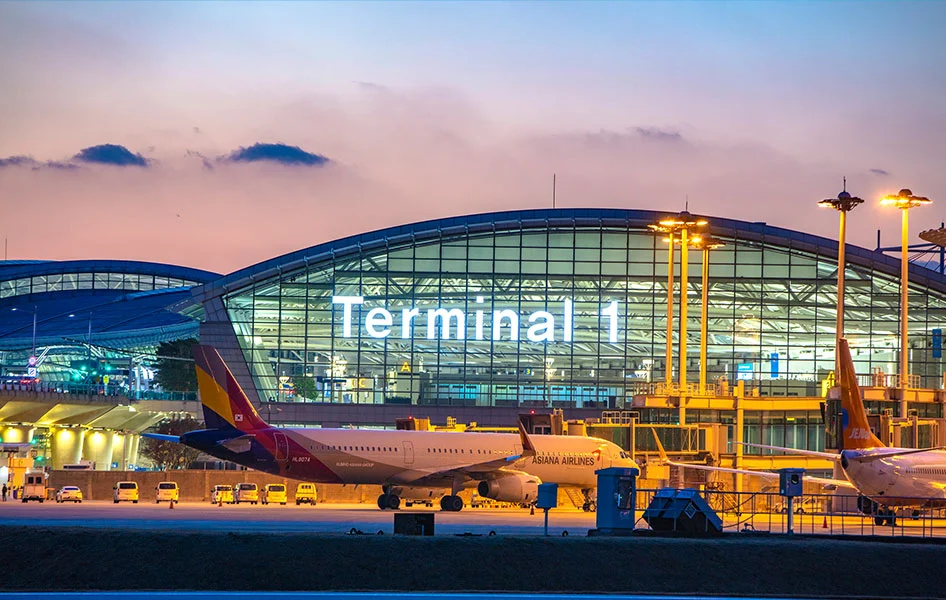
The first hour after landing at Incheon is when most visitors overpay or get stuck. You need a transit card before you reach the train gates, you have to pick between two AREX trains that leave from the same station, and the tourist pass you read about may not work for the ride you are about to take.
Here is the short version. Buy a T-money card at an airport convenience store and load it with won. Use it on the AREX all-stop train, which goes to Seoul Station for a transport-card fare of 4,750 won from Terminal 1. Take the express train only if speed matters more than cost, and buy its ticket separately. The Climate Card pass is useful inside Seoul, but you cannot board with it at Incheon Airport.
Your First Hour at Incheon: The Order That Works
Most arrival stress comes from doing things in the wrong order. After immigration, baggage claim and customs, follow this sequence before you head down to the trains:
- Get connected. Pick up your SIM, eSIM activation or pocket Wi-Fi so maps and translation apps work on the train.
- Get some won. Use an airport ATM or exchange counter. Cards are widely accepted in Korea, but several transit purchases are easier with cash.
- Buy and load a T-money card at a convenience store in the arrivals area.
- Walk to the Transportation Center on the basement level, where the AREX stations and the express ticket counters are [1].
- Choose your train: all-stop with your T-money card, or express with a separate ticket.
If you are carrying a lot of luggage or arriving very late, the airport limousine bus or a taxi may suit you better than the train. The rest of this guide focuses on the rail route.
When the bus or a taxi is the better call
Airport limousine buses leave from stops outside the arrivals hall and run to major hotel districts, so they can drop you closer to your door than the train. They suit travelers with several suitcases, families with small children and anyone staying far from an AREX station. Taxis are the most expensive option but the simplest late at night; use the official taxi rank or a ride app such as Kakao T rather than accepting offers inside the terminal. If you take either, you can still buy T-money at the airport for the rest of your trip.
How to Buy and Top Up a T-money Card
T-money is Korea’s standard rechargeable transit card. According to the Korea Tourism Organization, you can buy one at convenience stores nationwide, such as GS25, CU and 7-Eleven, and at information centers in Seoul subway stations on Lines 1 to 8 [3]. The card itself costs 3,000 to 5,000 won, depending on the design [3].
The card arrives empty, so load it straight away. Subway ticket vending machines recharge it, and the card can hold up to 500,000 won [3]. Carry some Korean won for top-ups; it avoids problems if a machine will not take your foreign card.
How much to load
Start with enough to cover the airport train plus a day or two of city rides. The all-stop train alone uses 4,750 won from Terminal 1 [2]. You can top up again at any station, so there is no reason to load your whole trip at once.
What else T-money pays for
Beyond subways and buses, T-money works in taxis, at affiliated stores, at some vending machines and photo booths in subway stations, and at expressway toll gates [3]. Transfers between buses and subways within a set time window are discounted [3], which is a good reason to tap your card when you get off a bus as well as when you get on.
AREX Express or All-Stop: Which Train to Take
The Airport Railroad (AREX) runs two services between Incheon Airport and Seoul Station, and they use different tickets.
Express train
The express runs nonstop between Seoul Station and the airport. The adult fare is 13,000 won and the child fare is 9,500 won [1]. The trip takes 43 minutes to Terminal 1 and 51 minutes to Terminal 2 [1]. You must buy the ticket separately before boarding [1], at the express customer centers on the basement level of each airport Transportation Center or at Seoul Station [1].
All-stop train
The all-stop train stops at intermediate stations and connects to other subway lines along the way. With a transport card such as T-money, the adult fare from Seoul Station is 4,750 won to Terminal 1 and 5,350 won to Terminal 2 [2]. If you buy a single-journey ticket instead of using a card, the adult fare is 100 won higher and there is a 500 won deposit, refunded at your arrival station [2].
Pick the express if you are heading straight to Seoul Station and value a guaranteed seat and fewer stops. Pick the all-stop if your hotel is near Hongik University, Gongdeok or another station on the line, or if you simply want to keep the fare low.
Fares at a Glance
These fares come from the official AREX pages as checked in November 2026. Fares change from time to time, so treat them as a planning guide.
| Option | Adult fare | Time to Seoul Station | How you pay | Best for |
|---|---|---|---|---|
| AREX all-stop, from Terminal 1 | 4,750 won | Longer, with stops | T-money or other transport card | Budget travelers, hotels along the line |
| AREX all-stop, from Terminal 2 | 5,350 won | Longer, with stops | T-money or other transport card | Same as above, Terminal 2 arrivals |
| AREX all-stop, single-journey ticket | Card fare + 100 won, plus 500 won deposit | Longer, with stops | Ticket machine | Visitors without a card yet |
| AREX express | 13,000 won | 43 min (T1), 51 min (T2) | Separate express ticket | Speed, heavy luggage, nonstop ride |
Fares are from the AREX express page [1] and the AREX all-stop fare table [2]. Children pay reduced fares on both services, and teens also get a reduced all-stop fare [1][2].
The Climate Card: Useful in Seoul, Not for the Airport Ride
Seoul’s Climate Card offers unlimited rides on the city’s subways and Seoul-licensed buses for a set period. Short-term passes cost 5,000 won for one day, 8,000 won for two days, 10,000 won for three days, 15,000 won for five days and 20,000 won for seven days [4]. The physical card costs 3,000 won [4].
Know the limits before you buy:
- No boarding at Incheon Airport. You cannot board at Incheon Airport Terminal 1 or 2 with the card, although you can get off there [4]. Use T-money for your arrival trip.
- Not every line. The Sinbundang Line, GTX, subway stations outside Seoul and express or airport buses are excluded [4].
- Payment. Physical cards are paid in cash or with a Korea-issued credit or debit card [3].
- No pre-loading. A pass starts on the day you charge it [4].
- Refunds. Unused value is refunded minus a 500 won fee, only if you ask before the pass period ends; visitors without a Korean bank account go to Tmoney headquarters [4].
The system is changing. The 30-day Climate Card has been discontinued, with the card limited to Seoul from October 1, 2026 [3], while Seoul residents move to a new Climate Pass linked to the national K-Pass program [4]. Short-term passes remain listed for visitors [4]. Check the official page shortly before your trip.
Is a pass worth it? It pays off on days with many rides inside Seoul. If you will take a few trips a day and plan day trips outside the city, plain T-money is simpler.
Other Cards Visitors Use
T-money is not the only option. The Korea Tourism Organization lists several cards aimed at visitors [3]:
- WOWPASS: a transit-plus-payment card that costs 5,000 won, requires a passport, and can be loaded with won or foreign currencies at kiosks [3].
- Mpass: a foreigner-only pass with up to 20 rides a day on Seoul subways, city buses and the AREX all-stop train, but not the express [3]. It is bought in won cash and issued at Tmoney Town near Seoul Station Exit 10 [3].
- EZL card: another rechargeable card sold at convenience stores [3].
For a first visit of a few days, T-money remains the easiest choice. It is sold everywhere, you control the balance, and it works across the country.
Riding the Seoul Subway With Confidence
Once you are in the city, the subway is the fastest way around. A few habits make the first days easier.
- Tap in and out. Fares are distance-based. On the capital-area network, the basic fare covers the first 10 km at 1,550 won on a transport card, with more for longer trips [2].
- Read the line color and number. Signs show both, along with the direction’s end station. Know the last stop on your line before you go down to the platform.
- Use a map app built for Korea. Naver Map and KakaoMap are widely used in Korea and show station exits and transfers in detail.
- Avoid the rush. Weekday commuter peaks are crowded; travel slightly earlier or later with large bags.
- Keep your card handy. A card holder on your phone means one tap at the gate instead of a pocket search.
When something goes wrong, the 1330 Korea Travel Helpline answers visitors’ questions at +82-2-1330 [3]. Station staff at information centers can also help you top up and check your balance.
A Few Korean Phrases That Help on Day One
Signs in the airport and subway are in English, but buses, small stores and taxi rides are easier with a few phrases. You do not need fluency. You need the right ten sentences at the right moment: asking where the exit is, how much a top-up costs, or whether a bus stops at your hotel.
The JPLUS Useful Korean Travel Phrases book is built for this. Its listing covers essential expressions for ordering food and asking directions, a step-by-step introduction to Hangul and pronunciation, and notes on dining etiquette and local customs.
Who it is for: first-time visitors who want a pocket guide. Who it is not for: travelers who want to learn grammar properly; choose a course book instead.
If you would rather build real sentences, Talk To Me In Korean’s 1100 Short & Useful Korean Phrases teaches 100 common sentence patterns through 1,100 example sentences, with QR codes for native-speaker audio. More options are in our Korean language study category.
Travel Gear That Makes Transit Easier
Two small items solve the most common transit annoyances: digging for your card at every gate, and juggling a passport, SIM and cards in one pocket.
The K-Heritage Blue and White Porcelain Card Wallet attaches to a MagSafe-compatible phone and holds one or two cards, which is exactly a T-money card plus one payment card. Its listing describes magnetic protection for the cards, a rear thumb hole to push them out, and a PU body in a Joseon-era blue-and-white porcelain pattern.
Who it is for: travelers who pay mostly by phone and card. Who it is not for: anyone who carries cash in notes; it has no bill pocket.
For the flight itself, the K-Heritage Najeon Hanji Leather Passport Case holds a passport, four cards, a SIM card and small notes, with an RFID anti-theft film and a mother-of-pearl design. It doubles as a Korean keepsake after the trip. Browse more ideas in our Korean souvenir category.
Before You Leave: Refunds and Leftover Balance
On your last day, decide what to do with the money left on your card.
- Spend it down. T-money pays at convenience stores, so the last few thousand won can buy snacks for the flight.
- Refund small balances. According to the Korea Tourism Organization, smaller amounts can be refunded at convenience stores, while balances over 50,000 won must be refunded at Tmoney Town near Seoul Station [3].
- Keep the card. T-money works across Korea, so if you plan to return, keep it with a small balance.
- Climate Card passes must be refunded before the pass period ends [4].
Plan the trip back the same way you arrived. The all-stop train with T-money is the cheapest route, and the express is the quickest if you buy your ticket before boarding. Climate Card holders can ride to the airport and get off there, but still cannot board at the airport [4].
Frequently Asked Questions
Can I use T-money on the AREX express train?
AREX says the express train needs a separately purchased ticket before boarding. Use T-money for the all-stop train, and buy an express ticket at the counter or machine if you want the nonstop service.
How much does the AREX train from Incheon Airport to Seoul Station cost?
As of November 2026, the all-stop train costs 4,750 won from Terminal 1 and 5,350 won from Terminal 2 with a transport card. The express costs 13,000 won for adults.
Where do I buy a T-money card at Incheon Airport?
At convenience stores such as GS25, CU and 7-Eleven. The card costs 3,000 to 5,000 won and must be loaded before use.
Can I use the Climate Card from Incheon Airport?
No. You cannot board at Incheon Airport Terminal 1 or 2 with the Climate Card, though you can get off there. Use T-money for the ride into Seoul.
Can I get a refund on my T-money balance?
Yes. Small balances can be refunded at convenience stores, and balances over 50,000 won at Tmoney Town near Seoul Station.