
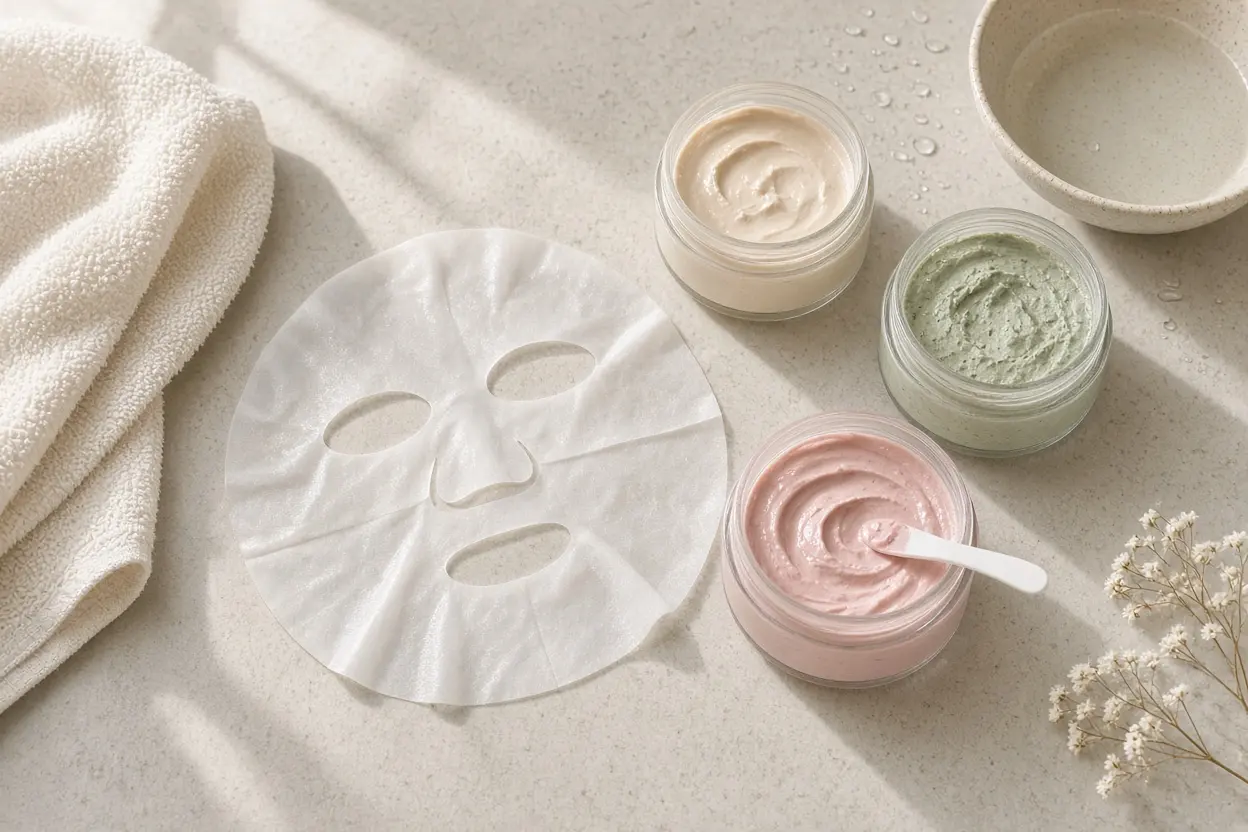
The Korean sheet mask vs wash-off mask question usually gets framed as a contest, but the two formats do different jobs. A sheet mask holds a serum against your face so water can’t easily escape. A wash-off mask sits on clean skin for a few minutes, works through humectants, oils, clay or scrub particles, and then goes down the drain.
So the useful question is not which format is better. It is which job your skin needs this week. If you want a brief hydration lift before an event, the sheet format has the clearer mechanism behind it. If your complaint is rough texture, congestion or a dull, flaky surface, a wash-off mask is the more direct tool, and choosing the right wash-off type matters more than the format debate. Every product featured below is a wash-off formula, so the second half of this piece is about telling those apart.
Korean Sheet Mask vs Wash-Off Mask: The Decision Rule
Here is the rule this article defends: choose the format by the mechanism your skin needs, then choose the formula by your skin type and tolerance. Format first, product second. Most disappointment with masks comes from asking one format to do the other’s job. People expect a five-minute rinse-off to plump skin like a soaked sheet, or expect a sheet to smooth rough texture.
- You want a brief, visible hydration lift before an event or after a dehydrating day. Use a sheet mask for its labelled time, then follow with moisturizer.
- Your skin surface feels rough, flaky or dull. Use a wash-off mask with an exfoliating component, either physical particles or an acid source.
- You feel congested or want to mask and cleanse in one step. Use a clay or foaming wash-off.
- You want hydration but dislike a wet sheet on your face, or you only have a few minutes. Use a wash-off built on humectants and emollients, then your usual leave-on hydration.
Three situations where the rule helps
Imagine your skin feels tight after a long flight and you have plans in two hours. The problem is low water content in the skin’s surface, and short occlusion addresses exactly that. A sheet mask is the logical tool.
Now imagine your cheeks feel sandpapery and makeup clings to dry patches. More water won’t lift those loose flakes. A wash-off with gentle buffing or an exfoliating ingredient will do more, as long as you don’t overdo the rubbing.
Finally, picture acne-prone skin that already feels clammy under heavy layers. A wash-off that rinses away after a few minutes avoids the warm, damp seal a sheet creates. That is one less variable to manage.
Why the choice matters
Masks are a busy corner of Korean skincare. Among Korean skincare categories, packs and masks posted the highest production growth rate in 2025, at 28.3 percent [6]. That figure covers production and doesn’t separate sheets from wash-off formats. It tells you the shelf is crowded, not which type is winning, which is exactly why a decision rule beats browsing.
How a Sheet Mask Hydrates, and Where the Benefit Ends
The occlusion mechanism
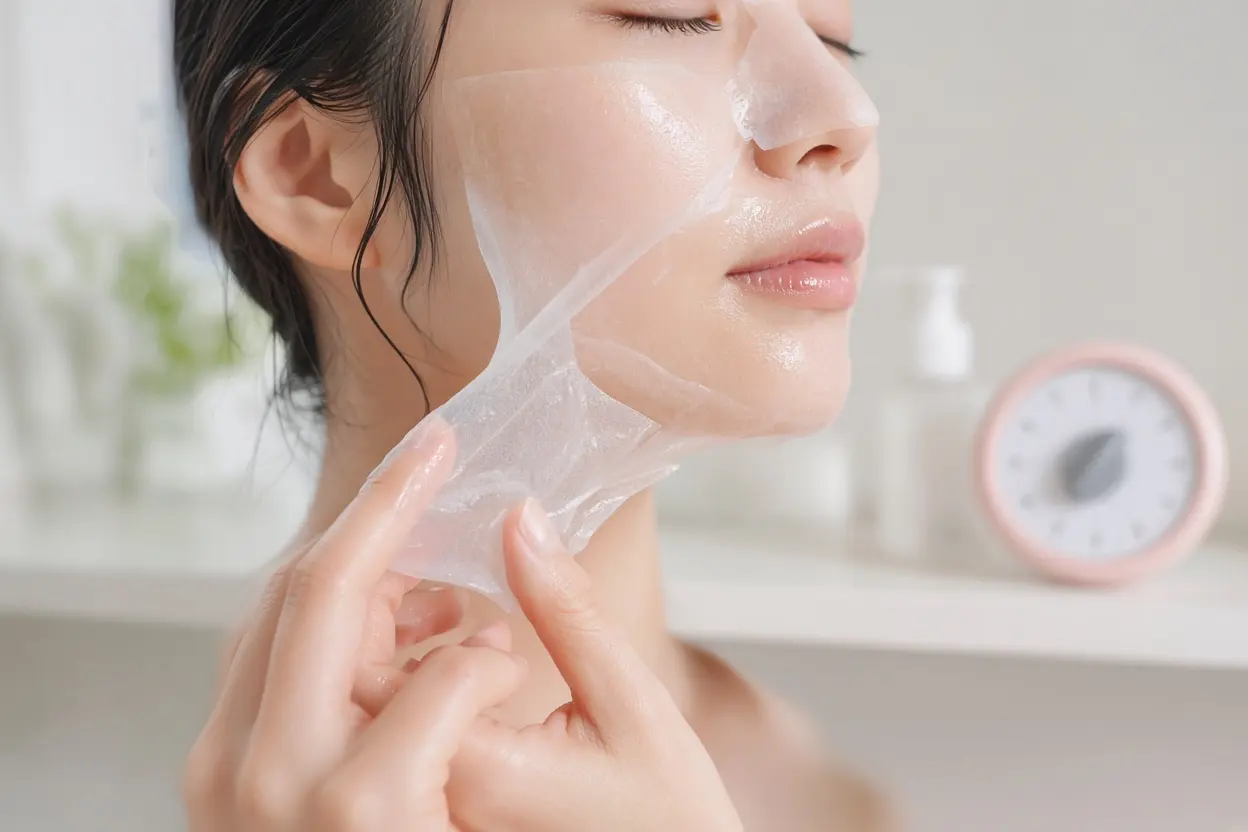
A sheet mask is a delivery system built on one idea: stop water leaving the skin for a while. Sheet masks work through temporary occlusion, trapping moisture against the face and creating a warm, humid microenvironment that briefly raises hydration in the stratum corneum, the skin’s outermost layer [1]. That seal may also help water-soluble ingredients in the serum penetrate more readily [1].
The sheet material varies (cellulose, bio-cellulose, hydrogel or cotton), but the physics is the same. Think of it as a short, wet version of the principle behind heavy occlusive balms.
Why the clock matters
Standard sheet masks are formulated for roughly 15 to 20 minutes of wear [1]. Occlusion beyond about 25 to 30 minutes can push the water content of the stratum corneum above 35 percent, a level linked to redness, dryness and barrier disruption [1]. The same source puts normal water content in that layer between 10 and 30 percent [1].
That is why wearing an ordinary sheet mask to bed is a poor idea, even though the habit circulates on social media. Purpose-built sleeping masks are a different category: leave-on creams or gels formulated for extended contact [1]. If you’re weighing hydrogel or collagen-style sheets specifically, our comparison of two collagen hydrogel masks covers that sub-category in detail.
What the evidence actually shows
Clinical data on sheet masks exists, but it applies only to the formula tested. In a 2025 single-center trial, 33 adults aged 39 to 59 applied one multi-component sheet mask every two days for 28 days [2]. The researchers reported significant improvements in skin hydration and reduced transepidermal water loss (TEWL), both immediately after application and at day 28 [2].
Read the study design before you read the headline:
- The study compared skin before and after use, with no separate control group, and the team doing the assessments was not blinded [2].
- Two of the authors worked at the research center of the company that supplied the mask [2].
- The trial ran in a humid summer period [2].
None of that makes the study worthless. It makes it evidence for one formula under one set of conditions. It is not a verdict on sheet masks in general, and it says nothing about wash-off masks.
Where the benefit stops
The hydration a sheet mask delivers is temporary. It does not replenish the skin’s lipid matrix, replace ceramides or stimulate collagen synthesis [1]. Occlusion also amplifies whatever the serum contains, which is why fragrance, essential oils, alcohol and high-percentage exfoliating acids carry more irritation risk under a sheet [1]. For acne-prone skin, the concern is less that the ingredients clog pores and more that prolonged occlusion itself can trigger breakouts [1].
How Wash-Off Masks Work: Humectants, Emollients, Clay and Exfoliants
A wash-off mask, often labelled a “pack” in Korean product names, has no sheet and no seal. It spends a few minutes on the skin, and most of it is then rinsed away. That changes what matters: the question is what the formula does during contact and what it leaves behind after the rinse.
The four working parts
- Humectants such as glycerin, hyaluronic acid and sodium hyaluronate attract and hold water in the upper skin layers. Some of that effect survives rinsing, but contact time is short.
- Emollients such as squalane and jojoba esters soften the surface and can leave a light lipid film after rinsing. That is why some hydrating wash-offs feel cushioned rather than squeaky.
- Clays such as kaolin absorb oil and help lift surface debris. Formulas that foam add a cleansing action on top.
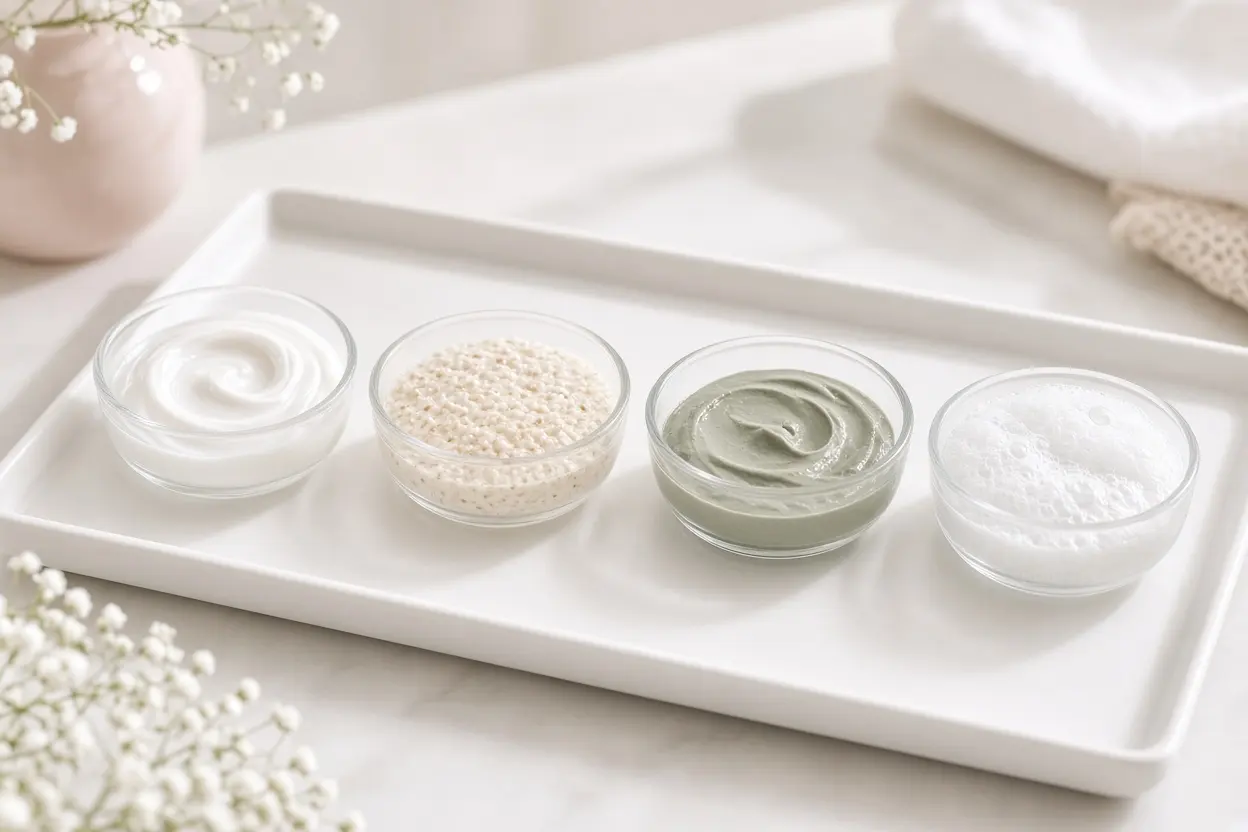
- Exfoliants come in two kinds. Physical particles such as sugar or rice-derived grains buff by friction. Chemical exfoliants such as alpha hydroxy acids (AHAs) loosen the bonds between dead surface cells.
Most wash-off formulas combine two or three of these parts. Reading the label for which ones lead tells you more than the marketing name does.
Reading an exfoliating claim
“Exfoliating” on a jar is not a strength rating. How strongly an AHA product exfoliates depends on the type of acid, its concentration, the product’s pH and its other ingredients [4]. The FDA lists citric acid among the AHAs used in cosmetics [4]. So a pack that names lemon extract as an AHA source without publishing a concentration or pH tells you its intent, not its strength.
What wash-off masks don’t do
No study directly comparing sheet and wash-off masks for hydration turned up in the research for this piece. Any claim that one beats the other is based on how they work, not on measured results. By that logic, a five-minute humectant mask without occlusion gives a smaller hydration boost than a sealed sheet. If hydration is your main goal, a leave-on step does most of the work. Our Korean hyaluronic acid serum explainer covers why the formula around the hyaluronic acid matters more than how many types a label lists.
Where wash-off masks win is control. You set a timer, you rinse, and contact with the active ingredients ends. For skin that dislikes long occlusion, that predictability is the real benefit.
Sheet vs Wash-Off Masks Side by Side: Which Format Fits Your Skin
With the mechanisms clear, the comparison is mostly about fit. The table sets out the practical differences. The notes below it cover who should hesitate on each format.
| Factor | Sheet mask | Wash-off mask |
|---|---|---|
| How it works | Temporary occlusion holds serum and water against the skin | Humectants, emollients, clay or exfoliants act during short contact, then rinse off |
| Typical wear time | About 15–20 minutes; not overnight | Per label; the featured formulas range from 5 to 15 minutes |
| Strongest at | Short-term surface hydration | Softening rough texture, cleansing, surface polish |
| Main watch-out | Wearing it too long; irritants amplified under occlusion | Over-scrubbing; sun sensitivity from acids; fragrance |
| What comes next | Moisturizer | Toner or essence if you use them, then moisturizer; sunscreen by day |
Who should hesitate on sheet masks
If fragrance or essential oils have irritated your skin before, occlusion raises the stakes. A sheet presses the serum against skin, so an ingredient you tolerate in a lotion may sting under a mask. Acne-prone skin that flares in warm, damp conditions is the other group to be cautious, especially with long wear.
Who should hesitate on wash-off masks
Skin that reacts to friction may not tolerate scrub-style formulas, however soft the particles. Acid-based packs bring a sun-sensitivity question, covered below. And if you’re hoping a wash-off will deliver the same plumped look as a soaked sheet, the mechanism doesn’t support that expectation.
Cost and convenience
Sheets are single-use by design. Wash-off masks come in jars, pouches or sachets, so one purchase covers repeated sessions. Sachet formats cover both needs: portioned like a sheet, but rinse-off in function.
Wash-Off Masks for Hydration: Skipping the Sheet
If your skin mainly feels thirsty but you don’t want a wet sheet clinging to your face, a hydrating wash-off is a reasonable compromise. Calibrate expectations, though. Without occlusion, it gives a short hydration boost that works best when followed by a leave-on moisturizer.
A soft-serve option for dehydrated, tolerant skin
The I DEW CARE Cake My Day Hydrating Sprinkle Wash-Off Mask is built around hyaluronic acid and squalane, with glacier water presented as a refreshing element. The pairing makes formulation sense: hyaluronic acid is a humectant that binds water, while squalane is an emollient that softens the surface. The brand directs you to apply a generous, even layer to clean skin, avoiding eyes and lips, and leave it on for 5 to 10 minutes. You then rinse with lukewarm water while massaging in circles. The brand recommends using it two to three times a week.
The label notes the mask will not dry, and that is the practical point. Masks that set hard can feel tight on dehydrated skin; one designed to stay soft avoids that. The trade-offs are the advertised birthday-cake scent and the colourful sprinkles. If fragrance or colorants have bothered you before, read the full ingredient list on the jar rather than assuming a hydrating mask is automatically a gentle one.
A five-minute rice option for normal-to-dry skin
The SKINFOOD Rice Daily Brightening Mask Wash Off 210g takes a different route. Its formula centres on Odae rice bran water from Cheorwon, with jojoba esters and sodium hyaluronate: again an emollient paired with a humectant. SKINFOOD positions it for normal to dry skin and for dull, rough-looking complexions. The routine is short: apply a thick layer after cleansing, avoiding the eyes and lips, then rinse with lukewarm water after five minutes.
The brightening promise is a brand claim, and no independent clinical data on this formula turned up. What you can judge from the label is fit: a short contact time, a softening emollient and a humectant, aimed at drier skin. At 210g, it is also the largest jar among the masks featured here.
Choosing between them
- If you want a non-setting texture and a slightly longer 5–10 minute window, the I DEW CARE mask matches.
- If you want the shortest routine and a bigger jar, the SKINFOOD 210g mask fits better.
- If you’re scent-sensitive, don’t choose either from the front of the box. Compare the full ingredient lists first.
Wash-Off Masks for Rough, Dull Skin: Scrub or Acid
When the complaint is texture, such as flakes, roughness or a grey, unpolished look, exfoliating wash-offs are the relevant tool. The two featured options take different approaches, and that difference should drive your choice.
The rice scrub mask, and what users report
The SKINFOOD Rice Mask Wash Off 100g is a separate formula from the 210g mask above, so don’t carry one’s reputation over to the other. SKINFOOD describes it as a classic wash-off built on rice bran water, which the brand says is rich in vitamin E and antioxidants, intended to gently exfoliate while softening dull, dry skin. Directions differ too: massage it gently into damp skin, spread it evenly while avoiding the eyes and lips, leave it on for 10 to 15 minutes, then rinse with lukewarm water.
Collected Korean-user feedback on this exact 100g jar fills in what the label can’t. Users most often describe it as a relatively mild physical scrub that leaves skin feeling softer and smoother after rinsing, with a clearer, brighter look that some noted did not last. The reservations are just as consistent: the fragrance divides opinion, and one sensitive-skin user avoided facial use because of it; the creamy residue and soft particles can take several rinses to clear; and rubbing can still bother sensitive skin. Treat those as individual experiences rather than guarantees, but together they point to a clear profile.
That profile suits normal-to-dry skin that feels rough and tolerates scent and gentle friction. It suits fragrance-sensitive or easily reddened skin less well. If you choose it, budget extra time for rinsing, and keep the massage light rather than scrubbing.
The lemon honey pack and its sun question
The LAVIORA Lemon Honey Brightening Wash-Off Pack combines lemon extract, which the brand describes as an AHA source, with sucrose particles for buffing and honey for moisture. That makes it a hybrid of chemical and physical exfoliation. No concentration or pH is published, so its strength can’t be judged from the label.
If the lemon component works as an AHA, the FDA’s AHA guidance is the relevant reference. It is general guidance, not a judgment on this product. In FDA research, four weeks of AHA application increased volunteers’ sensitivity to UV-induced skin reddening by 18 percent [4]. That sensitivity was reversible, with no significant difference one week after stopping [4]. The FDA advises sunscreen, protective clothing and limited sun exposure while using AHA products and for a week afterward [4].
- Use an acid-style pack in the evening, and wear sunscreen the next day.
- Don’t use a scrub mask and an acid pack in the same session; pick one exfoliation route per day.
- If your skin is already sensitized from retinoids or recent treatments, start with the less aggressive option or skip exfoliation that week.
Cleansing Wash-Off Masks for Congested Skin
Some wash-off masks are really cleansers with extra ambitions. That isn’t a criticism. For oily or congested skin, a mask that clears the surface and rinses away can be more useful than another layer of hydration.
Clay that turns to foam
The beplain Greenful Bubble Wash-off Mask combines kaolin clay, mung bean and green tea, and the brand describes it as both a mask and a cleanser. You apply it as an even clay layer on a clean, dry face. Once bubbles start to rise, you massage in circles and rinse thoroughly with lukewarm water. Kaolin is an absorbent clay, so the logic is to soak up oil and debris and then lift it away with a foaming rinse.
The packaging is a quiet advantage: twelve 5g sachets, 60g in total. Single-use portions mean no fingers dipping into a jar, and they fit easily in a travel bag. The flip side is that a foaming mask already cleanses, so following it with a second strong foaming cleanser is redundant. Dry skin may do better using this as an occasional reset than as a regular habit.
Traditional-ingredient pouches
The HOUSE OF DOHWA Wash-Off Mask Pack comes in a 100ml pouch in three versions: White Rice, Mung Bean and Pumpkin, each built around that ingredient’s extract. Directions call for applying it after cleansing and drying your face. No clinical data turned up for any of the three, so choose by ingredient preference and the variant’s full label. Don’t expect one version to outperform the others.
Testing before you commit
A rinse-off format doesn’t rule out irritation. The American Academy of Dermatology suggests testing a new product on a quarter-sized spot, such as the inner arm, twice daily for seven to 10 days [5]. For something you would normally wash off, leave it on for about five minutes or as long as the instructions say [5]. Redness, itching or swelling means you should wash the product off and stop using it [5].
If your skin reacts easily, our guide to choosing a Korean cleanser for sensitive skin walks through the label signals worth checking. The same label-reading habits apply to cleansing masks.
Fitting Sheet and Wash-Off Masks Into a Weekly Korean Routine
Masks are an add-on, not a foundation. The core of a routine is still cleansing, moisturizing and daytime sunscreen. A mask earns its place when it solves a specific problem you can name. If you’re still sorting out the basics, our breakdown of which Korean routine steps actually earn a spot is a better starting point than any mask.
Where each format sits
- Cleanse. Even the cleansing-style beplain mask goes on a clean, dry face, according to its directions.
- Apply a wash-off mask for its labelled time, then rinse thoroughly.
- Use a toner or essence if they’re part of your routine.
- On nights you use one, apply a sheet mask for its labelled time, not longer.
- Finish with a moisturizer.
No research turned up on combining a sheet and a wash-off mask in one session. The simplest course is to keep them on separate nights. That matters most for exfoliating wash-offs, because occlusion from a sheet afterward could amplify any irritation the exfoliation started.
A sample week for dry, rough skin
This is one hypothetical pattern, not a prescription:
- Two evenings: a hydrating wash-off, staying within the brand’s two-to-three-times-weekly guidance where one is given.
- One evening: a single exfoliating wash-off, either scrub or acid but not both, followed by sunscreen the next morning.
- Before an event: a sheet mask for 15 to 20 minutes, then moisturizer.
- Remaining nights: your regular routine with no mask.
Your next decision
Name your main complaint first: thirst, texture or congestion. Then pick one wash-off that matches it and use it consistently for a couple of weeks before adding anything else. If your skin still feels tight before big days, that’s when a sheet mask becomes worth adding, as a short, timed tool rather than an overnight habit.
Frequently Asked Questions
Does a sheet mask hydrate better than a wash-off mask?
No study directly compares the two, so there's no proven winner. Based on how they work, a sheet mask has the stronger case for short-term surface hydration, because occlusion slows water loss while it's on. A hydrating wash-off relies on humectants and emollients during a few minutes of contact. Either way the effect is temporary, so finish with a moisturizer.
Can I leave a sheet mask on overnight?
Not a standard one. Regular sheet masks are designed for about 15 to 20 minutes, and occlusion beyond roughly 25 to 30 minutes can over-hydrate the outer skin layer and disrupt the barrier [1]. If you want an overnight treatment, choose a purpose-made sleeping mask, which is a leave-on cream or gel formulated for extended wear. Take the sheet off when the timer ends.
How often should I use a wash-off mask?
Follow each label first. The I DEW CARE Cake My Day mask recommends two to three times a week. The SKINFOOD rice masks give contact times (five minutes for the 210g mask, 10 to 15 for the 100g) but no weekly frequency. For exfoliating formulas without guidance, start with once a week and increase only if your skin stays calm.
Do I need sunscreen after an exfoliating wash-off mask?
If the product contains an AHA, yes. The FDA advises sunscreen and limited sun exposure while using AHAs and for a week afterward [4]. That applies to packs that list an AHA source, such as the LAVIORA Lemon Honey pack. Daily sunscreen is sound practice after any exfoliation, including physical scrubs.
Can I use a sheet mask and a wash-off mask in the same routine?
No research addresses combining them, so keep it simple. If you do both on the same night, the logical order is the wash-off first, rinsed off, then the sheet. Avoid following an exfoliating wash-off with a sheet mask, since occlusion can amplify irritation from acids and freshly buffed skin. Putting them on separate nights is the safer default.