
The best Korean cleanser for sensitive skin is rarely the one with the softest-sounding name. Nearly every wash in this category calls itself gentle, so the word tells you nothing. The real dilemma is which of the gentle ones your particular skin will tolerate twice a day.
Here is the short answer. Sort by what a formula documents rather than what it promises: scent status, a stated pH, and whether it carries exfoliating acids or essential-oil botanicals. On those terms, an unscented, mildly acidic gel is the sensible starting point for most reactive faces. The other five cleansers below earn their place in narrower situations: a dry face that hates foam in the morning, sensitive skin that also breaks out, or a household that wants one large pump bottle.
What Sensitive Skin Actually Needs From a Cleanser
Sensitive describes how skin behaves. It is not a single diagnosis. One person stings after every wash. Another flushes around the nose and cheeks. A third tolerates almost anything until a fragranced product arrives. A cleanser can be right for one of them and wrong for the next, which is why a single ranked list tends to disappoint.
A cleanser also has an unusually narrow job. The goal of cleansing is to remove impurities from the skin’s surface without removing protective surface proteins and lipids, affecting the skin’s microbiota or altering its pH [1]. Water cannot do it alone, because most of what sits on the skin is not water-soluble [1]. So you need surfactants, and the whole question becomes how much collateral damage they cause on the way out.
The decision rule
Read each product for four documented things, in this order:
- Scent. Is it fragranced, scented with botanical extracts, or free of both?
- Stated pH. Does the brand publish a number, or only a vague promise of balance?
- Actives that work on skin rather than on dirt. Exfoliating acids and essential-oil botanicals are the two to notice.
- The job you need done. A morning rinse, a second cleanse after makeup removal, or a single wash that has to shift sunscreen.
Three situations show how the rule plays out. If your skin stings with most products and you have no idea why, remove variables: pick the option with no added scent and no acids. If you are dry and tight only in the morning, the answer may be less cleansing rather than a different surfactant. If you are reactive and breakout-prone at once, you want a formula designed for troubled skin, without assuming acids are the only route to clear pores.
Brand claims, in-house tests and user opinions are not head-to-head clinical trials, and none of the six cleansers discussed has been shown to outperform the others for every reactive skin. Persistent burning, swelling or a rash that outlasts a product change is a reason to see a dermatologist, not to keep shopping.
Soap, Syndets and pH: Why Some Cleansers Sting
Skin cleansers fall into two broad families: soap-based formulas and synthetic detergents, usually shortened to syndets [1]. Both rely on surfactants, molecules with a water-loving head and an oil-loving tail that let sebum and grime rinse away more easily than water alone would manage [1]. The difference lies in what else they do to skin.
A published review of cleanser chemistry reports that syndets can maintain the skin’s native structure, function and integrity, while soap tends to cause barrier disruption, lipid dissolution and pH alteration [1]. That is not a marketing distinction. It describes what happens to the outermost layer of your face.
What is being protected
The stratum corneum is often described as bricks and mortar, with flattened, protein-rich cells as the bricks and a lipid matrix as the mortar [1]. That matrix is predominantly ceramides at 40–50%, cholesterol at about 25% and free fatty acids at 10–15% [1]. Its ordered structure maintains water content in the outer skin and regulates transepidermal water loss, the water that escapes through the skin’s surface [1].
A surfactant cannot tell the difference between sebum you want gone and mortar you want kept. Harsh cleansers, alkaline soaps in particular, can damage the proteins, lipids and natural moisturising factor of that outer layer [1]. This is why chasing a tight, squeaky finish is the most common mistake reactive skin makes. Squeak can mean more than dirt came off.
Where pH fits
The review lists pH among the key points of difference between soaps and syndets [1]. It also names pH alteration as one of the ways soap-based cleansers affect skin [1]. A published pH figure is therefore useful evidence when a brand offers one. It is not a guarantee of comfort by itself, because surfactant type, concentration and everything else in the bottle matter too.
What the terms on a Korean cleanser usually signal:
- Low pH or mildly acidic: the brand is placing the formula on the acidic side of the scale and away from the alkaline end where soap sits. Look for an actual number.
- Amino surfactant: a cleansing agent derived from an amino acid. The term names a surfactant family, not a tested irritation result.
- Gel-to-water or foamless: low lather by design. Lather is a sensory preference, not a measure of cleaning power or mildness.
- Fatty-acid-free: a brand-specific claim whose meaning depends on the brand’s own reasoning, covered further down.
The Best Korean Cleanser for Sensitive Skin as a Default: S.NATURE Blanche
If you want one starting point and have no particular complication, the S.NATURE BLANCHE CLEANSER is the easiest to justify. The reason is plain: it documents more of the four checklist items than any other option here. That is a statement about the paperwork, not a claim that it is milder than the rest.
What the listing actually states
- The product listing describes it as a mildly acidic cleanser with a pH of 5.5 (±0.5) [7].
- The same listing says a healthy skin pH balance is around 5.5, which is the brand’s own framing of why that number matters [7].
- Its specification table gives the scent as unscented [7].
- The listing reports a completed skin irritation test [7].
- It names hyaluronic acid and glycerin as moisturising ingredients, with beta-glucan, purslane extract and chamomile flower extract for soothing [7].
- The texture is a transparent gel that forms rich foam when mixed with water [7].
Notice the absences as much as the presences. The description names no exfoliating acid blend and no essential oils. For skin that reacts unpredictably, fewer active variables is the feature.
Two things to read carefully
First, unscented and fragrance-free are not synonyms. Dermatologist guidance written for rosacea-prone skin advises choosing fragrance-free rather than unscented products [3]. If fragrance is your known trigger, read the full ingredient list on the pack rather than relying on a one-word descriptor. Chamomile is a botanical extract too, which matters if you already know you react to it.
Second, the testing is narrower than it sounds. The fine dust evaluation involved 21 subjects, with artificial dust applied to the forearm and the cleanser massaged for 15 seconds before rinsing [7]. That shows it removes a model pollutant from arm skin, and nothing about sunscreen or makeup. The brand’s own evening directions call for a dedicated makeup remover first on heavy-makeup days, with this gel as the second wash [7].
The patented Red Snow ingredient and the brand’s BioDtox complex are described in terms of elasticity, soothing, pore residue and mild dead-skin care [7]. Treat those as brand positioning in a rinse-off product with brief skin contact. The composition of BioDtox is not spelled out in the description, so anyone avoiding exfoliants entirely should confirm it on the ingredient list.
Who it suits: skin that reacts to scent or to unknowns, people who like lather, and households that want one bottle. The listing describes it as usable from head to toe, from toddlers to adults [7]. Who should look elsewhere: anyone who finds foam drying in the morning, and those whose main complaint is persistent congestion.
Six Korean Cleansers for Sensitive Skin, Compared
Side by side, the differences that matter to reactive skin are easy to see. The third column lists what each product’s description offers in its favour. The fourth lists what to weigh before buying.
| Cleanser | Format and size | Documented for reactive skin | Weigh this first | Best fit |
|---|---|---|---|---|
| S.NATURE BLANCHE CLEANSER | Foaming transparent gel, 260ml | Stated pH 5.5 (±0.5), unscented, completed irritation test | Brand complex not detailed; not a makeup remover | Default daily wash for unpredictable skin |
| LAGOM Cellup Gel To Water Cleanser | Low-foam gel, 220ml | Low-pH, described as mild; 85% skincare ingredients | Users find it too light for makeup or heavy sunscreen | Dry or tight skin, mornings |
| La Theorie Cleanser Clearing Gel | Gel, 210ml | Fatty-acid-free; formulated for troubled and sensitive skin | No pH figure or scent status in the description | Reactive and breakout-prone skin |
| ma:nyo Factory Bifida Complex Ampoule Gel Cleanser | Foaming gel, 400ml pump | Described as hypoallergenic; bifida ferment lysate, seven types of hyaluronic acid | Ylang-ylang and jasmine scent | Sensitive but not scent-reactive skin |
| WHIPPED Vegan Pack Cleanser | Whipped cream, 130g | Positioned for sensitive, acne-prone skin, with hydration claims | Mugwort and tea tree | Oilier skin that tolerates botanicals |
| BANILA CO Clean it Zero Pore Clarifying Foam Cleanser | Foam, 150ml | Natural amino surfactant base | AHA, BHA and LHA acid blend | Congested, oily skin; cautious use if reactive |
A pattern runs through the table. The first three make their case mostly through restraint: a stated pH, low foam, or a deliberately omitted ingredient class. The last three make it through additions: a scent, botanicals, an acid blend. Additions are not bad. They are simply more things your skin has to agree with.
That gives you a practical order of operations:
- Unknown triggers: start in the top half of the table and stay there until your skin is calm.
- Known tolerance for scent and plant extracts: the lower half opens up, and the choice becomes about texture and oiliness.
- Active flare-up: this is the wrong week to trial anything with acids, however gently they are described.
Size deserves a thought as well. A 400ml pump is economical once you know a formula suits you and a gamble before you do. If you are still testing, a smaller bottle limits the cost of being wrong. You can browse the wider Korean skin care range once you know which half of the table you belong in.
A Morning Cleanser for Dry, Reactive Skin: LAGOM Gel to Water
Morning skin has not been through sunscreen, makeup or a day of city air. It has been on a pillow. For a dry or easily tightened face, that changes the brief. You are no longer asking which foam is kindest, only how little cleansing you can get away with. A fuller comparison of what shifts between the two ends of the day sits in our piece on Korean morning versus night skincare routines.
The LAGOM Cellup Gel To Water Cleanser is built for exactly that slot. Its description positions it as a morning cleanser for overnight sebum, dead skin cells and impurities, with a low-pH, mild formula and a gel that glides over skin without heavy foaming. The brand states that 85% of the formula is skincare ingredients such as moisturising agents and skin conditioners.
It also features Aqualicia, described as a peptide extracted from African acacia seeds that supports aquaporins, the water channels in cell membranes. Keep that in proportion. It is the brand’s account of the ingredient, and a rinse-off product has brief contact with skin, so the low-foam texture is the more dependable reason to choose it.
What users in Korea say
Collected Korean-user feedback on this exact 220ml cleanser lines up closely with that positioning. Users with dry and sensitive skin describe it as comfortable and low-stripping for morning use, quick to massage in, and good at lifting light overnight oil without tightness. The reservations are just as consistent: many consider it too weak for makeup or heavy sunscreen, some oily and combination users feel sebum is left behind, and the foamless, non-squeaky finish can read as under-cleansed if you expect lather. One sensitive user who valued it when foam felt like too much still hesitated over the price.
Who should and should not buy it
- Good fit: dry or sensitive skin that feels tight after foaming washes, and anyone who currently rinses with water in the morning but wants a little more than that.
- Poor fit as your only cleanser: if you wear makeup or heavy sunscreen, you will need a separate evening cleanse.
- Likely to frustrate: oily skin that wants a freshly washed, matte finish.
Consider a hypothetical. Your cheeks are dry, your forehead is fine, and your evening routine already includes a proper makeup-removing step. This gel in the morning and a foaming gel at night is a coherent pairing. If you want a single bottle for both ends of the day, it is the wrong one.
Sensitive and Breakout-Prone: La Theorie, and When to Skip Acids
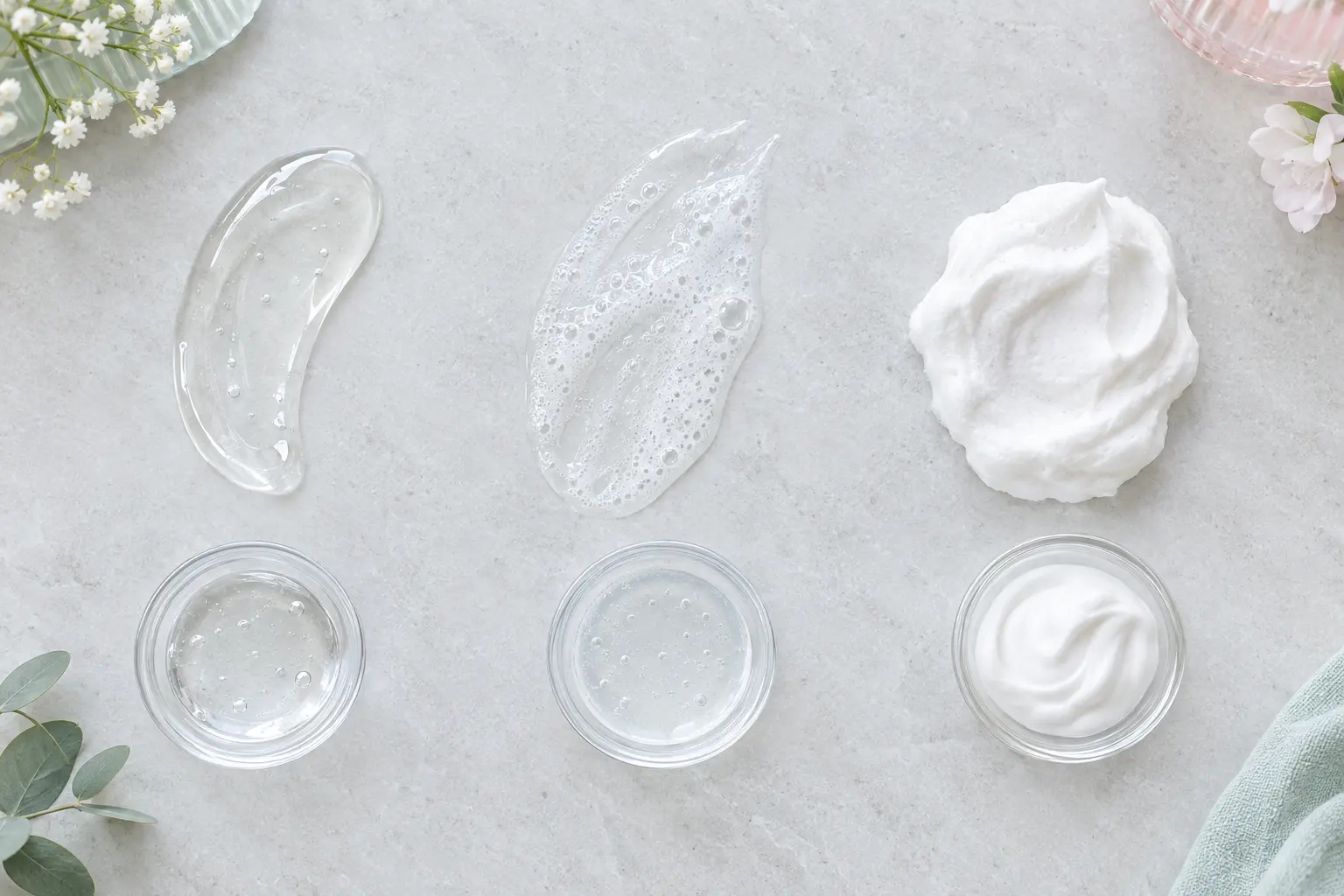
Reactive skin that also breaks out is the hardest brief in this category. Cleansers aimed at congestion often lean on exfoliating acids, and those are the ingredients flush-prone skin is most often told to avoid. So the useful question is whether a cleanser can be aimed at troubled skin without relying on them.
The description of La Theorie Cleanser Clearing Gel names no exfoliating acid blend. It builds its case on an omission instead: a gel cleanser formulated specifically for troubled and sensitive skin, free from fatty acids that the brand says can trigger acne, and designed to remove impurities, makeup and excess sebum without stripping moisture. The brand’s own site summarises it as a barrier-protecting cleanser with gentle surfactants [5]. That site organises the whole range around the skin microbiome and troubled skin [5]. A description is not a full ingredient list, so anyone avoiding exfoliants entirely should confirm on the pack.
What fatty-acid-free does and does not tell you
The claim describes an omission chosen for acne-prone skin, based on the brand’s microbiome reasoning. It is not an independent test result. The brand says it built its distribution through dermatology clinics and medical aesthetic salons, reaching more than 200 clinics across Seoul and Busan [5]. It also says it cannot promise miraculous skin changes, only calmer skin through small, steady changes [5]. That modesty is the right frame for any cleanser.
What the description leaves out is a pH figure and a scent statement. If either is your deciding factor, check it on the label before committing. The directions suggest morning and evening use with lukewarm water and a gentle massage.
Should reactive skin use an acid foam?
BANILA CO Clean it Zero Pore Clarifying Foam Cleanser is formulated for congested, oily skin, pairing a natural amino surfactant with a Tri-Peel Acid Blend of AHA, BHA and LHA. The brand describes LHA as suitable for sensitive skin and the foam as non-stripping. For oily skin that is only mildly reactive, that is a reasonable proposition.
For flush-prone skin it is a different matter. Dermatologist guidance for rosacea lists glycolic acid and lactic acid among ingredients to avoid [3]. The same guidance says that if you exfoliate, you should stop [3]. The product description does not specify which AHA the blend uses, so the cautious reading is to keep this off skin that flushes or stings, and never to layer it with other exfoliants.
And tea tree?
WHIPPED Vegan Pack Cleanser is positioned for sensitive, acne-prone skin, with mugwort extract and tea tree, a whipped creamy texture, and a brand claim that it removes sunscreen and light makeup in one wash. The brand’s site presents its pack cleansers as a line of several types chosen by skin concern [6]. For skin whose triggers are unknown, mugwort and tea tree are two more botanical variables to account for. Dermatologist guidance for rosacea-prone skin recommends testing skin care products before applying them to your face [3]. If plant extracts have never bothered you, this is a pleasant single-step option for oilier skin. If they have, test it on a small area first or pass.
Scent, Ferments and the Limits of Hypoallergenic: ma:nyo Bifida
The ma:nyo Factory Bifida Complex Ampoule Gel Cleanser is the most generous option here in two senses. It comes in a 400ml pump bottle, and its ingredient story is the richest: bifida ferment lysate, botanical extracts and seven types of hyaluronic acid, in a gel that builds a rich, dense foam. The description calls it hypoallergenic, formulated to minimise irritation, and suitable for daily use.
It also has a scent. The formula features ylang-ylang and jasmine extracts, described as refreshing and uplifting during use. That detail decides whether this cleanser belongs in your bathroom.
Why the scent matters more than the ferment
Fragrance sits on the list of ingredients dermatologists advise rosacea-prone patients to avoid [3]. Whether a scent that comes from floral extracts counts as a problem for you is something only your own history can answer. If scented products have set your skin off before, treat a scent-giving extract as a reason for caution, whatever its source. Hypoallergenic is a brand’s description of intent. It does not guarantee that no one will react.
The ferment deserves a measured reading too. The listing names bifida ferment lysate among its ingredients, and that is all it establishes. A cleanser spends a short time on the face before it is rinsed away, so the ferment should not be read as a treatment. The same goes for the seven types of hyaluronic acid: a reasonable sign that the formula was built with comfort in mind, and no substitute for the moisturiser that follows.
Who it suits
- Yes: skin that is sensitive to harsh surfactants or tightness but has never reacted to scented products, and anyone who uses a lot of cleanser and wants a pump on the sink.
- With a patch test: skin whose triggers are unknown.
- No: anyone who already knows fragrance or floral extracts set them off.
A hypothetical makes the trade-off concrete. Suppose your sensitivity shows up as dryness after washing, and you happily wear perfume and scented hand cream. The scent is probably irrelevant, and the large bottle is good value. Suppose instead your eyelids itch after scented shampoo. Then the unscented gel discussed earlier is the more logical bottle.

How to Introduce a New Cleanser Without a Flare-Up
The formula is half the outcome. The other half is how you use it, and reactive skin is unforgiving about technique. The points below come from dermatologist guidance written for rosacea-prone skin. Applying it to other easily irritated faces is an editorial judgment, and a cautious one. Where a product’s own directions differ, follow the product.
Trial it before you trust it
That guidance recommends testing skin care products before applying them to your face [3]. In practice, try a new cleanser on a small area first and change only one product at a time. If you swap your cleanser, toner and cream in the same week and something stings, you will have no idea which one did it.
Wash like this
- Use fingertips only. The guidance is to apply cleanser gently with your fingertips in a circular motion, without a washcloth or facial sponge [3].
- Rinse thoroughly with warm water. Cleanser left on the skin can cause irritation [3].
- Pat, do not rub. A clean cotton towel pressed gently against the face is the recommended finish [3].
- Moisturise afterwards. Moisturiser helps hydrate skin by trapping water in it [3].
One detail runs against common habit. The same guidance suggests waiting for your face to dry before applying moisturiser, because a moisturiser is less likely to burn or sting on dry skin [3]. If your creams tingle after cleansing, test that timing before blaming the cleanser. A plain cream from the moisturizers shelf is the natural partner to a gentle wash.
Mistakes that undo a good cleanser
- Massaging for a long time in the hope of clearing pores. The guidance says to avoid rubbing, scrubbing or massaging rosacea-prone skin [3].
- Using a light morning gel to remove makeup, then scrubbing harder when it fails.
- Adding an acid cleanser on top of other exfoliating products.
- Judging a cleanser on a week when your skin is already inflamed.
Your next step is small. Decide which of three descriptions fits you: unpredictable, dry in the morning, or reactive and breakout-prone. Choose the matching gel, and give it a fair, isolated trial before changing anything else in your routine.
Frequently Asked Questions
What type of Korean cleanser is best for sensitive skin?
A mild, non-soap gel or low-foam cleanser with a stated mildly acidic pH and no added scent is the most defensible starting point. Among the options covered here, S.NATURE BLANCHE CLEANSER documents the most relevant details, with a stated pH of 5.5 (±0.5), an unscented specification and a completed skin irritation test. That makes it the easiest to verify, not a proven winner for every skin. If your sensitivity is mainly morning dryness, a foamless gel such as LAGOM Cellup Gel To Water Cleanser may suit you better.
Is a low-pH cleanser always better for sensitive skin?
Not automatically. A published review of cleanser chemistry lists pH among the key differences between soaps and syndets and names pH alteration as one of the ways soap affects skin, so a stated mildly acidic figure counts in a formula's favour. The S.NATURE listing, for example, puts healthy skin pH at around 5.5 as its own brand statement. But pH is one factor among several, and surfactant type, concentration, scent and added actives all affect how a wash feels on reactive skin. Treat the number as useful evidence, then check the rest of the ingredient list.
Can I use an exfoliating acid cleanser if my skin is sensitive?
It depends on what kind of sensitive you are. Oily, congested skin that is only mildly reactive may tolerate an acid foam such as the BANILA CO Clean it Zero Pore Clarifying Foam Cleanser, particularly if you do not layer it with other exfoliants. If your skin flushes, stings or is rosacea-prone, dermatologist guidance leans toward avoiding acids such as glycolic and lactic acid and stopping exfoliation altogether. Stop using any acid cleanser that causes burning or lasting redness.
Are tea tree and mugwort cleansers safe for reactive skin?
There is no single answer, because it depends on what your own skin reacts to. The WHIPPED Vegan Pack Cleanser contains both mugwort extract and tea tree, which makes them two added botanical variables if your triggers are still unknown. Dermatologist guidance for rosacea-prone skin recommends testing skin care products before applying them to your face, so try it on a small area first. If you already know plant extracts bother you, an unscented gel is the more cautious choice.
Do I need to double cleanse if I have sensitive skin?
Only when what you are removing calls for it. A light, foamless morning gel will not reliably take off makeup or heavy sunscreen, and Korean users of the LAGOM gel say exactly that. On days you wear heavy makeup, a dedicated makeup remover followed by a gentle second wash, as the S.NATURE directions describe, makes more sense than scrubbing with one weak cleanser. On bare-skin days, one gentle wash is enough.
What is the difference between unscented and fragrance-free?
Dermatologist guidance for rosacea-prone skin recommends choosing fragrance-free rather than unscented products, which is why this article treats the two words as different claims. The S.NATURE BLANCHE CLEANSER, for instance, is specified as unscented, and that is the word to take at face value. If fragrance is a known trigger for you, read the full ingredient list on the pack rather than relying on a single front-of-pack descriptor.