
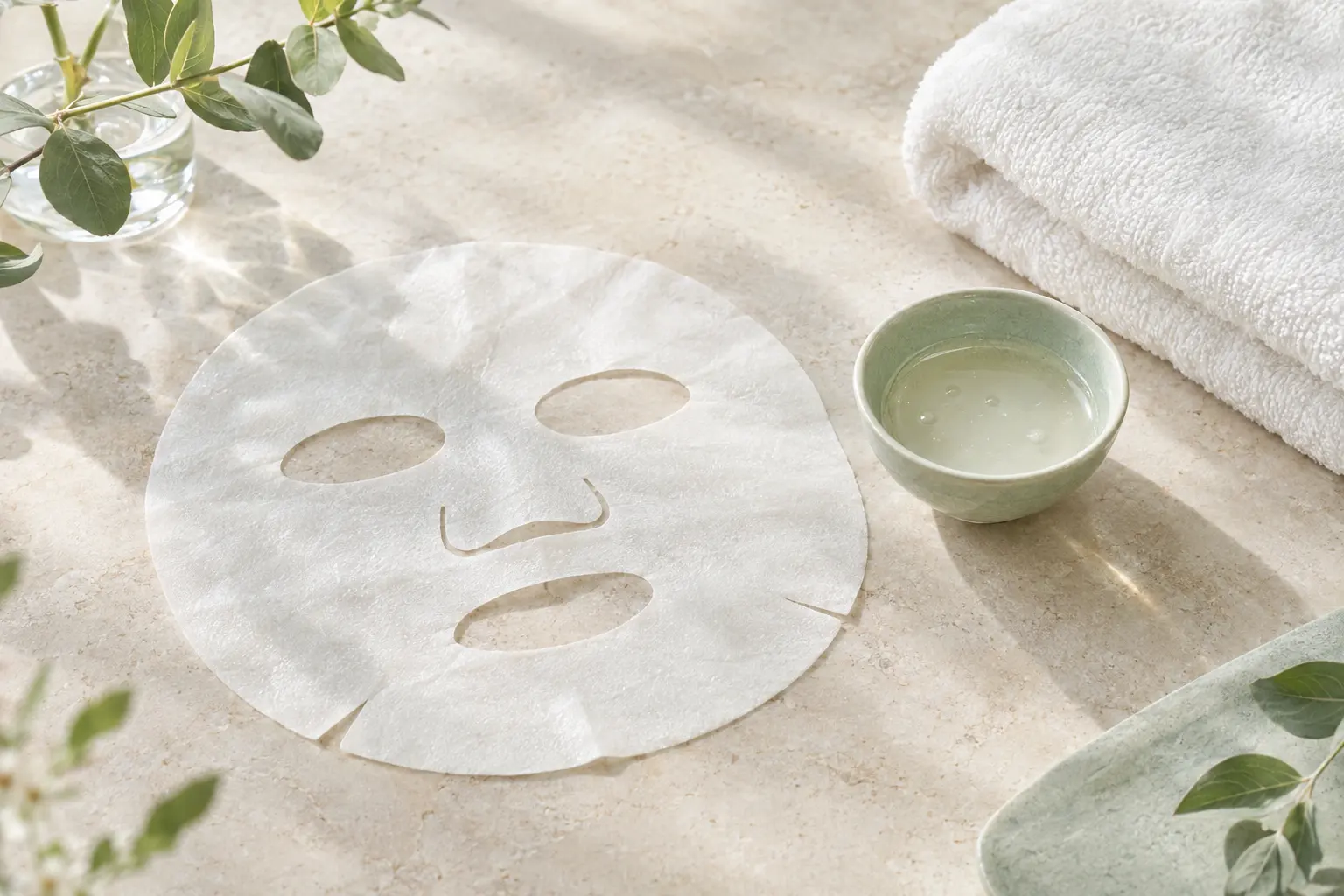
Choosing between a Korean sheet mask and a collagen mask sounds straightforward until you realize that one mask can be both. The other ingredients, the application area and the size of the pack may matter more than the word on the front.
For a first purchase aimed at a hydrated look, choose a manageable pack with a formula that fits your routine. Move to a retinal treatment, a large snail-collagen set or a hand glove only when that particular format and commitment make sense for you.
Korean sheet mask vs collagen mask: the distinction that matters
A sheet mask describes the delivery format: a prepared sheet sits against the face for the time specified on its packaging. A collagen mask describes a formula or marketing focus. The two descriptions can apply to the same product, so neither one tells you enough about the full ingredient list on its own.
In this selection, the face-mask options all combine a sheet format with collagen. Their meaningful differences are the additional ingredients, the number of steps and how many masks you buy at once. One product is a hand glove, which makes it a different purchase altogether.
| Option | What distinguishes it | Reason to consider it | Main trade-off |
|---|---|---|---|
| numbuzin No.2 Water Collagen | Four face sheets; collagen, peptide and hyaluronic acid | Smaller hydration-focused pack | Its percentage claim does not establish comparative performance |
| BONCEPT Retinal Collagen Two-Step | Five face masks with a separate ampoule step and retinal | A targeted addition for someone who wants a retinoid in a mask | Requires care around an existing active-heavy routine |
| Re:Excell Snail Collagen masks | Snail secretion filtrate and collagen in 40-sheet sets | A larger purchase when the formula and pack format fit your needs | Much more commitment before you know you like it |
| Arocell Super Collagen Hand Cream Mask | Cream-containing glove for hands | Targeted hand care rather than a facial treatment | Not interchangeable with a face sheet |
The most useful first question is therefore not which type wins. Ask what you want the mask to add. If the answer is a short hydration-focused step, a compact face-sheet pack is easier to justify than a 40-sheet box. If the answer is a vitamin A treatment, inspect your existing routine before buying a retinal mask.
Also separate the mask from the promise on the pack. A formula can be marketed for elasticity or brightness without providing independent evidence that its collagen rebuilds the skin. Dermatologists describe masks as possible additions to a routine, not replacements for it or for treatment of skin conditions[1].
A sheet keeps a formula against the skin while you wear it, but the sheet itself does not tell you which ingredients are present or how your skin will respond. Two masks that look similar in their packets can have different treatment goals and different directions. The packaging category is a useful starting point, not a complete comparison.
You can browse the wider masks and treatments selection with the same framework: look at the application area, full formula, directions and pack size before comparing headline claims. The most relevant option is the one that solves the specific problem you have, rather than the one with the most ambitious description.
What collagen in a sheet mask can actually do
Collagen is a structural protein in skin, but putting collagen on the surface is not the same process as making new structural collagen. For a cosmetic mask, a sensible expectation is surface moisturization and a temporarily smoother-looking finish, rather than a proven replacement for the collagen already in your skin.
A review of collagen hydrolysates describes native collagen as a large protein of approximately 300 kilodaltons and hydrolyzed collagen as smaller protein fragments, commonly between 1 and 10 kilodaltons[2]. Hydrolysis changes the size of the material; it does not turn every resulting fragment into a demonstrated skin-rebuilding active.
Think moisture and film, not a new scaffold
The same review identifies hydrolyzed collagen as a moisturizer at the stratum corneum, the outermost skin layer[2]. The European cosmetic ingredient database also lists hydrolyzed collagen as a film former and humectant[3]. A humectant helps retain moisture, while a film former can leave a continuous layer on a surface.
That distinction helps decode plumping language. Better-hydrated surface skin can look smoother, but that visible change is not proof that a mask has deposited new collagen fibers deeper in the skin. It is also not evidence that any one featured mask has outperformed another.
Penetration is more complicated than a single number on a package suggests. The review discusses the outer skin layer as a barrier and describes several potential routes through which peptides might enter skin[2]. Laboratory observations about individual fragments or delivery systems cannot be assumed to describe the outcome of a finished sheet mask on your face.
There is a practical distinction between an ingredient having a plausible cosmetic function and a finished product delivering a measured result. A mask contains a combination of ingredients, and its reported benefits cannot automatically be assigned to collagen alone. Without a direct comparison, the ingredient name cannot tell you which of these masks will look or feel best on your skin.
Read a number in context
The numbuzin name includes “65%,” while the BONCEPT catalog describes 300-dalton collagen. These are different kinds of claims: one is a percentage in a product name, and the other describes a stated molecular size. Neither number alone tells you how much useful ingredient reaches a particular layer of skin, how long any effect lasts or how the product compares with another mask.
For the numbuzin mask, available product descriptions do not clearly establish what the 65% figure measures. Treat it as a label claim, not a reason to assume that 65% of the finished sheet or every part of the formula is collagen. Likewise, a small stated molecular size does not establish a clinical result for the finished BONCEPT mask.
Finally, topical collagen research and oral collagen research involve different routes of use. Evidence about swallowing a collagen ingredient cannot simply be transferred to a sheet worn on the face. If supplements interest you separately, read the collagen stick overview as a different decision, not as proof for a mask.
The practical first choice: a smaller hydration-focused pack
If your goal is to add a moisturizing face-mask step without buying a large quantity, numbuzin No.2 Water Collagen 65% Voluming Sheet Mask is the clearest starting point in this selection. The box contains four single-use sheets of 33 g each, and the catalog identifies collagen, peptide, hyaluronic acid and pearl powder in the formula.
That ingredient combination gives you more to assess than the word “collagen” alone. The American Academy of Dermatology identifies hyaluronic acid as an ingredient that helps skin retain water[1]. The product also carries firming and elasticity claims, but those should be read as product claims rather than a guarantee of lasting structural change.
Who gets the most useful choice here?
Consider a hypothetical shopper who already has a cleanser, moisturizer and sunscreen but wants an occasional face-mask step before an event. A four-sheet box limits the quantity they have committed to while giving them a chance to decide whether the format belongs in their routine. It is a more relevant starting point for that situation than a 40-sheet set or a hand glove.
The catalog directions say to apply the sheet after cleansing and toning, discard it after 15 minutes and pat in the remaining essence. That is a defined, short step rather than an overnight treatment. Follow the current packaging if its directions differ, and do not assume that adding extra wear time will improve the result.
This is not automatically the right pick for everyone with sensitive skin. A short ingredient summary cannot establish how an individual will react to the complete formula. If you know that a particular ingredient causes trouble, compare it against the full package list before choosing the box.
The four-pack also makes sense if your main uncertainty is about using a face sheet at all. It gives you a limited number of uses without committing to a large supply. It does not, however, answer a separate question about whether a snail formula or a retinal product would suit you; those have different ingredient profiles.
What the small pack does not prove
Four masks are a practical quantity, not a clinical trial. You can judge whether you like the application and how your own skin responds, but a few uses cannot establish that collagen has repaired skin architecture or that one mask is better than every alternative.
Nor should “voluming” be read as a substitute for a procedure or medical treatment. If your concern is persistent irritation, acne or eczema, a mask is a cosmetic addition, not the treatment plan. Keep the purchase aligned with the modest goal it can reasonably serve: a hydration-focused sheet step in a routine you already maintain.
When a retinal collagen mask earns its extra step
BONCEPT Retinal Collagen Two-Step Mask Sheet is a different proposition from a hydration-focused sheet. Its five-piece set pairs a boosting shot ampoule with a face sheet, and the catalog lists retinal, hydrolyzed collagen, centella, hyaluronic acid, niacinamide and panthenol among its ingredients.
The reason to consider it is the retinal and two-step format, not an assumption that it is simply a stronger version of every collagen mask. Retinal is a vitamin A ingredient, and its presence makes the complete routine more important to the buying decision. The catalog also makes pore-tightening and firming claims; treat those as claims for the finished product, not established results from its collagen alone.
Check what is already on your bathroom shelf
Imagine that you already use a retinol product or an exfoliating acid. Adding a mask with another active can make the routine harder to manage, especially if you use the products together. Dermatologists recommend avoiding facial masks with active ingredients already used elsewhere in your routine, particularly when using retinol or acids, because overlapping ingredients can contribute to irritation[1].
In that situation, the smaller hydration-focused mask may be the more straightforward purchase. If you specifically want to introduce the BONCEPT mask, plan around its directions rather than stacking it over your usual active products. The two-step format is part of the product: follow the sequence and wear time on the package rather than substituting a generic sheet-mask schedule.
The extra step also changes the convenience calculation. You are choosing an ampoule and a sheet as a paired treatment, rather than only placing a sheet on your face. That can be appealing if you want the specified two-step format; it is less useful if your priority is keeping an already complicated routine simple.
What to make of the spicule claim
The catalog describes “collagen spicule shots” and attributes deep delivery to them. That is a product claim, not a demonstrated clinical outcome for your skin. The available evidence does not establish comparative results or human irritation rates for this particular two-step mask, so the number of claimed shots should not decide the purchase.
The catalog also calls the formula low-irritation and suitable for sensitive skin, but that does not establish that it will suit every sensitive user or that it is gentler than the other masks. If you are seeking the simplest possible hydration step, an ampoule plus retinal sheet may introduce complexity you did not want.
Pregnancy changes the decision. MotherToBaby advises that avoiding topical tretinoin during pregnancy may be the safest approach, even though the expected risk from properly used topical tretinoin is probably low[8]. That source concerns tretinoin, not this retinal mask; avoiding the retinal option during pregnancy is a cautious choice by retinoid category, not a claim of demonstrated harm from this product. Ask your healthcare professional for advice on your own routine.
Snail collagen masks: the bulk-buy question
The Re:Excell and Reexel snail-collagen options are for shoppers making a larger commitment. The listed sets contain 40 sheets: there is a whitening-focused set, a 40-sheet snail-collagen pack, and a split set containing 20 brightening sheets and 20 wrinkle-care sheets. The catalog gives 25 ml per sheet for the named whitening and split sets.
The formula story is also different from the numbuzin pack. Snail secretion filtrate appears alongside collagen, and the catalog for the 40-sheet Re:Excell pack also lists adenosine. That gives you additional ingredients to assess, not a reason to assume that snail and collagen together will produce a clinically established lifting effect.
One formula or two aims?
Choose the whitening-focused set only if its stated brightening aim and large quantity appeal to you. Consider the split set if you deliberately want separate brightening and wrinkle-care sheets in one purchase. Because it contains two varieties, check the ingredient lists and directions for both rather than assuming that they are identical except for the name.
As a hypothetical example, someone who already knows that a particular snail-collagen sheet suits their skin may value a larger supply. Someone trying snail filtrate for the first time faces a less comfortable trade-off: 40 individually packed masks are a substantial commitment if the formula does not suit them. The four-sheet numbuzin pack is the more manageable entry point, although it is not a way to test a snail formula.
The split set deserves particular attention because buying two stated treatment aims at once does not mean you have assessed two formulas. If one variety contains an ingredient you prefer to avoid, the other half of the box does not resolve that issue. Compare both lists with your needs before treating the assortment as a convenience.
What “functional” means
Korea’s Ministry of Food and Drug Safety defines functional cosmetics to include products intended to aid skin whitening or improve wrinkles, among other categories[6]. The agency says a responsible seller must obtain an evaluation or submit a safety and effectiveness report for a functional cosmetic, with certain products eligible for exemption from evaluation[6].
That regulatory framework is useful context, but it does not independently verify the status of every listing. The catalog describes certain Re:Excell options as functional; an official record for these particular products was not checked. A functional label also does not, by itself, establish that collagen was the tested active responsible for a brightening or wrinkle claim.
Read “whitening” here as the product’s brightening or tone-related positioning, not a promise to change your natural skin color. If a named active or certification is important to your decision, look for it on the specific box. Do not assume the same claim applies across all three sets simply because their names are similar.
For application, the listed 40-sheet pack and split set direct you to leave the mask on for 15 to 20 minutes and pat in the remaining essence. The useful comparison is still the whole formula and quantity, not an unsupported contest between snail mucin and collagen as isolated ingredients.
A collagen glove is a hand-care decision, not a face-mask alternative
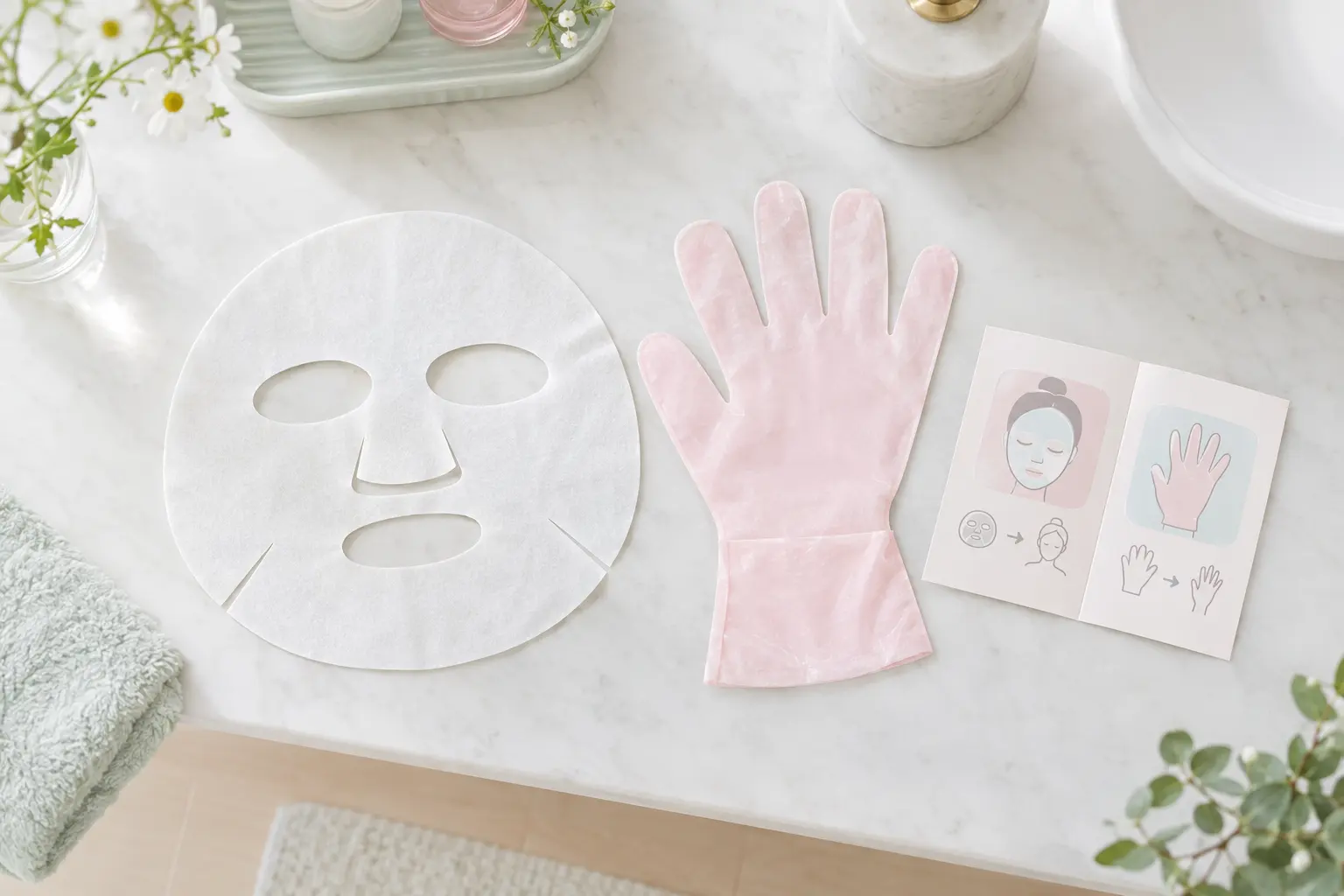
Arocell Super Collagen Hand Cream Mask belongs in a separate lane. It is a cream-containing glove intended for hand care, so it makes sense when your concern is the skin on your hands rather than the fit or ingredients of a facial sheet.
The catalog describes collagen, salmon PDRN, adenosine and niacinamide in the formula. It positions the product for dry hands and cuticles and claims intensive nourishment. Those are reasons to examine it as a hand-care treatment, not evidence that it will produce the same result as a face mask or a lasting change in hand structure.
Choose the application area first
A shopper comparing masks for a face-care evening should not treat this glove as a competing face option merely because “collagen” appears in the name. Conversely, someone looking for a contained hand-care step has little reason to buy a facial sheet for that job. The format determines where the product is intended to be used.
The catalog claims visible rejuvenation in 10 minutes, but that claim does not establish a wear-time instruction. Follow the directions on the package you receive for how long to use the glove and what to do afterward. This is a single-use format, so compare its convenience with the way you actually use hand cream rather than assuming the glove is necessary for everyday hand care.
The decision is partly about how you want to apply the product. A glove is a distinct treatment format, while a conventional hand cream can be incorporated into an existing routine. If you prefer a single, defined hand-care occasion, the glove may be relevant; if you want a repeat-use product, assess that need separately.
Also consider the intended recipient if you are shopping for someone else. A hand-care format can be easier to match to the intended application area than a face mask, but it does not remove uncertainty about ingredient preferences. The full formula and directions still matter, especially if the recipient has told you they avoid a particular ingredient.
Be cautious with impressive-sounding quantities
The catalog calls out a collagen-butter figure, while other descriptions use a different figure for hydrolyzed collagen. Those descriptions do not establish a directly comparable collagen percentage for the finished product. There is no need to turn either number into a ranking against the facial masks.
The catalog also refers to an irritation test on 32 adults. That is a reported product claim, not proof that every person with sensitive skin will tolerate the glove. If you are buying hand care as a gift and do not know the recipient’s preferences, the hand cream gift guide offers a useful way to think about format and label details before committing.

How to fit a sheet mask into a reliable routine
A mask is an optional step, not the foundation of skin care. The American Academy of Dermatology recommends continuing a regular routine that includes cleansing, moisturizing and sun protection[1]. Choose the mask only after those essentials are working for you.
A practical sequence
- Read the full ingredient list and directions for your specific mask, including any separate ampoule or glove instructions.
- For a new facial formula, test a small area first as dermatologists recommend[1].
- Use the product in the order stated on its package. The numbuzin and listed Re:Excell face-mask directions place the sheet after cleansing and toning.
- Remove it at the stated time. For numbuzin, the catalog specifies 15 minutes; for the listed Re:Excell 40-sheet pack and split set, it specifies 15 to 20 minutes.
- Follow the product’s after-use directions and continue your regular routine. The cited face-mask listings instruct you to pat in remaining essence.
Do not leave a mask on overnight just because it feels comfortable. Dermatologists advise following the label and warn that leaving a facial mask on longer than intended or using it too often can cause side effects such as irritation[1]. The appropriate schedule depends on the individual product and your skin; the available evidence does not establish a universal number of sheet-mask days per week.
If itching, burning or stinging occurs, wash the facial mask off immediately[1]. Ingredient sensitivities vary, and a product marketed as soothing can still contain something that does not suit an individual. For sensitive skin, the AAD identifies fragrance, essential oils and rubbing alcohol among ingredients that can be problematic[1].
Where moisturizer and sunscreen fit
A sheet’s remaining essence is not automatically a complete replacement for your usual moisturizer. If your routine calls for a moisturizer after the mask, keep that step rather than judging the routine by how many products you applied. The moisturizer category is the more relevant place to look if your basic daily step needs attention.
Likewise, a mask is not sun protection. Keep your regular sunscreen step in the daytime; a brighter-looking finish after a mask does not tell you anything about UV protection. The mask is an extra in the routine, not a reason to remove a product that serves a different purpose.
It also helps to avoid changing several routine steps at the same time. When you introduce a new mask alongside other new products, it becomes harder to identify which one is responsible if your skin feels worse. Keeping the rest of your routine familiar makes the mask easier to assess.
If your skin continues to feel worse after a mask, speak with a dermatologist rather than trying to correct the problem by adding more treatments. Dermatologists can help identify the cause of a skin issue and advise on treatment when needed[1].
How to make the final mask choice without overbuying
Start with the area you want to treat, then the formula, then the quantity. This order prevents a striking ingredient claim from making a hand glove look like a facial option, or a large box look attractive before you have considered whether its contents fit your skin.
Use these decision checks
- Face and hydration-focused care: Consider the four-sheet numbuzin pack if its full ingredient list suits you and you want a limited purchase.
- Face and a deliberate retinal step: Consider BONCEPT only if its two-step format fits around the actives you already use and pregnancy-related caution does not change your choice.
- Face and a larger snail-collagen supply: Consider a Re:Excell or Reexel set when you are comfortable with the formula and the 40-sheet quantity; inspect both varieties in the split set.
- Hands: Consider the Arocell glove for its intended hand-care format, not as an alternative face sheet.
Now compare the commitment, not just the box price. Divide the listed price by the number of masks if you want a per-use figure, but keep the quantities in view: four face sheets, five two-step masks and 40 face sheets solve different shopping problems. A lower apparent cost per sheet is not useful if many masks remain unused because the formula or format is wrong for you.
Check the precise variant before ordering. The Reexel split set contains two stated purposes, while the Re:Excell whitening set is a different selection. For numbuzin, the relevant name is No.2 Water Collagen 65% Voluming Sheet Mask; do not assume a similarly named mask has the same formula.
It is also worth deciding how much uncertainty you are willing to purchase. A smaller box reduces the number of sheets left over if you decide the format is not for you, but it does not guarantee compatibility. A large box can make sense when its particular contents are already a considered choice, rather than an experiment based on an appealing headline.
Know when none of them is the answer
If your priority is treatment of acne, eczema or persistent irritation, the better next step is to address that concern rather than choose a mask by its collagen percentage. Dermatologists distinguish an optional mask from treatment for conditions such as eczema and acne[1]. A mask can be enjoyable and useful without carrying the burden of solving every skin concern.
If you are still undecided, start by checking the complete ingredient list of the smallest relevant face-mask pack against your known sensitivities and current routine. If that information does not support a comfortable choice, wait rather than buying the largest set on the strength of its claims. The right decision is the one you can use as directed alongside the care you already rely on.
Frequently Asked Questions
Is a collagen mask better than a regular Korean sheet mask?
Not automatically. A collagen mask may itself be a sheet mask, so the comparison depends on the complete formula and your goal. Choose based on ingredients, application area and pack size rather than assuming collagen makes one sheet superior.
Does a collagen sheet mask replace collagen in your skin?
That effect has not been established for these masks. Hydrolyzed collagen is used as a moisturizing and film-forming cosmetic ingredient, which is different from proving that applied collagen rebuilds the skin's structural fibers. Expect a surface-care step rather than a permanent structural treatment.
Can I leave a Korean collagen sheet mask on overnight?
Do not leave it on overnight unless the specific product directions say to do so. The numbuzin catalog directions specify 15 minutes, while the listed Re:Excell 40-sheet pack and split set specify 15 to 20 minutes. Follow the current package directions because longer wear can cause irritation.
Can I use a retinal collagen mask with my usual retinol?
Avoid layering the retinal mask with your usual retinol or acid products. Dermatologists warn that overlapping active ingredients in a mask and the rest of a routine can increase irritation. If you are unsure how to incorporate a retinoid product, ask a healthcare professional for individualized advice.
Should I choose snail mucin or collagen for dry-looking skin?
You do not necessarily have to choose: the listed Re:Excell and Reexel face sheets contain both. Compare the rest of the formula and the 40-sheet commitment with your needs. If you are new to the ingredients or have known sensitivities, a large pack may not be the most practical first purchase.
How often should I use a collagen sheet mask?
There is no single supported weekly schedule for every formula and every person. Follow the product's directions and consider how it fits with the rest of your routine. If a mask causes itching, burning or stinging, wash it off rather than continuing to use it.