
The phrase korean beauty standards explained means unpacking a mix of long-standing ideals, modern trends and practical routines — from the luminous “glass skin” finish to the petite under‑eye aegyo‑sal and the cushion compact’s skin‑first coverage. This article breaks each element down into what it looks like, how people get there safely, and which steps matter most in daily care.
Expect specific product formats, ingredient choices, step‑by‑step routines, and cultural context so you can tell realistic, healthy goals from marketing. For a cultural snapshot of these pressures and portrayals, a contemporary Korean manhwa like True Beauty captures how makeup and self-image intersect in youth culture.
What 'glass skin' and other modern ideals actually mean
When people talk about glass skin they mean a surface that looks smooth, hydrated and luminous — minimal visible pores, very even tone, and a dew that reads like skin rather than lotion. The phrase became a global shorthand for a pore‑refined, reflective finish that rose to prominence in the late 2010s and remains a central K‑beauty aesthetic [1]. It’s not a single product result but the visible outcome of consistent hydration, gentle exfoliation and light‑diffusing makeup.
Alongside glass skin are several other recognizable traits: aegyo‑sal (the slight puff or shadow under the lower eyelid that reads young and cute), straight but soft brows, blurred lips, and a facial contour that reads small or V‑shaped. Some of these are enhanced with makeup and shading techniques; others are sought via minimally invasive fillers or surgical contouring — trends that show up in global aesthetic data [2].
There’s also a historical preference within East Asia for lighter skin tones, a complex social phenomenon tied to class and colonial histories that scholars describe as colorism; modern discourse in Korea increasingly critiques and questions this preference [6]. That critique is part of why today’s trends split: one lane pushes perfect, airy skin and facial refinement, while another pushes skinimalism and acceptance.
How to recognize an achievable vs. retouched ideal
- Achievable: hydrated, even tone, consistent SPF use, reduced flakiness and softer texture — obtainable with a few months of consistent care.
- Often retouched: literally pore‑free, surgically narrowed faces on young models, or skin with unnatural, glassy specular highlights edited in campaigns.
- Helpful lens: aim for skin that looks healthy in natural light and under close inspection — not camera‑perfect in every shot.
Daily routines that actually build the look (what to keep and what to skip)
You can spend hours layering products or you can simplify. Korean routines historically popularized multi‑step layering, but the modern trend is skinimalism: keep the steps that deliver measurable benefit and drop what’s cosmetic theatre. The three pillars are hydration, barrier repair, and sun protection.
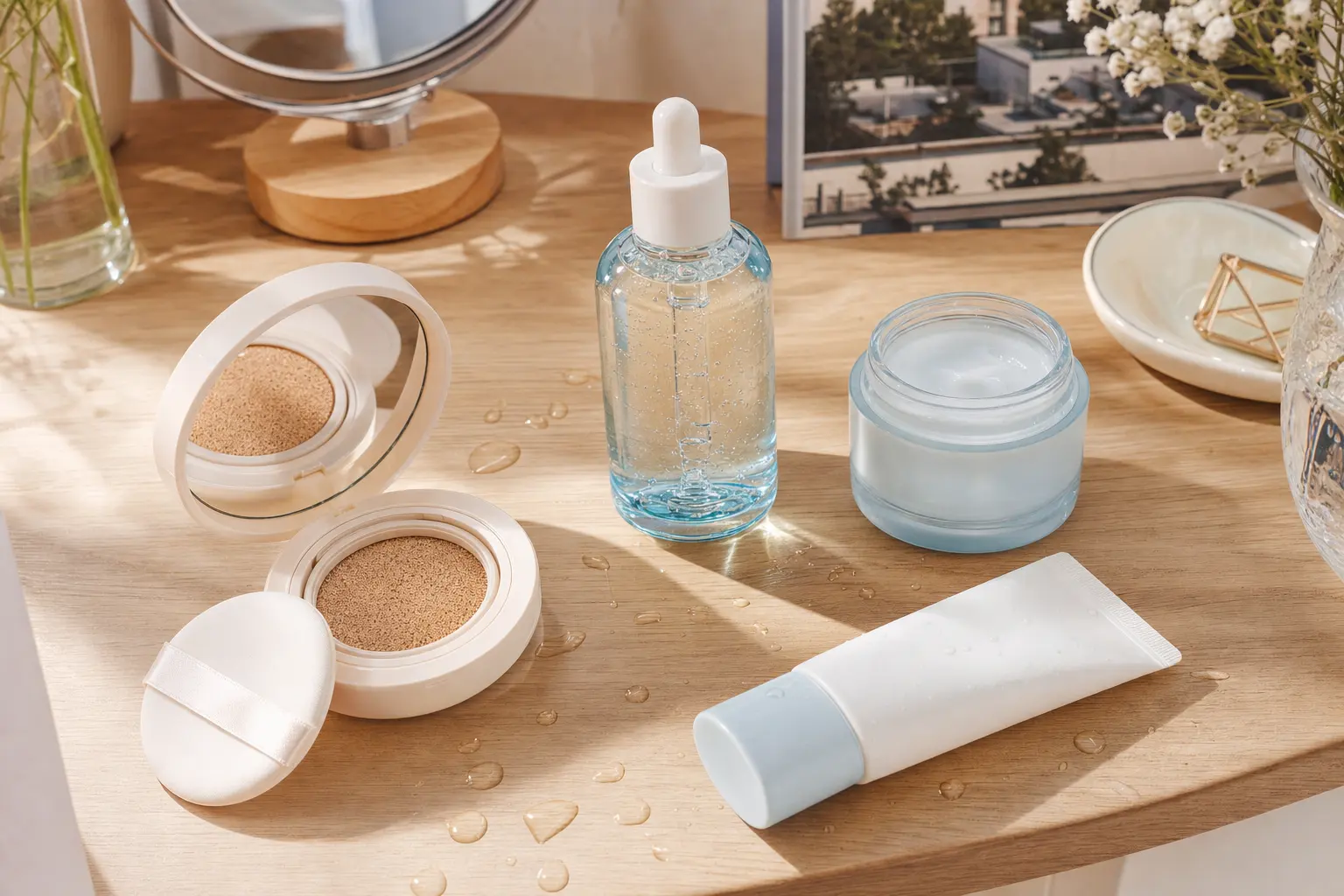
Morning routine (practical sequence): double‑cleanse only if you slept in heavy products or sweat; otherwise, gentle water‑based cleanse or splash. Tone or hydrating toner pad for immediate moisture and to prep layers — see when a pad fits your skin type in our comparison of toner pads and liquid toners: Korean Toner Pads vs Liquid Toner. Press in an essence or lightweight serum, layer a barrier moisturizer, then finish with a broad‑spectrum sunscreen and, if desired, a cushion compact or very light BB for coverage.
Night time: double cleanse if wearing SPF/makeup; follow with a chemical exfoliant 1–3 times weekly (AHA for textured/dry skin, BHA for congestion). Then an essence or hydrated serum (hyaluronic acid + niacinamide is a classic pair), treat with targeted actives (vitamin C or retinoid alternated), and finish with a richer moisturizer or sleeping mask when barrier repair is needed. Sheet masks and ampoules are used as occasional boosters.
Where people waste time
- Too many serums at once — actives can conflict and irritate.
- Skipping sunscreen because coverage feels like it protects — SPF is non‑negotiable for long‑term evenness.
- Excessive exfoliation trying to force pore‑free skin — that damages the barrier.
If you want product types focused on glowing skin, browse our Serums & Essences category for formulations that support hydration and tone: Serums & Essences.
Key ingredients behind the look — what science supports and how to use them
K‑beauty advanced popularized certain ingredient groups; some have solid clinical backing, others are cultural favorites. The reliable, evidence‑backed actives for the primary aims — hydration, brightening and texture — are hyaluronic acid (for hydration and plumping), niacinamide (for brightening and barrier support), vitamin C (for antioxidation and tone), and chemical exfoliants AHA/BHA (for surface renewal and pore clearing). Centella asiatica and propolis are soothing, anti‑inflammatory additions that help when skin is sensitized.
Snail secretion filtrate is a distinct K‑beauty staple: it’s used for hydration and repair and became widely popular in multiple bestselling formulas. Use it as you would any hydrating essence: after toner and before a targeted serum. Hyaluronic acid serums should be applied to damp skin and followed by a cream or occlusive to lock moisture in.
How to layer without drama
- Toner or water‑based hydrator — keep it light.
- Essence — thin, hydrating; press in three to five drops, not a puddle.
- Serums — apply the most watery to the thickest. Vitamin C in the morning under sunscreen; retinoids at night with reduced exfoliant frequency.
- Moisturizer and then sunscreen (AM) or occlusive (PM) — seal the work.
Chemical exfoliants: AHAs (glycolic, lactic) remove surface dullness; BHAs (salicylic) penetrate sebum and help clear pores. Start slow: once weekly for sensitive skin, then increase to 2–3 times as tolerated. When you want a hydrating boost, masks and treatments spike in colder seasons — browse product boosters in our Masks & Treatments category: Masks & Treatments.
Makeup techniques that create aegyo‑sal, blurred lips and a glassy finish
Makeup in Korea tends to accentuate natural features while keeping the skin base dominant. The cushion compact is a cornerstone: developed by IOPE/AmorePacific, cushions give thin, buildable coverage that blends into a dewy, skin‑like finish rather than heavy cake coverage [5]. For glass skin, choose sheer to light coverage formulas and focus on skin prep first — hydrated, primed, and with minimal texture.
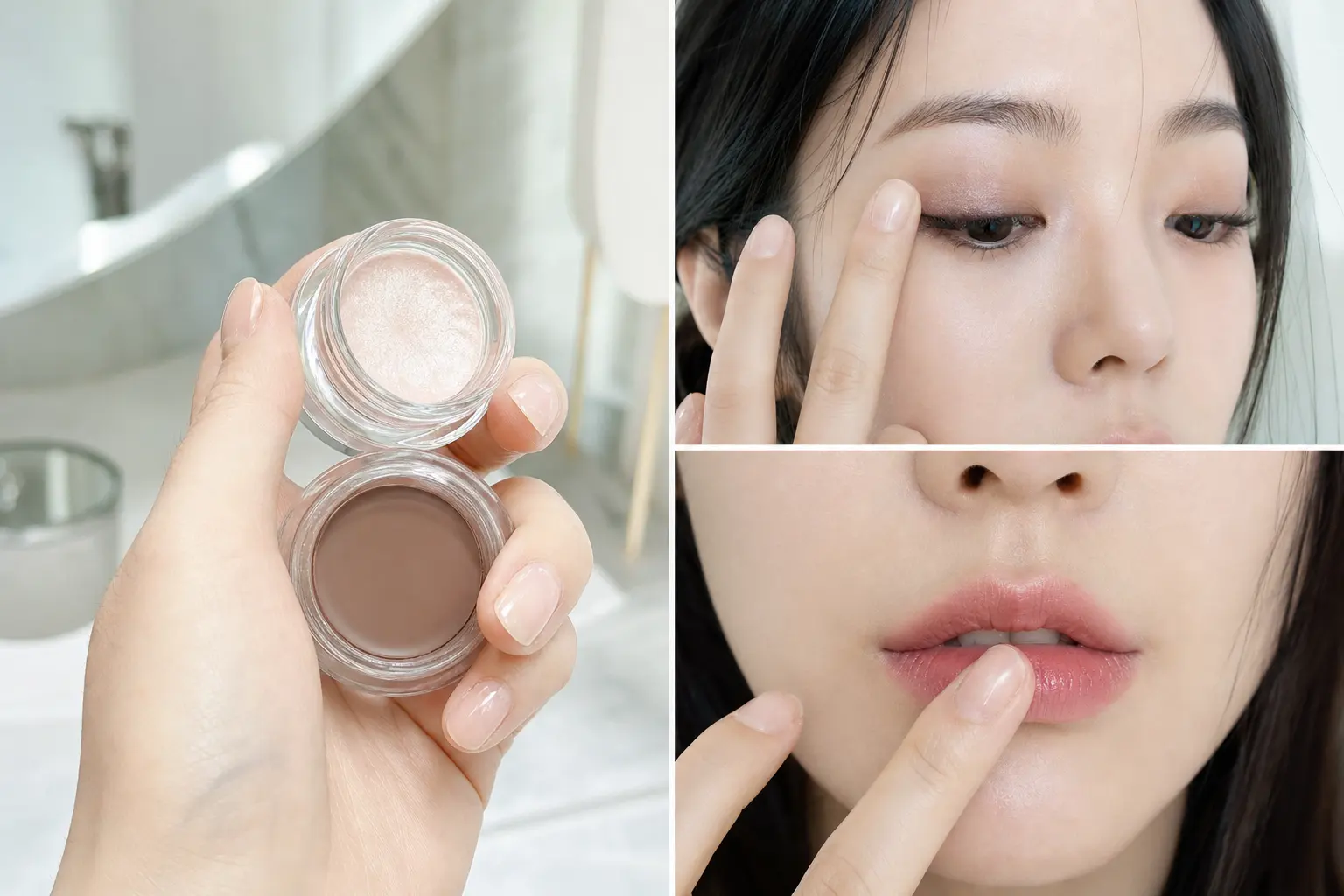
Aegyo‑sal is achieved two ways: natively some people have a small fatty pad under the eye; makeup artists recreate the illusion with soft highlight on the lower eyelid and a gentle shadow beneath to mimic that roll. Use a cream highlighter on the highest point of the under‑eye, then a matte contour shade in a thin line beneath, blended well to avoid harshness. The result should read youthful, not makeupy.
Step‑by‑step: quick aegyo‑sal
- Prime under‑eye with a hydrating eye cream — avoid silicone‑heavy primers that crease.
- Apply thin highlighter (cream or pearl) on the lower eyelid, just above the lash line, in a small crescent.
- Softly shade a matte taupe/brown a few millimeters beneath that highlight, blending horizontally to create depth.
- Set very lightly with translucent powder to avoid migration; finish with a fine coat of mascara.
For the blurred lip, use a soft cushion or fingertip to press a tint into the center of the lips, then tap outward — never drag. That creates the gradient look popular across K‑beauty trends for 2025–2026 [7]. For a cultural companion that dramatizes makeup’s role in self‑image, read True Beauty Vol.3 for early series scenes where makeup transforms perception.
Recommended reading if you want the narrative context for looks like aegyo‑sal:
Surgical and non‑surgical procedures: prevalence, risks, and why people choose them
Aesthetic procedures are part of the modern picture in Korea and influence standards. ISAPS reports continuing growth in surgical procedures globally, with facial and eyelid procedures among the fastest‑growing categories [2]. In Korea, double‑eyelid surgery, rhinoplasty and facial contouring (so‑called V‑line surgeries) have been popular goals for decades in the cosmetic market. Minimally invasive procedures — fillers for aegyo‑sal and contouring using hyaluronic acid or PDRN-type injectables — have also increased clinical interest [3].
People pursue procedures for many reasons: to match a personal ideal, to reduce social friction (e.g., interviews, professional settings), or to align an outer face with an inner identity. That doesn’t make them trivial: every procedure carries risk, recovery time and possible psychological outcomes. If you’re considering any procedure, seek board‑certified practitioners, review before/after results the clinic provides, and expect realistic timelines and complication discussions.
How to weigh a procedure
- Ask why you want it and whether a non‑surgical option (makeup, fillers) might deliver the same feeling with less risk.
- Find clinics with transparent complication rates and clear follow‑up care; ask about technique, materials, and how revisions are handled.
- Plan recovery and give yourself time to feel the psychological change; cosmetic results are subtle shifts, not miraculous transformations in self‑worth.
Clinical growth does reflect pressure to conform; that’s part of broader conversations in Korea about beauty expectations, medical ethics and consumer protection. Read accounts and expert pieces when you can — the choice is personal, and good providers will treat it with that gravity.
Media, storytelling and why popular culture matters to beauty ideals
Beauty standards are social products — shaped by history, media portrayals and industry incentives. Manhwa and K‑dramas often dramatize transformation scenes: makeup as armor, a new haircut as rebirth. That fictional depiction influences real behavior by normalizing certain looks and hooking desire to narrative relief. The popular webtoon True Beauty explicitly explores these themes: its protagonist’s makeup work and consequent social reception map neatly to real pressures around appearance and acceptance.
Reading how characters negotiate identity and social feedback can clarify your own response to cultural pressure. For a direct cultural snapshot, the original Korean volumes dramatize the social calculus around makeup and self‑esteem. If you want to see how narratives and makeup intersect, True Beauty Vol.11 shows later arcs where self‑acceptance becomes a central tension: it’s useful for anyone trying to understand the push‑and‑pull between cosmetic change and mental health.
Beyond fiction, editorial aesthetics and social media amplify certain images: high‑gloss close‑ups, heavily edited promotional shots, and influencer tutorials that compress years of practice into a single clip. That mix of aspiration and curated reality is why media literacy matters: ask whose camera, lighting and retouching produced the image before you internalize the standard.
Finally, media also enables critique. Discussions about colorism and realistic representation are growing within Korea and internationally; consumers and some creators are pushing for broader, inclusive depictions of beauty.
Practical step‑by‑step routines for three realistic goals (with a comparison table)
Below are tight, realistic routines you can follow for common goals: hydration + glow, brightening/spot control, and texture/pore refinement. Each list gives the small set of steps that matter. Repeat nightly and be consistent for 6–12 weeks to see real changes.
Comparison of focused routines:
| Goal | Core Steps (AM / PM) | Key Ingredients | When to see a pro |
|---|---|---|---|
| Hydration & Glow | Light cleanse / essence + HA serum / moisturizer + SPF PM: double cleanse / essence + HA + occlusive |
Hyaluronic acid, snail mucin, ceramides | If barrier fails after 4 weeks or irritation persists |
| Brightening & Even Tone | Cleanse / Vitamin C serum / SPF PM: Cleanse / gentle AHA 2–3× wk / niacinamide |
Vitamin C, niacinamide, tranexamic acid | For resistant melasma or unevenness, consult a dermatologist |
| Texture & Pore Control | Cleanse / BHA spot treat / sunscreen PM: Cleanse / BHA 2–3× wk / retinoid (alternate) |
BHA (salicylic), retinoid, niacinamide | Deep scarring or persistent cystic acne: see a dermatologist |
| Sun‑first Preventive Care | Gentle cleanse / antioxidant serum / SPF reapply | Broad‑spectrum SPF, antioxidants | For photoaging consultations or spot treatments |
Exact quantities and technique
Use 2–3 drops of a watery essence, three to five drops of a serum, and a nickel‑sized amount of moisturizer for the face. Pat products in rather than rub; for hyaluronic acid, apply to damp skin to trap water. Sunscreen should be 1/4 to 1/2 teaspoon for the face and neck and reapplied every two hours in sun exposure. These small, repeatable habits build the visible results people often attribute to the elusive “ideal.”
For cultural reading that pairs with practical routines, True Beauty Vol.12 explores how daily makeup practice shapes social interactions — useful if you want to reflect on how routines influence self‑perception.
How to make this sustainable: seasonality, ethics and shopping smart in Korea
Sustainability and skinimalism are growing in Korean retail and editorial picks; consumers increasingly search for eco‑friendly packaging, refill systems and formulations that do more with less [8]. Seasonality matters: lightweight cushions and high‑SPF products sell best in summer, while richer masks and barrier repair items spike in winter. Plan your routine to shift textures with the seasons rather than reinventing ingredients.
Smart shopping tips from Seoul editors: buy concentrated actives once you’ve confirmed tolerance, lean on sheet masks and ampoules as short‑term boosters, and keep a stable sunscreen you trust year‑round. If you need guidance on sunscreens that avoid a white cast — central to achieving an even, natural finish without chalkiness — consult our seasonal SPF picks: Best Korean Sunscreen No White Cast.
Ethics and mental health
When buying or browsing, notice whether brands use extreme retouching or diverse models. Representational choices matter. Also, set limits on scrolling: frequent exposure to retouched images increases dissatisfaction. A practical habit: for every five minutes of beauty scrolling, read a short essay or fiction chapter that reframes appearance — several readers find Korean manhwa like True Beauty useful for reflective reading; Vol.7 revisits identity themes in mid‑series beats.
Finally, combine conscious consumption with realistic goals. If barrier repair is your priority, invest in a good moisturizer and stop chasing every new serum. If you want a youthful under‑eye without surgery, learn aegyo‑sal makeup techniques or consult a qualified clinician about minimally invasive, reversible filler options.
How Koreans really shop, seasonally and socially — insider habits
In Seoul, beauty shopping mixes convenience and ritual. Convenience: compact format products like cushions and ampoules are available at boutiques and convenience stores and are built for on‑the‑go top ups. Ritual: many consumers still prioritize in‑store sampling and advice, especially around premium brands and clinical treatments. Socially, gifting skincare during holidays and significant life events remains common; people often select moisturizers or sheet mask packs as thoughtful, useful gifts.
Seasonal behaviour is predictable. Summer: lightweight cushions, high‑SPF, and oil‑control primers sell best. Winter: sleeping masks, heavier moisturizers and occlusives rise. Retailers curate bundles accordingly and editors drop seasonal lists. If you want deeper reading on essence selection — a central product to the glass skin workflow — check our piece on essences: Best Korean Essence for Glowing Skin.
Common buying mistakes to avoid
- Buying active serums without a trial or patch test — returns are harder once opened.
- Stacking exfoliants and retinoids blindly — causes barrier damage and defeats the goal of luminous skin.
- Relying on influencer single‑product recommendations without considering skin type and climate.
Finally, know that trends travel fast. What’s viral on social apps this week may feel dated in a season; make choices that fit your schedule, budget and sensitivity rather than chasing every trend. If you want to explore how narrative and shopping collide, many readers find True Beauty’s volumes a compact cultural primer for the social forces behind appearance decisions.
Frequently Asked Questions
What is glass skin and is it realistic for most people?
Glass skin describes a luminous, pore‑refined, hydrated appearance rather than literal glass. It’s realistic for many people as a goal if you prioritize hydration, gentle exfoliation and consistent SPF; severe texture or scarring may need professional treatments. Avoid chasing a photoshopped ideal — aim for natural luminosity in real light.
How is aegyo‑sal created with makeup versus procedures?
Makeup creates aegyo‑sal using a subtle lower‑eye highlight and a soft shadow beneath to mimic the fatty roll, plus careful setting to prevent creasing. Non‑surgical approaches use soft fillers to accentuate the under‑eye pad; surgical options are less common. If considering injections, consult an experienced clinician to discuss risks and longevity.
How many steps should a practical K‑beauty routine have?
Practical routines range from three to seven steps. The essentials are cleansing, hydration (toner/essence/serum), moisturizer and sunscreen in the morning. Night adds targeted treatments and sometimes an occlusive. The most important rule is consistency: choose fewer, effective products you’ll use daily.
Which K‑beauty ingredients are best for hydration and brightening?
Hyaluronic acid and snail mucin are top hydrating actives; niacinamide and vitamin C are strong for brightening and evening tone. Chemical exfoliants (AHA/BHA) help with texture and allow brighteners to work better. Start slowly with actives and pair them with a barrier‑supporting moisturizer.
Are Korean beauty standards driving cosmetic surgery rates?
Beauty ideals in Korea influence demand for procedures; global data shows growth in facial surgeries and minimally invasive treatments [2]. Social and economic pressures contribute, but personal choice and medical safety are crucial. If you consider procedures, seek qualified providers and realistic counseling about outcomes and risks.