
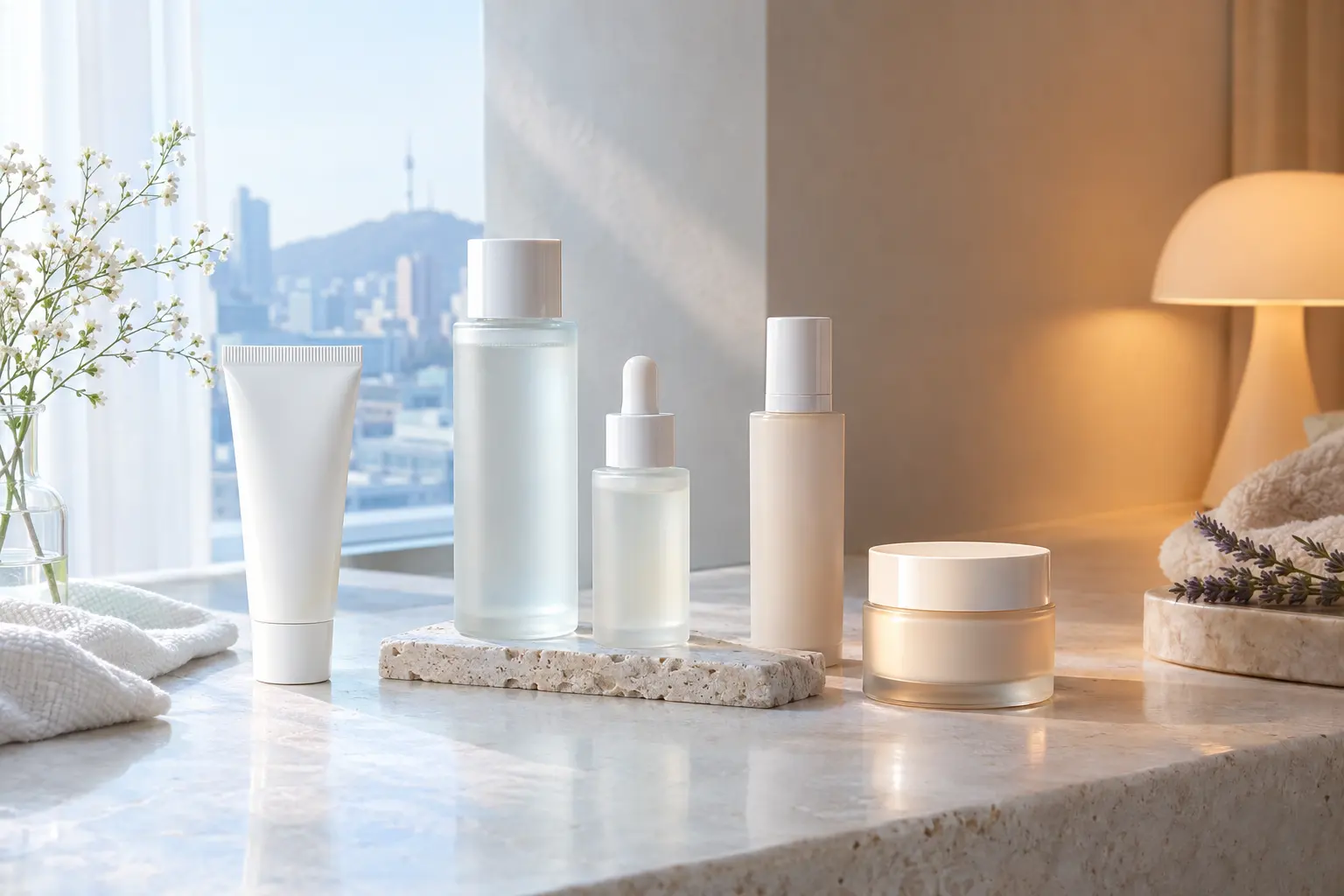
A Korean morning vs night skincare routine should not require buying your bathroom shelf twice. The real dilemma is deciding which products can do useful work in both routines—and which deserve a different time slot.
Start with one hydration base, prioritize sun protection in the morning, and make evening additions earn their place. A lifting set is not automatically a night treatment, and an ampoule is not automatically essential. Among these six options, the meaningful differences are their stated purpose, format, and complexity—not an assumed rule that Korean skincare needs more steps after sunset.
Korean morning vs night skincare routine: change the job, not the whole shelf
The most useful distinction is between a routine’s purpose and a product’s marketing name. Morning care needs to accommodate sun protection and whatever you wear over your skincare. Evening care can prioritize cleansing, moisturizing, and a treatment you have deliberately chosen. Neither schedule requires a completely separate collection of hydrating products.
Dermatologists recommend sunscreen that provides broad-spectrum protection, SPF 30 or higher, and water resistance [1]. None of the featured products is documented here as a sunscreen. That missing category matters more to your morning plan than deciding between two products that both promise radiance.
Use this division before choosing products
| Routine decision | Morning priority | Evening priority | Buying implication |
|---|---|---|---|
| Hydration | Use the layers you want beneath sunscreen | Choose the moisturizing finish you prefer before bed | A shared base may cover both routines |
| UV protection | Make sunscreen a dedicated step | Do not confuse treatment with next-day protection | No featured item fills the sunscreen role |
| Brightening or firming | Optional, according to product directions | Optional, according to product directions | A concern-specific purchase, not a clock-specific one |
| Exfoliation or customization | Requires clear formulation and usage information | Still requires clear formulation and usage information | Nighttime does not remove uncertainty |
This approach changes how you assess a set. A collection can be convenient because it groups complementary formats, but ownership does not obligate you to use every item at every application. Decide which functions you need before deciding how many bottles belong beside the sink.
It also prevents a familiar shopping mistake: buying a second moisturizer because the first one is not called a night cream. If you already like your moisturizing step at bedtime, a nighttime label alone is a weak reason to replace it. Conversely, wanting fewer layers in the morning is a perfectly reasonable reason to simplify—even when a set presents a longer ritual.
The conditions that change this recommendation are specific. A product may have directions restricting its timing, you may want a different finish before bed, or you may have an unmet concern that justifies another treatment. Those are useful distinctions. A general promise of glow is not.
Hydration, repair, and functional claims are different things
Skincare language often compresses several different outcomes into one word: repair. A moisturizer can be sold for hydration, an ampoule for brighter-looking skin, and a set for wrinkle improvement. Treating all three as interchangeable nighttime repair products makes comparison harder rather than more scientific.
Separate surface care from structural claims
The epidermis contributes to the skin’s barrier against environmental damage and regulates water release from the body [3]. The dermis is a deeper connective-tissue layer containing a structural matrix that includes collagen, elastin, and hyaluronic acid [3]. These are different anatomical roles, not interchangeable descriptions of what a cosmetic achieves.
Hyaluronic acid has water-binding properties that contribute to skin moisture [3]. That mechanism is useful context when reading hydration claims. It does not, by itself, establish how deeply a particular finished product penetrates, how long its effects last, or whether it changes wrinkles.
Likewise, a product name containing collagen, protein, or lifting is not enough to show that it rebuilds the dermal structures described in skin biology. To justify that conclusion, you would need evidence on the actual finished formula and the outcome measured. For shopping, keep the claim at its documented level: intended moisturization, brightening, or improvement in appearance.
Understand the Korean label context
Korea’s Ministry of Food and Drug Safety recognizes functional-cosmetics categories that include products aiding skin whitening, wrinkle improvement, and UV protection [7]. Responsible sellers must undergo the relevant evaluation or submit a report for functional cosmetics under the applicable process [7].
That framework explains why Korean product descriptions may use particularly formal wording about whitening or wrinkle improvement. It does not make those products interchangeable with sunscreen, nor does it tell you to use them only at night. For Cellinon’s set, the functional-skincare wording is a catalog claim; an individual filing is not established by the material available here.
- Hydration: ask whether the product fills a moisturizing gap.
- Brightening or firming: ask what appearance concern you actually want to address.
- Timing: follow the finished product’s directions rather than assigning a schedule from its headline ingredient.
Keep one boundary clear: this is a cosmetic buying framework, not a treatment plan for a diagnosed skin condition. Product directions take precedence over generic schedules, and prescribed care should not be reorganized around a shopping article. There is no need to add an active simply to make your evening routine look more advanced.
Build your morning skincare around a useful hydration base
A good morning routine should be easy to repeat. Before adding a toner, essence, ampoule, and lotion, decide what each layer is supposed to contribute. If the answer is simply more hydration for every bottle, consider whether you actually want four applications or would prefer one coordinated moisturizing approach.
A hydration-focused set for a shared routine
PYUNKANG YUL Moisture Skincare Set is positioned around hydration, moisture-and-oil balance, and a minimalist formulation philosophy. Its catalog description identifies milk vetch root extract and presents the set as an option for dry, sensitive, or imbalanced skin. Those are its stated aims, not comparative proof that it is gentler than every alternative.
This is a relevant starting point if your main problem is choosing a hydration-focused routine rather than targeting a specific brightening or lifting claim. The reason to consider it is the alignment between that purpose and your need—not an assumption that a botanical ingredient guarantees a particular level of tolerance.
The practical trade-off is buying a set rather than one moisturizer. A set makes more sense if you want to establish a coordinated routine and expect to use its components. If you already have several moisturizing products you like, another collection may create duplication instead of solving a gap.
Organize the morning by function
- Begin with your existing cleansing step. A hydration-set purchase does not, by itself, answer every cleansing question.
- Select the hydrating components you actually need. Follow their stated order and directions rather than assuming every item belongs in every application.
- Keep sun protection separate. Do not count a dewy finish, a botanical extract, or a brightening claim as SPF.
- Assess the whole routine. Decide whether you like the combination under your usual sunscreen and makeup before adding another serum.
There is no documented finish or sunscreen-layering test here for this exact set, so it would be misleading to promise weightlessness or universally smooth makeup application. Instead, make those practical requirements part of your own selection criteria. A product can be relevant to hydration without being a guaranteed match for every combination of layers.
If you are still deciding whether an essence belongs in your routine at all, the guide to choosing an essence for dry skin addresses that narrower question. Make the format decision first; there is little value in adding an essence simply because a longer routine looks more complete.
Make nighttime skincare simpler before making it stronger
Evening is an opportunity to remove unnecessary steps as well as add targeted ones. A routine can be complete for your purposes without an ampoule, a separate lifting set, and a customized powder. If your goal is straightforward moisturization, start by choosing the moisturizing step you are most likely to use consistently.
A single-product alternative to another set
O HUI The First Geniture For Men Moisturizer 110 ml is sold as a moisturizer with hydration, firmness, and wrinkle-improvement claims. The catalog also describes an approach targeting pores, elasticity, and tone. The documented capacity is 110 ml; the supplied facts do not establish a measured duration of hydration or a comparative improvement over the other options.
Its clearest advantage for this decision is format: it is one moisturizer rather than a multi-product collection. Consider it if you are shopping within men’s skincare and want a moisturizing anchor without committing to an entire set. The buying case is convenience and stated purpose, not a claim that it performs every possible treatment function.
It is a less obvious choice if you specifically want a toner-and-lotion pairing or a dedicated ampoule format. Those are different preferences, and there is no need to pretend one is universally better. You are choosing how to organize care, not entering a competition for the most elaborate shelf.
What should actually change after sunset?
First, distinguish a bedtime preference from a biological requirement. You might prefer to spend longer applying skincare in the evening because there is no makeup step afterward. That is a practical reason to move an optional product to nighttime; it is not evidence that its ingredients become more effective after dark.
Second, do not use nighttime as permission to combine every treatment. Educational guidance on glycolic acid recommends evening application and describes increased UV sensitivity during use [5]. That is a reason to handle an identified exfoliating active deliberately, not a basis for classifying all toners, serums, or brightening products as nighttime-only.
- If moisturization is the unmet need: choose your moisturizing anchor before adding a specialized treatment.
- If you already use a directed treatment: build around its instructions rather than adding competing steps for completeness.
- If you simply enjoy a longer routine: acknowledge that preference without treating it as a requirement for good skincare.
You can compare formats within the moisturizer category, but keep your decision narrow. The useful question is whether you want one moisturizing product or a collection—not whether your shelf looks sufficiently different at night.
When a brightening ampoule earns a place in either routine
Once hydration is covered, a dedicated brightening product becomes a more focused decision. Are you looking for an additional cosmetic treatment for radiance and texture, or are you expecting another moisturizing layer to solve an unrelated concern? Being explicit about that distinction makes it easier to decide whether an ampoule is worth the extra application.
Choose the format for a reason
Metregen Brightening Skincare Ampoule 2ml x 20 is presented as a treatment for moisture, elasticity, brightening, and skin texture. The catalog identifies plant stem-cell extracts, including ginseng callus culture extract, and describes ginseng, damask rose, and green tea among its botanical components. Its documented presentation is 2 ml x 20.
This is a relevant option if you already have a moisturizing base and specifically want a separate brightening-focused ampoule. It is less compelling if your main aim is to reduce the number of products you use, or if the routine you already own addresses the same stated goals and you cannot identify what is missing.
The botanical language needs careful interpretation. The ingredient description establishes the presence of plant-derived extracts; it does not establish that the product supplies replacement human skin cells, performs a regenerative medical procedure, or has proven superiority to other brightening formulas. None of those stronger conclusions follows from the word stem-cell.
Morning or night is the second decision
The first decision is whether you want this treatment at all. Its name does not establish a nighttime-only requirement, and the documented facts do not identify it as a vitamin C serum. Do not assign it the antioxidant performance of a different ingredient combination simply because both products might be described as brightening.
If you prefer fewer layers before sunscreen, evening may be the more convenient place for an optional ampoule, subject to its directions. If you prefer doing your fuller routine in the morning, the word ampoule alone is not a reason to move it. That is scheduling based on usability, not a promise of equal measured performance at both times.
- Do not infer a 20-day course. Twenty containers do not establish application frequency.
- Do not infer a dose from capacity. A 2 ml unit is packaging information, not automatically one application.
- Do not infer storage after opening. Follow the specific opening and storage instructions supplied with the product.
When browsing serums and essences, use the same filter: identify the unmet concern, then choose a format you want to maintain. A dedicated treatment should add a clear purpose, not just another synonym for glow.
Two different set decisions: exfoliating ritual or lifting-focused care
ODYSSEY LIGHTHOUSE Skincare Gift Set Toner 140ml+Lotion 110ml and Cellinon Renew Centa Luminous Lifting Skincare Set illustrate why sets should not be sorted into morning and night piles by appearance. Their documented differences concern product purpose and formulation claims. Those differences are more useful than assigning one to daylight and the other to bedtime.
For a fragranced toner-and-lotion routine
ODYSSEY LIGHTHOUSE pairs a 140 ml toner with a 110 ml lotion. The catalog describes antioxidants, soothing agents, and gentle exfoliators, with fragrance notes of neroli, amberwood, and musk. That gives you a concrete reason to consider it if you want a two-format ritual and intentionally prefer fragranced skincare.
It is not the obvious match if fragrance is something you are specifically trying to avoid. Nor should the word gentle be treated as a comparative finding that its exfoliation is milder than every alternative. The supplied description does not identify the exfoliating ingredients, their concentration, or the formula’s pH.
That missing detail has a practical consequence: you cannot responsibly assign this toner the same scheduling rules as a known glycolic-acid treatment. Antioxidant and exfoliating are broad descriptions, not complete application instructions. If you already have an exfoliating step, resolve whether this set would duplicate that role before adding it.
For lifting and radiance as the shopping priority
Cellinon Renew Centa Luminous Lifting Skincare Set is described as a triple luminous lifting routine using a placenta protein complex and peptides. Its catalog claims include moisture, elasticity, radiance, and wrinkle improvement. This is the more directly aligned option if that combination of cosmetic goals is what draws you to a coordinated set.
The trade-off is claim specificity. Placenta protein complex does not identify the ingredient’s origin, and the supplied information does not establish a day-versus-night performance advantage. If ingredient provenance matters to your personal preferences, obtain a clear answer before purchase rather than filling in the missing origin from the product name.
- Choose by ritual: ODYSSEY offers a documented toner-and-lotion pairing with a stated fragrance profile.
- Choose by stated concern: Cellinon emphasizes lifting, radiance, and wrinkle-improvement positioning.
- Do not choose by an invented clock rule: neither description establishes that its benefits occur only at night.
Neither set earns an automatic place simply because your current routine lacks a product labeled lifting or antioxidant. Start with the role you want to add. If there is no clear role, keeping your existing hydration base is the more disciplined choice.
Skincare powders add a formulation decision, not a nighttime shortcut
Customizable skincare can sound like an efficient way to adapt one routine for morning and night. Instead of buying another finished serum, you add a powder to something you already own. The appeal is understandable, but the decision becomes more technical: you now need usable instructions for the combination, not just an appealing ingredient story.
Read the three-powder name carefully
mixsoon 3 Types of Powder (Amino Acid Powder+Collagen Powder+Vitamin Powder) names three powder types. The detailed catalog description emphasizes an amino-acid powder, L-serine, and pairing with hyaluronic acid. Its 100% pure amino-acid language should not be transferred to the collagen and vitamin powders as if all three had the same composition.
The same restraint applies to timing. Vitamin powder does not establish a specific vitamin identity, and collagen powder does not establish that it rebuilds dermal collagen. The available description is not enough to assign the entire product an antioxidant morning role or a structural-repair nighttime role.
Hyaluronic acid’s ability to bind water helps explain why it appears so often in hydration discussions [3]. That property does not establish a mixing ratio for this product, compatibility with every hyaluronic-acid serum, or the performance of a combination you prepare yourself.
The information that would make customization useful
- Composition: know which powder you are using and its full ingredient identity.
- Quantity: use a documented amount, not an improvised scoop based on how dry your skin feels.
- Mixing medium: establish which finished products the instructions actually permit.
- Preparation and storage: determine whether the directions describe immediate application and what they say about leftover mixture.
These are the details that would make the powder a considered purchase. Without them, it is not the best starting point for a reader whose central aim is a simpler AM/PM routine. A ready-to-use moisturizer or ampoule asks you to choose a product; customization also asks you to make decisions about preparation.
Nighttime does not answer those questions. Moving an improvised mixture to bedtime cannot supply missing composition or usage information. Consider this option only if the customization itself interests you and clear instructions are available; otherwise, spend your attention on choosing a dependable finished-product routine.
Do not let the powder format imply that you need a booster. If your existing products already serve the moisturizing and appearance goals you care about, adding a preparation step may be complexity without a defined benefit.
Choose your next purchase from the routine you actually want
The best AM/PM plan is the one that solves your particular decision, not the one with the longest list. These three hypothetical situations show how the recommendation changes when the reader’s priorities change. None requires buying every featured product or building two matching collections.
If you are starting over and hydration is the priority
Suppose you want a coordinated routine because you are tired of choosing unrelated bottles, and your main shopping concern is dryness rather than a dedicated brightening treatment. PYUNKANG YUL Moisture Skincare Set is the relevant starting point because hydration and balance are central to its catalog positioning.
Use the set as a purchasing framework, not an obligation to apply every component twice daily. Establish the components you want to use, preserve a separate morning sunscreen step, and postpone an ampoule purchase until you can explain what additional job it would do. That keeps the initial decision manageable.
If you want the fewest product decisions
Suppose you are shopping for men’s skincare and do not want a multi-bottle ritual before work or bed. O HUI The First Geniture For Men Moisturizer is the relevant single-moisturizer option here. Its hydration and wrinkle-improvement positioning may match your interests without requiring another set.
This is a choice about format and convenience, not a promise that one product replaces cleansing, sunscreen, or any treatment you have been directed to use. If you prefer a toner-and-lotion ritual instead, the reason to change your choice is that preference—not an assumption that more steps are automatically more effective.
If hydration is settled and radiance is the remaining goal
Suppose your moisturizing routine already suits you, but you want to consider a separate brightening-focused treatment. Metregen Brightening Skincare Ampoule is the directly relevant option. Decide where it fits around your existing routine according to its directions and your preferred number of morning layers.
Do not simultaneously replace your moisturizer, add a new set, and start customizing powders if your aim is to understand the value of that one purchase. Keeping the rest of your routine familiar makes your buying decision easier to assess without confusing several changes.
- Name the gap: hydration, a preferred format, or a targeted cosmetic concern.
- Choose one response: a set, a single moisturizer, or a dedicated ampoule.
- Leave unnecessary categories empty: an unused step is not a flaw in your routine.
Your next sensible purchase is the product that answers that gap. If you cannot name one, keep the routine you have rather than shopping for a difference between morning and night that your skin-care goals do not require.
Frequently Asked Questions
Can I use the same Korean skincare products morning and night?
A moisturizing base can serve both routines when its directions allow it and you like using it at both times. You do not need a second collection simply because the first is not labeled night care. Morning sun protection remains a separate requirement; none of these featured products is documented as sunscreen.
Which skincare ingredients must I use only at night?
There is no reliable nighttime-only rule based on words such as ampoule, lifting, or brightening. Glycolic-acid guidance favors evening application and emphasizes sun protection because of increased UV sensitivity [5]. For retinoids or another directed treatment already in your routine, follow that exact product's instructions rather than applying one schedule to the entire category. The supplied information does not establish a nighttime-only requirement for any featured product.
Do I need toner, essence, serum, and moisturizer in every routine?
No; buying every format is not the objective. Decide what each proposed step adds that your existing routine does not provide. If you want one moisturizing anchor, O HUI The First Geniture For Men Moisturizer is the relevant single-product format here. If you want coordinated hydration care, PYUNKANG YUL Moisture Skincare Set is a different organizational choice, not an instruction to maximize layers.
Does a brightening ampoule replace sunscreen?
No. Metregen Brightening Skincare Ampoule has documented brightening and moisturizing positioning, not a documented SPF claim. Dermatologists recommend broad-spectrum, water-resistant sunscreen with SPF 30 or higher [1]. Treat an optional brightening product and sun protection as separate decisions.
Is Metregen's 2 ml x 20 ampoule pack a 20-day treatment?
The packaging quantity does not establish a 20-day course. It also does not tell you that each 2 ml container equals one application. Use the product's actual dosing, opening, and storage directions to determine how the pack fits your routine.
Are placenta and plant stem-cell skincare claims proof of regeneration?
No; those ingredient descriptions do not establish a regenerative treatment effect. Cellinon's supplied description does not identify the placenta protein complex's origin, while Metregen's description identifies plant-derived extracts. Ask for ingredient provenance if it affects your purchasing preferences, and assess cosmetic claims separately from medical-sounding interpretations.