
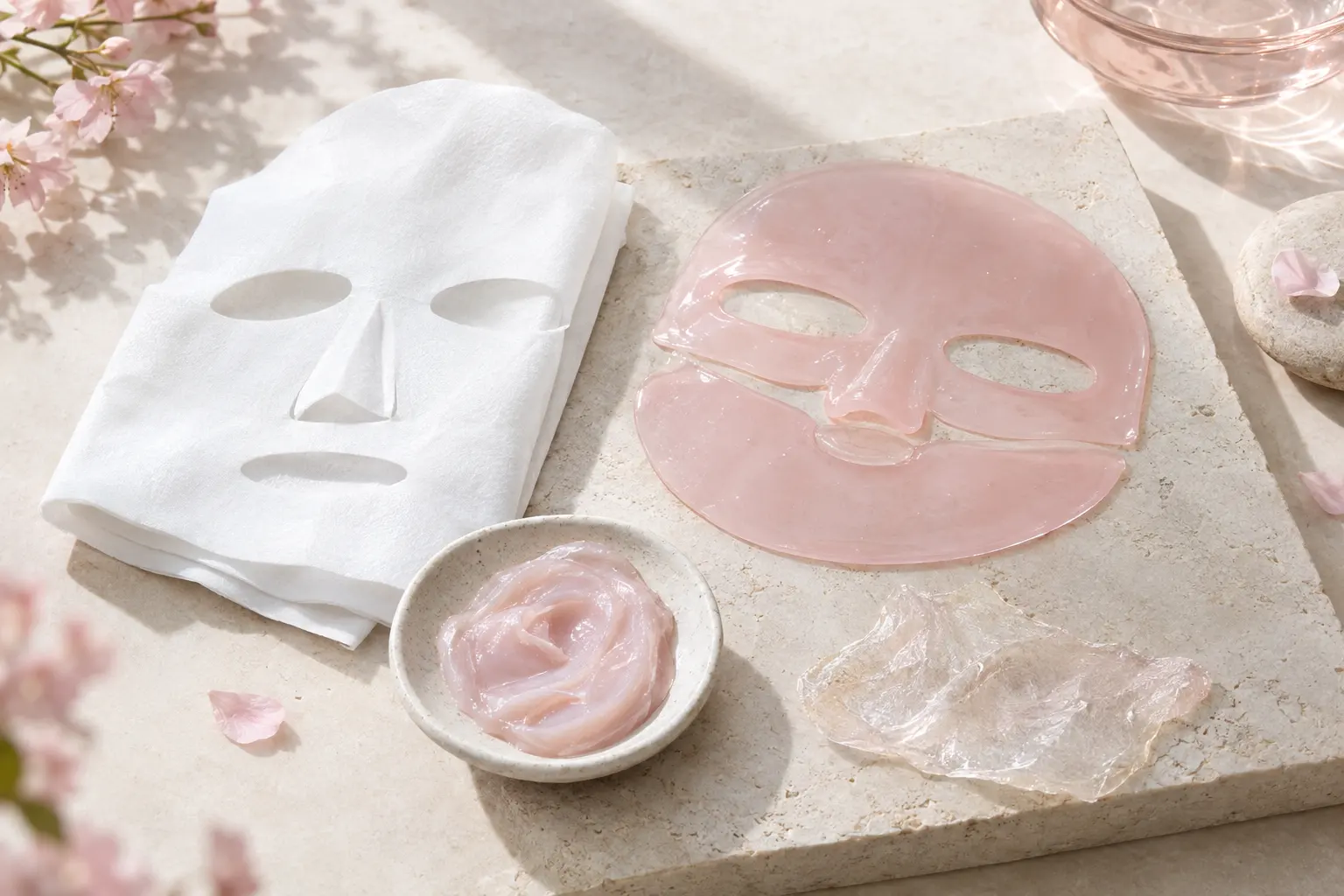
This Korean collagen mask guide starts with a practical dilemma: should you buy a familiar sheet, a hydrogel or a peel-off wrapping mask? The most useful answer is to choose the application you will comfortably complete, then assess the formula—not to chase the largest collagen number.
For a clearly timed sheet-mask step, start with numbuzin No.2 Water Collagen 65% Voluming Sheet Mask. Consider HINCE Kingberry Vita Collagen Mask if you specifically want a hydrogel, and MEDIPEEL Red Lacto Collagen Wrapping Mask if you enjoy applying and removing a film. None earns a recommendation here as a substitute for structural wrinkle treatment.
Korean collagen mask guide: decide what success looks like
A collagen mask becomes a much easier purchase when you separate a cosmetic finish from a change in skin structure. You might want your complexion to look more hydrated, feel less rough or sit better beneath makeup. Those are different goals from rebuilding the collagen network underneath the surface.
A systematic review of oral hydrolyzed collagen notes that topical collagen creams have limited ability to penetrate skin [7]. That supports caution about deep-delivery promises, but it does not establish how any particular mask performs. The review’s intervention evidence concerns supplements, not the three masks compared here [7].
Read the outcome, not just the ingredient headline
Words such as firming, lifting and plumping can appear beside one another on a mask description, yet they should not be treated as interchangeable endpoints. For buying purposes, ask what you would actually observe: a smoother-looking surface, a glossier finish, a sensation of tightness or a lasting change in wrinkles. One does not automatically demonstrate another.
That distinction matters especially with a film-forming mask. Collected Korean-user feedback for MEDIPEEL includes immediate gloss and smoother-looking skin, but also reports of tightness, excessive shine and little visible improvement. A taut sensation is therefore not a useful stand-alone reason to conclude that the product has improved elasticity.
- A reasonable shopping goal: a cosmetic hydration or appearance step that fits your routine.
- A claim needing stronger evidence: measurable, lasting wrinkle improvement from the exact finished formula.
- A poor selection shortcut: assuming more collagen, more peptides or smaller stated molecules guarantee better results.
Set your success criterion before choosing a packet. If your priority is makeup preparation, judge the finish under your usual base. If it is an enjoyable evening skincare step, judge the handling and whether the process feels worth repeating. Neither requires you to accept every claim printed on the front.
The recommendation would change if robust comparative testing showed one of these exact formulas delivering your desired outcome better than another. Without that evidence, the defensible choice is the format and documented application that suit you. This is not dismissing collagen masks; it is choosing a job they can reasonably be bought to do.
Sheet, hydrogel or wrapping film: the practical comparison
Start with construction. A ready-made mask and a spread-on wrapping product ask different things of you, even when both carry collagen in the name. You are choosing how the formula is presented and removed, not simply choosing between three versions of the same treatment.
numbuzin’s published directions specify application after cleansing and toning, followed by removal after 15 minutes [6]. HINCE describes its mask as a hydrogel made from a 37 g ampoule formulation [3]. MEDIPEEL identifies its product as a 70 ml wrapping mask, while its catalog description specifies a peel-off film [2].
| Product | Format and pack | Choose it when | Main trade-off |
|---|---|---|---|
| numbuzin No.2 Water Collagen 65% Voluming Sheet Mask | Sheet mask; four 33 g masks | You want a ready-made mask with a published 15-minute step | The collagen percentage does not establish superior performance |
| HINCE Kingberry Vita Collagen Mask | Hydrogel; four 37 g masks | You specifically prefer the hydrogel format and its stated ingredient combination | The 100 Da headline is not proof of delivery depth |
| MEDIPEEL Red Lacto Collagen Wrapping Mask | Spread-on, peel-off wrapping mask; 70 ml | You enjoy a film-forming application and removal step | Collected feedback reports that uneven application can complicate drying and peeling |
Convenience is a legitimate selection criterion
With the two individually portioned options, there is no decision about how much product to spread over your face. The wrapping format adds that decision. For someone who dislikes application troubleshooting, that alone may outweigh an appealing ingredient story.
Conversely, a ready-made format is not automatically the most satisfying choice. You may actively prefer controlling a spread-on layer and peeling it away. The point is to choose that process deliberately rather than discovering, after purchase, that it is the part of masking you dislike.
Do not interpret this comparison as a ranking of penetration or clinical firmness. Nothing in the available evidence establishes that these three formats deliver collagen into skin in a comparable way, let alone that one wins. A format comparison is useful because it predicts the task you are buying; a performance ranking would require different evidence.
When browsing masks and treatments, narrow by application style first. Then compare the formulas within the style you genuinely want. That avoids buying a technically interesting product whose actual use is a poor match for your habits.
How to read collagen percentages and molecular-weight claims
The numbers on these masks describe different things. One refers to an ingredient called collagen extract, another to a fruit-water ingredient, and another to the stated molecular weight of a collagen material. They are not competing scores on a single scale.
65% collagen extract is not a certificate of protein purity
The published numbuzin ingredient list begins with Collagen Extract (65%), followed by water, glycerin and other ingredients [6]. That supports the claim that collagen extract makes up a large stated portion of the formula. It does not, by itself, tell you the dry collagen-protein concentration within that extract.
This distinction is essential when comparing an extract with a differently described raw material. You need to know what the ingredient itself contains before equating its percentage with the amount of pure protein in the finished mask. A large extract percentage can be useful formulation information without being a reliable performance ranking.
72% Kingsberry Water describes a different ingredient
HINCE’s launch information states 72% Kingsberry Water and separately lists a vitamin C derivative, niacinamide, collagen ingredients, hyaluronic acid, panthenol and peptides [3]. The 72% figure is therefore not a collagen concentration. Nor should the fruit-water percentage be read as a quantified vitamin C dose.
That makes HINCE a broader formula proposition rather than a simple competitor in a collagen-percentage contest. If you are interested in its combination of ingredients, that is a coherent reason to consider it. Treating 72 as inherently better than 65 is not.
Parts per million still need a clearly defined ingredient
MEDIPEEL’s published formula lists hydrolyzed collagen extract at 7,000 ppm and Lactobacillus ferment at 1,000 ppm [2]. Mathematically, those figures correspond to 0.7% and 0.1%. The first remains a percentage of the named extract, not an independently established pure-collagen content.
There is no contradiction in a mask using a smaller stated amount of one collagen raw material while another leads with a much larger extract percentage. Without matched ingredient specifications, the numbers cannot establish which formula delivers more relevant material—or a better cosmetic result.
Small molecules do not settle the delivery question
HINCE advertises a 100 Da collagen claim alongside seven collagen types [3]. This is a manufacturer statement, not a penetration study. Before paying extra specifically for that number, you would want to know exactly which material it describes and what finished-product testing supports the implied benefit.
The same discipline applies to ingredient counts. Four peptides or seven collagen types can describe formulation variety, but counting them does not reveal their concentrations or establish synergy. Use numbers to understand what is being claimed, then stop short of conclusions they cannot support.
Choose numbuzin for a defined sheet-mask step
numbuzin No.2 Water Collagen 65% Voluming Sheet Mask is the clearest starting point here when your main requirement is a ready-made mask with a defined application window. Its directions specify 15 minutes after cleansing and toning [6]. That makes it easier to assess against the time you actually want to spend.
The EmpressKorea set contains four single-use masks, listed at 33 g each. It is positioned around a fuller, hydrated-looking complexion rather than a spread-on wrapping experience. The recommendation rests on that format and documented timing—not on an assumption that its 65% headline makes it stronger than the alternatives.
The formula is more than its collagen name
The published ingredient list includes glycerin, niacinamide, dimethicone, adenosine, pearl powder, several hyaluronic-acid-related ingredients and copper tripeptide-1 [6]. For a formulation-minded shopper, the useful point is that collagen is one component of a mixed skincare formula. It would be misleading to attribute every reported benefit to collagen alone.
Ingredient presence also does not tell you how much of each supporting ingredient is included. Copper tripeptide-1 appearing in a list is not equivalent to evidence that this particular mask achieves a measured peptide-related result. The complete formulation, exposure and testing would matter to that conclusion.
Hypothetical situation: you want a short evening masking step but do not enjoy spreading products evenly or peeling away a dried layer. Choose numbuzin ahead of MEDIPEEL on usability grounds. You do not need to decide that one is scientifically more advanced to make that choice.
- Best reason to consider it: a clearly described, individually portioned sheet-mask step.
- Weak reason to buy it: expecting the 65% number to predict a proportionate increase in skin firmness.
- Reason to choose differently: you specifically want a hydrogel or enjoy a spread-on film.
This is a practical default, not a universal winner. The available evidence does not establish it as the mildest, most hydrating or most effective option. Its advantage in this decision is simpler: the documented routine is easy to understand before you commit to a box.
Choose HINCE when the hydrogel is the attraction
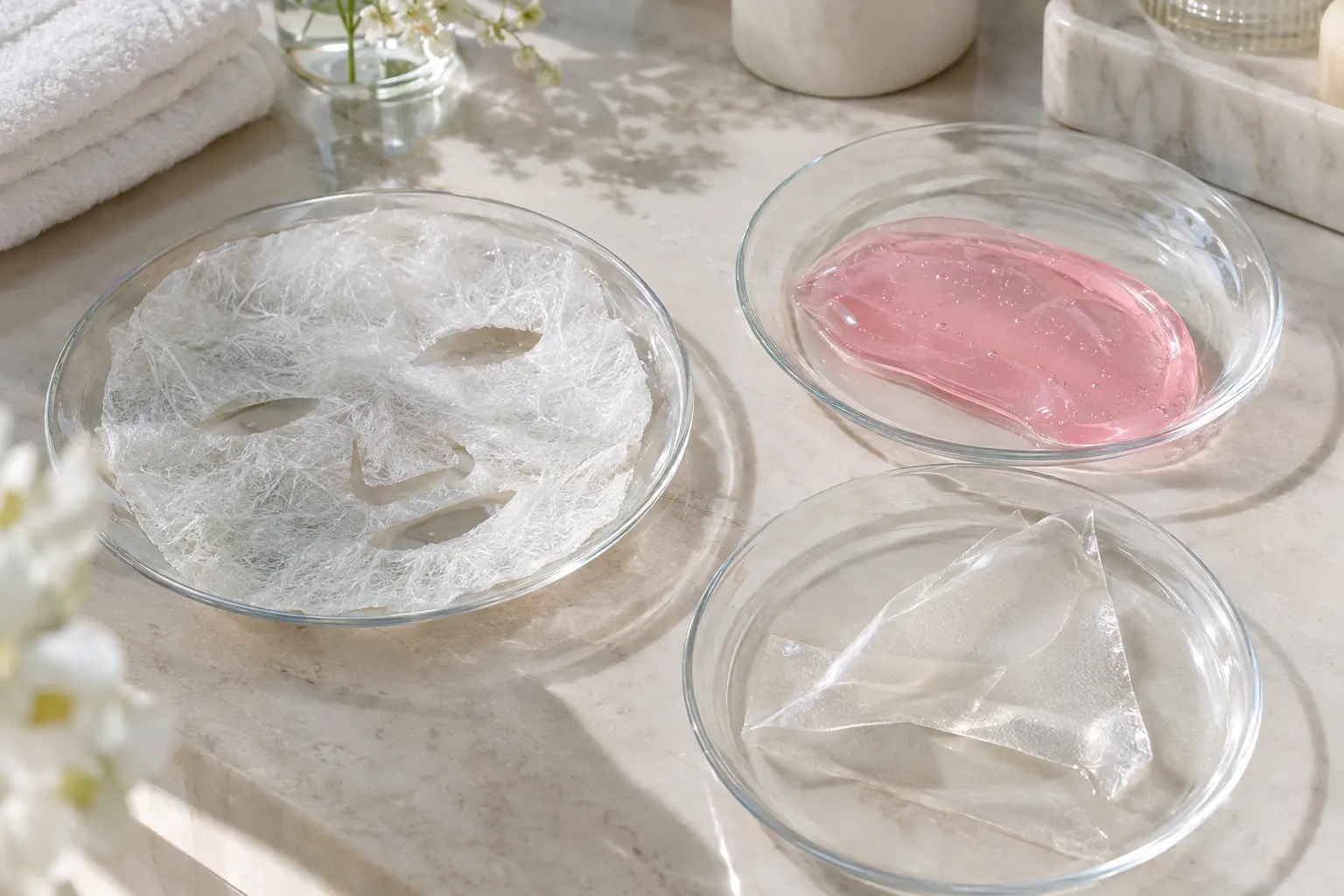
HINCE Kingberry Vita Collagen Mask deserves consideration when you want a hydrogel rather than a conventional sheet or peel-off layer. The manufacturer’s launch information describes a pink hydrogel formed from 37 g of ampoule formulation [3]. The EmpressKorea pack contains four masks.
That physical format is the strongest reason to put it on your shortlist. The 100 Da claim is less useful as a purchase rule because it does not establish where the ingredient goes or how the finished mask compares with the alternatives. Buy the format knowingly; do not buy an imagined delivery study.
A vitamin-and-collagen formula, not just a collagen vehicle
Alongside Kingsberry Water, the launch information names a vitamin C derivative, niacinamide, panthenol, hyaluronic acid and four peptides [3]. Those details distinguish its ingredient proposition from a product described only as a collagen mask. They do not provide the concentrations needed to rank its brightening or firming performance.
The brand attributes the mask’s pink color to vitamin B12 rather than artificial coloring [3]. That is an interesting formulation detail, but color itself should not influence your assessment of effectiveness. A visually distinctive gel can be appealing without being proof of a stronger treatment.
Hypothetical situation: you already know you prefer hydrogel masks and want to compare a formula with both vitamin-related and collagen-related ingredients. HINCE is the relevant choice among these three. If your actual priority is a clearly documented short application, numbuzin remains the easier decision.
Do not turn transparency into an absorption measurement
HINCE’s launch description says the gel becomes transparent during use [3]. That observable change is not, on its own, a measurement of how deeply collagen has penetrated. A visual endpoint and a biological delivery endpoint are different forms of evidence.
Likewise, broad overnight positioning should not be substituted for the instructions supplied with your exact pack. The product’s appeal should survive without assuming that longer wear must be better. If your interest disappears once the dramatic molecular-weight and absorption interpretations are removed, this probably is not the right purchase for you.
Choose HINCE because its construction and stated ingredient combination match what you want from masking. That is enough of a reason. There is no need to promote it into a proven collagen-rebuilding treatment to justify enjoying the format.
MEDIPEEL's wrapping mask: the finish comes with technique
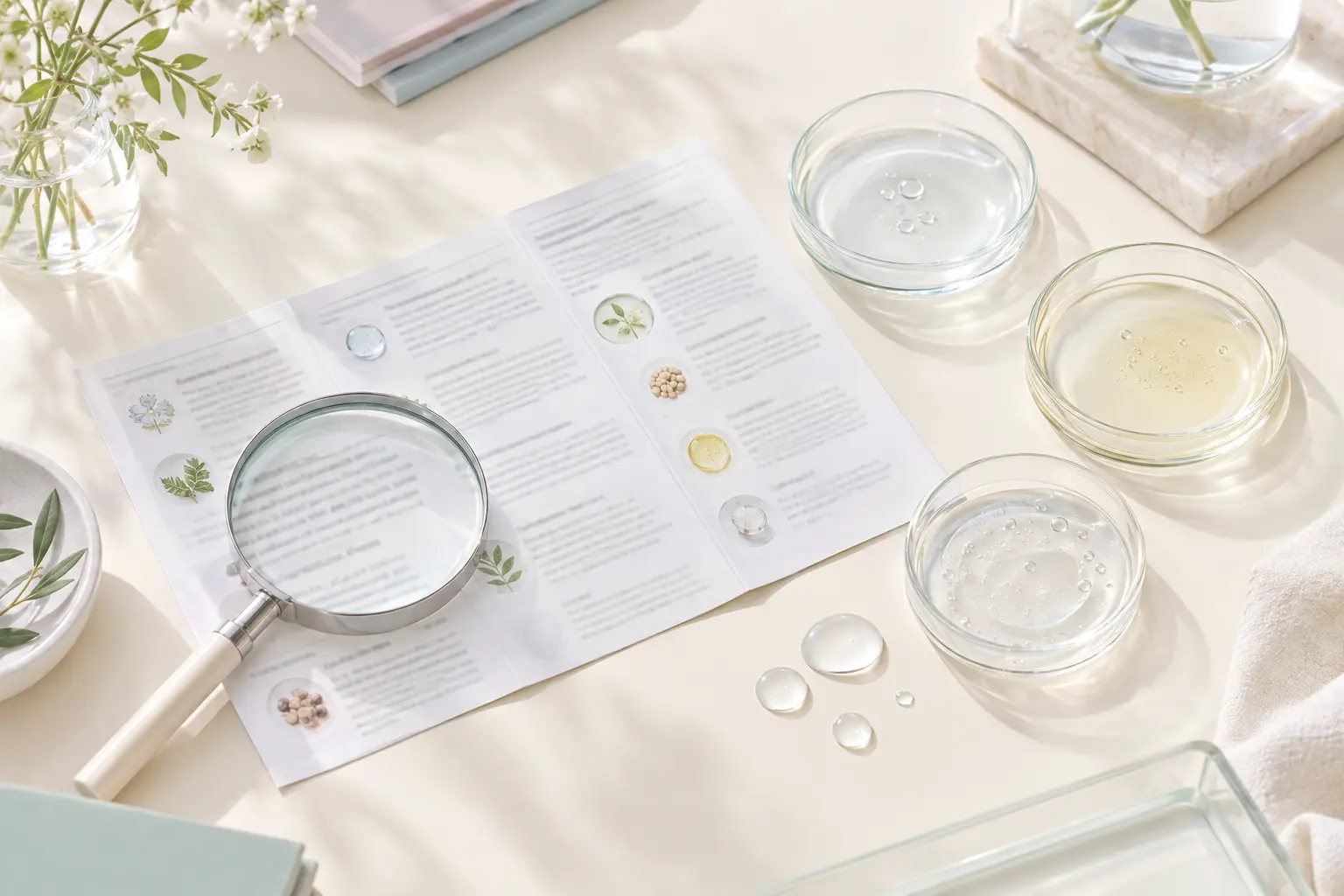
MEDIPEEL Red Lacto Collagen Wrapping Mask is the choice for someone who actively wants a spread-on, peel-off film. Its catalog description positions it as a high-adhesion wrapping treatment. The published ingredient list includes polyvinyl alcohol, pullulan and algin alongside hydrolyzed collagen extract [2].
Those ingredients are consistent with the product’s film-forming design. From a formulation perspective, the wrapping structure is part of the product’s identity, not merely packaging for collagen. That makes application and removal central to the buying decision in a way they are not for a preformed mask.
What collected Korean-user feedback adds
Collected Korean-user feedback for MEDIPEEL describes an immediately glossier, smoother-looking surface, sometimes with better-looking base makeup afterward. The same feedback includes users who noticed little benefit, while others found the finish tight, drying or excessively shiny. These are individual experiences, not evidence of lasting wrinkle improvement.
Application quality is the more actionable finding. Collected feedback describes uneven or overly thin layers that dried poorly or peeled away in fragments, alongside more satisfying removal experiences when the layer was even. That makes MEDIPEEL a less attractive choice if you want a masking step with minimal technique.
These reports do not establish a universal thickness or drying time. They do tell you where the process can disappoint. A shopper who dislikes troubleshooting should not interpret the possibility of a polished finish as a reason to ignore the work needed to achieve comfortable removal.
Choose the film deliberately
Hypothetical situation: you enjoy peel-off masks and want an optional preparation step before base makeup. MEDIPEEL is worth considering because collected feedback directly addresses that use. If your skin already tends to look shinier than you prefer, the reported excessive gloss is a relevant reservation rather than a minor footnote.
Dry-skin feedback was mixed, too: some users liked the moisturized-looking finish, while others described tightness or dryness. That prevents a simple recommendation based on skin-type labels. Your preference for the removal process and finish is more informative than assuming that everyone with dry skin will respond alike.
There is also a useful claims boundary. The published Korean product information lists functional-cosmetic review status as not applicable [2]. Do not turn its firming language or the sensation of a tightening film into a claim of officially reviewed wrinkle improvement.
For this mask, the technique is part of the purchase. Choose it when that sounds appealing, not when you are reluctantly accepting extra effort in exchange for a hoped-for structural lift. The strongest supporting evidence here concerns a cosmetic finish, with clear variation in user satisfaction.
Fit the mask into your routine without inventing extra rules
The most useful routine instruction is the one written for the exact mask, not a generic schedule borrowed from the category. A sheet with a defined removal time and a spread-on film should not automatically share the same sequence, wear duration or frequency.
For numbuzin, the published instructions say to apply after cleansing and toning and discard after 15 minutes [6]. Its EmpressKorea description then directs you to pat in the remaining essence. That is a complete, concrete step; adding an extended wear period would be an unsupported modification.
Keep the first use interpretable
For HINCE and MEDIPEEL, use the application, removal and timing instructions supplied with your current pack. Do not extrapolate HINCE’s timing from numbuzin, or convert MEDIPEEL user feedback into a precise layer thickness. Where the available information does not specify a number, inventing one would make the advice less useful.
As an evaluation method, keep the rest of your routine familiar when first assessing the mask. The aim is not to prescribe a new regimen but to make your observations interpretable. If you change your cleanser, serum, cream and mask together, you will have little basis for deciding which change produced the finish you liked or disliked.
- Read the mask’s own sequence and removal instructions before starting.
- Choose a use occasion when you can complete the stated process without rushing.
- Notice application and removal separately from the appearance afterward.
- Judge the result against your original goal, rather than against a dramatic marketing phrase.
For broader scheduling, the morning-versus-night skincare routine guide can help you think about where an optional mask belongs. There is no need to turn a mask purchase into an entirely new routine.
One safety check before choosing
The published ingredient lists for both numbuzin and MEDIPEEL include fragrance [6][2]. If you avoid fragrance or a particular ingredient, assess the full current ingredient list rather than relying on a collagen or all-skin-types label.
MEDIPEEL’s published cautions advise avoiding wounded areas and the eye area, and seeking professional advice for symptoms such as redness, swelling or itching [2]. Follow the safety directions for your selected product and stop if irritation occurs. A glossy finish is not a reason to persist through an uncomfortable reaction.
Judge value by useful applications, not headline grams
Once the format is settled, compare what you are actually buying. The featured numbuzin and HINCE sets each contain four masks, while MEDIPEEL is a 70 ml spread-on product. These are different purchasing units, so the biggest package number does not automatically represent better value.
For the individually portioned sets, divide the current pack price by four to calculate the cost per mask. For the wrapping product, you need a supported application quantity—or your own record of completed uses—before estimating cost per application. A 70 ml size alone cannot tell you how many satisfactory treatments it provides.
Weight is not absorbed dose
Do not compare numbuzin’s 33 g and HINCE’s 37 g labels as though the difference measures how much active ingredient reaches your skin. The pack weights describe the products, not a measured absorbed collagen dose. Similarly, grams and milliliters should not be treated as directly interchangeable without the information needed to convert them.
Application effort belongs in the value calculation, too. A wrapping mask that you avoid because removal frustrates you is not a bargain simply because its container seems generous. A more appealing format may be better value if it is the one you actually want to use.
- Before checkout: confirm the current pack quantity and final delivered cost.
- After use: record whether the finish met your goal and whether the process was comfortable.
- Before repurchasing: ask whether the mask contributes something you value beyond your existing routine.
That last question can lead to buying nothing. If you mainly want a straightforward daily moisture step rather than the experience of masking, assess your existing routine and the moisturizer category before adding another format.
If a mask still makes sense, start with the one whose application you can describe clearly and whose claimed outcome matches your goal. Then judge the actual cosmetic result. Your next purchase should follow that evidence—not a larger collagen number on the next box.
Frequently Asked Questions
Do Korean collagen masks rebuild collagen in the skin?
You should not buy these masks expecting proven dermal collagen rebuilding. A review of oral collagen research notes limited skin penetration from topical collagen creams, but it does not test these masks [7]. Hydration-oriented cosmetic claims and structural collagen regeneration are different propositions. None of the evidence presented here establishes that these exact masks rebuild dermal collagen.
Is a hydrogel collagen mask better than a sheet mask?
Not automatically; choose according to the format you prefer and the instructions you can comfortably follow. HINCE Kingberry Vita Collagen Mask is described as a hydrogel, while numbuzin No.2 Water Collagen 65% Voluming Sheet Mask has published 15-minute sheet-mask directions [3][6]. Those facts help distinguish the application experience, not rank clinical effectiveness. There is no head-to-head evidence here establishing superior firmness from either product.
Does 65% collagen mean the mask is mostly pure collagen?
No: the published numbuzin ingredient list specifies Collagen Extract (65%) [6]. That wording identifies the proportion of the named extract, not an independently verified dry-protein concentration. You would need the extract's specification to make that calculation. It therefore cannot be directly ranked against a different product's hydrolyzed collagen extract percentage.
Can I leave a collagen mask on overnight?
Only use an overnight application when the directions for your exact product allow it. numbuzin's published directions specify removal after 15 minutes [6]. Do not transfer overnight positioning from a hydrogel to a sheet mask or wrapping film. Follow the packet rather than assuming that a longer application improves results.
Is MEDIPEEL's wrapping mask good before makeup?
It is worth considering if you enjoy peel-off application and want a smoother-looking cosmetic finish. Collected Korean-user feedback includes reports of better-looking base makeup afterward, but also excessive shine, tightness and little visible benefit. Uneven application was another recurring reservation. Assess the finish during an ordinary routine before relying on it for an important makeup occasion.