
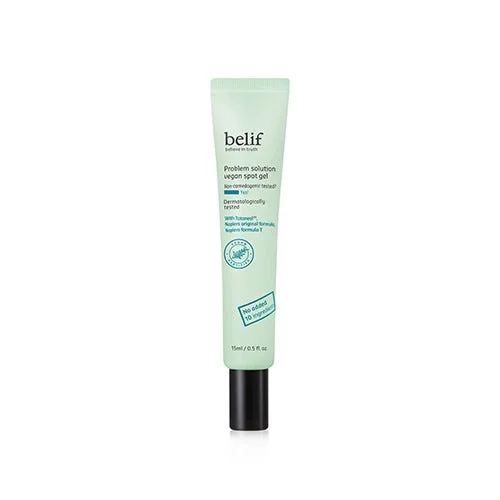
belif Problem Solution Vegan Spot Gel is a small leave-on product, not a complete acne treatment plan. Its value depends on the type of blemish, the undisclosed finished-formula exposure to retinal and salicylic acid, and how it fits with other products already in use.
The former article called retinal and BHA a formidable acne-fighting duo, promised rapid lesion reduction and prevention, and advised mixing the gel broadly into moisturizer. It also said vegan formulas are naturally gentler and that nighttime is automatically the skin’s optimal repair period. Those statements blurred product directions, ingredient mechanisms and clinical proof.
Current product identity
Current Korean-product records identify belif Problem Solution Vegan Spot Gel as a 15mL product made and distributed by LG Household & Health Care in Korea. The directions consistently center on a small amount applied to a concerned or breakout spot, generally at the end of a nighttime routine.
The cleanser, toner and moisturizer in the same line are separate formulas. A line name does not make their active exposure or directions interchangeable.
| Label or claim | Reasonable meaning | What it cannot guarantee |
|---|---|---|
| Spot gel | Small-area leave-on format | Suitability for full-face use |
| Retinal + BHA | Both appear in current ingredient records | Known concentration or clinical synergy |
| Noncomedogenic tested | Lower clogging risk under test conditions | No breakout for every user |
| Sensitive-skin tested | Tolerability assessed under a protocol | No burning, allergy or irritation |
| Vegan | Defined animal-origin/testing standard claimed | Greater efficacy or inherent gentleness |
Retinal, retinol and retinoic acid are not the same
Retinal, also called retinaldehyde, is a vitamin A derivative. Skin metabolism can convert retinoid forms along a pathway toward retinoic acid, but different molecules, concentrations and vehicles have different evidence and irritation profiles. A product description that switches between “retinal” and “retinol” loses important precision.
The current full ingredient records for this gel list Retinal. That does not establish equivalence to prescription tretinoin, adapalene or a clinical retinaldehyde formula studied at a named percentage.
What retinal research can and cannot transfer
Small clinical studies have investigated specific retinaldehyde formulas for comedonal acne and biologic effects. For example, one pilot study used a 0.05% retinaldehyde-loaded nanoemulsion for four weeks. Results from that exact vehicle and dose cannot be copied to a retail gel whose public concentration and delivery system are not stated.
Ingredient plausibility supports cautious evaluation, not a promise that an inflamed pimple will disappear overnight. Finished-product trials need the exact formula, comparator, participants, duration and objective lesion counts.
Salicylic acid is the named BHA
The current ingredient list includes salicylic acid. It can help loosen material within clogged pores and is an established OTC acne active at regulated concentrations and labeling. A cosmetic ingredient list does not reveal whether this product meets an OTC drug monograph concentration or is marketed as a U.S. acne drug.
Look for an exact active percentage and Drug Facts panel before treating it as a regulated OTC acne medicine. “Contains BHA” alone does not supply dose or clinical outcome.
Two active families can also mean two irritation pathways
Retinoid-type products and salicylic acid can each cause dryness, stinging, peeling or redness. Combining them in one formula may be intentionally balanced, but adding separate retinoid, acid, benzoyl peroxide, scrub or peeling pads increases cumulative exposure.
AAD notes that acne actives often dry and irritate skin, and moisturizer can improve tolerance. More tingling is not evidence of faster cell turnover or deeper pore cleaning.
Read the rest of the formula
Current records begin with water, glycols, glycerin, caprylic/capric triglyceride, panthenol, fatty alcohol and glyceryl stearate. They also list oat, calendula, rosemary, lavender, tea-tree, eucalyptus and other extracts; retinal; totarol; 4-terpineol; ceramide NP; beta-carotene; allantoin; salicylic acid; cholesterol and supporting ingredients.
Orange-peel and geranium oils plus limonene, citronellol, geraniol, linalool and citral also appear. Botanical complexity and vegan positioning do not remove sensitization or fragrance-allergen considerations.
Vegan is an ethical and sourcing claim
A vegan formula can be effective, ineffective, gentle or irritating. Animal origin does not determine whether retinal, salicylic acid, fragrance components or a preservative will suit a particular person’s skin.
Verify the current certification or no-animal-derived statement on the package and define what matters to you: ingredients, finished-product testing, parent-company policy or certification body. Do not use “vegan” as a surrogate for acne efficacy.
Noncomedogenic is risk reduction, not immunity
Noncomedogenic testing is useful, but acne develops through multiple mechanisms and individual responses vary. A formula can pass a study and still irritate one user, trigger follicular occlusion under another routine or simply fail to improve existing lesions.
Evaluate new clusters by location and timing. If bumps appear only where the gel is repeatedly spread beyond spots, discontinue and simplify rather than applying more.
Sensitive-skin testing needs a protocol
“Dermatologically tested” or “sensitive-skin tested” does not tell the reader participant number, skin conditions, exposure length, comparator or adverse-event rate unless the protocol is published. It is not a guarantee for eczema, rosacea, allergy or a damaged barrier.
A small-area introduction can reduce avoidable full-face reactions, but it cannot predict every delayed allergy or cumulative irritation.
Spot care fits some lesions better than others
A targeted gel is easiest to use on a small number of emerging or existing blemishes. Blackheads and widespread comedones occupy areas rather than single spots; nodules, cysts and scarring acne often need a broader medical plan. Picking or repeatedly drying an inflamed lesion can worsen marks.
Do not apply to open, squeezed or bleeding skin unless the package explicitly permits it. Broken skin changes exposure and can sting.
Why “overnight repair mode” is not the evidence
Night use may be practical because retinal can be easier to schedule away from daylight and because a spot gel can remain undisturbed. The claim should rest on directions, stability and tolerability, not a vague idea that every ingredient works better while a person sleeps.
A daytime routine still needs sun protection. Retinoid and exfoliating routines should not be used as an excuse to skip sunscreen or intentionally seek sun.
A conservative first-use plan
- Confirm Retinal and Salicylic Acid on the exact package.
- Pause other new actives so one variable is being tested.
- Apply a rice-grain-or-smaller total amount only to selected intact spots.
- Use it on a spaced schedule rather than assuming nightly tolerance.
- Follow with or precede a compatible moisturizer according to label and tolerance.
- Record redness, burning, peeling and lesion change for the next 48 hours.
The package, not this general guide, controls exact amount and frequency. Stop for progressive irritation instead of forcing an “adjustment period.”
Do not improvise broad mixing without checking the package
Some current retailer directions mention mixing the gel with moisturizer for a large breakout area. Mixing changes distribution and makes the dose per area less predictable. The original article extended this to cheeks or chest without defining amount, package version or skin condition.
For widespread acne, use the current package directions or ask a dermatologist for an area-based treatment. Do not mix in a moisturizer jar; that contaminates the container and changes the remaining product.
Layering order is less important than compatibility
The brand-style instruction places a thin spot layer at the final nighttime step. If a moisturizer is needed to buffer irritation, a clinician may recommend applying it before or after an active depending on the product. There is no universal need for toner or essence first.
Let each layer settle and avoid occlusive patches over the gel unless the label supports them. Occlusion can increase local exposure and irritation.
Retinoid and acid overlap checklist
- Prescription tretinoin, adapalene, tazarotene or trifarotene.
- Other retinal, retinol or retinyl products.
- Salicylic, glycolic, lactic or mandelic acid.
- Benzoyl peroxide or sulfur spot treatments.
- Scrubs, peeling pads or strong cleansing devices.
- Recent waxing, peel, laser, microneedling or irritated shaving.
Overlap is not always prohibited, but it should be deliberate. A dermatologist can sequence proven acne medicines while protecting tolerance.
Pregnancy and trying to conceive
AAD advises avoiding retinoids during pregnancy and recommends expert review of acne treatments when pregnant or trying to conceive. Because this product lists retinal, do not assume cosmetic availability makes it pregnancy-compatible.
Ask an obstetrician or dermatologist about pregnancy, breastfeeding and plans to conceive before use. Do not substitute another vitamin A derivative without guidance.
Morning sun protection
Use broad-spectrum, water-resistant SPF 30 or higher and reapply with outdoor exposure. Sunscreen is not a license to continue a product that is actively inflaming the skin; significant irritation should be addressed first.
Marks after acne can darken with ultraviolet and visible-light exposure, especially in deeper skin tones. Preventing picking and controlling inflammation also matter.
How to measure a spot product
Choose three to five comparable lesions, photograph them in fixed light and record lesion type, tenderness, size and whether they were manipulated. Compare at planned intervals rather than taking a different-angle photo the next morning.
A lesion can naturally evolve or flatten without the product. One successful pimple does not prove prevention. A better evaluation tracks several uses, tolerance and the number of new lesions over a defined period.
When to stop
Discontinue for significant swelling, hives, blistering, severe burning, widespread rash or eye/lip involvement. FDA has warned that OTC acne products containing salicylic acid or benzoyl peroxide can rarely cause serious hypersensitivity; any breathing difficulty, faintness or facial swelling requires emergency care.
Mild dryness may be managed by reducing frequency and using moisturizer, but persistent worsening should not be normalized.
When acne needs a dermatologist
Seek care for nodules, cysts, scarring, widespread inflammatory acne, significant pain, rapidly worsening lesions or substantial emotional impact. A dermatologist can identify acne mimics and build a regimen with evidence-based concentrations.
Spot gel is unlikely to control an area where new lesions continually form. Early effective treatment can reduce the risk of permanent scars.
Current Empress Korea listing
The card below is the exact belif Problem Solution Vegan Spot Gel 15mL. Confirm the current full ingredient list, directions, vegan statement, expiry or period-after-opening and regional labeling before ordering.
Who should consider it
This product may suit a non-pregnant user with occasional localized blemishes who wants a small leave-on gel and is not already overloaded with retinoids or exfoliants. It is a less obvious choice for someone with fragrance allergy, highly reactive skin, widespread acne or a prescription routine that already causes peeling.
The decision should follow the exact package and total routine, not the idea that more active families always produce a stronger solution.
The practical verdict
belif Problem Solution Vegan Spot Gel has a credible targeted format and current ingredient records that list retinal and salicylic acid. The missing public concentrations and lack of a complete exact-product clinical protocol limit claims about speed, prevention and synergy.
Use a small amount on intact selected spots, introduce it gradually, moisturize as needed and protect from sun. Treat vegan and noncomedogenic claims as useful attributes within their scope, not guarantees of gentleness or clear skin.
Sources
- Current Korean product record: identity, directions and ingredients
- Authorized retailer: product claims, directions and ingredients
- American Academy of Dermatology: acne diagnosis and treatment
- American Academy of Dermatology: moisturizer with acne treatment
- American Academy of Dermatology: acne treatment in pregnancy
- Pilot study of a specific 0.05% retinaldehyde formulation
- FDA: Cosmetic and drug claim boundaries
- FDA: Rare serious reactions to certain OTC acne products
Frequently Asked Questions
Does belif Problem Solution Vegan Spot Gel contain retinal or retinol?
Current full ingredient records list Retinal, also called retinaldehyde. It should not be described interchangeably with retinol or prescription retinoic-acid medicines.
Can I use the spot gel over my whole face?
The core direction is targeted use on selected spots. Broad use changes exposure; follow the exact package or obtain clinician guidance for widespread acne instead of improvising.
Can I combine it with another retinoid or exfoliating acid?
Overlap can increase dryness and irritation. Review all retinal, retinol, prescription retinoid, salicylic acid, AHA, benzoyl peroxide and scrub steps before combining them.
Is it safe during pregnancy?
Do not assume so. The product lists retinal, and dermatology guidance advises avoiding retinoids during pregnancy. Ask an obstetrician or dermatologist before use when pregnant, breastfeeding or trying to conceive.
What does noncomedogenic testing mean?
It suggests lower pore-clogging risk under the test conditions. It does not guarantee that no user will break out, become irritated or fail to improve.