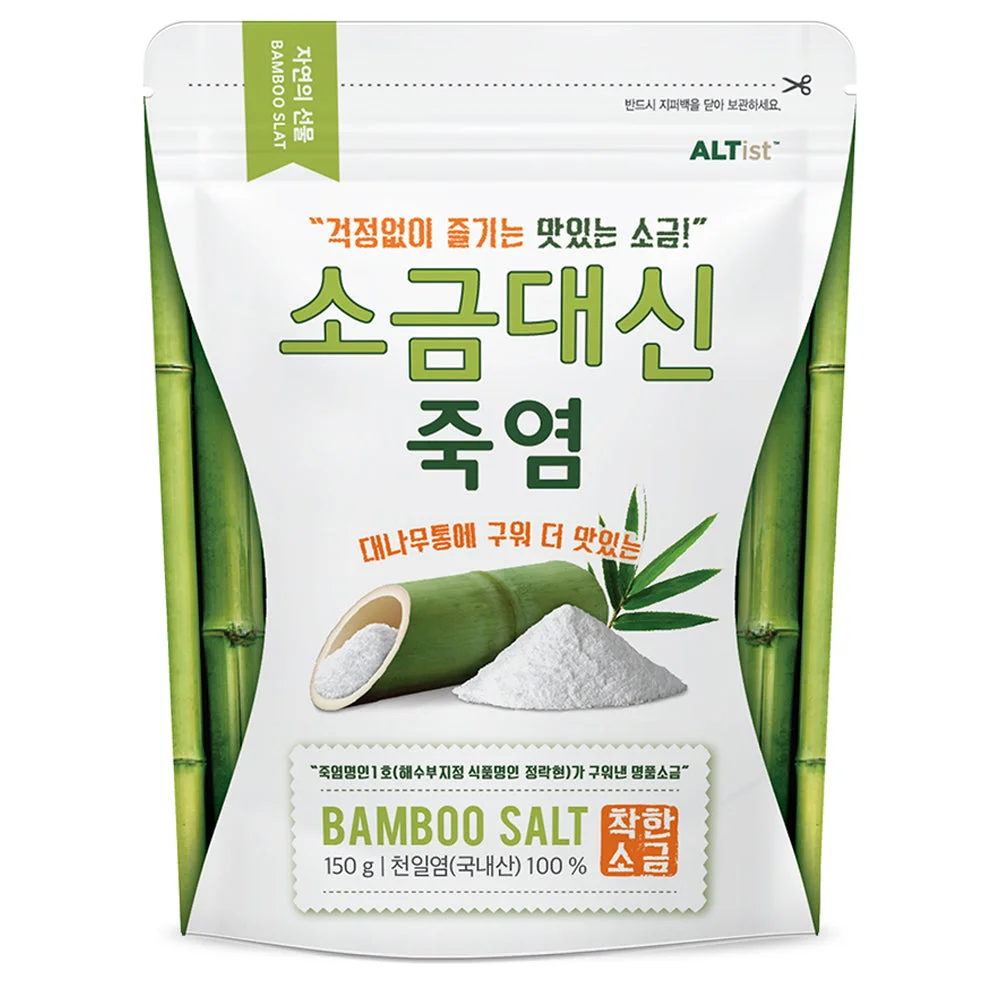
Korean bamboo salt, or jugyeom, can be interesting for its process and flavor without being promoted as medicine. The ALTIST product here uses Korean sea salt packed in mature bamboo and roasted three times. That changes aroma, color and mineral profile; it does not remove the need to count sodium.
The former article called bamboo salt a healthier alternative with alkalizing, antioxidant, antibacterial and oral-health benefits, and suggested adding it to tea or water. It treated trace minerals and government artisan recognition as clinical proof. Those claims could encourage extra salt intake and require correction.
Current product identity
The current Empress Korea product is “bamboo salt instead of salt 150g,” linked to ALTIST’s Sogeumdaesin line. Current Korean retail information describes 150g of Korean sea salt roasted three times in large bamboo. The current ALTIST site now also lists a 210g three-times-roasted version, so size and packaging should be confirmed on the live listing.
The 150g package is a food seasoning. It is not a potassium-chloride low-sodium substitute, supplement, medicine, toothpaste or mouthwash.
| Statement | What is established | What remains unproven |
|---|---|---|
| Roasted in bamboo three times | Product process and sensory identity | Lower blood pressure or disease prevention |
| Contains trace minerals | Mineral profile differs by source/process | Nutritionally meaningful dose at safe salt intake |
| More alkaline in a laboratory test | Salt solution can have measured pH | Alkalizing a healthy person’s blood |
| Bamboo-salt toothpaste studied | Specific toothpaste compared for four weeks | Eating or gargling this food product improves oral health |
| Traditional-food master recognition | Craft and heritage recognition | Clinical efficacy or unrestricted intake |
How bamboo salt is made
Traditional production places sea salt in bamboo tubes, closes them with clay and heats them with wood. Products differ by sea-salt source, bamboo age, clay, fuel, temperature and number of firings. Three-times-roasted salt is not identical to nine-times-roasted purple bamboo salt used in many laboratory papers.
The process can introduce or concentrate elements and generate sulfur-containing aroma compounds. “Purified” should not be interpreted as sodium-free or toxin-proof without a defined analytical specification.
The flavor case is the strongest case
Bamboo salt may taste rounder, smokier, egg-like or more savory than plain refined salt. Flavor depends on batch, particle size and food. That sensory difference can be worthwhile for eggs, grilled vegetables, tofu, soups or a finishing pinch.
A stronger distinctive flavor might help someone enjoy a smaller measured amount, but the reduction must be demonstrated by using less. A premium label does not lower sodium when equal sodium amounts are consumed.
Sodium remains the main nutrient
WHO recommends adults consume less than 2,000mg sodium per day, equivalent to less than 5g salt. FDA’s Daily Value and the AHA upper recommendation are 2,300mg per day; individual medical plans can be lower or different.
Bamboo salt remains mostly sodium chloride. Mineral-composition studies find differences among specialty salts, but not a general disappearance of sodium. The correct comparison is the Nutrition Facts sodium amount for equal serving weights.
Salt grams and sodium milligrams are different
Five grams of salt is not 5,000mg sodium because salt contains chloride as well. A useful approximation for ordinary sodium chloride is sodium milligrams = salt grams × 393. Exact food-label values should take priority because bamboo salt is not pure laboratory NaCl.
For example, 1g of salt is roughly 393mg sodium, before accounting for other sodium in the meal. Weighing is more reliable than “a pinch,” whose mass changes with crystal size and fingers.
Read the serving, not the package story
FDA advises checking sodium per serving, servings consumed and percent Daily Value. Five percent DV or less is considered low per serving, while 20% or more is high. A tiny label serving can look modest even when several pinches are used.
Track sauces, kimchi, soup base, bread, processed food and restaurant meals as well as the salt shaker. More than 70% of U.S. dietary sodium comes from packaged and prepared foods.
Trace minerals do not cancel sodium
Bamboo salt may contain more potassium, calcium, magnesium or other trace elements than refined salt. “More” is not the same as enough to meet nutrient requirements at a safe seasoning dose. To obtain meaningful minerals by eating more salt would also increase sodium.
Vegetables, legumes, dairy or fortified foods provide nutrients without using sodium chloride as the delivery vehicle. Evaluate mineral nutrition across the diet.
Bamboo salt is not a low-sodium salt substitute
WHO’s lower-sodium salt-substitute guidance refers to products where some sodium chloride is replaced, often by potassium chloride. This bamboo salt is described as 100% Korean sea salt processed in bamboo, not as an 18% or 52% sodium-chloride formula.
Do not infer reduced sodium from the word “instead.” If a future formula contains potassium chloride, people with kidney disease or medicines that raise potassium need clinician advice.
The body does not need alkaline seasoning
Blood acid-base balance is tightly managed by lungs, kidneys and bicarbonate systems. MedlinePlus notes that even small abnormal shifts can be medically serious. The pH of a salt solution or urine after food does not show that a seasoning has usefully “balanced” blood pH.
An alkaline laboratory reading is a chemical property, not a detox or disease-treatment outcome. Healthy people should not consume extra sodium to pursue it.
Antioxidant claims need human outcomes
Some bamboo-salt studies measure chemical antioxidant capacity, cell responses or animal outcomes, often with nine-times-roasted material. These experiments can generate hypotheses but do not establish that seasoning a meal with this three-roast product improves human antioxidant status or prevents disease.
Human dietary trials would need exact product identity, controlled sodium exposure, clinical endpoints and safety monitoring. A processing-dependent lab value cannot override sodium guidance.
Immune and anticancer studies are not eating advice
Published research includes macrophage cell lines, forced-swim animal models and tumor-cell experiments. The model, dose and salt type differ from normal culinary exposure. Calling these results immune enhancement or anticancer benefit for shoppers would be misleading.
Never replace medical prevention or treatment with bamboo salt. High-sodium intake can create its own cardiovascular and kidney risks.
Oral-health evidence is product-specific
A randomized four-week trial compared an herbal toothpaste containing bamboo salt with conventional toothpaste in 60 dental students. Both groups had lower bacterial counts, and the between-group differences were not statistically significant.
That study evaluated complete toothpastes plus brushing, not eating this seasoning, brushing directly with its crystals or drinking salt water. Abrasive salt and unvalidated gargles should not replace fluoride toothpaste, flossing or dental care.
Do not drink bamboo-salt water as a remedy
Adding seasoning salt to water or tea increases sodium without making the drink hydrating. A published case describes severe hypernatremia after a healthy young woman consumed about 150g bamboo salt in one day for digestion and weight loss, followed by repeated vomiting and diarrhea.
The case amount was extreme, but it illustrates the hazard of treating a food package as a remedy. Confusion, severe weakness, repeated vomiting, seizure or altered consciousness after excessive salt intake requires emergency care.
Blood pressure depends on total sodium
High sodium intake raises blood pressure in many people and increases cardiovascular risk. AHA recommends no more than 2,300mg daily and an optimal goal of 1,500mg for most adults, while recognizing individualized exceptions such as major sweat loss or clinician-directed plans.
Switching from table salt to equal sodium from bamboo salt is not sodium reduction. The useful strategies are less total salt, lower-sodium packaged foods, smaller sauce portions and more herbs, acids and aromatics.
Kidney, heart and fluid-balance considerations
People with chronic kidney disease, heart failure, hypertension, edema or prescribed sodium restriction should follow their care team’s target. Specialty salt is still salt. Do not use flavor or mineral marketing to modify a medical diet independently.
Vomiting, diarrhea, heavy heat exposure and certain medicines can also change electrolyte needs. Generic salt advice is not a replacement for medical assessment.
Iodine is a separate question
WHO recommends that consumed food-grade salt be iodized because iodine is essential, particularly for fetal and child brain development. Sea salt, bamboo processing and mineral richness do not guarantee adequate iodine.
Check the package for iodized-salt labeling and iodine amount where available. If bamboo salt replaces a household’s iodized salt, iodine must come from an appropriate dietary source without increasing total salt.
Measure it in cooking
- Weigh an empty small dish.
- Add the amount normally used and record grams.
- Reduce it by 10-25% in the next batch.
- Build flavor with garlic, ginger, pepper, sesame, herbs, citrus or vinegar.
- Add a small finishing portion only if the dish still needs it.
- Divide total salt by portions, then add sodium from other ingredients.
This preserves the sensory reason to buy bamboo salt while making sodium reduction measurable.
Where its flavor works
Try a small amount on boiled eggs, plain tofu, roasted mushrooms, grilled meat or vegetables where the sulfurous note can be evaluated. In strongly seasoned soups or sauces, its distinction may disappear while sodium remains.
Use it late when you want surface impact from less salt. Taste only after crystals dissolve or distribute; an undissolved pocket can create uneven salinity.
Storage and quality checks
Keep the package dry and closed. Salt can absorb moisture and clump; this does not necessarily mean spoilage, but foreign material, damaged packaging or an abnormal odor beyond the expected sulfur note should be investigated.
Check lot, origin, ingredient statement, net weight, manufacturer and nutrition label. Artisan recognition supports heritage and process authenticity, not a guarantee of medical benefit or contaminant-free status.
Current Empress Korea listing
The card below is the exact 150g three-times-roasted ALTIST-style bamboo salt product. Confirm the current net weight, ingredient statement, sodium per serving, iodine status and any destination warning on the live page before ordering.
Who may enjoy it
This product can suit a cook who wants a Korean traditional seasoning with a distinctive roasted flavor and is willing to measure it like any other salt. It is not appropriate as a wellness drink, weight-loss aid, digestive remedy, dental treatment or unrestricted “healthy salt.”
People under sodium restriction should ask whether the flavor justifies allocating part of their prescribed sodium budget to it; the product name does not decide.
The practical verdict
Bamboo salt is culturally and culinarily interesting. Three firings in bamboo can create a characteristic taste and different trace-mineral profile. Its main dietary fact remains sodium chloride.
Buy it for flavor and tradition, use it by weight, keep total sodium below the applicable target and confirm iodine. Do not consume extra salt to pursue alkaline, antioxidant, immune, oral-health or detox claims that lack exact-product human evidence.
Sources
- ALTIST current product catalog
- Kurly: ALTIST 150g three-roast product identity
- WHO: Sodium reduction
- FDA: Sodium in your diet
- American Heart Association: Daily sodium
- MedlinePlus: Fluid, electrolyte and pH balance
- Bamboo-salt toothpaste randomized trial
- Severe hypernatremia from excessive bamboo-salt ingestion
- Mineral composition of bamboo and other salts
Frequently Asked Questions
Is bamboo salt lower in sodium than regular table salt?
Not automatically. It remains mostly sodium chloride. Compare sodium per equal serving weight on the Nutrition Facts label rather than relying on trace minerals or the word “instead.”
Can bamboo salt alkalize the body?
A salt solution can have a measured pH, but healthy blood pH is tightly regulated by lungs, kidneys and buffer systems. Eating alkaline salt is not a proven way to improve blood pH.
Does bamboo salt improve oral health?
A trial of a complete bamboo-salt toothpaste found both it and conventional toothpaste lowered bacterial counts, without significant between-group differences. That does not validate eating or brushing with this seasoning.
Should I add bamboo salt to water or tea?
No health need is established, and it adds sodium. Use it as measured culinary seasoning, not a hydration, digestion, detox or weight-loss remedy.
What should I check before replacing iodized salt?
Check whether the bamboo salt is iodized and how your diet supplies iodine. WHO recommends iodized food-grade salt while also limiting total salt intake.