
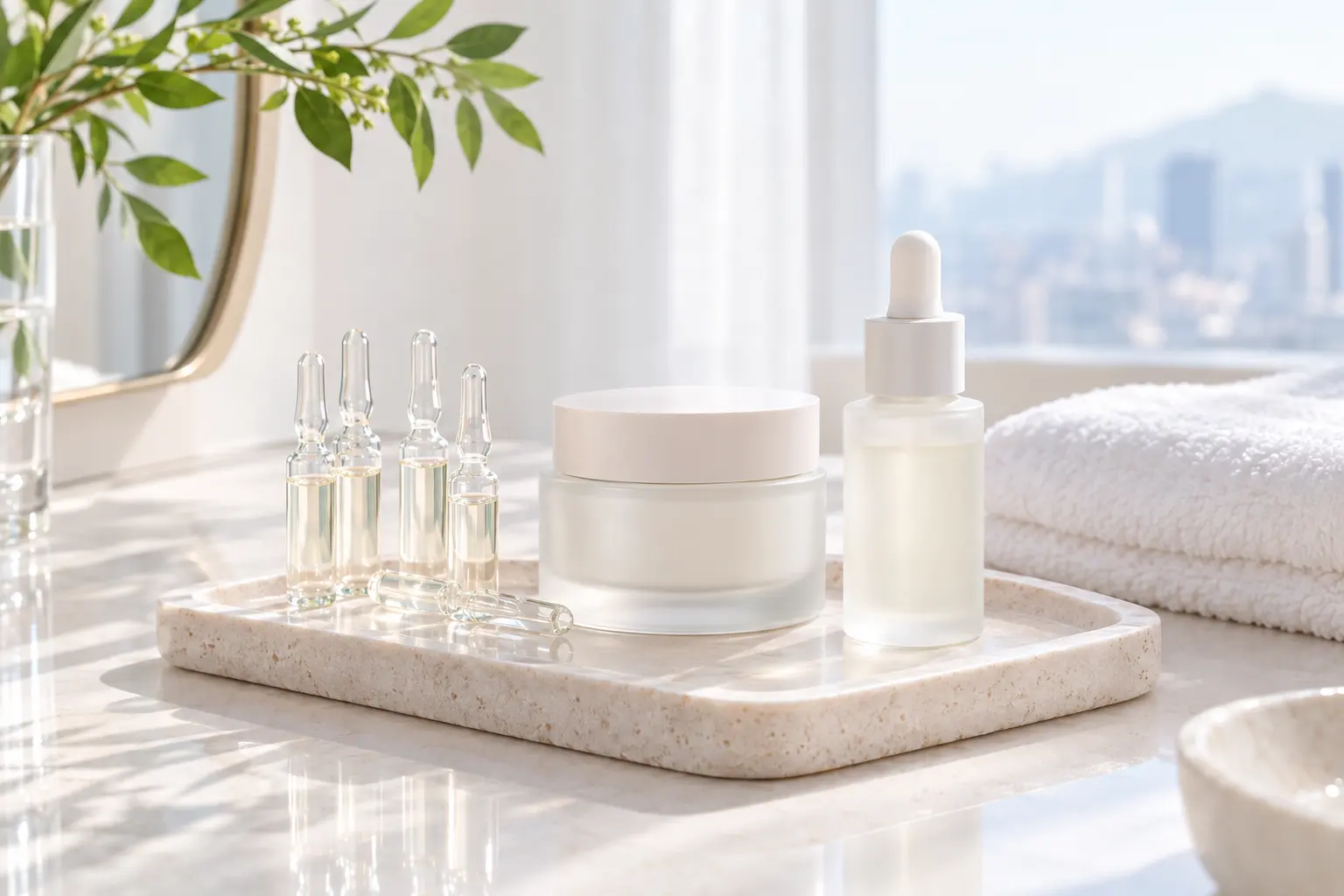
Most searches for K-pop idol skincare secrets end in the same place: a long shopping list of ampoules, lifting creams and powders that promise the camera-ready glow you see on stage. Before you buy any of it, answer one question. Is your skin short on water and comfort, or does it need a targeted active?
For most readers the honest answer is the first, and that changes the order you should spend in. This piece covers four things. It explains the mechanism behind that glow and shows how to read Korean label claims. It then sets out where a concentrated ampoule or a full lifting set earns its price, and when fragrance or DIY mixing makes a product the wrong pick for you.
What K-Pop Idol Skincare Secrets Really Come Down To
The phrase promises insider knowledge, but little of what circulates under it can be verified. You usually cannot confirm which products a given performer uses, how often they use them, or how much a dermatologist, makeup artist or lighting rig contributed to the result. Treat the “secret” as a look, not a formula. The look is skin that reflects light evenly, reads as plump and does not flake under makeup.
That look has an ordinary physical basis. A smooth, well-hydrated surface reflects light evenly. Dehydrated skin shows fine lines, rough patches and uneven texture that scatter light and catch powder. The most dependable route to the effect is keeping the outer layer of skin, the stratum corneum, supplied with water and able to hold onto it.
Here is the decision rule used throughout this article:
- Build the hydration and barrier base first. If your skin feels tight, flakes under makeup or stings easily, consistent, gentle moisture will help sooner than any ampoule.
- Add one targeted step only when you can name the concern. Dullness, loss of firmness or uneven tone justify a concentrated product. A vague wish for “idol skin” does not.
- Let fragrance and format decide ties. Reactive skin should favor unscented formulas. If you dislike mixing or the hygiene fuss that comes with it, favor ready-made or pre-portioned formats.
Two conditions would change this advice. If your base routine already keeps skin comfortable through a full day under makeup, the base is done and your money is better spent on a targeted step. If your skin reacts to new products often, the reverse holds: use fewer products and introduce them slowly.
Everything below follows from that rule. One section explains why hydration does so much of the work. Another covers how Korean labels signal what a product is legally positioned to do. The rest look at where each featured product fits, and where it does not.
The Hydration Base Behind the Idol Glow
Hydration in skincare relies on three complementary roles. Humectants such as glycerin and hyaluronic acid draw in and bind water. Emollients smooth the surface by filling the gaps between flaking cells. Occlusive and barrier-supporting ingredients, including lipids such as ceramides, slow how fast water evaporates. A routine that covers only the first role often feels good for an hour and tight by the afternoon.
Your skin also makes its own humectants. The natural moisturizing factor, or NMF, is a mix of free amino acids, their derivatives and salts held inside the outer skin cells, and serine is among those amino acids. This explains why amino acids appear in so many hydrating formulas. Keep it in mind when you meet amino-acid powders later in this article.
Why a minimalist base often beats a crowded one
Every extra product adds ingredients your skin has to tolerate. For dry, sensitive or easily flushed skin, the useful question is not how many layers you apply. It is whether each step adds water, keeps it in or calms the surface. For a framework on trimming steps, see our breakdown of which Korean routine steps actually earn a spot.
The PYUNKANG YUL Moisture Skincare Set is built on that minimalist idea. Its catalog listing describes formulations inspired by traditional Korean medicine, centered on milk vetch root extract (Astragalus membranaceus). The set is positioned for deep hydration and oil-moisture balance in dry, sensitive or imbalanced skin. The brand presents milk vetch root as its signature extract, used alongside gentle formulations meant to soothe, strengthen and hold moisture. Check the box for the exact items included and their order of use, because the listing frames the set as a ritual rather than a single product.
- Suits: skin whose main complaint is tightness or flaking under makeup, or skin that swings between oily and dry.
- Look elsewhere if: your skin is already comfortable and you want visible brightening or firming. A base set alone will feel like a sideways step.
One practical point: hydration depends more on consistency than on any single ingredient. A base you use morning and night is more likely to show in your skin’s finish than an expensive serum used now and then. Make the base a habit before judging whether you need anything else.
Reading Korean Skincare Label Claims Before You Pay for Them
Korean skincare often carries words like “whitening” (meaning brightening), “wrinkle-improving” or “functional.” These words carry regulatory meaning. Korea’s Cosmetic Act and its Enforcement Rule govern what functional cosmetic labels may say [1]. A 2020 amendment to that Enforcement Rule removed terms such as “atopic dermatitis” and “eczema” from functional cosmetic labels [1]. The replacement wording describes products that help relieve itching by repairing the skin barrier [1].
That change shows how to read these claims. Functional cosmetic language describes cosmetic support, such as barrier care, brightening or the look of wrinkles. It does not describe treatment of a skin condition. If a product’s marketing drifts toward medical promises, give it more scrutiny, not less. Any persistent rash, itch or flare belongs with a clinician rather than a new serum.
Applying this to a real listing
The Cellinon RenewCenta set is a useful example of a dense Korean listing to parse. Its product page calls it whitening and wrinkle-improving functional skincare [2]. The ampoule in the set lists niacinamide, which the page describes as a KFDA-approved whitening ingredient [2]. KFDA is the former name of the agency now known as the Ministry of Food and Drug Safety (MFDS).
Sort the claims by type as you read:
- Ingredient disclosure: placenta protein complex, peptides, niacinamide and glutathione. These tell you what is in the product.
- Functional positioning: brightening and wrinkle improvement. If that assurance matters to you, look for the functional cosmetic marking on the packaging you receive.
- Brand testing statements: the page describes the set as clinically tested and proven non-irritating [2]. That is the brand’s own account of its testing. It is useful, but it is not an independent trial you can read.
- Manufacturing statements: the page lists CGMP manufacturing and ISO 22716, ISO 9001 and ISO 14001 certification [2]. These describe production and quality systems, not skin results.
None of this makes a product better or worse. It lets you match what you are paying for to the kind of evidence behind it. This matters most for premium sets, where much of the price reflects the active story.
Matching Korean Skincare Picks to Your Skin, Side by Side
The table condenses each product’s own catalog positioning into the two questions that matter at checkout: who it fits, and when to pause. It is not a ranking. A base set and a lifting set do different jobs, and the right purchase depends on which job your skin needs done.
| Product | Format | Key listed ingredients | Best fit | Think twice if |
|---|---|---|---|---|
| PYUNKANG YUL Moisture Skincare Set | Minimalist set | Milk vetch root extract | Dry, sensitive or imbalanced skin that needs a base | Visible brightening or firming is your main goal |
| Metregen Brightening Skincare Ampoule 2ml x 20 | Twenty 2 ml portions, as listed | Ginseng callus culture, damask rose and green tea stem cell extracts | Dullness or uneven texture on top of an existing routine | You do not have a moisturizer base yet |
| Cellinon RenewCenta Luminous Lifting Skincare Set | Toner, ampoule and cream | Placenta protein complex, peptides, niacinamide, glutathione, hyaluronic acid | Dry, dull skin with firmness concerns, wanting one coordinated routine | You need to confirm the placenta source, or prefer adding one step at a time |
| mixsoon 3 Types of Powder | DIY powders to mix into a serum | Amino acids (L-serine), collagen, vitamin | Hands-on users customizing a hyaluronic acid serum | You want ready-to-use, no-fuss products |
| O HUI The First Geniture For Men Moisturizer 110 ml | Single moisturizer | Peptides, ceramide NP, niacinamide, adenosine | Men who want one step for hydration and wrinkle care | Your skin reacts to fragrance |
| ODYSSEY LIGHTHOUSE Toner 140ml + Lotion 110ml | Two-step set | Antioxidants, gentle exfoliators, neroli-amberwood fragrance | Fragrance lovers and gifting | Your skin is sensitive or reactive |
Read the “think twice” column before the “best fit” column. Mismatches cause the most expensive mistakes. Typical examples are a fragranced lotion bought for reactive skin, or a brightening ampoule layered over skin that is still dehydrated and irritated.
The order to spend in
- A hydration and barrier base you will use morning and night.
- One targeted step for a concern you can name, such as dullness or loss of firmness.
- Optional extras: DIY boosters, scented rituals and gift sets.
If your budget forces a choice, the first item does the most for the even, reflective finish people call idol skin. The second item refines the result. The third is about enjoyment and personalization, which is a perfectly valid reason to buy as long as you know that is what you are buying.
Where a Concentrated Ampoule Earns Its Place
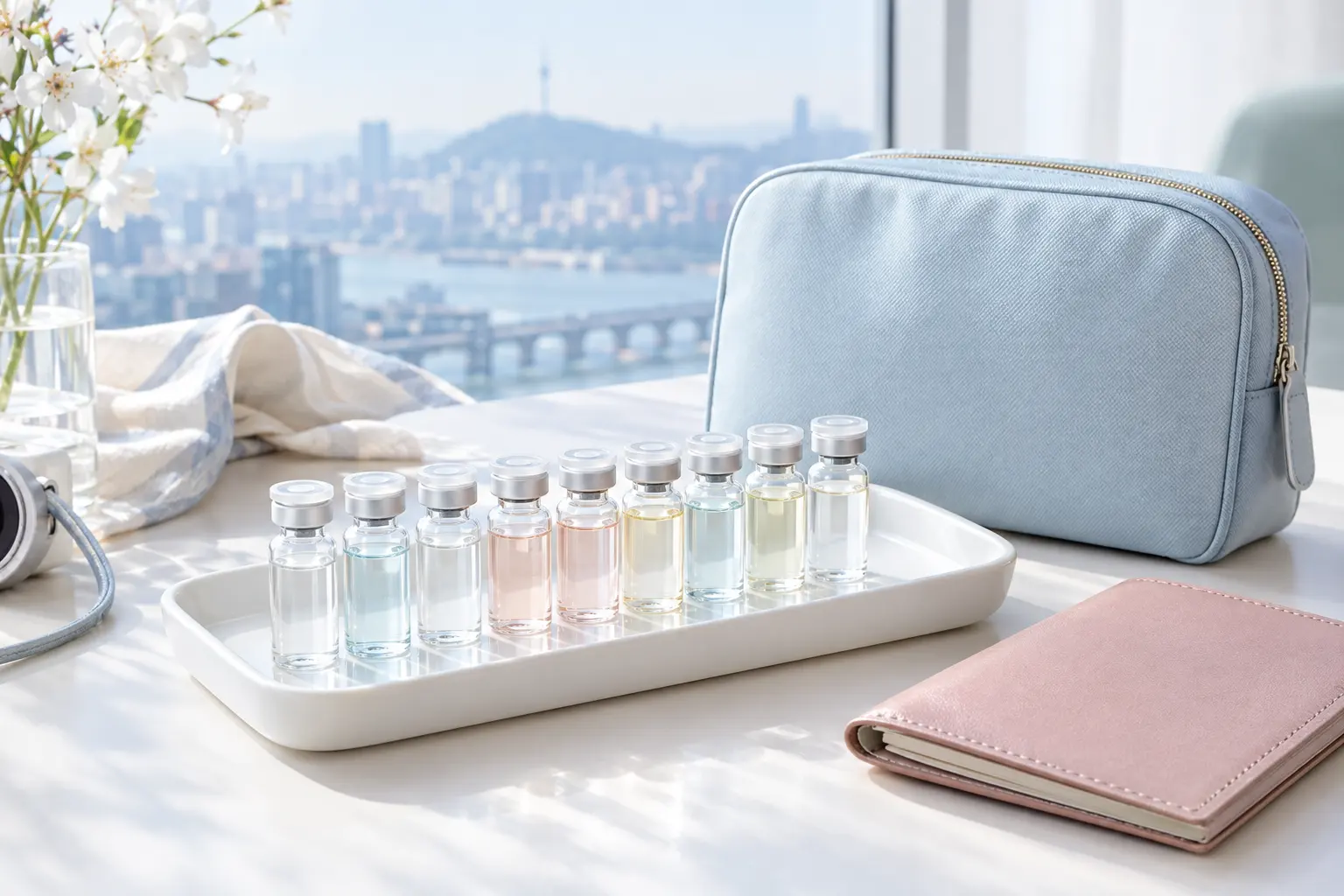
In Korean skincare, an ampoule is a concentrated serum-type step meant to deliver a focused dose of actives. Packaging matters here as much as the formula. A large multi-use bottle gets opened dozens of times, which exposes its contents to air and fingers. Smaller portions can reduce that exposure, but only depending on how you use them.
The Metregen Brightening Skincare Ampoule is listed as twenty 2 ml portions. The listing does not say whether each portion is meant for a single application or can be resealed, so check the box. If you use each portion in one sitting, you avoid repeatedly reopening one bottle and apply a similar amount each time. Its catalog listing targets moisture, elasticity, brightening and skin texture, and its ingredient story centers on plant stem cell extracts: ginseng callus culture extract, damask rose and green tea.
What “plant stem cell” means on a label
The term is shorthand. Cosmetic plant stem cell ingredients come from plant cell cultures grown in controlled, microbe-free nutrient conditions rather than from whole field-grown plants [4]. A recent review lists the advantages of cultured cells as sustainability, no pesticide residues and independence from climate fluctuations [4]. The same review names Panax ginseng among the plants associated with repairing damaged epidermal cells [4].
Read that carefully. It describes effects researchers attribute to the ingredient category. The benefit always depends on the specific extract, how much is present and the formula around it. That makes the ingredient plausible. It does not prove that any particular portion will brighten your skin.
Who the ampoule suits
- You already have a moisturizer you like and want to add a focused step for dullness or uneven texture.
- You travel often and prefer small, portable portions to a glass bottle in a toiletry bag.
- You like a defined number of portions rather than an open-ended bottle that sits half-used.
It suits you less if you have no base routine yet, because a brightening step on dehydrated skin is a poor trade. Check the box for how much the brand intends per application, and whether the ampoule is meant for morning, evening or both. To decide where a brightening step belongs in your day, see our comparison of Korean morning versus night routines.
Treat an ampoule as an addition you assess on its own. Add it to an otherwise unchanged routine. That way, any difference you notice in tone or texture can reasonably be put down to the ampoule rather than to everything changing at once.
Full Lifting Sets: When One Coordinated Korean Routine Makes Sense
A full set takes the opposite approach to a single ampoule. One brand designs the toner, serum and cream to work together, and you adopt the whole sequence. The appeal is coherence. The cost is that you change three products at once, which makes it hard to tell which one is responsible if your skin reacts or improves.
The Cellinon RenewCenta Luminous Lifting Skincare Set, from the biotechnology company CELLTRION, is built around a placenta protein complex and peptides. Its product page describes three steps:
- The Hydrating Skin Toner lists placenta protein complex, multiple hyaluronic acid types, panthenol and allantoin, and is patted on morning and night after cleansing [2].
- The Glow Toning Ampoule pairs niacinamide with glutathione and is positioned for dull, dehydrated skin [2].
- The Extra Firming Cream is massaged onto the face and neck as the final step and is positioned for aging, dry or sagging skin [2].
Understanding the ingredient stack
The page also names a patented peptide and vitamin C derivative blend called Active-Pep [2]. It further lists hydrolyzed collagen, hydrolyzed elastin and a hyaluronic acid complex [2]. Applied to the skin, proteins such as collagen and elastin work mainly at the surface, where they help hold moisture and can make skin feel smoother and more supple. They are not a way to replace the collagen inside your skin. Peptides are the more targeted part of the formula, used in firming products as signaling ingredients, though results vary with the specific peptide and its dose.
Placenta protein deserves a note of its own. The listing describes it as a source of peptides, amino acids and growth factors [2]. The available description does not state the source of the placental ingredient. If animal origin matters to you, confirm it from the full ingredient list before ordering.
You may also notice that the set copy cites a seven-type hyaluronic acid complex, while the toner description lists eight types [2]. This kind of discrepancy is common in long product copy and makes little practical difference. As our guide on why counting hyaluronic acids misses the point explains, the formula around HA matters more than the tally.
- Suits: drier, duller skin where firmness is a stated concern, for buyers who want a coordinated routine rather than one pieced together.
- Hesitate if: your skin is very reactive, or you prefer to introduce products one at a time.
If you buy the set, you do not have to start all three steps on the same day. Staggering them keeps the coherence of a matched routine and still lets you identify a step that does not agree with you.
DIY Powders, Men's Moisturizers and Fragrance: The Tie-Breakers
Three remaining products serve narrower needs. Each one tests a different part of the decision rule: willingness to mix, wanting a single step, and tolerance for fragrance.
DIY powders: flexible, but hygiene is your job
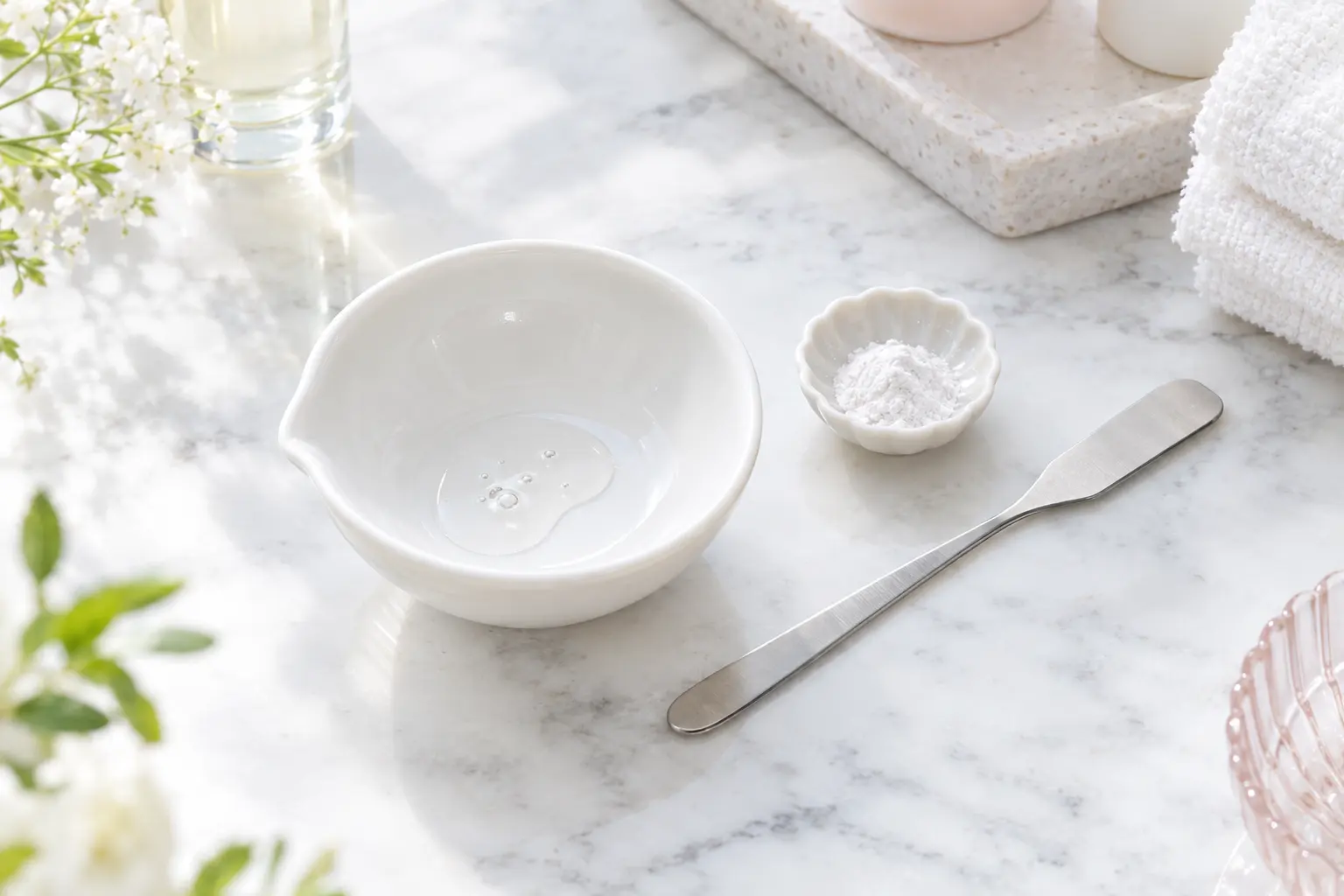
mixsoon 3 Types of Powder bundles an amino acid powder, a collagen powder and a vitamin powder. The catalog describes the amino acid powder as 100% pure amino acids, rich in L-serine, and designed to be mixed into a hyaluronic acid serum. The mechanism holds up as a hydration idea, because serine is part of the skin’s natural moisturizing factor. Expect support for moisture and surface texture rather than structural firming. The same applies to the collagen powder, which works at the surface like other collagen in skincare. For the vitamin powder, check the label for which vitamin it contains and how the brand says to store it.
The real trade-off is hygiene. When you stir a dry powder into a water-based serum, you create a new mixture that neither maker has tested for preservation. Mix only what you will use straight away, in a clean dish or palm, rather than tipping powder into the serum bottle. Discard any leftovers.
A men’s moisturizer with fragrance in the formula
The O HUI The First Geniture For Men Moisturizer comes in a 110 ml size. Its catalog positioning covers hydration, wrinkle improvement, pores, elasticity and tone. Its published ingredient list includes niacinamide, adenosine, ceramide NP, copper tripeptide-1 and several oligopeptides [3]. The same list also includes fragrance, limonene and linalool [3]. The directions are to spread a moderate amount over the face and tap until absorbed [3]. It suits men who want one capable step instead of a sequence, provided their skin tolerates scented products.
Fragrance as a deliberate choice
The ODYSSEY LIGHTHOUSE set pairs a 140 ml antioxidant toner with a 110 ml lotion. The catalog describes the toner as formulated with two antioxidant ingredients, soothing agents and gentle exfoliators. The fragrance is a central feature: neroli top notes, amberwood in the middle and musk at the base. For someone who enjoys scent as part of a routine, or is buying a gift, that is the point.
This is the place for the one fragrance caution in this article. Fragrance ingredients are a recognized cause of irritation and allergic reactions in some people with sensitive skin, and exfoliating ingredients can add to that sensitivity. If you know your skin is reactive, scan the full ingredient list the same way you would when choosing a cleanser for sensitive skin, and favor unscented options for leave-on facial steps.
Building Your Own Idol-Inspired Korean Skincare Routine
Three hypothetical readers show how the decision rule plays out in practice. Find the one closest to you and start there.
You wear long-wear makeup most days and it flakes by evening
That pattern points to dehydration and a stressed surface, not a missing active. Start with a hydration base such as the PYUNKANG YUL set and use it consistently before adding anything. Once makeup sits smoothly through the day, the Metregen ampoule is a sensible next step if dullness is still your complaint.
Your skin is dry and dull, and you notice less bounce
Here the full Cellinon set is a reasonable buy, because its steps map to concerns you can name. The toner handles hydration, the ampoule carries the brightening ingredients and the cream is positioned for dry, firmness-focused skin. Introduce it gradually. Start with the toner for several days, then add the ampoule, then the cream, so you can identify any step that causes a problem.
You react to many products but love a scented ritual
Keep your leave-on facial products unscented where you can and enjoy fragrance elsewhere. The ODYSSEY set and the O HUI moisturizer both list fragrance, so they suit skin that has handled scented products before. The PYUNKANG YUL set is positioned for dry, sensitive or imbalanced skin, but its listing does not state whether it is fragrance-free. Confirm the ingredient list on the box and patch-test it like any other addition.
Patch testing and pacing
- Apply a small amount of any new product to one area, such as along the jawline, for a few days before using it across your face.
- Stop anything that causes burning, swelling or a spreading rash. If a reaction persists, get medical advice.
- Change one product at a time where you can, especially with multi-step sets and fragranced formulas.
Your next decision is simple. Look at your skin at the end of a long day. If it is tight or flaking, buy the base. If it is comfortable but flat, buy the one targeted step that addresses the flatness. That is the closest thing this category has to a secret.
Frequently Asked Questions
What is the real secret behind K-pop idol skin?
No one can verify individual performers' routines. The look itself is mostly well-hydrated, comfortable skin that reflects light evenly, often helped by professional makeup and lighting. Consistent hydration and barrier care do most of the work. Targeted actives refine the result once that base is in place.
Are ampoules better than serums?
Not automatically. An ampoule is a concentrated serum-type step, and its results depend on its actives and the formula. The Metregen ampoule is listed as twenty 2 ml portions; if you finish each portion in one sitting, you avoid repeatedly reopening one bottle and apply a similar amount each time. Check the box for the brand's intended amount per use.
Do placenta protein and collagen products rebuild collagen in the skin?
Expect surface benefits rather than structural rebuilding. Applied to the skin, proteins like collagen and elastin mainly help hold moisture and make skin feel smoother. Peptides are the more targeted firming ingredients, but results vary by peptide and dose. Treat claims about lifting as cosmetic improvements in look and feel.
Is it safe to mix amino acid or collagen powder into my serum?
It can be, if you mix only what you need for one application, in a clean dish or palm. Adding powder to a water-based serum bottle creates an untested mixture that you then keep for weeks. Mix immediately before use and discard any leftovers.
What does 'whitening' mean on Korean skincare labels?
In Korean labeling, 'whitening' is a functional cosmetic claim for brightening and evening out skin tone. It does not mean bleaching. Korea regulates what functional cosmetic labels may claim. If the claim matters to you, look for the functional cosmetic marking on the packaging you receive.
Should men use a separate men's moisturizer?
Only if the formula suits your needs. A men's product like the O HUI The First Geniture For Men Moisturizer appeals because it covers hydration and wrinkle care in one step. Its ingredient list includes fragrance, limonene and linalool, so men with reactive skin should weigh that first.