
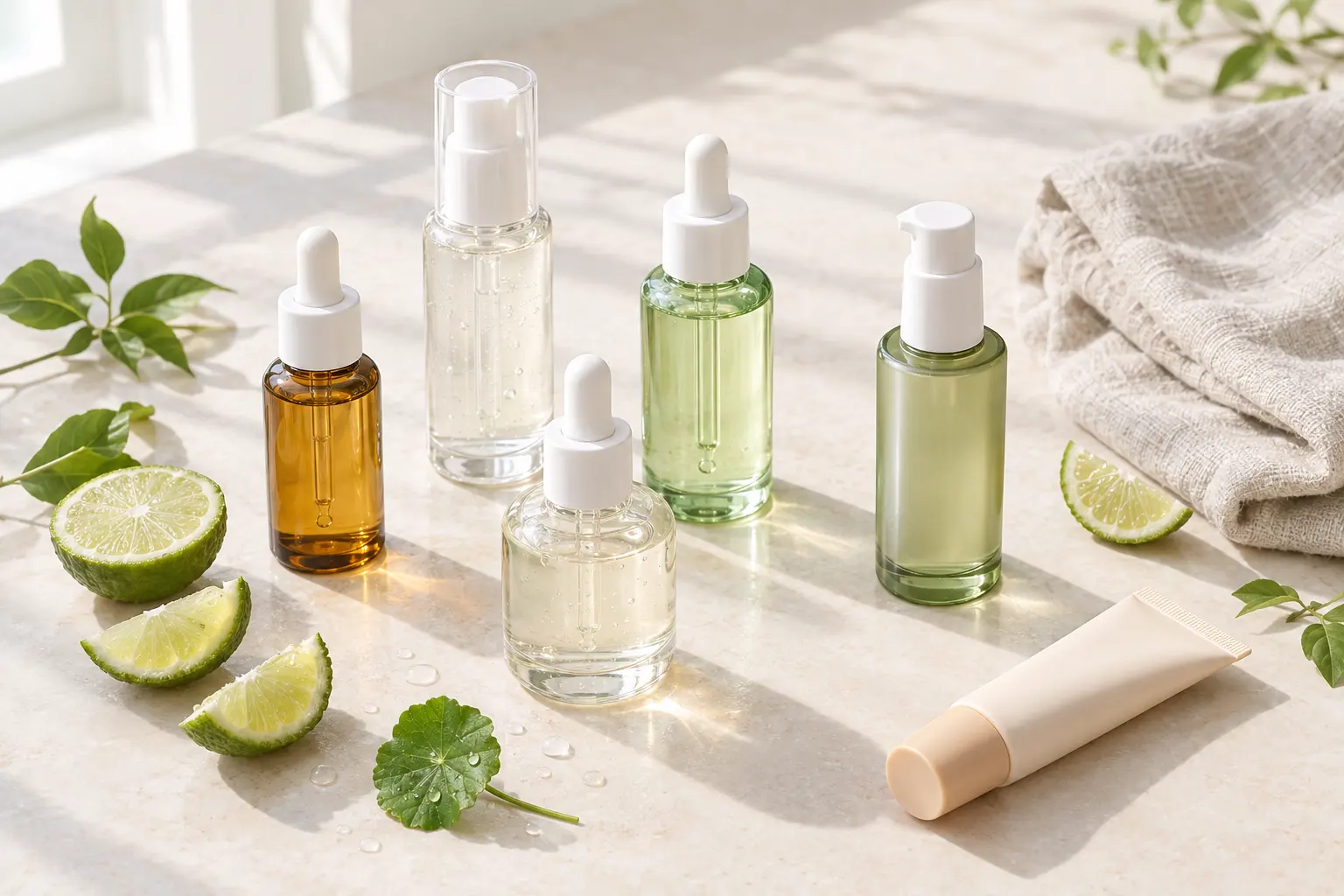
Choosing a Korean serum for dark spots comes down to something most labels blur: whether a real, disclosed brightening active matches the kind of mark you actually have. Six bottles here make confident promises. But a tangerine-extract percentage on the front of a box is not a vitamin C dose, and a claim of results in two weeks is not a study.
The short version: if you have post-acne marks or sun spots and your skin handles actives, choose a formula that tells you how much brightening ingredient it contains. If vitamin C has stung you before, choose for daily tolerance and expect slower, subtler change. If your patches are blue-grey, symmetrical or keep coming back, no serum here should be your main treatment. The sections below explain why, and which EmpressKorea option suits each situation.
What Kind of Dark Spot Are You Treating?
The words “dark spot” cover several different problems, and they don’t respond equally to a serum. The most common is post-inflammatory hyperpigmentation, the flat brown or tan mark left behind after a pimple, bite, cut or eczema flare heals. Sun spots build up on skin that has had years of UV exposure. Melasma is a separate condition: broader, often symmetrical patches across the cheeks, forehead, upper lip or jawline.
The American Academy of Dermatology lists healing pimples, healing wounds, certain medications, irritating skin or hair products and hormonal changes such as pregnancy among the common triggers for dark spots [1]. Melasma is described as chronic and highly recurrent, and UV light, hormones and family history are all implicated in it [6]. That difference shapes the whole decision. A post-acne mark has a finished cause. Melasma has an ongoing one.
Depth matters too. A spot a few shades darker than your natural skin color usually fades within 6 to 12 months once its cause has stopped [1]. Pigment that sits deep in the skin, often slate blue to grey, can take years to fade [1]. A topical serum mainly works on the upper layers, so the deeper and darker the mark, the smaller its share of the job.
A quick self-check before you buy
- The mark sits where a breakout, scratch or bite used to be: almost certainly post-inflammatory. This is where a serum earns its keep.
- Small, defined brown spots on the cheeks, nose or backs of the hands after years outdoors: likely sun spots. A serum helps, but only alongside strict sun protection.
- Symmetrical patches that darken in summer or after hormonal changes: possibly melasma. A serum plays a supporting role, and a dermatologist’s diagnosis is worth getting.
- Blue-grey, very dark or deep-looking discoloration: see a dermatologist before spending money on serums.
Keep your answer in mind. Every recommendation later in this piece branches from it.
Sunscreen Decides Whether a Dark Spot Serum Works at All
This is the unglamorous part, and it does more than any bottle on the shelf. Dermatologists say effective treatment for dark spots begins with sunscreen [1]. The AAD specifically recommends a tinted sunscreen containing iron oxide, because iron oxide helps protect against visible light, which is itself a cause of dark spots [1].
Look for these on the tinted sunscreen you choose:
- SPF 30 or higher, broad-spectrum and water-resistant [1].
- A non-comedogenic formula if you have oily skin, and a shade that blends without a white cast [1].
- Iron oxide in the inactive ingredients. It protects against visible light rather than UV, so it is listed there rather than as an active [1].
Then use it properly. The AAD advises reapplying every two hours and after swimming or sweating, wearing a wide-brimmed hat outdoors and avoiding the strongest sun between 10 a.m. and 2 p.m. [1]. Without that, a brightening serum is mostly trying to keep up with fresh pigment.
Remove the cause, including your skincare
The second foundation is stopping whatever is creating new marks. If acne, eczema or psoriasis is behind your spots, the AAD says the skin condition has to be treated first [1]. Products count as causes as well. A skin or hair product that irritates your skin can itself trigger dark spots, which is why gentler, often fragrance-free products are recommended when spots keep appearing [1].
This is the trade-off most shoppers miss. A strongly scented or tingly brightening serum can create the problem it promises to fix, especially on medium to deep skin tones that pigment easily after irritation. If a product burns or stings, the AAD’s advice is simply to stop using it [1]. That single rule should outrank any front-label promise.
How Brightening Actives in Korean Serums Actually Work
Most Korean dark-spot serums rely on one or more of a handful of mechanisms. Knowing which one you are buying tells you what to expect, how long to wait and what you can pair it with.
Niacinamide: slowing pigment delivery
Niacinamide works less by stopping melanin production than by interrupting its delivery. It has anti-inflammatory properties and can reduce the transfer of melanosomes, the pigment packets that melanocytes pass up to surface skin cells [4]. That makes it a logical fit for post-acne marks, where inflammation and pigment travel together.
The clinical picture is modest but real. In a double-blind trial, 27 women with melasma applied 4% niacinamide cream to one side of the face and 4% hydroquinone cream to the other for eight weeks, alongside SPF 50+ sunscreen [4]. Average severity scores fell 62% on the niacinamide side and 70% on the hydroquinone side [4]. Instrument-measured color showed no statistical difference between the two sides [4]. Side effects were reported in 18% of patients on the niacinamide side and 29% on the hydroquinone side [4].
Read that with care. It was one small trial of a pharmacy cream, not a K-beauty serum, and it doesn’t prove any finished product works. It does suggest that niacinamide around the 4% mark is a reasonable workhorse that was tolerated relatively well in that setting. Because it acts on an ongoing process, plan to keep using it rather than treating it as a short course.
Tranexamic acid: the melasma-adjacent option
Tranexamic acid (TXA) entered brightening skincare through melasma research. An expert consensus concluded that topical TXA, alone or with other treatments, may be offered to melasma patients who have already had other therapy or have not responded to it [6]. The same paper notes that combination therapy may give the best outcomes because pigment production is a multi-stage process [6].
That positions TXA as a sensible second mechanism to pair with niacinamide rather than a standalone fix. Much of the research behind it comes from small, varied studies, so a confident “fades melasma” claim on any box deserves skepticism.
Vitamin C and its derivatives
Vitamin C inhibits tyrosinase, the enzyme that drives melanin synthesis [7]. Pure L-ascorbic acid remains the most clinically validated form [7]. It is also demanding: effective topical delivery requires a highly acidic formula, below pH 3.5 [7].
Derivatives trade some direct potency for stability. Water-soluble derivatives are more stable and less irritating, but skin enzymes must convert them into active vitamin C first [8]. Ascorbyl glucoside, one common derivative, is described as well tolerated for chronic hyperpigmentation [7]. No single derivative is universally superior [8]. Clinical effectiveness depends on derivative chemistry, vehicle, pH, stabilization and delivery method [7].
The AAD names vitamin C among the over-the-counter ingredients worth trying for dark spots, alongside azelaic acid, glycolic acid, kojic acid and retinoids [1]. Niacinamide and TXA are not on that list, a reminder that their evidence is promising but thinner.
Melasolv: a brand-described mechanism
Melasolv is the named brightening ingredient in IOPE’s essence. The catalog says it was developed to target melanin formation and positions it for stubborn spots and deeper pigment. No independent evidence for it was reviewed for this article, so treat its mechanism as the brand’s description rather than an established finding.
Reading a Korean Dark Spot Serum Label: Extract Percentages vs. Active Doses
The number on the front of a Korean serum is usually the biggest number the formula can honestly claim, and it is often a botanical extract rather than the active doing the brightening. Ingredient lists run roughly from highest to lowest concentration, but the more useful question is simpler: has the brand told you how much of its brightening ingredient is inside?
Four labels, four different stories
- goodal Green Tangerine Vita C Dark Spot Care Serum advertises 70% Jeju green tangerine extract and calls itself a mild vitamin C serum. The catalog doesn’t disclose which vitamin C form it uses or at what dose, so the 70% figure describes the citrus extract, not a vitamin C level. Its claim of fading blemishes from two weeks is the brand’s own.
- make p:rem Poncirus Trifoliata C Dark Spot Serum is sold in Korea as a 40ml whitening and wrinkle dual-functional serum with 66% poncirus (hardy orange) extract and vitamin C derivative capsules. The catalog calls the derivative stable, but its dose isn’t disclosed.
- DR.PEPTI Centella Dark Spot Solution Ampoule Pro leads with 50.568% centella asiatica extract, which the catalog positions as soothing and hydrating rather than as the pigment active. Brightening is credited to a “Mela Control Complex” whose composition and dose aren’t detailed.
- IOPE Bright Dark Spot Essence names Melasolv as its brightening agent but gives no concentration, and a full ingredient list wasn’t supplied for comparison.
By contrast, Dr.Melaxin TX Pigmentation Dark Spot Ampoule states its actives directly: 43,000ppm each of tranexamic acid and niacinamide. Since 10,000ppm equals 1%, that works out to roughly 4.3% of each. It is the only product in this group that tells you the dose of the ingredients most associated with fading pigment.
What “whitening functional” status means
Korea’s Ministry of Food and Drug Safety treats brightening products, labeled “whitening” in the Korean regulatory sense of evening tone rather than bleaching skin, as a functional cosmetic category. A seller must pass a review or file a report on safety and effectiveness, unless the product uses a pre-approved ingredient at the specified level. Dr.Melaxin’s catalog listing claims this certification, and make p:rem’s Korean listing describes a dual whitening and wrinkle function.
It is a meaningful signal that the regulator accepted evidence for a brightening claim. It is not a drug approval, and it doesn’t mean a product treats melasma. Before you buy any serum, ask three questions:
- Is the brightening active named, and is its dose disclosed?
- Is the big front-label percentage an active or an extract?
- Does the full ingredient list on the box include fragrance or essential oils that your skin has reacted to before?
The Best Korean Serum for Dark Spots, Compared by Skin Need
Here is how five of the EmpressKorea options line up on the evidence that matters: what drives the brightening, whether the dose is disclosed, and what might give reactive skin pause. Details come from catalog data and, for make p:rem, its Korean listing and collected user feedback. Formulas can change, so the box in your hand always has the final word.
| Product | Lead brightening ingredients (per catalog) | Disclosed dose | Watch-outs | Best fit |
|---|---|---|---|---|
| Dr.Melaxin TX Pigmentation Dark Spot Ampoule 30ml | Tranexamic acid, niacinamide | 43,000ppm (about 4.3%) each | Supporting formula not detailed in catalog; “pharmacy-grade” is marketing wording | Post-acne marks and sun spots on skin that tolerates actives |
| IOPE Bright Dark Spot Essence 45ml | Melasolv | Not disclosed | Full ingredient list not supplied; 14-day claim unverified | Tolerant skin wanting a different mechanism, day or night |
| make p:rem Poncirus Trifoliata C Dark Spot Serum 40ml | Poncirus extract (66%), vitamin C derivative capsules | Derivative dose not disclosed | Users describe brightening as subtle; oil content may not suit oily skin | Skin that stings with vitamin C serums |
| goodal Green Tangerine Vita C Dark Spot Care Serum 30ml | Jeju green tangerine extract (70%) | Vitamin C form and dose not disclosed | Full ingredient list not supplied; two-week claim is the brand’s | Readers who want a citrus-extract serum and accept undisclosed doses |
| DR.PEPTI Centella Dark Spot Solution Ampoule Pro 30ml | Mela Control Complex, centella extract (50.568%), peptides | Complex dose not disclosed | Refreshing fragrance noted in catalog | Dark spots plus dehydration in warm weather |
FATION Mela Zero Dark Spot Toning Ampoule is left out of the table on purpose. Its brightening system is described only by the brand’s own term, “DALN PICO-TONEUP,” and no independent ingredient list was available to compare. Ask for the full ingredient list before choosing it, especially if your skin is reactive.
Two patterns stand out. Only one formula discloses a meaningful dose of the ingredients most tied to fading pigment. And DR.PEPTI’s catalog notes a refreshing fragrance, while full ingredient lists for several others weren’t supplied, so fragrance-sensitive readers should patch test whichever they choose. If you want to compare these against hydrating and barrier serums as well, the broader guide to Korean serums and essences for different routines sets out how each category fits.
Post-Acne Marks and Sun Spots: When a Measured Dose Wins
Picture a reader with a scattering of brown marks from last year’s breakouts, a few sun spots across the cheekbones and skin that has handled niacinamide before without fuss. For this person, the decision is fairly clear-cut: choose the serum that discloses enough of the right actives to be worth applying every day.
The lead pick: Dr.Melaxin TX Pigmentation Dark Spot Ampoule
Dr.Melaxin TX pairs two pigment mechanisms at stated levels: 43,000ppm tranexamic acid and 43,000ppm niacinamide, roughly 4.3% each. That niacinamide level sits close to the 4% used in the melasma trial described above. It is reasonable to call this a properly dosed formula, but that trial was not run on this product, and no independent clinical study of the ampoule itself was found. The catalog also states that it carries Korean whitening functional certification and is sold through pharmacies.
Why it leads for this reader:
- Two mechanisms in one step. Niacinamide reduces pigment transfer, and TXA adds a second pathway, which fits the case for combination approaches.
- A transparent dose. You know what you are applying, so you can judge it fairly over three months.
- Room in the routine. Because it already combines two actives, you don’t need to stack a second brightening serum.
The trade-off: the catalog entry focuses on the two headline actives and doesn’t spell out the rest of the formula, so read the full ingredient list on the box if you are avoiding anything specific. The “pharmacy-grade” and “clinical-strength” wording is a marketing description, not an independent efficacy rating.
The alternative: IOPE Bright Dark Spot Essence
Now picture a second reader, mostly concerned with sun spots, who already uses niacinamide in a moisturizer and wants a different mechanism rather than more of the same. IOPE’s essence is built around Melasolv, which the catalog says was developed to target melanin formation. It comes in a 45ml pump bottle, and the catalog describes it as dermatologist-tested and suitable for both day and night use, which makes it easy to slot into either half of a routine.
The reservations are real. No independent evidence for Melasolv was reviewed here, so its mechanism rests on the brand’s description. The catalog’s “visible results in 14 days” is likewise a brand claim without an independent study behind it. A full ingredient list wasn’t supplied for comparison, and “dermatologist-tested” is not the same as fragrance-free or suitable for reactive skin. If you avoid particular ingredients, read the list on the 45ml packaging before committing.
If neither reader sounds like you because your skin protests at the first sign of an active, the next section is the one that matters.

Dark Spot Serums for Reactive Skin: Tolerance Over Strength
Take a third reader: easily flushed skin, a history of stinging from vitamin C serums and a few lingering post-acne marks. For this person, strength is a trap. A potent formula used for a week and then abandoned does less than a mild one used daily for months. Irritation can also leave fresh pigment behind.
The tolerance pick: make p:rem Poncirus Trifoliata C Dark Spot Serum
The catalog describes this 40ml serum as pairing a stable vitamin C derivative with poncirus extract, and its Korean listing frames it as a whitening and wrinkle dual-functional serum with 66% poncirus extract and vitamin C derivative capsules. The derivative’s dose isn’t disclosed, so there is no basis for calling it a high-dose treatment. Its case rests on how it is reported to behave on skin.
Collected Korean-user feedback is the most useful evidence here, and it is consistent on one point: users repeatedly describe this serum as non-stinging, including people who react to other vitamin C products. They describe a very watery, slightly runny texture that absorbs quickly with low stickiness and layers under later steps and makeup without pilling. Scent comes across as nearly absent, with one user noting only a faint natural citrus-like note rather than added fragrance.
Users also mention that the capsules break down into moisture as the serum is rubbed in, without a grainy feel, and that it sinks in fast enough to skip waiting in a morning routine. The same feedback is candid about its limits. Brightening is described as subtle and gradual rather than obvious. One oily-skinned user found that the formula’s oil content clashed with her sebum and rolled off, and another felt it was slightly heavy for oily skin in hot weather. That points to a clear profile: dry, normal or combination skin that prioritizes comfort, with patience about results.
Formulas that need more caution
- goodal Green Tangerine Vita C: the brand calls it mild, but a full ingredient list wasn’t supplied here and the vitamin C form isn’t disclosed. If fragrance or essential oils have bothered you before, read the box’s ingredient list before applying it to your face.
- DR.PEPTI Centella Dark Spot Solution Ampoule Pro: the catalog describes a lightweight, non-sticky, fast-absorbing ampoule with centella, peptides and a Moist 24 hydrating agent, pitched for warm weather. It also notes a refreshing fragrance, so fragrance-sensitive skin should patch test first.
- IOPE and FATION Mela Zero: without full ingredient lists to review, there is no basis for calling either suitable for reactive skin. Verify the label before buying.
If fragrance is your recurring trigger across categories, the thinking in this piece on choosing products by what your skin tolerates carries over to serums.
Building a Dark Spot Routine You Can Keep for Months
Whichever serum you choose, the routine around it decides the result. Simpler is better here: one brightening serum, a supportive moisturizer and a tinted sunscreen in the morning. Adding three dark-spot products at once mostly multiplies the chance of irritation and makes it impossible to tell what is working.
A practical sequence
- Patch test for several days on a small area, such as along the jaw, before applying it to your whole face.
- Introduce one new active at a time. Give it a few weeks before adding anything else.
- Apply the serum to clean skin, following the label for amount and frequency, then seal it with a plain moisturizer. The moisturizers collection is the place to look for a simple, low-fragrance partner.
- Finish with tinted, iron oxide sunscreen every morning and reapply through the day.
If you already use a niacinamide toner or cream, count it. Pairing that with Dr.Melaxin’s 4.3% niacinamide means more of the same ingredient, not a second mechanism. A more selective skincare routine usually serves pigment-prone skin better than an ever-growing shelf.
Judging progress honestly
Take photos in the same daylight every four weeks and judge them at around three months, not two weeks. The AAD’s timeline for natural fading runs to 6 to 12 months for lighter spots once the cause is stopped [1]. Treatment can speed fading up, but brand claims of 14-day or two-week results have no independent study behind them.
When to stop, and when to see a dermatologist
Stop any product that burns or stings [1]. If your marks aren’t responding, dermatologists can offer prescription-strength treatment and combine options safely [1]. Be wary of lightening products with incomplete labels. Researchers have found unlisted steroids or mercury in some imported skin-care products [1]. The AAD’s own advice is to buy products made in the United States or recommended by your dermatologist [1]. Wherever you shop, it is sensible to choose products with complete ingredient labels you can read before use. Never apply liquid bleach to your skin [1].
Your next decision is simple. Name your spot type, check your tolerance against the table, and commit to one serum for a full three months alongside daily sunscreen.
Frequently Asked Questions
What is the best Korean serum for post-acne dark spots?
For post-acne marks on skin that tolerates actives, Dr.Melaxin TX Pigmentation Dark Spot Ampoule is the most transparently dosed choice here. It discloses 43,000ppm, about 4.3%, each of tranexamic acid and niacinamide. Those two ingredients target different steps of pigment production, so you don't need a second brightening serum. Pair it with daily sunscreen, because treating breakouts and preventing new UV damage matter as much as the serum.
Is a 70% tangerine extract serum the same as a vitamin C serum?
No. A large botanical extract percentage describes the base of the formula, not a vitamin C dose. goodal Green Tangerine Vita C advertises 70% Jeju green tangerine extract and calls itself a mild vitamin C serum, but the catalog doesn't disclose which vitamin C form it uses or how much. Pure L-ascorbic acid is the most clinically validated form and needs a highly acidic formula, so treat any extract-led serum as a different, milder proposition.
Niacinamide or tranexamic acid: which is better for dark spots?
Neither clearly wins, and they work differently, which is why a combination makes sense. Niacinamide slows the delivery of pigment to surface skin cells. Topical tranexamic acid is mainly studied for melasma and is often recommended as part of a combination approach. If your skin tolerates both, a single formula containing disclosed doses of each is the most efficient choice.
How long does a Korean dark spot serum take to work?
Plan on months, not days. A lighter spot often takes 6 to 12 months to fade naturally once its cause stops, and treatment can shorten that. Claims of results in 14 days or two weeks are brand claims without independent studies behind them. Judge your serum at around three months using photos taken in consistent light.
Which dark spot serum is best for sensitive skin?
Among these options, make p:rem Poncirus Trifoliata C is the one that collected Korean-user feedback repeatedly describes as non-stinging and nearly unscented, even for people who react to other vitamin C products. Users also describe its brightening as subtle and gradual, and some with oily skin found its oil content too heavy. DR.PEPTI's catalog notes a refreshing fragrance, and full ingredient lists for several others weren't supplied, so patch test them first. Always stop a product that burns or stings.