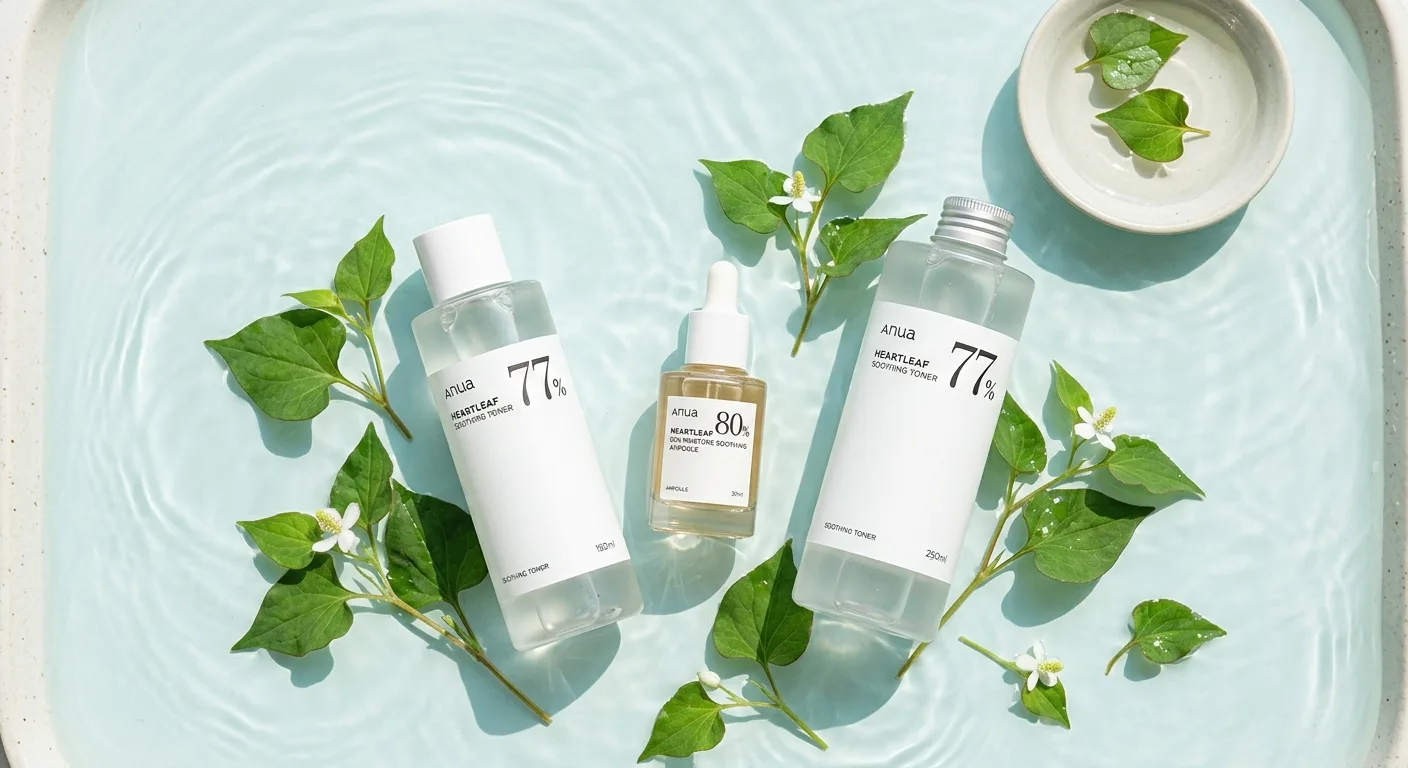
Anua is a Korean brand that built its reputation on one plant, Houttuynia cordata, sold under the friendlier name heartleaf. The Heartleaf 77% Soothing Toner became a global entry point to Korean skincare, and the catalog has since grown into cleansing oils, pads, creams, sunscreens and treatment lines around PDRN, azelaic acid, niacinamide and retinol. That growth is exactly why a brand-level review is no longer enough: an Anua toner and an Anua retinol cream are different formulation problems with different rules.
This guide reads the range the way a formulator would. It explains what the heartleaf extract is and what the research actually shows, why the famous percentage matters less than the surrounding formula, how the cleansing oil is built, where the PDRN, azelaic acid and niacinamide lines fit, and how to combine Anua products into a routine that reactive skin can tolerate.
What heartleaf is, and what the studies actually measured
Houttuynia cordata is a perennial herb used in East Asian traditional medicine and food. Its skin relevance comes from a group of polyphenols, chiefly quercitrin, hyperoside, quercetin and rutin. A 2022 study in Antioxidants exposed cultured human keratinocytes to UVB and found that heartleaf extract, and its purified quercitrin and hyperoside, reduced reactive oxygen species, lowered inflammatory mediators including IL-6, IL-8 and COX-2, and raised antioxidant enzymes such as superoxide dismutase and heme oxygenase-1.
That is a meaningful mechanism for a soothing claim, and it fits the way heartleaf products feel: cooling, calm, uneventful. The limitation is that the work was done in cell culture. It does not tell you how much flavonoid reaches living skin from a leave-on toner, or how a person with rosacea or eczema will respond. Anua’s own page for the toner reports quick changes in skin temperature, sebum and hydration, but without sample sizes, so those figures describe product behavior rather than proof of a clinical effect.
The practical conclusion is to expect a heartleaf product to be gentle and hydrating, and to judge it on that. If your skin is inflamed by a medical condition, heartleaf can be a comfortable base but is not a substitute for a dermatologist’s plan.
The 77% toner: why the number is less important than the list
On the current ingredient list, the first entry is Houttuynia cordata flower/leaf/stem water, followed by water, 1,2-hexanediol, glycerin, betaine, butylene glycol, isopentyldiol and panthenol. “77%” simply means that heartleaf water replaces most of the plain water. A plant water is not a concentrated extract; it carries a small amount of the plant’s water-soluble compounds and a lot of the sensory signature. The percentage is honest labeling, but it is not a dose.
What actually makes the toner useful is the rest of the formula. Glycerin, betaine and panthenol are reliable humectants. The product uses seven different hyaluronic acid forms, from high-molecular-weight sodium hyaluronate that films on the surface to hydrolyzed and crosspolymer variants that hold water in the upper layers. There is no added fragrance, no drying alcohol and no essential oils, which is why so many people with reactive skin tolerate it. It is a good liquid toner for anyone who wants a light hydrating first layer and nothing else.
The catalog listing is offered as a 350 mL bottle with a refill or as a 500 mL bottle; choose based on how quickly you use a toner, because an opened product should be finished within its period-after-opening window. Apply with hands or a cotton pad after cleansing, morning and night. If you prefer a pre-soaked format, the separate Heartleaf pads are a different formula; our toner pads versus liquid toner guide explains the trade-offs.
Heartleaf cream: the B3 and zinc addition
The Heartleaf 77 B3Zinc Soothing Cream extends the toner concept into a moisturizer and adds niacinamide (vitamin B3) and a zinc salt. Niacinamide is one of the best-documented cosmetic actives: it increases ceramide synthesis in the stratum corneum, which supports barrier function, it reduces the transfer of melanosomes to keratinocytes, and at 2% it has been shown to lower sebum excretion over four weeks. Zinc salts are added for their astringent and soothing feel on oily, blemish-prone skin.
The cream is a light gel-cream, which makes it suitable for combination skin and warm climates. On very dry skin it may need a richer occlusive layered over it at night. Because it already contains niacinamide, there is no need to add a separate niacinamide serum on top; duplicated actives rarely add benefit and often add irritation.
The cleansing oil: how it is built and who it suits
Anua’s Heartleaf Pore Control Cleansing Oil is the product that turned the brand from a toner into a routine. Its ingredient list opens with ethylhexyl palmitate, a light emollient ester, followed by sorbeth-30 tetraoleate and sorbitan sesquioleate, the self-emulsifying surfactants that let an oil turn milky and rinse away with water. Caprylic/capric triglyceride and a blend of sunflower, macadamia, olive, jojoba and grape seed oils provide the solvent power that dissolves sunscreen and makeup. Turmeric, neem and heartleaf extracts appear near the end of the list in small amounts.
Two facts matter for fit. First, the formula contains fragrance, listed sixth, so people who choose the toner precisely because it is fragrance-free should know that the cleansing oil is not. Second, an ester-based oil is lighter and rinses cleaner than a heavy plant-oil cleanser, which is why it is popular on oily skin. The brand reports a clinical sebum-change figure for the product but not the sample size, so treat it as directional.
Use two to three pumps on dry hands and a dry face, massage for one to two minutes, add a little water to emulsify until milky, rinse, then follow with a water-based cleanser if you wore sunscreen or makeup. On mornings with no sunscreen residue to remove, the second cleanse is optional. Explore the current cleanser category for the matching foam or gel.
PDRN: a medical ingredient in a cosmetic wrapper
Anua’s PDRN line, including the Hyaluronic Acid Capsule 100 Serum, mist and melting patches, uses polydeoxyribonucleotide, a DNA fragment mixture traditionally extracted from salmon or trout. A 2021 review in Marine Drugs summarized 70 studies: PDRN acts as an adenosine A2A receptor agonist and supplies nucleotides for repair, and the evidence for wound healing and tissue regeneration is real. Almost all of it, however, comes from injected medical products in clinical settings, not from leave-on cosmetics applied to intact skin.
That distinction sets expectations. A PDRN serum sold as a cosmetic in Korea is regulated as a cosmetic, contains far lower amounts than injectable products, and must cross an intact barrier that large DNA fragments do not cross easily. What you can reasonably expect from Anua’s PDRN serum is a well-hydrating, lightweight layer with hyaluronic acid doing most of the visible work. If the regeneration language matters to you, read our PDRN cream versus serum comparison before choosing a format.
The capsule serum is best used after toner and before moisturizer, morning and night. It layers well under sunscreen and does not conflict with niacinamide, azelaic acid or retinol.
Azelaic acid, niacinamide and retinol: cosmetic strengths, honest limits
Anua’s treatment lines use three actives with strong dermatology literature, but at cosmetic concentrations. The table summarizes how the cosmetic use differs from the prescription evidence.
| Active | What the evidence supports | Prescription reference | Cosmetic use in an Anua routine |
|---|---|---|---|
| Azelaic acid | Competitive tyrosinase inhibition, anti-inflammatory and antimicrobial effects; well tolerated, no photosensitization | 15% gel and 20% cream studied for rosacea, acne and melasma | Around 10% in cosmetics; suitable for maintenance of uneven tone and mild congestion, applied at night after toner |
| Niacinamide | Ceramide synthesis, reduced melanosome transfer, sebum reduction at 2%; 4–5% has the deepest trial base | Not a prescription active; studied at 2–5% | Present in the B3Zinc cream and serums; do not stack multiple niacinamide products |
| Retinol | Precursor to retinoic acid; supports cell turnover and collagen signaling over months | Prescription retinoids such as tretinoin are far more potent | 0.1% in the caffeine eye cream and the collagen gua sha cream; start two nights a week, use sunscreen daily |
A 2025 review in Cureus notes that azelaic acid is unusual among actives for not causing allergic sensitization or photodynamic reactions, with mild transient redness the main side effect. That makes the cosmetic strength a reasonable choice for rosacea-prone skin that wants a maintenance product, while recognizing that the clinical trials were done at higher strengths.
Sunscreen and the daytime routine
The Heartleaf Silky Moisture Sun Cream, labeled SPF 50+ PA++++, gives the range a daytime finish. Sunscreen is the step that protects every other investment: retinol, azelaic acid and niacinamide all work against pigmentation that UV exposure creates faster than any serum can correct it. Apply a generous layer as the last skincare step in the morning, and reapply according to the label when outdoors. Its labeled rating is a listing fact; the amount applied determines the protection you actually get.
Building an Anua routine that reactive skin tolerates
The American Academy of Dermatology recommends a simple order: cleanse, treat, then moisturize and protect, and warns that using too many products, especially several anti-aging products, commonly irritates skin. Anua’s soothing identity is easy to undermine with over-layering, so use the following framework.
- Morning: water or the heartleaf foam, the 77% toner, optional PDRN serum, the B3Zinc cream, then sunscreen.
- Evening: cleansing oil, water-based cleanser, toner, one treatment (azelaic acid or retinol, not both on the same night while you build tolerance), then cream.
- Introduce one product per week. Patch test new items on the inner forearm and the jawline for several days.
- Stop on persistent redness. The FDA’s consumer guidance is to discontinue a product that causes a rash, redness or burning and to keep containers closed and away from heat.
Common mistakes with the heartleaf range
- Using the toner as a treatment for acne. It hydrates and soothes; it does not contain a comedolytic active.
- Assuming every heartleaf product is fragrance-free. The toner is; the cleansing oil is not.
- Stacking the B3Zinc cream with a separate niacinamide serum and a niacinamide-containing sunscreen.
- Expecting a PDRN serum to behave like a clinic procedure.
How to verify what you are buying
Anua renews formulas and sizes frequently, and the same product name can appear as a single, a refill set or a duo. Confirm the exact size and configuration on the listing, check that the ingredient list on the box matches the version you researched, and treat sets as separate products from singles. Korean cosmetics that claim brightening, wrinkle improvement or UV protection are regulated as functional cosmetics and must carry a notified active; a soothing claim is not a functional-cosmetic claim, which is consistent with the modest, comfort-focused role heartleaf products play.
Sources
- Anua: Heartleaf 77 Soothing Toner, ingredients and usage
- Anua: Heartleaf Pore Control Cleansing Oil, ingredients and usage
- Antioxidants (2022): Hyperoside and quercitrin in Houttuynia cordata extract attenuate UVB-induced keratinocyte damage
- Marine Drugs (2021): Applications of marine organism-derived polydeoxyribonucleotide
- Cureus (2025): Azelaic acid in dermatology, a review of its mechanism of action
- Journal of Clinical and Aesthetic Dermatology (2021): Topical benzoyl peroxide plus 5% niacinamide in facial acne
- American Academy of Dermatology: Applying skin-care products in the right order
- U.S. Food and Drug Administration: Using cosmetics safely
- ChemLinked: Decoding South Korea functional cosmetic regulation
Frequently Asked Questions
Is the Anua Heartleaf 77% toner good for acne?
It is a hydrating, fragrance-free toner that many blemish-prone people tolerate well, and heartleaf flavonoids reduced inflammatory markers in cell studies. It does not contain a comedolytic or antibacterial active, so it will not treat acne on its own. Use it as a calm base layer and pair it with a dermatologist-recommended treatment or a cosmetic azelaic acid product if congestion is your main concern.
Does the 77% heartleaf percentage make the toner stronger?
No. The 77% refers to Houttuynia cordata flower, leaf and stem water replacing plain water in the base. A plant water carries small amounts of water-soluble compounds and is not a concentrated extract. The toner's real value comes from its humectant blend of glycerin, betaine, panthenol and several hyaluronic acid forms, and from the absence of fragrance, drying alcohol and essential oils.
Is the Anua cleansing oil fragrance-free like the toner?
No. The Heartleaf Pore Control Cleansing Oil lists fragrance sixth on its ingredient list. It is an ester-based oil with sunflower, macadamia, olive, jojoba and grape seed oils and a self-emulsifying surfactant, which makes it light and easy to rinse. People with fragrance sensitivity should patch test it or choose a fragrance-free cleansing balm and keep the toner as their heartleaf step.
Do Anua PDRN products regenerate skin?
Polydeoxyribonucleotide has genuine wound-healing evidence, but a 2021 review found that nearly all of it comes from injected medical products, not leave-on cosmetics. A cosmetic PDRN serum contains far less and must cross intact skin, so expect hydration and comfort rather than tissue regeneration. Anua's PDRN Hyaluronic Acid Capsule serum performs well as a lightweight hydrating layer under moisturizer and sunscreen.
Can I use Anua azelaic acid and retinol products together?
Both are compatible, but while you build tolerance use them on alternate nights rather than layered in one routine. Azelaic acid is well tolerated and does not cause photosensitivity; retinol needs a slow start of two nights per week and daily sunscreen. Keep the rest of the routine simple with the heartleaf toner and cream, and stop any product that causes persistent redness or burning.