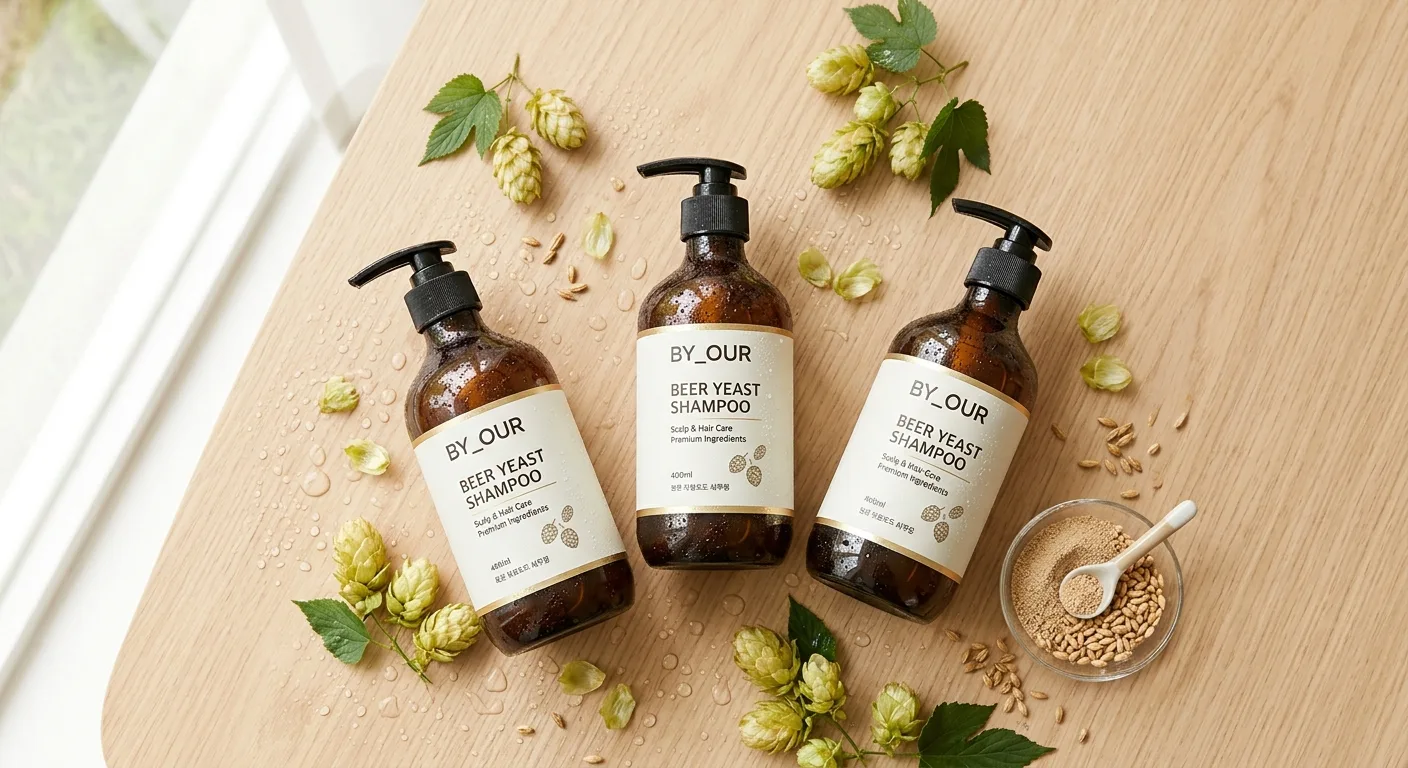
Beer yeast shampoo is one of the largest hair-care categories in Korea, and BY_OUR is one of the brands that built it. The pitch is simple: brewer’s yeast, the Saccharomyces cerevisiae left over from brewing, is dense in protein, B vitamins, minerals and cell-wall beta-glucan, so a shampoo built around a high concentration of yeast extract should feed the scalp. The reality is more interesting and more limited than the pitch. Some of what brewer’s yeast contributes is real and measurable; some of the claims made for it belong to oral nutrition, not to a rinse-off product; and the part of these shampoos that carries a regulated hair-loss claim in Korea is usually a separate, well-documented set of actives that sit alongside the yeast.
This guide explains what brewer’s yeast actually is, how “810,000 ppm” should be read, what the Korean functional-cosmetic label for hair-loss symptom relief does and does not mean, what the evidence says about biotin and caffeine on the scalp, and how to build a scalp routine around the BY_OUR line without expecting more from it than a shampoo can deliver.
What brewer’s yeast is, and what is actually in it
Brewer’s yeast is Saccharomyces cerevisiae, the same species used for bread and beer. After fermentation the spent cells are harvested, and in food use they are dried and often deactivated; that deactivated product is what nutrition writers call nutritional yeast. Cleveland Clinic’s dietitians describe it as a complete protein containing all nine essential amino acids, a rich source of B vitamins, and a carrier of two distinctive fibres, alpha-mannan and beta-glucan. The key difference between brewer’s and nutritional yeast is that nutritional yeast is heated so it can no longer ferment; the nutrient profile is otherwise similar.
The cell wall is where the cosmetic interest lies. A 2016 paper in Scientia Pharmaceutica describes the S. cerevisiae wall as built from mannan, chitin and polysaccharides of the β-1,3- and β-1,6-glucan type, with (1→3)-β-D-glucan giving the wall its shape and rigidity. Yeast beta-glucan is used in skincare as a film-forming humectant and soothing agent, and a yeast ferment filtrate brings amino acids, peptides, small sugars and minerals into solution. That is what a “beer yeast extract” in a shampoo is: a water-based ferment filtrate, not a spoonful of yeast powder.
This distinction matters for reading claims. Protein “ten times that of milk”, B-vitamin density and selenium content are true of dried yeast eaten as food. They say nothing about how much of any nutrient survives extraction, formulation and a sixty-second contact with the scalp before rinsing. What a well-made yeast ferment can plausibly do on a scalp is condition the surface with amino acids and beta-glucan, support the skin barrier, and improve the feel of the hair fibre.
How to read “81 percent” and “810,000 ppm”
Parts per million is a mass fraction: 10,000 ppm is 1 percent, so 810,000 ppm is 81 percent. When a shampoo label says 81 percent beer yeast, it means that 81 percent of the formula by weight is the yeast ferment extract ingredient as supplied, and that ingredient is itself mostly water carrying dissolved ferment solids. The brand’s 100,000 ppm treatment, by the same arithmetic, is 10 percent extract. Neither number tells you the dry-solids content, which is the figure that would actually describe how much yeast material is present, and Korean labelling does not require it.
The honest reading is comparative. An 81 percent extract formula has replaced most of the plain water that a conventional shampoo would use with a ferment solution, so it will carry more amino acids and beta-glucan than a shampoo that lists yeast extract near the end of the ingredient list. That is a real formulation choice with a real effect on feel. It is not a dose of nutrients comparable to eating yeast, and it should not be compared with the concentration of a leave-on scalp serum, which stays on the skin for hours rather than seconds.
What Korea’s hair-loss-relief label means
Many BY_OUR products are sold in Korea as functional cosmetics for hair-loss symptom relief. According to the U.S. International Trade Administration’s market brief on the category, the Ministry of Food and Drug Safety reclassified hair-loss alleviation products from quasi-drugs to functional cosmetics in 2017, functional-cosmetic status requires MFDS review that typically takes three to six months, and review cases in the category rose from 28 in 2021 to 131 in 2023. Two standard compositions can be registered without new efficacy data: dexpanthenol 0.2 percent with salicylic acid 0.25 percent and L-menthol 0.3 percent, or niacinamide 0.3 percent with dexpanthenol 0.5 percent, biotin 0.06 percent and 2.0 percent of a 50 percent zinc pyrithione solution.
Those combinations explain the ingredient lists of most Korean “hair-loss” shampoos, including yeast shampoos. The regulated claim rests on panthenol, salicylic acid, menthol, biotin, niacinamide or zinc pyrithione at defined levels; the yeast ferment is the brand’s differentiator and conditioning base rather than the source of the claim. It is also worth being precise about what the label promises. “Symptom relief” in this category refers to supporting the scalp environment and reducing the sensations and shedding associated with a stressed scalp. It is not a drug claim, it is not a promise of regrowth, and it is not a treatment for androgenetic alopecia, which needs medical assessment.
| Ingredient | Role in a beer yeast shampoo | What the evidence supports |
|---|---|---|
| Saccharomyces ferment extract | Conditioning base: amino acids, peptides, beta-glucan, minerals | Surface conditioning and barrier support; no clinical data for regrowth from rinse-off use |
| Dexpanthenol (pro-vitamin B5) | Humectant; part of MFDS standard compositions | Moisturising and soothing; recognised in Korea for hair-loss symptom relief at set levels |
| Salicylic acid | Keratolytic; loosens scale and sebum plugs | Lipophilic, penetrates follicles and dissolves keratin plugs; used in scalp seborrheic dermatitis regimens |
| L-menthol | Cooling; sensory relief | Immediate cooling sensation; part of the MFDS standard composition |
| Biotin | Marketing keyword and MFDS-listed ingredient | No proven benefit for hair in people without deficiency |
| Caffeine | Follicle-targeted active in some variants | Trials favour topical caffeine, but evidence quality is low to very low |
| Zinc pyrithione, niacinamide | Antifungal control; barrier support | Established in dandruff and seborrheic dermatitis care |
Biotin and caffeine: what the studies say
Biotin is the ingredient most associated with hair in marketing, and the evidence is the clearest. A 2017 review in Skin Appendage Disorders found only case reports, all in patients with an underlying pathology, and concluded that biotin has no proven efficacy in hair and nail growth of healthy individuals, with no randomised controlled trials in people without deficiency. Brewer’s yeast is a food source of biotin, but a shampoo is not a supplement, and a supplement does not help hair that is not biotin-deficient. Treat “biotin” on a shampoo label as a compliance and marketing term, not a mechanism.
Caffeine is more promising and less settled. A 2025 systematic review in Healthcare assessed nine clinical trials with 684 participants and found that all favoured topical caffeine, while grading three as medium-quality evidence, one as low and five as very low, citing missing randomisation, absent placebo groups and unreported caffeine concentrations. The authors’ conclusion is that topical caffeine appears safe and effective against hair loss but that better-designed trials are needed before a firm statement can be made. For a rinse-off shampoo the practical implication is modest: caffeine penetrates the follicle quickly, so brief contact can deposit some, but a leave-on tonic is the format where the ingredient has the best chance to matter.
Sebum, flakes and why yeast shampoos feel “cooling”
The oily-scalp and dandruff variants of the line lean on two well-understood tools. Salicylic acid is lipophilic; a 2025 clinical study in the Journal of Cosmetic Dermatology describes how it penetrates hair follicles and sebaceous glands, dissolves keratin plugs and reduces inflammation, and reports meaningful reductions in dandruff and itch scores over four to sixteen weeks in moderate-to-severe scalp seborrheic dermatitis when combined with piroctone olamine. Menthol provides the cooling that customers notice immediately; it activates cold receptors in the skin rather than lowering scalp temperature in any lasting way, and it is the reason the green-apple-mint variant feels different from the amber-wood variant even when the cleansing system is similar.
The dandruff picture also sets a boundary. Flaking driven by Malassezia yeast and altered sebum needs an antifungal such as zinc pyrithione, piroctone olamine, selenium sulfide or ketoconazole; a yeast ferment on its own does not treat it. If flakes are greasy, yellow and accompanied by redness, or if itch persists after a month of a salicylic acid shampoo, that is a dermatology visit, not a product change.
The BY_OUR range on EmpressKorea
BY_OUR is a lifestyle care brand from the Korean company NNB Cosmetics. A June 2025 trade report describes its flagship products as the Black Beer Yeast shampoo and the 810,000-ppm beer yeast shampoo, and notes distribution through E-mart, E-mart Traders and, from 2025, Lotte Mart. The brand’s own product page for its 500 ml beer yeast shampoo lists 100,000 ppm of German-origin beer yeast. The products below are current EmpressKorea listings; each is checked for availability before this article is published.
The Beer Yeast 81 Cool Shampoo in the green-apple-mint scent is the high-extract, menthol-cooled cleanser for scalps that run warm and oily. It is the variant to choose for summer, for exercise days and for anyone whose main complaint is an itchy, greasy scalp by evening.
The Beer Shampoo 81 percent in the amber-wood scent is the same extract level without the strong cooling, which suits normal and drier scalps and anyone who finds menthol harsh in winter.
The 100,000-ppm protein treatment is the conditioning step for the lengths. High-extract shampoos leave the fibre feeling slightly firm because the amino acids and beta-glucan deposit on the cuticle, and a treatment that adds slip and lipid is what turns that firmness into softness. Apply it from mid-length to ends, not to the scalp.
A scalp routine that uses the products correctly
- Wash the scalp, not the lengths. The American Academy of Dermatology advises applying shampoo to the scalp rather than the full length of the hair, and washing daily if the scalp is oily and the hair is straight. Wet the hair thoroughly with lukewarm water, apply a small amount of shampoo, and massage with fingertip pads for one to two minutes so the salicylic acid and menthol have contact time; do not use nails.
- Rinse completely. Ferment extracts and salicylic acid left behind can feel tacky or irritate. Rinse until the water runs clear and the scalp feels clean rather than coated.
- Condition the lengths. Apply the treatment from the ears down, leave it two to three minutes, and rinse. Fine or straight hair should keep conditioner to the ends; dry or curly hair can take it through the full length.
- Add a leave-on if you want an active to stay. Caffeine, panthenol and niacinamide have a better chance of doing anything in a tonic that remains on the scalp than in a product rinsed off in a minute.
- Dry gently. Wrap the hair in a towel to absorb water instead of rubbing, and detangle wet hair with a wide-tooth comb.
- Give it time, then reassess. Hair cycles are measured in months. Judge shedding and comfort after eight to twelve weeks, and photograph the part line under the same light at the start and end so the comparison is real.
For a broader view of how Korean scalp-first routines are structured, see our Korean hair care routine guide, and for a salon-brand comparison read the Amos Professional scalp and hair guide. The full range of cleansers, tonics and treatments is in the scalp care category.
Who should use a beer yeast shampoo, and who should see a doctor
A high-extract yeast shampoo is a sensible choice for an oily, warm or seasonally shedding scalp that wants a mild, protein-conditioned cleanse with cooling and light exfoliation. It is compatible with colour-treated hair as long as the formula is sulfate-free or mild and the lengths are conditioned; it is safe for daily use on an oily scalp; and it is a reasonable first step for someone whose “hair loss” is really a stressed, itchy scalp. It is not a treatment for pattern hair loss, for sudden or patchy shedding, for hair loss after illness or medication changes, or for persistent scaling with redness. Those situations deserve a dermatologist, and the earlier the visit, the more options remain. Used with that boundary in mind, the BY_OUR line delivers what a shampoo can: a cleaner, calmer scalp and hair that feels stronger between washes.
Sources
- Beyond Post (2025): NNB Cosmetics brand BY:OUR expands nationwide distribution through Lotte Mart
- BY:OUR official store: 맥주효모 탈모 샴푸 500ml product page
- U.S. International Trade Administration: South Korea Cosmetics Hair Loss Products (MFDS functional-cosmetic rules)
- Cleveland Clinic: Nutritional Yeast, what it is and its nutrients
- Scientia Pharmaceutica (2016): Beta glucan extracted from Saccharomyces cerevisiae (cell-wall composition)
- Skin Appendage Disorders (2017): A Review of the Use of Biotin for Hair Loss
- Healthcare (2025): Caffeine as an Active Ingredient in Cosmetic Preparations Against Hair Loss, a systematic review
- Journal of Cosmetic Dermatology (2025): Salicylic acid/piroctone olamine in scalp seborrheic dermatitis
- American Academy of Dermatology: Tips for healthy hair
Frequently Asked Questions
Does beer yeast shampoo make hair grow?
No shampoo has been shown to regrow hair, and the nutrients in brewer's yeast support hair when they are eaten rather than rinsed off the scalp. What a high-extract yeast shampoo can do is condition the scalp surface with amino acids and beta-glucan, control oil with salicylic acid and cool with menthol, which can reduce the itch and seasonal shedding that come with a stressed scalp. Progressive or patchy thinning needs a dermatologist, and the earlier the visit the better.
What does 810,000 ppm or 81 percent beer yeast actually mean?
Parts per million is a mass fraction, so 810,000 ppm equals 81 percent of the formula by weight. That figure describes the yeast ferment extract ingredient as supplied, which is a water-based filtrate carrying dissolved ferment solids, not dry yeast powder. It tells you the formula replaced most of its plain water with ferment solution, which affects feel and conditioning, but it does not state the dry-solids content or equal a nutritional dose.
What does Korea's hair-loss symptom relief label mean on a shampoo?
Since 2017 the Ministry of Food and Drug Safety has classified hair-loss alleviation products as functional cosmetics rather than quasi-drugs, and each product passes an MFDS review. Standard compositions built on dexpanthenol, salicylic acid and L-menthol, or on niacinamide, dexpanthenol, biotin and zinc pyrithione, can be registered without new efficacy data. The claim means scalp-environment support and symptom relief; it is not a drug claim and not a promise of regrowth.
Is biotin in a shampoo useful?
A 2017 review in Skin Appendage Disorders found only case reports in patients with an underlying condition and concluded that biotin has no proven efficacy for hair or nail growth in healthy people, with no randomised trials in those without deficiency. In a shampoo, biotin is mainly a labelling and marketing ingredient and part of a recognised Korean standard composition; it is not the reason a yeast shampoo feels or performs the way it does.
Can I use BY_OUR beer yeast shampoo every day and on coloured hair?
Daily use suits an oily scalp with straight hair, which dermatologists say can be shampooed every day; drier or textured hair does better with fewer washes. Focus the shampoo on the scalp, rinse thoroughly and always condition the lengths, because high-extract formulas can leave the fibre feeling firm. Colour-treated hair is compatible with mild, sulfate-free variants as long as the lengths are conditioned and the water is lukewarm rather than hot.
How long before I can judge whether a scalp routine is working?
Hair growth cycles run in months, so reassess after eight to twelve weeks rather than a few washes. Immediate effects such as cooling, reduced oiliness and less itch are real but are not the same as reduced shedding. Photograph the part line under the same light at the start and end of the period, count shed hairs on a fixed day each week if you want data, and consult a dermatologist if shedding increases or patches appear.