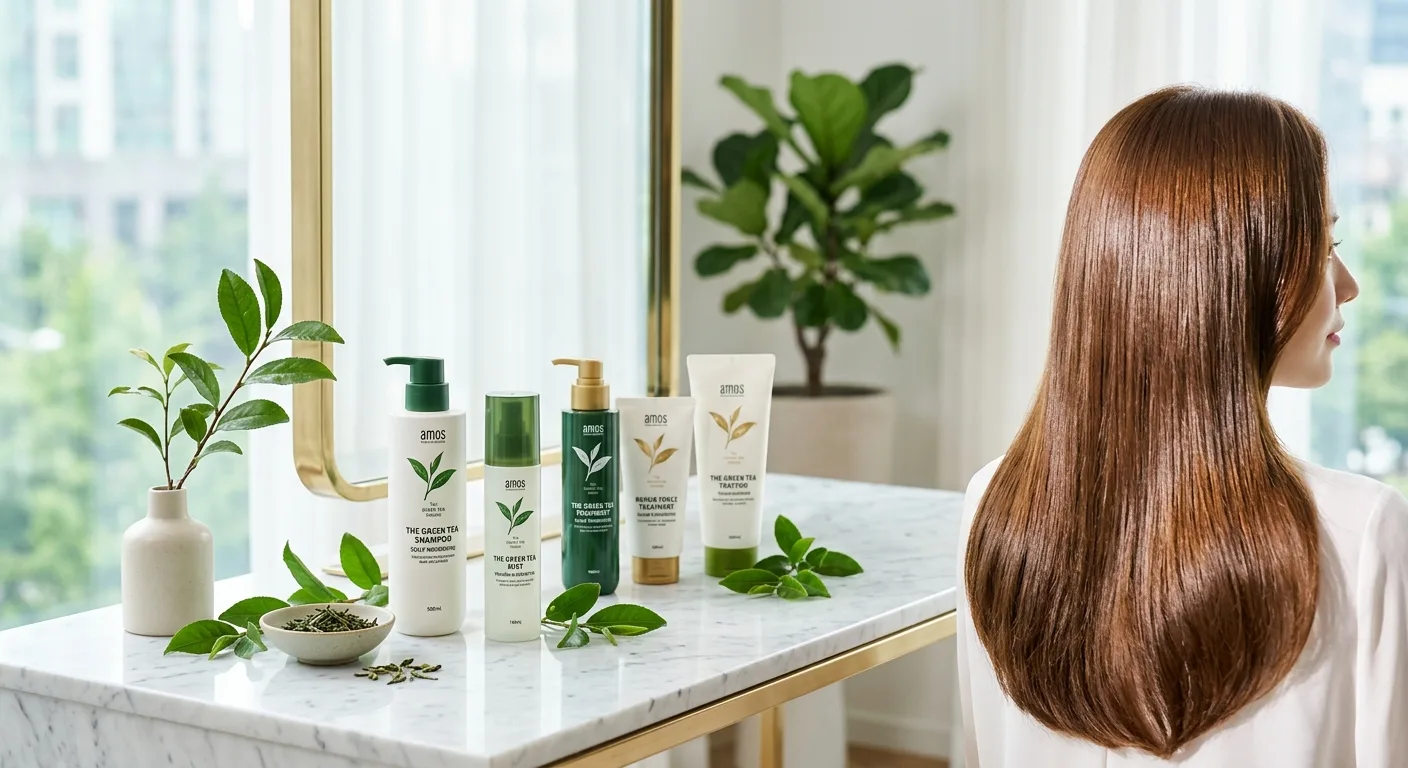
Amos Professional is the salon brand of Amorepacific, Korea’s largest cosmetics group, and it is the name most often seen on the back bar of Seoul salons. Unlike the group’s retail hair brands, it was built for hairdressers: products are sold through authorised salons, formulated to the demands of stylists who perm, colour and blow-dry all day, and organised by problem rather than by fragrance or trend. That professional logic is why the range can look confusing from outside. This guide explains the brand’s history, how its scalp-care and hair-care lines are meant to be used together, what green tea, salicylic acid, caffeine and cell-membrane-complex lipids actually do, how to work out your own scalp type, and which products on EmpressKorea correspond to each need.
Where the brand comes from
The brand’s own history page places its launch in 1990, when Amorepacific introduced Amos Professional alongside the Coloring Q dye and the Hair Force anti-hair-loss line. The corporate lineage behind it is older: the company traces itself to camellia-oil hair products made in 1932, introduced Korea’s first plant-based men’s pomade in the 1950s, and set up an in-house research laboratory in the 1960s. In the 2000s the brand added a hair collection and a stylist team, an education centre, the Colorjenic dye and the first Green Tea scalp-care line, and through the 2010s it ran annual hair-trend shows and backstage work at Seoul Fashion Week. Recent additions include the Repair Cica clinic line in 2020 and, between 2023 and 2025, the Repair CMC line, a new Green Tea serum, a Renew Camellia oil and the Hair Fit Curl Up Jelly.
Amorepacific’s brand page describes the positioning plainly as a premier salon brand offering scientifically validated hair and scalp solutions, and a company interview with an Amos product developer explains the method: the brand recruits panels of stylists to test domestic and international products, because a product has to satisfy professionals before it reaches a consumer. The practical result is that Amos products tend to be concentrated, sold in large pump bottles, and specific about the problem they solve.
Scalp care and hair care are different disciplines
The single most useful idea in the Amos catalogue is that the scalp and the hair fibre are treated as separate patients. Scalp care is skin care: it deals with sebum, the Malassezia yeast that feeds on it, inflammation, flaking and the follicle environment. Hair care is materials science: it deals with a dead keratin fibre whose cuticle, cortex lipids and protein cross-links are damaged by bleach, colour, perms and heat, and which can be conditioned and reinforced but not healed. A shampoo is a scalp product that happens to run down the hair; a treatment or mask is a fibre product that should stay off the scalp. Most disappointing hair routines come from confusing the two, for example using a heavy repair mask at the roots of an oily scalp, or expecting a scalp shampoo to fix split ends.
| Line | Problem it addresses | Key actives | Use on |
|---|---|---|---|
| Green Tea (oily / dry / sensitive scalp) | Sebum, itch, flakes, hair-loss symptoms (Korean functional-cosmetic claim) | Shade-grown Jeju green tea extract, caffeine, cooling and keratolytic agents by version | Scalp; lather at the roots |
| Repair CMC | Porous, brittle, tangling damaged hair | Cell-membrane-complex lipids, amino acids, botanical humectants | Mid-lengths and ends |
| Colour and Perm | Fading colour, loosening curl, post-service dryness | Mild surfactant system, pH control, macadamia oil, amino acids | Scalp-safe wash; conditioner on lengths |
| Salon Master Prep | Resistant hair before a chemical service | Alkaline pH 8 formula with 16 amino acids | Salon use before perm or colour |
| Styling (waxes, curling essence, gels) | Hold, texture, curl definition | Film formers, waxes, polymers | Dry or damp lengths |
The Green Tea line: what the ingredient does and does not do
The Green Tea line is the brand’s signature. According to the brand’s March 2023 announcement, the reformulated range uses shade-grown green tea, which the brand says contains about three times the amino acids of standard leaf, with 150 percent more green tea extract than the previous formula, and it is sold in versions for oily, normal-to-dry and sensitive scalps across six product types: cleanser, moisture pack, tonic, volume mist, volume mousse and shampoo. The product page for the dry-scalp shampoo confirms that it is registered in Korea as a functional cosmetic for hair-loss symptom relief and that the line is sold only through authorised Amos Professional salons.
Why green tea? The polyphenol epigallocatechin-3-gallate, EGCG, is the compound with the most research. A 2007 study in Phytomedicine reported that EGCG promoted hair growth in human hair follicles cultured ex vivo and the proliferation of dermal papilla cells, with effects attributed to proliferative and anti-apoptotic signalling. A 2025 study in Biochimica et Biophysica Acta Molecular Cell Research went further into mechanism, finding that EGCG increased dermal papilla cell proliferation and migration through the induction of VEGFA, the growth factor that supplies follicles with blood vessels, at concentrations as low as 0.5 micromolar. Those are laboratory findings. There is still no robust clinical trial showing that a green tea shampoo or tonic regrows hair on human scalps, which is why the honest claim is scalp conditioning and symptom relief, and why the Korean regulator classifies these products as functional cosmetics rather than drugs.
Caffeine, which the brand pairs with green tea in the oily-scalp shampoo, is in a similar position. A 2025 systematic review in Healthcare examined nine clinical trials of topical caffeine involving 684 participants and found that all favoured caffeine, but rated most of the evidence low or very low because of missing randomisation, absent placebo groups and unreported concentrations. Expect a well-formulated caffeine shampoo to deliver a little of the ingredient to the follicle during a two-minute massage; expect a leave-on tonic to do more.
Sebum, flakes and the oily-scalp problem
The oily-scalp version of the Green Tea shampoo is built for the most common salon complaint in humid Korean summers: roots that are flat and greasy by afternoon, with itch and sometimes flakes. The biology is well described. A 2013 review in the Journal of Clinical and Aesthetic Dermatology explains that seborrheic dermatitis and dandruff arise from the interaction of sebaceous secretion, Malassezia yeast and the host’s inflammatory response; the yeast produces lipases that split triglycerides in sebum into irritant free fatty acids, which drive scaling and inflammation. Effective scalp shampoos therefore do two things: lower the sebum load and control the yeast.
Salicylic acid handles the first job. A 2025 clinical study in the Journal of Cosmetic Dermatology notes that it is lipophilic, so it penetrates follicles and sebaceous glands, dissolves keratin plugs and has anti-inflammatory activity, and it reports meaningful drops in dandruff and itch scores over four to sixteen weeks when combined with the antifungal piroctone olamine. Antifungals such as zinc pyrithione, piroctone olamine, selenium sulfide and ketoconazole handle the second job. If your flakes are greasy, yellow and sit on red skin, a cosmetic scalp shampoo alone is not enough; that pattern is seborrheic dermatitis and benefits from an antifungal and, if it persists, a dermatologist.
Repairing the fibre: CMC lipids and amino acids
Hair’s cell membrane complex is the lipid-and-protein cement that holds cuticle cells to each other and to the cortex. Bleach, permanent colour, perms and repeated heat strip those lipids and break protein cross-links, which is why damaged hair swells in water, tangles, snaps when stretched and looks dull: light scatters off a lifted, ragged cuticle instead of reflecting from a smooth one. The Repair CMC line rebuilds the surface with a lipid complex that mimics the missing cement, supported by hydrolysed amino acids that can penetrate a porous fibre and by humectants that keep the cortex hydrated. The effect is real and repeatable, but it is a coating and a fill, not a cure; the fibre stays damaged underneath and needs the treatment reapplied every few washes.
Colour- and perm-treated hair has a second problem: the service itself leaves the fibre swollen and alkaline, and colour molecules or reformed curls are held inside a cuticle that has not fully closed. A mild, slightly acidic shampoo helps the cuticle lie flat, which slows colour fade and keeps curl definition, and a conditioner with amino acids and oils replaces what the service removed. The brand’s Salon Master Prep shampoo is the opposite tool: an alkaline pH 8 wash used before a service to soften resistant cuticles so the chemistry takes evenly. It belongs in a salon, not in a home shower.
How to diagnose your scalp type
Salon consultations start with the scalp, and you can run the same check at home. Wash in the evening with a neutral shampoo and no styling products, then assess the scalp the next morning, roughly eight hours later.
- Oily: the roots already look separated or shiny, a fingertip pressed to the crown comes away with visible sebum, and a tissue blotted on the scalp shows oil. Choose the oily-scalp shampoo, wash daily if the hair is straight, and keep treatments off the roots.
- Dry: the scalp feels tight or itchy, small dry white flakes appear with brushing, and there is no sebum on the tissue. Choose the dry-scalp version, wash every second or third day, and use lukewarm water.
- Sensitive: the scalp stings with many shampoos, shows patches of redness, or reacts to fragrance and menthol. Choose the sensitive version, avoid strong cooling agents, and patch-test tonics behind the ear.
- Combination: oily at the crown and dry at the hairline is common. Treat by the crown, because that is where sebum and Malassezia concentrate, and moisturise the lengths separately.
Hair type is a separate question. Fine, coarse, straight, wavy and curly hair change how much conditioner you need and where you put it; they do not change which scalp shampoo you should use.
Washing technique that makes the products work
- Brush before you wet. Detangling dry hair with a wide-tooth comb reduces breakage in the shower and lifts surface debris so the shampoo reaches the scalp.
- Use lukewarm water and wet thoroughly. Hot water dissolves more sebum than you want to lose and leaves the scalp reactive; a full minute of rinsing before shampoo removes most loose oil and product.
- Put the shampoo on the scalp, not the lengths. The American Academy of Dermatology advises applying shampoo to the scalp and letting the lather clean the hair as it rinses, and washing daily only if the scalp is oily and the hair straight; dry and textured hair needs fewer washes.
- Massage with fingertip pads for one to two minutes. Contact time is what lets salicylic acid, caffeine and green tea extract do anything; nails scratch and inflame.
- Rinse until the scalp squeaks. Residual surfactant and actives itch. Rinse longer than feels necessary.
- Treat the lengths. Squeeze out water, apply the treatment from the ears down, leave it two to five minutes, and rinse. Fine hair keeps conditioner to the ends; dry or curly hair takes it through the full length.
- Dry gently and add a leave-on. Wrap the hair in a towel rather than rubbing, then apply a scalp tonic or serum if you want an active to stay on the skin, and a leave-in or oil to the ends if the fibre is damaged.
Choosing from the range on EmpressKorea
The products below are current EmpressKorea listings, matched to the diagnosis above; each is checked for availability before this article is published.
The Green Tea Shampoo for oily scalp is the daily wash for greasy roots and afternoon itch. It combines Jeju green tea extract with caffeine and is the version to start with if a tissue test shows sebum.
The Green Tea Shampoo for dry scalp uses the same shade-grown green tea base with a more moisturising cleansing system for tight, flaky or thinning scalps that do not produce much oil.
The Repair CMC Treatment is the fibre product for hair that tangles, snaps or looks dull after colour, bleach or heat. It goes on the mid-lengths and ends after any of the shampoos above and is repeated every few washes because a lipid coating is not permanent.
The Colour and Perm Shampoo in the professional one-kilogram size is the gentle daily wash for chemically treated hair, formulated to keep the cuticle flat so colour and curl last longer between salon visits.
For a comparison with the high-extract yeast shampoos that dominate Korean retail, read our BY_OUR beer yeast shampoo guide; for a routine framework see the Korean scalp-first hair care routine. The complete range is in the hair care and scalp care categories.
Realistic expectations
Used as designed, Amos Professional gives a scalp that stays cleaner and calmer between washes and hair that feels smoother, reflects more light and breaks less. It does not regrow hair, it does not reverse chemical damage, and its hair-loss-relief registration in Korea describes symptom support, not a treatment for pattern hair loss. Judge a scalp routine after eight to twelve weeks using photographs of the part line under the same light, count shed hairs on a fixed day if you want numbers, and see a dermatologist for patchy, sudden or steadily progressive loss. Within those limits, the brand’s separation of scalp care from hair care is the most useful habit a Korean salon can teach.
Sources
- Amos Professional: brand history timeline
- Amos Professional news (2023): upgraded Green Tea (녹차실감) line announcement
- Amos Professional: The Green Tea Shampoo for dry scalp product page
- Amorepacific: Amos Professional brand page
- Amorepacific Stories: Amos Professional product developer interview
- Phytomedicine (2007): Human hair growth enhancement in vitro by green tea EGCG
- Biochimica et Biophysica Acta Molecular Cell Research (2025): EGCG promotes dermal papilla cell proliferation through VEGFA
- Healthcare (2025): Caffeine in cosmetic preparations against hair loss, systematic review
- Journal of Clinical and Aesthetic Dermatology (2013): Optimizing Treatment Approaches in Seborrheic Dermatitis
- Journal of Cosmetic Dermatology (2025): Salicylic acid/piroctone olamine in scalp seborrheic dermatitis
- American Academy of Dermatology: Tips for healthy hair
Frequently Asked Questions
What is Amos Professional and who makes it?
Amos Professional is the salon hair brand of Amorepacific, Korea's largest cosmetics group. The brand's own history page dates its launch to 1990, and the company develops products with panels of stylists and sells them through authorised salons. The catalogue is organised by problem: the Green Tea line for scalp care, Repair CMC for damaged fibre, Colour and Perm for chemically treated hair, a pre-service prep shampoo and a styling range.
Does the Amos Green Tea shampoo stop hair loss?
It is registered in Korea as a functional cosmetic for hair-loss symptom relief, which describes scalp-environment support rather than regrowth. Green tea EGCG has laboratory evidence for stimulating dermal papilla cells and VEGFA, and topical caffeine has encouraging but low-quality clinical evidence, but no shampoo has been shown to regrow hair in a robust human trial. Use it for a cleaner, calmer scalp and see a dermatologist for patchy or progressive thinning.
Which Green Tea version should I choose: oily, dry or sensitive?
Decide by the scalp, not the hair. Wash in the evening and check the next morning: visible sebum on a tissue pressed to the crown means the oily version; a tight, itchy scalp with small dry flakes and no oil means the dry version; stinging, redness or reactions to fragrance and menthol mean the sensitive version. A scalp that is oily at the crown and dry at the hairline is treated by the crown, with the lengths moisturised separately.
What is CMC in the Amos Repair line?
CMC stands for cell membrane complex, the lipid-and-protein cement between hair cuticle cells and the cortex. Bleach, colour, perms and heat strip those lipids, which makes hair porous, tangly, brittle and dull. The Repair CMC products replace the missing lipid layer and add hydrolysed amino acids and humectants, restoring slip and shine. The effect is a coating and a fill rather than a cure, so it needs reapplying every few washes on the lengths only.
How should I wash my hair to get the most from a scalp shampoo?
Detangle dry hair first, wet it thoroughly with lukewarm water, and apply the shampoo to the scalp rather than the lengths, as dermatologists recommend. Massage with fingertip pads for one to two minutes so actives such as green tea, caffeine and salicylic acid have contact time, then rinse longer than feels necessary. Apply treatment or conditioner from the ears down, leave it two to five minutes, rinse, and blot dry with a towel instead of rubbing.
Can I use Amos Professional products at home if they are salon products?
Yes, with one exception. The shampoos, treatments, tonics and styling products are designed for daily home use between salon visits and are sold in large pump sizes for that reason. The Salon Master Prep shampoo is different: it is an alkaline pH 8 wash used by stylists before a perm or colour to soften resistant cuticles, and it should not be part of a home routine because it opens the cuticle rather than protecting it.