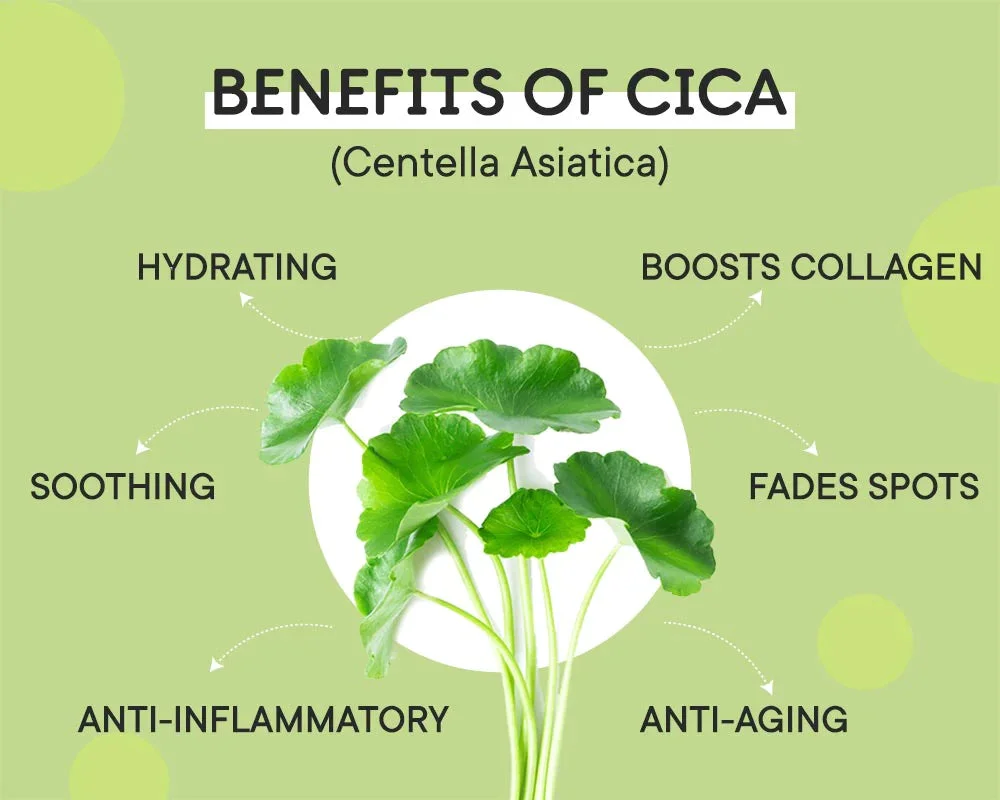
“Cica” is useful shorthand for shoppers but poor scientific identification. Two cica creams can use different Centella species documentation, plant parts, extraction solvents, marker compounds and concentrations. A third may contain only isolated madecassoside.
The former article treated all Centella constituents as one synergistic complex that accelerates healing, increases collagen, blocks inflammation and free radicals, deeply hydrates, prevents aging and transforms skin. It then advised choosing products by a high ingredient-list position, which cannot reveal active dose.
A name map for cica products
| Label material | What it identifies | What remains unknown |
|---|---|---|
| Centella asiatica extract | Botanical extract under an INCI name | Plant part, solvent, markers and active dose |
| Centella leaf/root/callus extract | More specific source tissue | Standardization and concentration |
| Madecassoside / asiaticoside | Triterpene glycosides | Percentage and vehicle delivery |
| Madecassic / asiatic acid | Aglycone triterpenes | Dose, stability and finished-formula effect |
| TECA or branded complex | Defined supplier blend if documentation exists | Exact grade and level in the product |
Botanical identity comes first
The medicinal and cosmetic plant is Centella asiatica (L.) Urb. Common names such as gotu kola, tiger grass and Indian pennywort are not sufficient manufacturing specifications. Species authentication, geography, harvest, plant part and contamination control matter.
A supplier certificate and marker assay provide stronger identity than a front-label leaf illustration.
Whole-plant, leaf and callus extracts differ
Whole-plant and leaf extracts can contain different ratios of triterpenes, polyphenols and other constituents. Callus culture is produced under controlled cell-culture conditions and is not compositionally identical to field-grown leaf.
Do not pool evidence for one extract into another without chemical characterization.
Extraction changes the material
Water, ethanol and mixed solvents extract different fractions. Temperature, time and purification also change composition. A product can list a high percentage of extract solution that contains mostly solvent and a much smaller dry extract fraction.
“Raw,” “fermented,” “nano” and “purified” need supplier specifications and finished-product data rather than assumed superiority.
How to read ppm claims
Parts per million is a ratio. Ten thousand ppm equals 1% of the named input when the denominator is the finished formula. But 20% Centella extract solution is not 20% madecassoside.
Ask whether ppm refers to plant water, extract, dry residue, one marker compound or a branded blend. The large number alone does not rank efficacy.
The four famous triterpenes
Madecassoside and asiaticoside are glycosides; madecassic acid and asiatic acid are related aglycones. Reviews discuss effects across cell, animal and human models, but each material has different solubility, metabolism and formulation needs.
The presence of all four can improve chemical definition. It does not prove synergy, optimum ratio or clinical superiority.
What TECA means
TECA commonly refers to a titrated or standardized extract of Centella asiatica with defined triterpene fractions. The exact commercial grade and specification should be verified because acronyms and branded complexes can be used loosely in retail copy.
A study of one standardized pharmaceutical or cosmetic material cannot be transferred to an unspecified plant water.
For a supplier document, look for the botanical Latin name, plant part, extraction solvent, drug-extract ratio or dry-residue specification, named marker compounds, assay method, batch range, residual solvents, microbial limits, heavy metals and storage stability. Then confirm the percentage of that supplied material in the finished product. Without both documents, a branded complex name cannot be converted into an active triterpene dose.
Ingredient-list order is not an active-dose meter
Cosmetic ingredients are generally listed in descending order above a jurisdictional threshold, while lower-level ingredients may appear in flexible order. Extract solutions also bring carrier water or glycols that complicate the apparent position.
“Among the first five ingredients” does not establish a therapeutic concentration. Ask for the exact material percentage or marker assay when the dose matters.
Build an evidence ladder
- Chemical identity and stability in the exact formula.
- Cell or biochemical mechanism.
- Animal or ex vivo skin model.
- Human tolerability.
- Controlled human efficacy for the same material and endpoint.
- Replicated finished-product trial in intended users.
Each rung answers a different question. A mechanism does not guarantee a visible consumer result.
Wound evidence has a narrow scope
A 2022 systematic review of Centella and wound healing found four eligible clinical trials and concluded that more studies were needed for meta-analysis and firmer effects. Wounds, burns and surgical sites are not equivalent to intact cosmetic skin.
Do not put an ordinary cica cosmetic on an open wound or replace medical wound care with a serum.
Mechanistic wound claims need translation
Reviews discuss angiogenesis, cytokines, collagen pathways and re-epithelialization. These endpoints depend on model and dose. More collagen in a wound model is not automatically desirable anti-aging performance on normal facial skin.
Report the studied material, route, lesion and time rather than summarizing it as “heals skin.”
Wrinkle evidence is promising but not universal
A systematic review included five double-blind randomized trials with 172 Asian women. It found possible improvements but noted weak reporting and lack of Centella standardization, limiting general application.
Periocular gels, creams and an asiaticoside lipstick over eight to twelve weeks do not prove every cica toner prevents visible wrinkle development.
Redness and “calming” need defined endpoints
Calming can mean lower self-rated sting, less visible erythema, reduced temperature or faster recovery after a controlled irritant. A cool gel texture can improve sensation without changing inflammation.
Look for the exact challenge model, comparator, instrument, timing and effect size. Marketing photographs cannot separate lighting and natural fluctuation.
Acne evidence must match acne type
Cell and animal anti-inflammatory findings do not establish comedone or inflammatory-lesion reduction. Acne trials need diagnosed participants, lesion counts, duration and comparison with vehicle or standard treatment.
A cica moisturizer may improve tolerance around acne therapy while doing little to the acne itself. Those are different outcomes.
Hydration may come from the base formula
Glycerin, glycols, hyaluronic acid, betaine, panthenol, emollients and occlusives often dominate a cica product’s hydration. Attributing all moisture to trace Centella ignores the vehicle.
Evaluate several-hour hydration and transepidermal water loss for the complete formula, not the hero ingredient alone.
Barrier support requires lipid and measurement context
A product may combine Centella with ceramides, cholesterol or fatty acids. Barrier recovery depends on complete composition and use. Centella presence alone does not reconstruct stratum-corneum lipids.
Useful endpoints include transepidermal water loss, hydration, symptoms and recovery after a standardized challenge.
Antioxidant assays are not anti-aging trials
Radical-scavenging assays and cell oxidative-stress models can compare materials under laboratory conditions. They do not establish prevention of human photoaging at cosmetic exposure.
Stability in the final package, skin exposure and clinically meaningful endpoints are required.
Vehicle can change delivery and irritation
A water serum, hydrogel, emulsion, balm, lip product and microneedle system create different contact, occlusion and delivery. Reviews of advanced wound systems cannot be generalized to a simple toner.
Fragrance, alcohol, acids, retinoids and preservatives may dominate tolerability even when Centella itself is well tolerated.
Cica can cause contact allergy
Published case reports document allergic contact dermatitis to Centella extract, sometimes alongside fragrance allergens. Rare reports do not make the ingredient broadly unsafe, but they disprove “cannot irritate” claims.
Stop with progressive itch, swelling, rash or blistering. Persistent reactions may need formal patch testing.
CIR safety and efficacy are different reviews
The Cosmetic Ingredient Review assesses safety of multiple Centella-derived ingredients as used in cosmetics. A safety conclusion under use conditions does not certify that a product calms, heals or removes wrinkles.
Confirm which INCI material the assessment covers. A plant extract and isolated madecassoside are not interchangeable names.
EMA monographs are medicinal context
The European Medicines Agency maintains a herbal monograph and assessment report for Centella herb in the area of skin disorders and minor wounds. That is a regulated medicinal-evidence context, not automatic authorization for cosmetic drug claims.
Use medicinal monographs to understand defined preparations and traditional-use boundaries, then apply the correct law to the marketed product.
A conservative introduction method
- Choose one exact product and record its full INCI.
- Test a small area repeatedly before full-face use.
- Keep cleanser, treatment and moisturizer stable.
- Apply the labeled amount at the intended step.
- Track one endpoint such as sting, redness or dryness.
- Stop for progressive reaction rather than forcing adaptation.
How to compare two cica products
- Exact Centella-derived INCI names.
- Whole extract versus isolated or standardized fraction.
- Declared input percentage and denominator.
- Fragrance, alcohol and other active ingredients.
- Vehicle, package and intended area.
- Finished-product tolerability and efficacy protocol.
- Price per usable amount, not ppm headline.
No product cards are shown
This is an ingredient-literacy guide and does not rank current EK cica products. A card would imply that the SKU’s exact extract, standardization and evidence had been verified against this framework.
Exact-product recommendations belong in separate current formula guides.
The practical verdict
Centella is a chemically and clinically interesting botanical, but “cica” collapses many materials into one retail word. The evidence is strongest when extract identity, standardization, dose, vehicle and endpoint match.
Read exact INCI names, treat ppm cautiously, separate wound and cosmetic skin, and test the finished formula. A plant’s history and mechanisms do not guarantee transformation, universal calming or anti-aging.
Sources
- Systematic review of Centella and wound healing
- Review of Centella pharmacology in skin disease
- Systematic review of Centella and wrinkles
- Contact dermatitis from Centella and fragrance allergens
- Cosmetic Ingredient Review: Centella-derived ingredients
- European Medicines Agency: Centella herb monograph record
- FDA: Cosmetic claim boundaries
- FDA: Finished cosmetic product testing
Frequently Asked Questions
Is cica the same as Centella asiatica extract?
Not always. Cica can refer to a whole or part-specific extract, isolated triterpenes, a standardized blend such as TECA, or a product category containing several of them.
Does a high Centella ppm guarantee better results?
No. Ppm must name the input and denominator. A high percentage of dilute extract solution is not the same as a high percentage of madecassoside or total triterpenes.
Do all four Centella triterpenes work better together?
Their co-presence can define a blend, but it does not by itself prove synergy, the optimal ratio or superiority in the finished product.
Can I use a cica cosmetic on an open wound?
Do not assume so. Wound studies use defined medicinal or experimental preparations. Ordinary cosmetics should be used only as labeled, and open wounds need appropriate care.
Can Centella cause allergy?
Yes, published contact-allergy cases exist, although they do not show that reactions are common. Stop with progressive rash, itch or swelling and seek evaluation when needed.