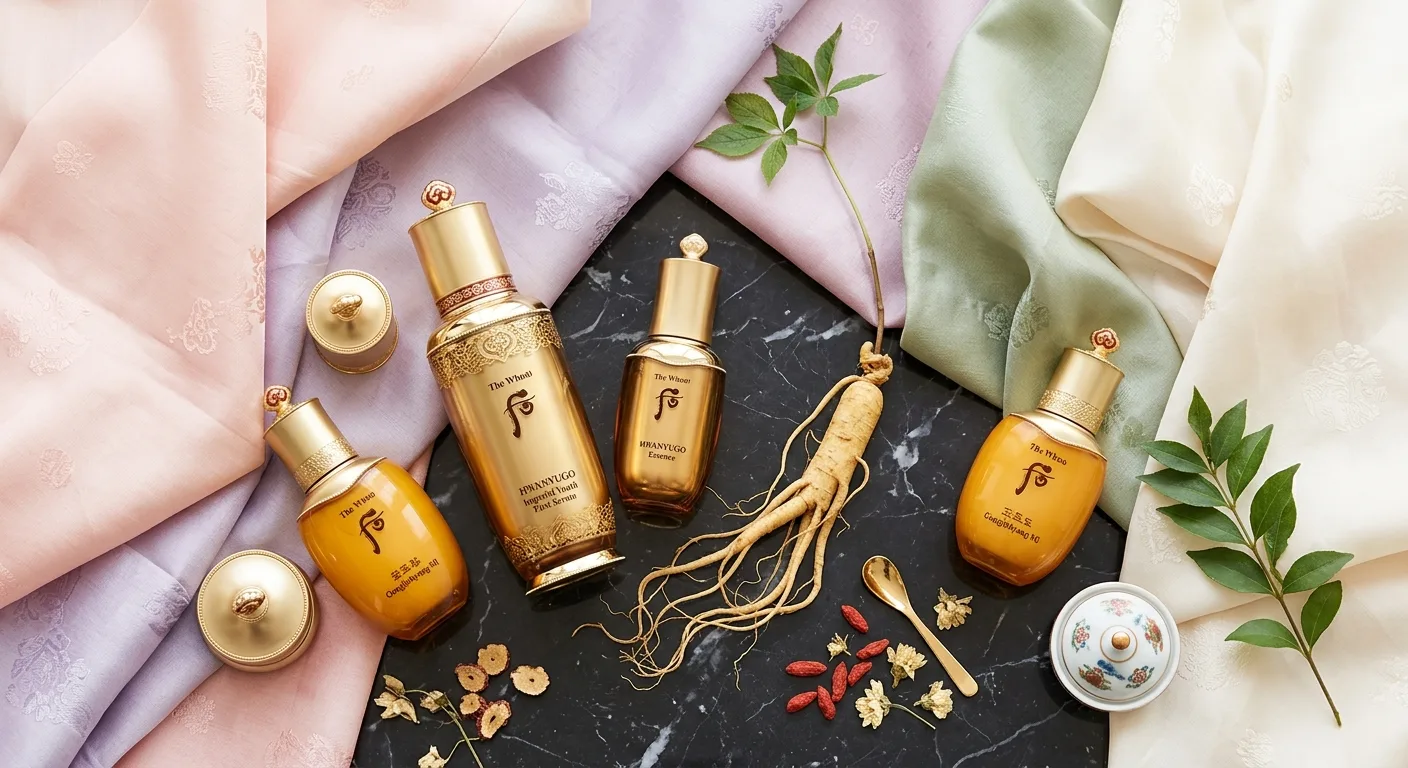
THE WHOO is the luxury skincare brand of LG Household & Health Care, launched in February 2003 as The History of Whoo and built around hanbang, the Korean tradition of herbal medicine as it was practiced for the royal court of the Joseon dynasty. The brand passed 20.1 trillion won in cumulative net sales by March 2025, opened a dedicated U.S. store in May 2025, and now mainly uses the shortened name THE WHOO. Popularity, however, is not a formulation argument. This guide explains what the lines actually contain, what the ingredient research does and does not show, and how to choose a product for mature skin without paying for the wrong texture.
The approach here is deliberately label-first. Hanbang brands communicate through poetic names such as Gongjinhyang, Cheongidan and Bichup. Behind those names sit ordinary cosmetic decisions: which plant extracts are used, how the emulsion is built, how occlusive the finish is, and which claims are regulated. Reading the range that way makes it far easier to buy well.
Where the royal-court story comes from
Joseon-era court medicine kept formulary records, and several classical preparations survive in Korean herbal pharmacopoeia. THE WHOO borrows those names and ingredient logic: the Gongjinhyang line takes its name from Gongjindan, a classical tonic prescription, and the brand’s own six-herb complex, Gongjinbidan, is built from deer antler velvet, wild thyme, Angelica gigas, Cornus officinalis, Acanthopanax and Asparagus cochinchinensis. The brand’s U.S. site describes a Royal Beauty Research Center and a botanic garden used to cultivate plant ingredients, and its signature material is wild ginseng described as requiring roughly 30 years of growth before harvest.
The heritage is genuine as cultural history. It is not, by itself, evidence of efficacy. A tonic taken orally in the seventeenth century and an extract dissolved into a modern emulsion are different things, and only the second is what you apply to your face. That distinction is the single most useful lens for evaluating any hanbang product.
How the brand is organized: lines, not products
THE WHOO sells by line, and each line signals both a hero ingredient story and a price tier. The table below summarizes the current structure as it appears in the EmpressKorea catalog and the brand’s own communications.
| Line | Positioning | Typical textures | Best routine fit |
|---|---|---|---|
| Gongjinhyang | Signature core line built on Gongjinbidan; includes Water Vital (hydrating), Seol (brightening) and Mi (makeup) sub-lines | Balancer, emulsion, essence, cream, foam cleanser | First hanbang routine; combination to normal skin |
| Bichup | Self-generating essence used as a first-step concentrate; fourth generation added NAD+ in March 2024 | Fluid essence, serum, cream | Anyone who wants one treatment step before moisturizer |
| Cheongidan (Hwahyun) | Radiance and elasticity line relaunched in 2023 with a stronger anti-aging message | Rich essence, cream, cushion | Dull, tired-looking skin that also wants richness |
| Cheonyuldan | Ultimate Rejuvenating line for advanced signs of aging | Lotion, emulsion, cream | Dry, mature skin that tolerates heavier layers |
| Jinyulhyang | Red wild ginseng anti-wrinkle line with a rose fragrance | Toner, eye cream, face oil, massage mask | Nightly nourishing routine; massage and occlusion |
| Hwanyu | Top-tier Imperial Youth collection; the products chosen for the U.S. launch | Emulsion, concentrate, cream, eye cream | Gift or flagship purchase for very dry, mature skin |
Sun care (UV Ultimate, Essentaill UV Protein Cream) and makeup (Gongjinhyang Mi) sit across the lines. For daytime use, the sunscreen’s labeled SPF and PA rating matters more than which line it belongs to.
Ginseng and the herbal complexes: what the research supports
Ginseng is the ingredient that most people associate with THE WHOO, and it is also the best-studied. A 2026 review in the Journal of Ginseng Research summarized skin studies published between 2021 and 2025. Ginsenosides such as compound K, Rg3, Rf and Re were reported to support barrier integrity, reduce UV-induced senescence markers, regulate collagen-degrading enzymes and suppress melanin synthesis in keratinocyte, fibroblast and melanocyte models, with hairless-mouse studies pointing in the same direction.
The same review is candid about the gap. The evidence is dominated by in-vitro and animal work; human clinical trials were essentially absent. Ginsenosides also have low solubility, limited skin permeability and rapid degradation, and most finished cosmetics use crude extracts rather than the purified rare ginsenosides used in experiments. The practical translation is modest: ginseng-rich formulas are plausible antioxidants and soothing agents, and they can improve the look of skin through hydration and film-forming, but a specific wrinkle-reduction outcome should not be inferred from cell-culture data.
Gongjinbidan’s other constituents have thinner cosmetic literature. Deer antler velvet, Angelica gigas and Cornus officinalis are traditional tonic materials; their skin effects in a leave-on emulsion have not been characterized in the same way. Treat them as part of the sensory and heritage identity, and let the base formula, hydration and comfort carry the decision.
Bichup, NAD+ and the delivery problem
The fourth-generation Bichup essence, launched in Korea in March 2024, added nicotinamide adenine dinucleotide, better known as NAD+, to a product that has sold more than ten million bottles since October 2009. NAD+ is a coenzyme central to cellular energy metabolism, and its decline with age has made it a popular longevity ingredient.
The science is interesting but early. A 2024 paper in Cells showed that exogenous NAD+ protected cultured human fibroblasts against UV-induced and intrinsic aging markers by supporting sirtuin activity, autophagy and mitochondrial function. The authors also flagged the problem that matters for a cosmetic: NAD+ is a large, charged molecule, its ability to cross cell membranes is debated, and the skin enzyme CD38 consumes NAD+ rather than preserving it. Their proposed fix was a co-formulated inhibitor complex, and LG H&H’s own approach uses a modified liposome carrier. Neither has been tested in a published human trial of a finished cosmetic. Bichup is therefore best understood as a well-built hydrating first-step essence with an experimental longevity ingredient, not as a topical NAD+ therapy.
Anti-wrinkle claims are regulated, and that helps you
Korea treats wrinkle improvement, brightening and UV protection as functional cosmetics. Under the Ministry of Food and Drug Safety framework, a product may carry those claims only after it is either reviewed by the ministry or reported using a notified active at a notified concentration. The commonly notified actives are ordinary cosmetic-science ingredients such as adenosine for wrinkles and niacinamide or arbutin for brightening. Many THE WHOO products are registered functional cosmetics, which means the regulated claim usually rests on one of those actives while the hanbang complex provides the brand’s sensory and heritage identity.
For a shopper this is useful. If a product is labeled as a wrinkle-improvement functional cosmetic, it contains a notified active at a notified level. If it is not, the wrinkle language is aspirational. Because EmpressKorea listings and current packaging change with each generation, verify the claim on the exact product page rather than assuming it from the line name.
Reading the textures: why mature skin often needs occlusion
Much of THE WHOO’s appeal to older skin is not exotic chemistry. It is emulsion design. The Jinyulhyang and Hwanyu lines are rich in emollients and occlusives, and that matches dermatology advice for dry, aging skin. The American Academy of Dermatology recommends applying moisturizer while skin is still damp, choosing creams or ointments over lotions when skin is dry, favoring ingredients such as glycerin, hyaluronic acid, dimethicone, shea butter and petrolatum, and avoiding fragranced products when skin is easily irritated.
That last point deserves attention. Several THE WHOO lines are perfumed; Jinyulhyang is explicitly built around a rose scent. Fragrance is part of the ritual, but it is also the most common cosmetic allergen category. If you have reactive skin, choose the least fragranced item in a line, patch test on the inner forearm for several days, and stop if you see persistent redness.
Match the texture to the routine slot
- Balancer or toner: the first hydrating layer after cleansing; in Gongjinhyang Water Vital it is light enough for combination skin.
- Essence or concentrate: a humectant-rich treatment layer. The Gongjinhyang Vital Hydrating Essence is the line’s accessible version of this step.
- Emulsion: a lightweight lotion that seals humectants; Hwanyu’s Imperial Youth Emulsion is the richest of these.
- Cream or face oil: the occlusive night step. Jinyulhyang’s Red Wild Ginseng Face Oil belongs here, pressed over cream rather than under it.
The essence is the simplest way to try the Gongjinhyang formulation language. Apply two to three pumps to damp skin after a balancer, then follow with an emulsion or cream. Because it is a leave-on humectant layer, it duplicates a hydrating serum from another brand; run one or the other, not both.
The Hwanyu emulsion is the mid-weight step in the top-tier collection. On very dry skin it can serve as the only moisturizer in the morning under sunscreen; on combination skin it is a night product. Use a pea-sized amount and warm it between the palms before pressing, which the brand recommends and which also reduces pilling under makeup.
Cheongidan versus Cheonyuldan: the radiance-versus-repair decision
These two similarly named lines are frequently confused. Cheongidan, marketed under the Hwahyun name, was relaunched in 2023 with a radiance and elasticity message and sits in the middle of the range. Cheonyuldan, the Ultimate Rejuvenating line, targets more advanced signs of aging and is heavier in feel. If your main complaint is dullness and a tired, uneven tone, start with Cheongidan. If your complaint is tightness, visible dryness lines and loss of bounce, Cheonyuldan’s emulsion and cream will feel more appropriate.
The emulsion is the entry point for Cheonyuldan and a good test of whether the richer texture suits you before committing to the cream. Pair it with the Gongjinhyang foam cleanser in the morning to avoid over-stripping, and reserve richer layers for the evening.
Jinyulhyang: the nightly nourishing ritual, explained
Jinyulhyang combines red wild ginseng with a rose fragrance and leans into massage. The line’s gua sha massage mask and face oil are designed for slow evening use, and this is where the ritual has a physiological rationale. Massage improves the spread and warmth of an occlusive layer, and a face oil applied over a cream reduces water loss overnight. The oil itself does not add water; it keeps the water your earlier layers provided.
Use three to four drops as the last step at night. Skip it on nights when you use a retinoid or an exfoliating acid, because an occlusive layer can intensify irritation from those actives, and space new products at least a week apart so you can identify what your skin does and does not tolerate.
How to build a routine with THE WHOO without over-layering
Luxury lines invite maximalism, but dermatologists warn that stacking multiple anti-aging products often makes skin look worse, not better. A simple order that works with these products is cleanse, treat, moisturize, protect. In practice:
- Morning: Gongjinhyang foam cleanser or water only, balancer, Bichup or the Vital Hydrating Essence, a light emulsion, then a broad-spectrum sunscreen such as the brand’s SPF50+ PA++++ options. Reapply sunscreen as directed.
- Evening: cleanse, balancer, essence or concentrate, cream from your chosen line, and optionally the Jinyulhyang oil pressed on top.
- Weekly: the gua sha or neck and face elasticity mask if you enjoy the ritual; it is a comfort step, not a corrective one.
If you already use a prescription retinoid or a notified functional active from another brand, keep it. THE WHOO’s rich creams pair well as the buffering, moisturizing layer that reduces retinoid dryness. For a wider view of how the hanbang category compares with peptide- and acid-based routines, see our hanbang skincare guide and the Korean peptide serum guide.
Buying safely: generations, sizes and gray-market risk
THE WHOO products are renewed by generation, and the packaging changes with each renewal. The Bichup essence alone has four generations; sizes, pump designs and set contents differ between markets. Before buying, match the exact product name, size and generation shown on the listing, and treat sets, refills and travel sizes as separate items.
Because the brand is high-priced and widely resold, it is a common target for counterfeits and diverted stock. The U.S. Food and Drug Administration’s consumer guidance applies directly: read the full label, follow directions and warnings, keep containers closed and away from heat, do not share products, and stop using anything that causes a rash, redness or burning. Authorized retailers can state the product generation and provide lot information; anonymous marketplace listings usually cannot. Browse the current EmpressKorea selection in the serums and essences category to compare generations side by side.
Realistic expectations
Used consistently, a THE WHOO routine can deliver what any well-formulated luxury emulsion system delivers: improved hydration, a smoother-looking surface, comfort in dry weather and a pleasant ritual. Fine dehydration lines soften within days because they are water-related; that is a cosmetic effect and it reverses when you stop. Structural wrinkles, sagging and pigmentation disorders are not changed by ginseng extract, and a claim that they are should be discounted. If those concerns matter most, a board-certified dermatologist can advise on retinoids, sunscreen discipline and procedures, and THE WHOO products can still play their appropriate supporting role.
Sources
- Korea Biomedical Review: LG H&H’s luxury brand THE WHOO accumulates ₩20 trillion net sales
- Off The MRKT: THE WHOO officially launches in the U.S. with ginseng-infused luxury skincare
- THE WHOO USA: official brand site, Royal Beauty Research Center and Imperial Youth Collection
- Journal of Ginseng Research: Cellular and molecular regulation of skin by ginseng and its bioactive constituents, 2021–2025 review
- Cells (2024): Boosting pharmacological effects of exogenous NAD+ by synergistic inhibition of CD38 expression
- ChemLinked: Decoding South Korea functional cosmetic regulation
- American Academy of Dermatology: Dermatologists’ tips to relieve dry skin
- U.S. Food and Drug Administration: Using cosmetics safely
Frequently Asked Questions
Is THE WHOO the same brand as The History of Whoo?
Yes. LG Household & Health Care launched the brand in February 2003 as The History of Whoo and shifted to the shortened name THE WHOO in 2024 alongside refreshed packaging and the fourth-generation Bichup essence. Formulas are renewed by generation, so a product bought under the old name may differ from the current one in size, texture and ingredient list. Match the exact generation shown on the listing.
Does wild ginseng really reduce wrinkles?
Ginsenosides have shown antioxidant, barrier-supporting and collagen-protective effects in cell and animal studies, but a 2026 review found human clinical trials essentially absent and noted poor skin permeability of these molecules. A ginseng-rich cream can improve hydration and the appearance of fine dehydration lines; it should not be expected to change structural wrinkles. Regulated wrinkle claims in Korea rest on notified actives such as adenosine.
Which THE WHOO line should a first-time buyer start with?
Gongjinhyang is the signature core line and the most versatile. Its Water Vital balancer, essence and emulsion suit combination and normal skin, and the foam cleanser is a gentle morning option. If your skin is dry and mature, move directly to Cheonyuldan or Jinyulhyang for richer creams and the face oil. Buy one product, use it for two to three weeks, then add the next step.
Can I use THE WHOO with retinol or exfoliating acids?
Yes, and the rich creams work well as a buffering moisturizer that reduces retinoid dryness. Apply the prescription or functional active first on clean skin, then the THE WHOO cream. Avoid layering the Jinyulhyang face oil over an acid or retinoid on the same night because occlusion can intensify irritation, and introduce only one new product per week so reactions are easy to trace.
How do I avoid counterfeit or gray-market THE WHOO products?
Buy from retailers that can state the product generation, size and lot, and compare the listing photos with the brand's current packaging. Follow the FDA's general guidance: read the full label, keep containers closed and away from heat, do not share products, and stop use if you notice a rash, redness or burning. Prices far below the official range are a warning sign for diverted or counterfeit stock.