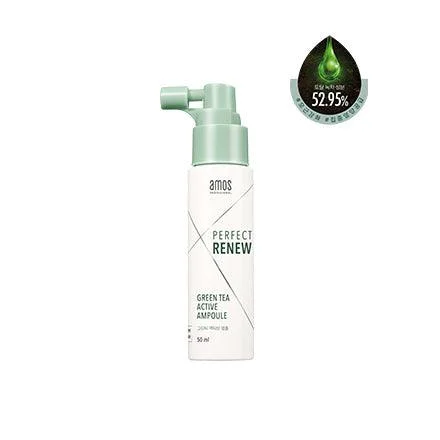
The original AMOS Professional Green Tea Active Ampoule 50ml is no longer found in the current EmpressKorea catalog. A discontinued or unavailable identity should not be replaced silently with another green-tea product.
The current AMOS line contains products with different contact and purposes: a leave-on scalp tonic, cleansing shampoos for scalp types and a rinse-off smoothing pack. This guide compares three exact products and separates Korean functional-cosmetic language from medical hair-regrowth claims.
Current identity comparison
| Product | Use/contact | Primary question |
|---|---|---|
| Green Tea Essential Tonic 50ml | Leave-on scalp tonic | Directions, frequency and scalp tolerance |
| Green Tea Shampoo for Sensitive Scalp 500g | Rinse-off cleanser | Cleansing comfort and complete rinsing |
| Green Tea Shampoo Smoothing Pack 250ml | Rinse-off scalp/hair pack | Conditioning without residue or irritation |
These products are not volume or format renewals of one ampoule unless the manufacturer documents that relationship.
What happened to the Active Ampoule?
The old article linked to a Shopify-style `/products/` URL for a 50ml Active Ampoule and made extensive ingredient claims. The current live search returns no visible in-stock product under that exact name.
This means purchase advice should stop. It does not prove the product is permanently discontinued worldwide; it proves the current EK catalog cannot support the old call to buy.
A future listing would need exact package, ingredient list, directions, status and identity review before the article could mention it as current.
AMOS Green Tea Essential Tonic
AMOS Green Tea Essential Tonic 50ml is currently listed as a leave-on scalp tonic with caffeine and patented Green Heritage green-tea extract positioning.
Apply to the scalp only as the current label directs. A tonic’s longer contact differs from shampoo. Do not increase dose or frequency because it feels refreshing.
Stop after persistent burning, itching, rash or increased shedding and seek appropriate care.
AMOS Green Tea Shampoo for Sensitive Scalp
AMOS Green Tea Shampoo for Sensitive Scalp 500g is currently a rinse-off cleansing product with caffeine and green-tea-complex positioning.
“Sensitive scalp” is a target, not a guarantee. Fragrance, surfactants and the full formula still matter. Massage gently, rinse completely and avoid scratching with nails.
Leaving shampoo residue can itself contribute to itch. Choose oily, dry or sensitive variants by actual scalp response and current directions.
AMOS Green Tea Shampoo Smoothing Pack
AMOS Green Tea Shampoo Smoothing Pack 250ml is currently a rinse-off care pack for scalp/hair moisture and softness with functional-cosmetic positioning.
A pack can improve fiber slip, softness and manageability through conditioning. That is different from creating new follicles or reversing genetic hair loss.
Apply to the intended scalp or hair areas, respect contact time and rinse as directed. Residue or occlusion may be uncomfortable for some scalps.
Korean functional-cosmetic language
MFDS defines functional cosmetics to include products that aid in alleviating hair-loss symptoms, excluding products that merely increase apparent volume by physical means. Responsible sellers undergo review or reporting for functional cosmetics.
The wording remains “aiding” symptom alleviation. It is not equivalent to an approved drug claim that a product grows new hair, treats androgenetic alopecia or cures a scalp disease.
Keep the Korean market claim attached to the exact evaluated/reported product and directions.
MFDS has warned against overclaiming
MFDS enforcement material identifies out-of-scope claims such as hair growth, hair restoration, increased hair thickness, scalp regeneration and gene effects in advertising for hair-loss-symptom-relief cosmetics.
The former article’s statements that green tea fortifies follicles, promotes growth and reduces hair fall transferred ingredient ideas directly to an unverified finished ampoule. Those claims have been removed.
Retailers and writers must not expand a functional-cosmetic statement into a treatment promise.
United States claims follow a different framework
FDA classifies products by intended use. Cleansing and beautifying hair are cosmetic purposes; restoring hair growth or treating disease are drug purposes.
A Korean functional-cosmetic status does not automatically authorize identical U.S. advertising. The market package, regulatory category and permitted claims must be reviewed separately.
“Cosmeceutical” has no legal meaning under U.S. federal law.
Green tea ingredient research is not the product result
Green tea contains catechins including EGCG, and laboratory studies explore many biological mechanisms. Extract composition depends on plant, processing, solvent, standardization, concentration and stability.
A cell or ingredient result does not prove that a rinse-off shampoo or proprietary tonic reaches a human follicle at an effective exposure. The finished formula and human study must support the exact claim.
“Used for centuries” and “natural antioxidant” are not substitutes for product testing.
Caffeine needs formula-specific context
Caffeine is highlighted in the current AMOS listings and is used within Korean functional-cosmetic frameworks. Its presence alone does not let a retailer promise regrowth.
Concentration, vehicle, contact time, tested population and endpoints matter. A shampoo rinsed after minutes and a leave-on tonic have different exposure.
Do not combine several caffeine scalp products on the assumption that more is better.
Hair fiber versus follicle
The visible hair shaft is a fiber. Conditioner can reduce friction, improve combing, smooth the cuticle and reduce breakage. These effects can make hair look fuller or shinier.
The follicle is living tissue in the skin. Claims about changing its growth cycle, creating follicles or reversing miniaturization are different and require medical/drug-level evidence.
Count breakage and root shedding separately when possible. Short broken pieces and full shed hairs suggest different questions.
Identify the scalp problem before choosing
Oil, flakes, itch, pain, pustules, scaling and shedding can have different causes. An oily scalp is not automatically hair loss, and dry flakes are not always simple dryness.
AAD lists product reaction, dandruff, psoriasis, ringworm, lice and other conditions among causes of scalp itch. Correct treatment depends on diagnosis.
Do not apply a cosmetic tonic over broken, infected or acutely inflamed skin unless qualified guidance and directions allow it.
A simple current-line routine
- Choose one shampoo variant for current scalp condition.
- Cleanse gently and rinse completely.
- Use the smoothing pack at its labeled frequency if conditioning is needed.
- Dry gently without high heat or tight pulling.
- Apply the Essential Tonic only according to its leave-on directions.
- Track shedding, itch, flakes and reaction without adding another new product.
Application and hygiene
Use clean hands and avoid touching applicator tips directly to irritated scalp. Do not share applicators or dilute shampoo and tonic inside their bottles.
Rinse shampoo and pack fully. Residue, scratching and very hot water can worsen discomfort. Keep containers closed and follow expiry or period-after-opening information.
Stop after unusual odor, color, texture, contamination or reaction.
How to track hair shedding
Daily shed counts vary with wash schedule, hair length, styling and collection. A single shower photo is not a diagnosis.
Record part width, ponytail circumference if relevant, standardized scalp photographs, wash frequency, illness, medication, childbirth, weight change and styling tension.
Do not delay care while waiting for perfect data. Tracking supports a clinician; it does not replace one.
When to see a dermatologist
Seek evaluation for sudden or patchy loss, scalp pain, scarring, pustules, severe scale, eyebrow/eyelash loss, rapid thinning or shedding after illness/medication. Earlier diagnosis can matter.
Persistent itch or rash after a hair product can indicate contact dermatitis. Stop the suspected product and seek help when it does not resolve.
Genetic, autoimmune, infectious, nutritional, hormonal and medication-related causes need different treatment.
Salon use does not remove consumer safety duties
“Professional” in a brand name can indicate salon positioning, but the home user still needs the exact label, warnings and contact time. A salon recommendation is not a medical diagnosis and should not expand a cosmetic claim.
Stylists can observe breakage, scalp residue and service history, while dermatologists diagnose scalp disease and hair loss. Share color, bleach, perm, extension and heat history with both when relevant. Do not apply tonic immediately after a chemical service unless the manufacturer and professional directions permit it.
Patch testing before color does not test every later shampoo or tonic ingredient. Keep records of product names and reactions.
Compare full formulas, not only green tea
The shampoos contain surfactants, fragrance, preservatives and conditioning materials in addition to green tea and caffeine. The pack and tonic use different vehicles. Any one of these components can determine cleaning, feel or irritation.
Read the delivered ingredient list because regional or renewed packages may differ. Known fragrance or preservative allergy matters more than the hero-ingredient story.
A short marketing description cannot predict every scalp response. Use the finished product as directed and stop after a reaction.
A direct comparison checklist
- Exact current product—not the unavailable ampoule.
- Leave-on, cleanser or rinse-off conditioning role.
- Korean functional-cosmetic wording kept within scope.
- No regrowth, follicle creation or disease-treatment promise.
- Scalp type, full formula, fragrance and contact time reviewed.
- One new product at a time with reaction tracking.
- Medical referral threshold defined before purchase.
Current AMOS green-tea scalp care can support cleansing, conditioning and a regulated Korean hair-loss-symptom-relief routine. It should not be sold as the missing ampoule or a green-tea miracle for hair growth.
Sources
- MFDS: Functional Cosmetics Approval Process
- MFDS: Warning on Hair-Growth Overclaims
- FDA: Cosmetic, Drug or Both
- FDA: Hair Cleansing Products and Adverse Events
- American Academy of Dermatology: Causes of Scalp Itch
- Current AMOS Green Tea Essential Tonic listing
- Current AMOS Sensitive Scalp Shampoo listing
- Current AMOS Smoothing Pack listing
Frequently Asked Questions
Is AMOS Green Tea Active Ampoule 50ml still available?
It is not currently found as a visible in-stock product in the live EK catalog. The current Essential Tonic, shampoos and smoothing pack are separate identities and should not be substituted silently.
Do AMOS green tea products regrow hair?
Do not make that claim. Korean functional-cosmetic wording is limited to aiding relief of hair-loss symptoms. MFDS specifically warns against expanding it to hair growth, restoration or scalp-regeneration claims.
What is the difference between the tonic and shampoo?
The Essential Tonic is leave-on scalp care; shampoo is a rinse-off cleanser. Their contact times, directions and roles differ, so evidence and frequency cannot be pooled.
Can green tea or caffeine treat alopecia?
Ingredient presence does not establish treatment for a cause of alopecia. Formula, concentration, human evidence and market authorization matter. Sudden, patchy or progressive loss needs diagnosis.
When should scalp itch or hair loss see a dermatologist?
Seek care for persistent rash or itch, sudden/patchy loss, rapid thinning, pain, scarring, pustules, severe scale or eyebrow/eyelash involvement. Stop a suspected reacting cosmetic.