Sunscreen is the step most people know, yet it is also the one they skip, under-apply or forget to reapply by mid-afternoon. A good hat solves part of that problem with no effort at all: put it on and it keeps working until you take it off. The catch is that many hats sold for summer do very little for the parts of your head that burn most, such as the ears, the sides of the face and the back of the neck.
The short answer: choose a hat with a brim of at least three inches all the way around, made from tightly woven fabric, ideally with a stated UPF or UV test result. If you need a cap or visor shape for sport, add a neck flap or a UV mask. And keep sunscreen for the skin a hat cannot shade.
Why a Hat Is the Easiest Sun Protection You Will Use
The head and face get the most direct sun of any part of the body, and they are also where skin damage shows first. The WHO describes UV-related premature aging as a loss of skin elasticity at a young age, and notes that skin cancer is highly preventable [5]. The question is not whether to protect your face but how to do it reliably.
Dermatologists recommend layering. The American Academy of Dermatology advises lightweight long sleeves, pants, a wide-brimmed hat and UV-blocking sunglasses when possible, plus a broad-spectrum, water-resistant sunscreen with SPF 30 or higher on skin that clothing does not cover [2]. That sunscreen needs reapplying every two hours, or after swimming or sweating [2].
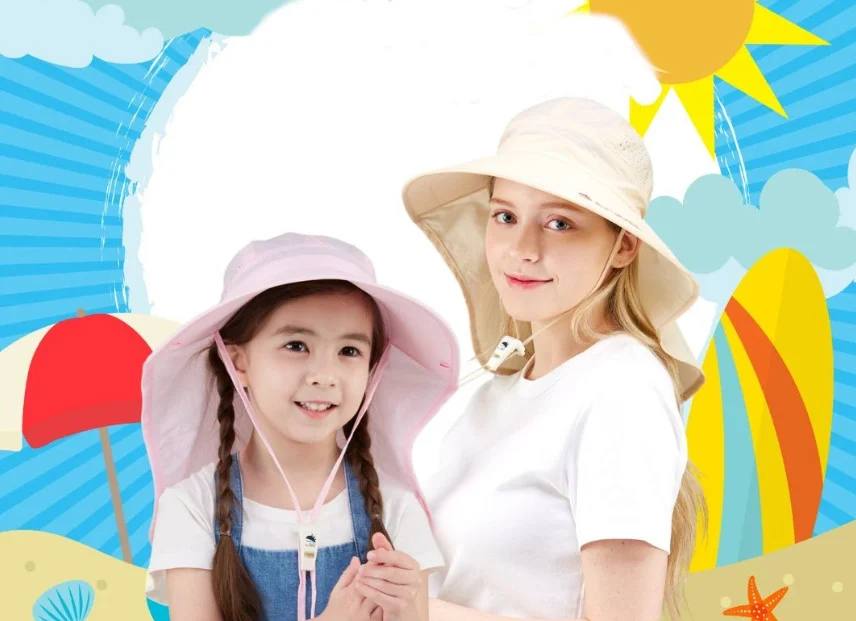
A hat earns its place because it does not depend on reapplication. It shades the scalp along your part line, the tops of the ears and the back of the neck, areas people commonly miss with sunscreen. You can browse our Korean hats with that job in mind: the shape matters far more than the logo.
Brim Width: The Number That Matters Most
If you remember one measurement, make it this one. The Skin Cancer Foundation says the best sun hats have a brim of at least three inches to shade the face, scalp, neck, shoulders and upper back [1]. Three inches is about 7.6 centimeters, which helps when Korean listings give sizes in metric.
The brim also needs to go all the way around. The CDC recommends a hat with a brim all the way around that shades your face, ears and the back of your neck [3]. A wide front bill with nothing at the back protects your nose and leaves your neck in full sun.
How to check a hat before you buy:
- Find the brim length on the listing. Anything from about 7.5cm upward meets the three-inch guidance.
- Check the back. Is there a brim, a flap or nothing behind the ears?
- Check that the brim holds its shape. A wire edge or structured brim keeps shade where you need it on a windy day.
For reference, the SUNGLADE flap cap lists a 10cm brim on its XL size [7], and the Laping floral sun hat lists a 12cm brim [8]. Both clear the three-inch line comfortably.
Fabric and UPF: What the Label Should Tell You
A wide brim made of see-through material is still a weak hat. The fabric decides how much UV gets through the shade you are standing in.
UPF, the ultraviolet protection factor, is how clothing is rated. A UPF 50 fabric blocks 98% of the sun’s rays and lets through only one fiftieth [1]. The Skin Cancer Foundation rates UPF 30 to 49 as very good protection and UPF 50+ as excellent [1]. The AAD likewise advises choosing clothing with a UPF number on the label for more effective protection [2].
Many Korean sun hats state a UV blocking percentage instead, such as 99% or 99.9%, often with a certificate from a Korean testing institute. That is a different way of reporting the same idea, and it is useful evidence. What it cannot tell you is how the hat performs once it is wet, stretched or faded, so the rest of the fabric checklist still applies.
- Weave: look for a tightly woven hat rather than a loosely constructed straw hat that lets in UV [1].
- Color: dark or bright colors absorb UV better than lighter shades [1].
- Water: wet fabric loses some of its protective ability [1], which matters for beach and water hats.
A quick test at home: hold the crown and brim up to a bright window. If you can see light through the weave, so can UV.
Caps, Visors and Bucket Hats: How the Styles Compare
Style is where most people make the wrong trade-off. The hat you like the look of may protect a much smaller area than the one next to it.
| Style | What it shades | What it leaves exposed | Fix the gap with | Best for |
|---|---|---|---|---|
| Wide-brim hat | Face, ears, neck when the brim is wide all around | Lower face and chest in low sun | Sunscreen | Walking, travel, gardening, beach |
| Flap cap (legionnaire style) | Face from the front, plus ears and neck under the flap | Cheeks if the flap is open at the sides | Sunscreen or a mask | Water sports, hiking, outdoor work |
| Bucket hat | Face and neck, depending on brim width | Depends on brim; many are narrow | Check brim length first | Everyday wear, festivals |
| Baseball cap | Forehead and nose | Ears, sides of face, back of neck | Collar, neck flap, sunscreen | Short errands, sport where brims get in the way |
| Sun visor or winged visor | Forehead and eyes; winged styles add the sides | Scalp, back of neck | A UV mask and sunscreen on the scalp part | Golf, walking, tennis |
The official advice on caps is blunt. Cancer Council Australia recommends a broad-brimmed, legionnaire or bucket style hat and states that caps and visors do not provide enough protection [4]. The CDC says that if you wear a baseball cap, you should wear clothing that covers your ears and the back of your neck [3].
That does not mean caps and visors have no place. It means they work as part of a set, not alone.
SUNGLADE UV Wide Aqua Flap Cap: Best for Water and Active Days
The SUNGLADE flap cap is the most complete design in our range for wet, active days. Its listing describes a structured wide brim that resists drooping, a fabric that blocks 99% of UV, and a flap that covers the neck [7]. On the XL size the brim is 10cm and the flap 23.5cm; the XXL has a 10.5cm brim and a 24.5cm flap [7].
The details are practical: a Coolmax sweatband, punch-hole ventilation, a water-repellent coating, an adjustable band with a ponytail hole, and a stopper with an emergency whistle [7]. Sizes run 57 to 60cm for XL, recommended for women and teens, and 60 to 63cm for XXL, recommended for adult men [7].
Who it is not for: anyone who wants a dressy hat for the city. It looks like what it is, a sports hat. It also needs hand washing in cold water, and chlorine and salt can damage the fabric if you do not rinse it [7].
Laping Wide-Brim Hats: Best for Gardening and Long Hours Outside
If you spend hours outside at a slow pace, the Laping hats offer the widest brims we carry. The floral sun hat lists a 12cm brim, a 30cm detachable neck cover and a weight of about 60g [8]. Its UV blocking is certified by the Korea Apparel Testing and Research Institute, and the brim is wire-reinforced so it keeps its shape [8]. The neck cover closes with snap buttons, so you can wear it open in a breeze or closed in full sun [8].
The Laping detachable scarf sun cap follows the same idea in solid colors, with a similarly wide brim and a removable face and neck scarf for fuller coverage. The floral hat fits a 57 to 59cm head with an elastic band [8], so check your head measurement before ordering.
Who they are not for: anyone who needs a hat that packs flat into a backpack. A wire brim holds shade well, but it also holds its shape in your luggage.
Sizing and Fit: Keeping the Shade Where It Belongs
A hat that slides back on your head or lifts in the wind stops shading your face at exactly the wrong moment. Fit is part of protection.
- Measure your head. Wrap a soft tape around your forehead, about a finger’s width above the eyebrows and over the widest part at the back. Korean listings give head circumference in centimeters.
- Compare against the listing. The SUNGLADE flap cap, for example, splits its sizes into 57 to 60cm and 60 to 63cm [7]. If you sit on the line, choose the adjustable band and the larger size.
- Use the strap on windy days. A chin strap, stopper or neck cord keeps a wide brim in place on a boat, a ridge or a golf course.
- Leave room for hair. A ponytail hole or an elastic back keeps the brim level instead of tilted up.
Once it fits, look in a mirror with the sun behind you. The shadow of the brim should fall across your nose, cheeks and ears. If it only reaches your eyebrows, the brim is too narrow or the hat is sitting too far back.
The Sea Winged Sun Cap: When You Want a Visor With Side Cover
The Sea winged sun cap is a Korean favorite for walking and hiking. It is a visor with side panels and a clear film window at the front, so you can see while the face stays in shade. Its listing reports a passed UV protection test and a patent for the design, and it is made in Korea. A strap keeps it from blowing away. Remove the protective film on the visor and wings before you wear it, or you will see bubbles and scratches through it.
Be honest about what this style does. Like any visor, it leaves the top of the head and the back of the neck open. That makes it a strong partner for a UV mask, which covers the cheeks, jaw and neck the visor misses. Our guide to Korean UV golf masks explains how to match the two, and the Modelo UV protection golf mask is a common pairing.
When to Wear It: Reading the UV Index
Summer is the obvious season, but UV does not follow the thermometer. The WHO and Cancer Council Australia both recommend sun protection whenever the UV index is 3 or higher [5][4]. The U.S. EPA describes a UV index of 3 to 7 as moderate to high, with protection needed, including a wide-brimmed hat, and advises seeking shade from late morning through mid-afternoon [6].
A few situations catch people out:
- Cloudy days. UV levels can be high even with cloud cover [5].
- Mountains. UV levels increase with altitude because thinner air absorbs less of it [5].
- Water, sand and snow. These surfaces reflect sunlight and can increase your sunburn risk [2]. A brim shades from above, not from below, so sunscreen on the chin and under the nose still matters at the beach.
- Midday errands. The AAD notes the sun’s rays are strongest between 10 a.m. and 2 p.m. [2], which is also when most people run short trips without protection.
Check the UV index in your weather app before you head out. If it reads 3 or higher, the hat goes on.
Hat Plus Sunscreen: Finishing the Job
A hat shrinks the area sunscreen has to cover. It does not remove it. The lower face, the chin, the backs of the hands and anything lit by reflected light still need a product.
Choose a sunscreen you will actually reapply. A stick is the easiest option outdoors because you can cover the nose, cheekbones and ears without a mirror or greasy fingers. The Dr.G Nice Buddy Up Sun Stick is designed for sweat and outdoor activity. If you prefer a lotion or cream, our guide to picking a Korean sunscreen you will use daily compares textures and finishes.
Add sunglasses that block UV, and you have the full set the AAD describes: clothing, a wide-brimmed hat, sunglasses and sunscreen on what is left [2].
If you have a history of skin cancer, a condition that flares in sunlight, or take a medication that raises sun sensitivity, ask your dermatologist which level of protection you need. A hat is a good start, not a medical plan.
Frequently Asked Questions
How wide should the brim of a UV protection hat be?
At least three inches, about 7.6cm, according to the Skin Cancer Foundation, and ideally all the way around so it shades the ears and back of the neck as well as the face.
Is a baseball cap enough sun protection?
No. A cap shades the forehead and nose but leaves the ears and neck exposed. The CDC advises cap wearers to cover the ears and back of the neck with clothing, and Cancer Council Australia says caps and visors do not provide enough protection on their own.
What does UPF 50 mean on a hat?
UPF 50 means the fabric lets through about one fiftieth of the sun's UV, blocking around 98%. UPF 30 to 49 is rated very good and UPF 50+ excellent. Many Korean hats state a UV blocking percentage instead, which reports the same idea.
Are straw hats good for sun protection?
Only if the weave is tight. The Skin Cancer Foundation warns that loosely constructed straw hats let UV through. Hold the hat up to a bright light: if light passes through the weave, UV does too.
Do I still need sunscreen if I wear a wide-brim hat?
Yes. A hat shades from above but not from light reflected off water, sand or pavement, and it does not cover the hands or lower face in low sun. Use broad-spectrum sunscreen on exposed skin and reapply about every two hours outdoors.