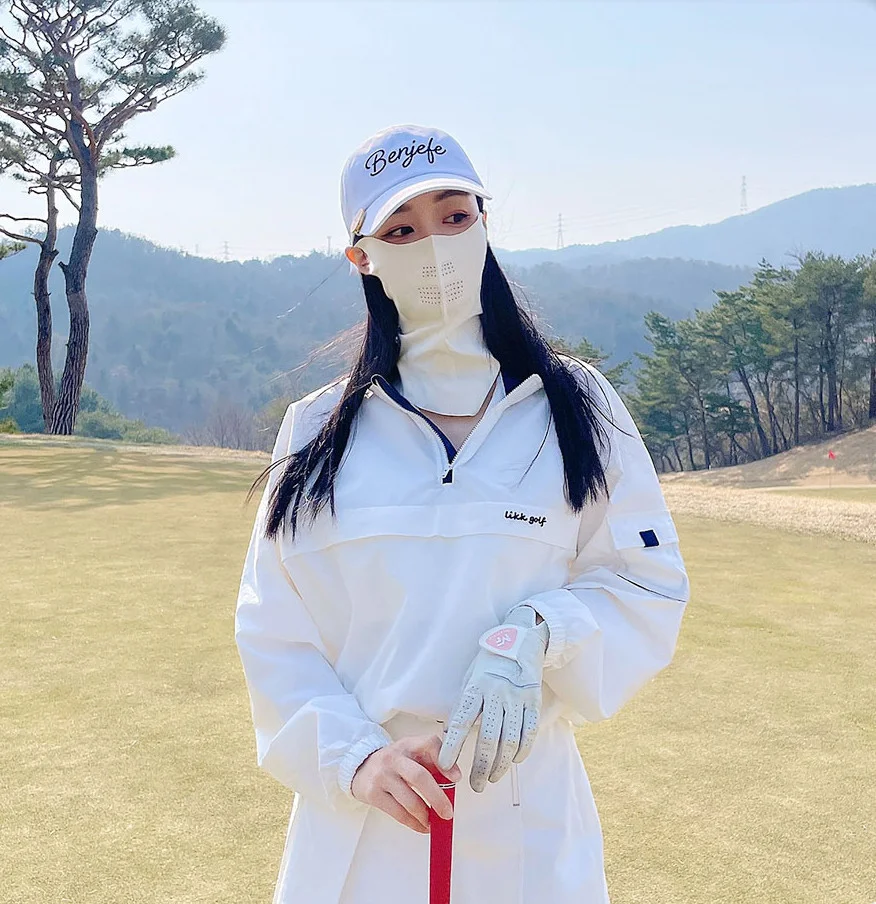
A round of golf keeps you outside for hours, usually through the middle of the day, with little shade between tee and green. Sunscreen helps, but it sweats off, gets wiped onto towels and gloves, and rarely gets reapplied on the 11th hole. That is why so many Korean golfers, cyclists and hikers wear a fabric UV mask over the lower face and neck.
The short answer: a UV mask is clothing, not cosmetics, so judge it the way you would judge sun-protective clothing. Look for a stated UV test result, a dense fabric, coverage that reaches the neck and cheeks, and a breathing design you will actually keep on. Then pair it with a wide-brimmed hat, sunglasses and sunscreen on whatever skin is still exposed.
Why Golfers Need More Than Sunscreen
Golf is one of the longest continuous sun exposures most people choose voluntarily. Researchers who fitted dosimeters to golfers in southern Queensland measured mean summertime exposures of 1.4, 2.2 and 3.2 standard erythema doses at the forearm, upper back and top of the head [4]. The same study recorded far lower winter numbers, and concluded that taking adequate sun protection in the summer months is an important strategy for golfers’ long-term health [4].
Timing makes it worse. In the continental United States, UV rays are strongest from 10 a.m. to 4 p.m. daylight saving time [5], which is exactly when most tee times fall. UV can also stay high under cloud cover, and it rises with altitude [6], so an overcast mountain course is not a safe day off.
Sunscreen remains the base layer. The CDC recommends a broad-spectrum product with SPF 15 or higher, reapplied if you stay in the sun for more than two hours and after sweating or toweling off [5]. On a course, that reapplication is the weak point. You are sweating, wiping your face, and holding a club. A fabric layer does not wear off in the same way, which is the practical case for a mask.
If your main worry is the face and neck, start with our Korean sun protection masks and build the rest of your kit around them.
How a UV Mask Actually Blocks the Sun
A UV mask works like a shirt, not like a cream. The fabric absorbs or scatters ultraviolet light before it reaches the skin. The Skin Cancer Foundation explains clothing protection with the ultraviolet protection factor, or UPF: a UPF 50 fabric blocks 98% of the sun’s rays and lets through only one fiftieth [1]. It rates UPF 30 to 49 as very good protection and UPF 50+ as excellent [1].
Three fabric traits decide how well that works in real use:
- Density. Densely woven cloth is more protective than sheer, thin or loosely woven cloth [1].
- Color. Dark or bright colors absorb UV instead of letting it through, so they protect better than light shades [1].
- Condition. Clothing that is stretched or wet loses some of its protective ability [1].
Masks have been measured directly too. A Korean study of 12 commonly used masks found that black KF94 and surgical masks reduced UVA penetration by approximately 100% [2]. White masks of the same types did less: UVA penetration fell on average by 95.51% for white KF94 masks and 86.41% for white surgical masks [2]. The authors concluded that color was the main factor separating the masks [2].
A review of masks and UV protection reached a similar picture. It identified fabric type, construction, porosity and color as the variables that matter, and found black, tightly woven, multi-layer polyester cloth masks to be optimal for UV protection [3]. It also noted moisture and stretch as wear factors [3]. Sports masks are built differently from those everyday masks, but the same physics applies.
Closed vs Open Masks: Which Style Fits Your Sport
Korean sports masks come in two broad shapes, and the choice is mostly about breathing versus coverage.
Closed style with a nose opening
These cover the cheeks, mouth, jaw and neck, with a hole or mesh panel at the nose and vents at the mouth. They give the widest coverage, and they suit golf well because the pace is slow and you rarely breathe hard. The trade-off is heat on very humid days.
Open style
Open masks leave the nose and mouth uncovered and protect the cheeks, jaw and neck. They breathe easily during running, cycling or tennis, and you can drink without pulling the mask down. The trade-off is obvious: the skin around your nose and lips needs sunscreen.
Half style
Some masks cover only the lower face with air holes at the mouth. They are lighter and quicker to put on, but they cover less of the neck, so pair them with a collar or a hat with a neck flap.
A simple rule: if you walk the course and want the most coverage, start closed. If you exercise hard or hate anything over your mouth, start open and be disciplined about sunscreen on the uncovered strip.
The Masks Worth Comparing
Here is how the masks in our sun protection mask range differ on paper. UV figures are what each listing states, not results we tested ourselves.
| Mask | Style | What the listing documents | Weigh this first | Best fit |
|---|---|---|---|---|
| Modelo Standard UV Protection Golf Mask | Closed, nose and mouth separated, Velcro at the neck | 99.9% UVA and UVB blocking, 78 breathing pores, protection kept after 30 washes [7] | Fuller coverage runs warmer in humid heat | Golfers who want maximum face and neck coverage |
| NORMAL LIFE UV Protection Sports Cooling Golf Mask | Closed, open nose air hole, wide ear loops | UPF 50+, over 99% UVA and UVB blocking, 28 small holes, seamless construction [8] | Only two colors and two sizes | Glasses wearers and people who sweat heavily |
| SUNMASKIN Premium Outdoor Sports Mask | Open, nose and mouth uncovered | UV-blocking Korean-made fabric, drink without removing | Nose and lips need sunscreen | Running, cycling, tennis, fishing |
| SUNGLADE UV Seamless Cool Sports Mask | Closed with mesh nose and mouth panels | Seamless ear loops, cooling nylon-spandex, extended neck back | Hand wash only, no machine or dryer | People whose ears get sore from straps |
Notice what separates them. The two closed masks document more test detail, which makes them easier to trust on paper. The open and mesh designs win on comfort during harder exercise. None of these is the right mask for every sport, so start from how you move.
Modelo: The Most Documented Coverage
The Modelo Standard mask is the easiest choice to justify when coverage is the priority. Its listing describes a mask developed with Seoul dermatologist Dr. Seo-gil Seo, and states 99.9% blocking of UVB and UVA rays [7]. It reports a fabric UPF test result of 1,486 under the Australian and New Zealand standard, and says protection held at 99.9% after 30 washes in testing by the Korea Apparel Testing and Research Institute [7].
Practical details matter more on the course. The listing describes 78 breathing pores, separated nose and mouth areas so you can talk, and adjustable Velcro for the neck [7]. It covers up to under the eyes and wraps the back of the neck [7]. Sizing is straightforward: the listing suggests a larger size for men, and fit preference for women [7].
Who it is not for: anyone who runs hot and hates fabric near the mouth. Full coverage is the point of this mask, and on a humid afternoon it will feel like it.
NORMAL LIFE: Cooler Fabric and Easier Breathing
The NORMAL LIFE mask is built around comfort for long, sweaty days. Its listing states a UPF 50+ rating with over 99% of UVA and UVB blocked, certified by the Korea Apparel Testing and Research Institute [8]. It uses an open nose air hole and 28 small holes, which the brand says helps prevent fogged glasses [8].
The construction is seamless, made without sewing to reduce irritation, and the ear loops are wide to stop the mask slipping during play [8]. The fabric is 76% polyester and 24% polyurethane [8]. Sizes are S/M for smaller faces and L/XL for a looser fit, with measurements listed so you can compare against a mask you already own [8].
Who it suits: glasses wearers, heavy sweaters, and people who are sensitive to sunscreen on the cheeks. Who it is not for: anyone who wants a wide color choice, since it comes in black and a skin tone only [8].
Open-Style Masks for Running, Cycling and Tennis
If you breathe hard, an open mask is usually the one you will keep wearing. The SUNMASKIN Premium mask leaves the nose and mouth uncovered while covering the cheeks, jaw and neck. It is made in Korea from fabrics using Hyosung yarns, sized by measuring from the tip of your nose to the tip of your chin, and designed to sit snugly because a tight fit increases coverage. The brand suggests going one size up if you prefer a looser feel.
An open mask changes your sunscreen routine rather than replacing it. The strip of skin around your nose and lips gets full sun, and the nose is one of the most exposed points on the face. A stick sunscreen is the easiest way to cover it mid-round without greasy hands.
The Dr.G Nice Buddy Up Sun Stick is an SPF 50+ PA++++ stick designed for sweat, water and mask wear, and its listing notes skin irritation testing. It glides over the uncovered areas in seconds and does not need a mirror. If you want more choices, our guide to picking a Korean sunscreen you will use daily walks through textures.
Fit, Breathing and Care: Keeping the Protection
A mask only protects where it sits, and only as well as its fabric holds up. A few habits keep it working.
- Size for coverage, not compression. Tight clothing can stretch and lose protection [1], so a mask that is pulled thin over the cheekbones is weaker exactly where the sun hits hardest. If you are between sizes, follow the brand’s guide rather than sizing down.
- Carry a spare on hot days. Wet fabric loses some of its protective ability [1]. The mask review also advised changing masks once they are moist [3]. A second mask in the bag costs less than a sunburned jaw.
- Wash gently. Most Korean sports masks are hand wash only. Fasten any Velcro first, use a neutral detergent in lukewarm water, and dry in the shade. Machine drying can deform seamless edges.
- Check the color. If you are choosing between two shades, the darker one is likely the more protective, based on both clothing guidance [1] and mask testing [2].
Comfort is a protection feature. The best mask on paper does nothing in your pocket, so prioritize the design you will wear for the full round.
Build the Rest of Your Sun Kit
A mask covers the lower face and neck. Everything above and around it still needs a plan.
- A hat with a brim. The CDC recommends a brim all the way around that shades the face, ears and the back of the neck, and notes that baseball cap wearers should cover their ears and neck another way [5]. Our guide to choosing a UV protection hat covers brim width and fabric in detail.
- Sunglasses. Glasses that block both UVA and UVB give the best protection, and wrap-around styles work best [5]. The WHO notes that some cataract blindness may be due to UV exposure [6].
- Arms and hands. Golfers’ forearms took a measurable dose in the Queensland study [4]. The Modelo UV protection arm sleeves match the mask and cover up to just below the shoulder.
- Sunscreen on everything else. Forehead, ears, the back of the hands and any skin the mask leaves open.
If you prefer a hat that also covers the sides of the face, the The Sea winged sun cap adds side panels and a clear visor window. It pairs well with a half or open mask.
Who Should Not Rely on a UV Mask Alone
A UV mask is a strong everyday tool, but some people need more than gear.
If you have a condition that flares in sunlight, a history of skin cancer, or you are taking a medication that makes skin more sun-sensitive, ask your dermatologist what level of protection you need. The Korean mask study specifically pointed to people with photo-aggravated skin conditions as those who benefit most from choosing masks carefully [2].
Watch also for heat. A covered face holds warmth, and on extreme days the right answer can be a later tee time rather than a thicker mask. Seek shade where you can, and drink between holes.
Finally, remember what a mask cannot do. It does not protect the eyes, the scalp or the hands. The strongest results come from layering: fabric where you can, shade when available, and sunscreen wherever skin is still out in the sun.
Frequently Asked Questions
Do Korean UV golf masks really block UV?
Fabric can block UV very effectively. A Korean lab test found black KF94 and surgical masks reduced UVA penetration by approximately 100%, while white versions blocked less. Sports masks add stated UV test results on their listings, which is the number to look for before you buy.
Is a UV mask better than sunscreen for golf?
It is not a replacement, it is a more reliable layer for the area it covers. Fabric does not sweat off or need reapplication, but it leaves the eyes, forehead, ears and hands exposed. Use both.
What color UV mask protects best?
Darker colors generally protect better. The Skin Cancer Foundation says dark or bright colors absorb UV instead of letting it through, and the Korean mask study found color was the main factor separating mask performance.
Can I breathe comfortably in a closed sports mask?
Most Korean closed masks add a nose opening, mesh panels or rows of small holes for airflow. For slow-paced golf most people are comfortable. For running or cycling, an open-style mask is usually easier.
How do I wash a UV golf mask without ruining it?
Hand wash in lukewarm water with a mild detergent, fasten any Velcro first, and dry in the shade. Avoid machine drying, which can deform seamless edges and stretch the fabric.