
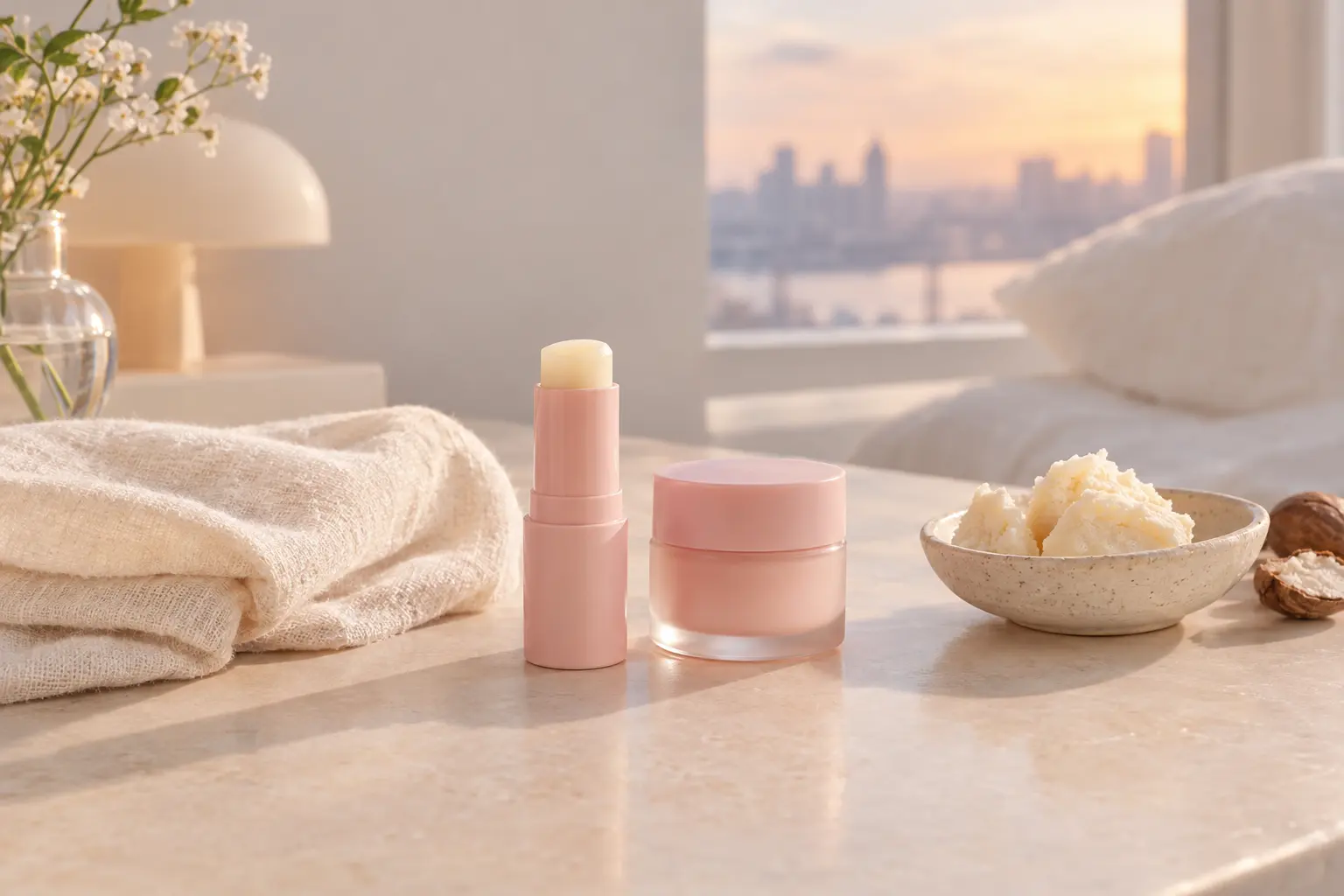
Choosing a Korean lip mask for overnight use comes down to a practical dilemma: do you want a richer layer, or a formula your lips can tolerate? A thick mask can be useful for ordinary dryness, but a product that irritates chapped lips is the wrong choice, however appealing its ingredients sound.
ETUDE Ginger Sugar and NEEDLY Sleeping Lip Mask take different approaches to the same routine step. Choose between them by their ingredient lists and your sensitivities—not by assuming ginger, fermentation or a long wear time guarantees better results.
Korean lip mask overnight guide: what a mask actually does
An overnight lip mask is a leave-on lip product intended for use while you sleep. Its practical job is to provide a protective layer that helps limit moisture loss; it is not a separate category of treatment that every dry lip needs. The American Academy of Dermatology recommends a non-irritating lip moisturizer several times a day and before bed, and suggests a thick ointment such as white petroleum jelly for very dry, cracked lips because ointments hold water in longer than waxes or oils[1].
That distinction changes the shopping decision. If your lips feel mildly dry and you want one product designated for the last step of your evening routine, a mask may be a convenient choice. If they are very dry and cracked, the priority is non-irritating care rather than a more elaborate ingredient story.
Mask versus balm: a useful distinction, not a strict rule
These names describe intended use more reliably than they describe a fixed formula. ETUDE describes Ginger Sugar as a thick overnight mask that can also be used as a daytime lip balm[2]. A product does not become more effective simply because its label says mask, and a balm is not automatically too light for bedtime.
Think about what you need from the layer. A mask marketed for overnight use may appeal if you prefer applying a substantial layer before bed. A product you can comfortably use during the day as well may be more practical if your lips feel dry long before bedtime. Neither description proves how long a particular formula will remain on your lips.
- For ordinary dryness: choose a formula you can tolerate and are happy to use consistently.
- For very dry, cracked lips: consider the AAD’s ointment recommendation before selecting either featured mask.
- For lips that react to products: investigate the ingredient list and stop using anything that causes discomfort.
The best choice is conditional. ETUDE is a reasonable starting point if you specifically want its stated thick layer and do not need to avoid its listed fragrance or beeswax. NEEDLY is a different ingredient-led option, not a proven upgrade, and neither is a substitute for investigating persistent irritation.
For a broader look at selecting fewer, more relevant steps, the guide to a more selective routine offers a useful companion read. Lip care can follow the same principle: give each product a clear job rather than adding a mask merely because it has a separate name.
ETUDE versus NEEDLY: which overnight lip mask fits?
Start with the reason you are buying, then look for a reason not to buy. ETUDE has a clearly described thick, moisture-sealing layer; NEEDLY’s appeal is its combination of panthenol, ceramide NP and oils. Those are differences in formula and positioning, not evidence that one performs better on every person.
The table compares the documented listings, not results from a head-to-head trial. A larger number in grams versus milliliters is not a direct measure of which product contains more usable applications, since the two units measure different things.
| Decision point | ETUDE Ginger Sugar | NEEDLY Sleeping Lip Mask |
|---|---|---|
| Documented size | 23 g[2] | 10 ml[4] |
| Formula emphasis | Shea butter, beeswax, murumuru butter and sugar components[2] | Panthenol, shea butter, ceramide NP and oils, including fermented ingredients[3] |
| Use described | Overnight mask or daytime lip balm[2] | Apply to dry lips; remaining product may be applied to dry body skin[3] |
| Ingredient consideration | Lists fragrance and beeswax[2] | Lists beeswax and botanical extracts, including lavender[3] |
| Practical limitation | Fragrance is a concern for chapped lips[1][2] | Discontinued according to one listing; availability may be limited[4] |
If your goal is a substantial bedtime layer and you know you tolerate the listed ingredients, ETUDE’s documented construction makes its purpose easy to understand. If you are specifically looking for panthenol and ceramide NP, NEEDLY is the closer match—but their presence does not establish a clinical benefit for this particular lip formula.
Consider a shopper whose lips are occasionally dry but who avoids fragrance. ETUDE’s ingredient list would rule it out for that shopper, even if its thick layer sounds appealing. NEEDLY still requires a careful ingredient review rather than an automatic green light, because it contains botanical extracts and beeswax.
Now consider someone who likes a single product for bedtime and daytime. ETUDE is explicitly described for both uses, making it the more straightforward match on that criterion. That does not mean it is lighter, longer-lasting or more comfortable than NEEDLY; the available evidence does not establish those comparisons.
Stock is another practical filter. NEEDLY is described as discontinued in one retrieved listing[4]. Check the current EmpressKorea listing before making it the foundation of a routine you want to repurchase, and compare the ingredient list on the actual package with your own avoidance list.
Size and stock should come after tolerance. A container that looks economical is not useful if you cannot comfortably apply its contents, and a formula that matches your preferred ingredients is a less dependable long-term choice if you cannot find it again.
ETUDE Ginger Sugar: a thick lip mask with a fragrance trade-off
ETUDE Ginger Sugar Overnight Lip Mask makes the strongest case for a shopper who wants a clearly described, substantial moisture-sealing layer. The brand listing describes shea butter, beeswax, murumuru seed butter and sugar components forming a thick layer, and says the mask can also serve as a daytime lip balm[2]. That is a useful match for someone seeking one product for both routine steps, provided the formula’s listed ingredients are suitable for them.
The ingredient list also reveals why the mask’s name should not be mistaken for a complete description of its formula. It begins with polybutene, hydrogenated polyisobutene and emollient esters; shea butter, waxes, glycerin and dimethicone appear later in the list[2]. These ingredients give the formula a more informative identity than the headline words ginger and sugar alone.
What ginger and sugar do—and do not prove
Ginger root extract and trehalose, a sugar, appear near the end of the published ingredient list[2]. Their presence supports saying the formula contains those ingredients. It does not establish that ginger improves lip circulation, that the mask must feel warming, or that the sugar component produces a special depth of hydration.
Ingredient order is a useful clue to a formula’s construction, but it cannot tell you the exact concentration of each ingredient or predict the experience of using the finished mask. For this product, the better-supported buying rationale is the brand’s stated thick layer and the listed combination of emollients and waxes—not an unverified mechanism attributed to ginger.
There is a meaningful caveat. The brand page claims no artificial fragrance while its ingredient list includes fragrance[2]. Those statements are not enough to tell a fragrance-avoidant shopper what the fragrance consists of; the AAD advises avoiding fragrance while lips are chapped[1].
Choose ETUDE if a thick layer is the feature you value, the listed ingredients suit you, and you want the option to use the same product during the day. Pass on it if fragrance or beeswax is on your personal avoidance list. Its rich presentation is not a reason to overlook a known trigger.
The catalog directs you to apply a generous layer before bed and leave it on overnight. You do not need to infer a separate exfoliation step from the word sugar: the formula listing identifies trehalose, but does not establish that the product should be used as a scrub.
When deciding on a daytime use, remember that neither the catalog description nor the cited product page establishes an SPF for this mask. A daytime lip-care routine also needs a separate sun-protection decision, discussed below.
The 23 g size is a documented specification, not a promise about how many nights the jar will last[2]. How much you use and whether you apply it during the day will affect that calculation, so compare value on the basis of your own routine rather than the overnight label alone.
NEEDLY Sleeping Lip Mask: panthenol, oils and a stock question
NEEDLY Sleeping Lip Mask 10ml is the more relevant option if you are looking specifically for a lip formula containing panthenol and ceramide NP. Its published ingredient list also includes shea butter, avocado oil, evening primrose oil, moringa seed oil and several botanical extracts[3]. That ingredient profile is a reason to consider it, not proof that it repairs an individual person’s lip barrier.
The list starts with hydrogenated polyisobutene, caprylic/capric triglyceride, sorbitan olivate, polyglyceryl-3 polyricinoleate and phytosterols, followed by shea butter and panthenol[3]. In practical terms, this is a formulated blend rather than a simple oil applied on its own. Ceramide NP appears further down the list, but the list alone does not tell you its percentage or establish the finished product’s clinical performance.
Fermented oils are a feature, not a performance guarantee
The product description highlights five fermented vegan oils, and the published list includes fermented ingredients[3]. Fermentation describes how an ingredient is made or processed; the available evidence does not establish that fermented oils outperform ordinary oils on lips. Buy NEEDLY for the overall formula and your own ingredient preferences, not because fermentation necessarily makes a mask more effective.
There is another distinction worth making: vegan ingredients do not make the entire finished formula vegan. Beeswax appears in NEEDLY’s published ingredient list[3]. If avoiding animal-derived ingredients is essential to you, that is a decisive reason to look elsewhere rather than rely on the phrase fermented vegan oils.
Botanicals are a similarly personal decision. NEEDLY lists lavender flower extract among other plant extracts, along with beeswax[3]. A shopper who knows they tolerate that ingredient profile may find the panthenol-and-ceramide positioning appealing; someone who needs to avoid a listed botanical or beeswax should not assume the product is suitable merely because it is marketed for lip care.
The listing says to apply it to dry lips and notes that remaining product can be applied to dry body skin[3]. Treat that second use as optional rather than a reason to buy a lip product for the whole body. Another listing identifies the size as 10 ml and describes the product as discontinued[4].
That availability issue matters for a repeat purchase. If you find the mask in stock, confirm the current package and ingredient list before relying on the older description. If it is unavailable, do not choose ETUDE automatically: return to the decision rule and consider fragrance, beeswax and the condition of your lips first.
Panthenol and ceramide NP are specific reasons to investigate this option, but they are not a substitute for a comparison of finished formulas. Without product-specific clinical results or a direct comparison, neither the ingredient list nor the marketing claim can tell you which mask will give you a better result.
How lip mask ingredients help hold in moisture
Ingredient names become more useful when you understand their roles. Lip masks generally combine materials that soften the surface with materials that form a layer over it. In these two formulas, the published lists include multiple emollients and waxes rather than a single headline ingredient doing all the work[2][3].
Occlusives, emollients and humectants
- Occlusive or film-forming materials: help create a layer that limits moisture loss. Waxes and certain oils or ointment bases can contribute to this kind of protection, although a finished formula’s performance depends on the whole blend.
- Emollients: help soften and smooth the feel of a surface. The ETUDE and NEEDLY lists both include hydrogenated polyisobutene and shea butter[2][3].
- Humectants: help attract and hold water. Glycerin appears in both published lists, while ETUDE also lists trehalose and NEEDLY lists panthenol[2][3].
These roles overlap, and the same ingredient may contribute more than one function. A product can contain a humectant without being mostly water, just as it can contain a wax without behaving exactly like every other wax-containing balm. The relative amounts, processing and interaction of the ingredients also matter.
Think of the formula as a system rather than a list of isolated promises. An emollient-rich base and a moisture-holding ingredient can serve different purposes in the same product. Their presence is useful context, but a listing alone cannot quantify the contribution each makes to the finished mask.
The AAD includes shea butter, ceramides and dimethicone among ingredients to look for in products for chapped lips[1]. ETUDE lists shea butter and dimethicone, while NEEDLY lists shea butter and ceramide NP[2][3]. That makes the lists relevant to the AAD’s general advice, but it does not establish that either finished product is non-irritating for you.
Nor should a familiar ingredient override the rest of the formula. A mask can contain shea butter and still contain fragrance, beeswax or extracts you personally need to avoid. When assessing a product, read the whole list instead of treating one recommended ingredient as a safety certificate.
What the order can tell you
Published ingredient order gives you a broad look at a formula’s structure: ETUDE’s list begins with polybutene and hydrogenated polyisobutene, whereas NEEDLY’s begins with hydrogenated polyisobutene and caprylic/capric triglyceride[2][3]. It does not give a complete recipe, and it cannot tell you which mask will feel better or stay on longer.
Similarly, seeing ceramide NP or ginger root extract on a list does not reveal the amount used or prove a particular outcome on lips. Ask a narrower question: does the full ingredient profile fit your preferences and known sensitivities? That question is more useful than trying to rank two finished products by counting desirable-sounding ingredients.
If you enjoy comparing formula roles across your routine, browse the moisturizers category for context. A face moisturizer and a lip mask are different purchase decisions, however; do not assume a product intended for one area is automatically appropriate for the other.
How to use a sleeping lip mask without overdoing it
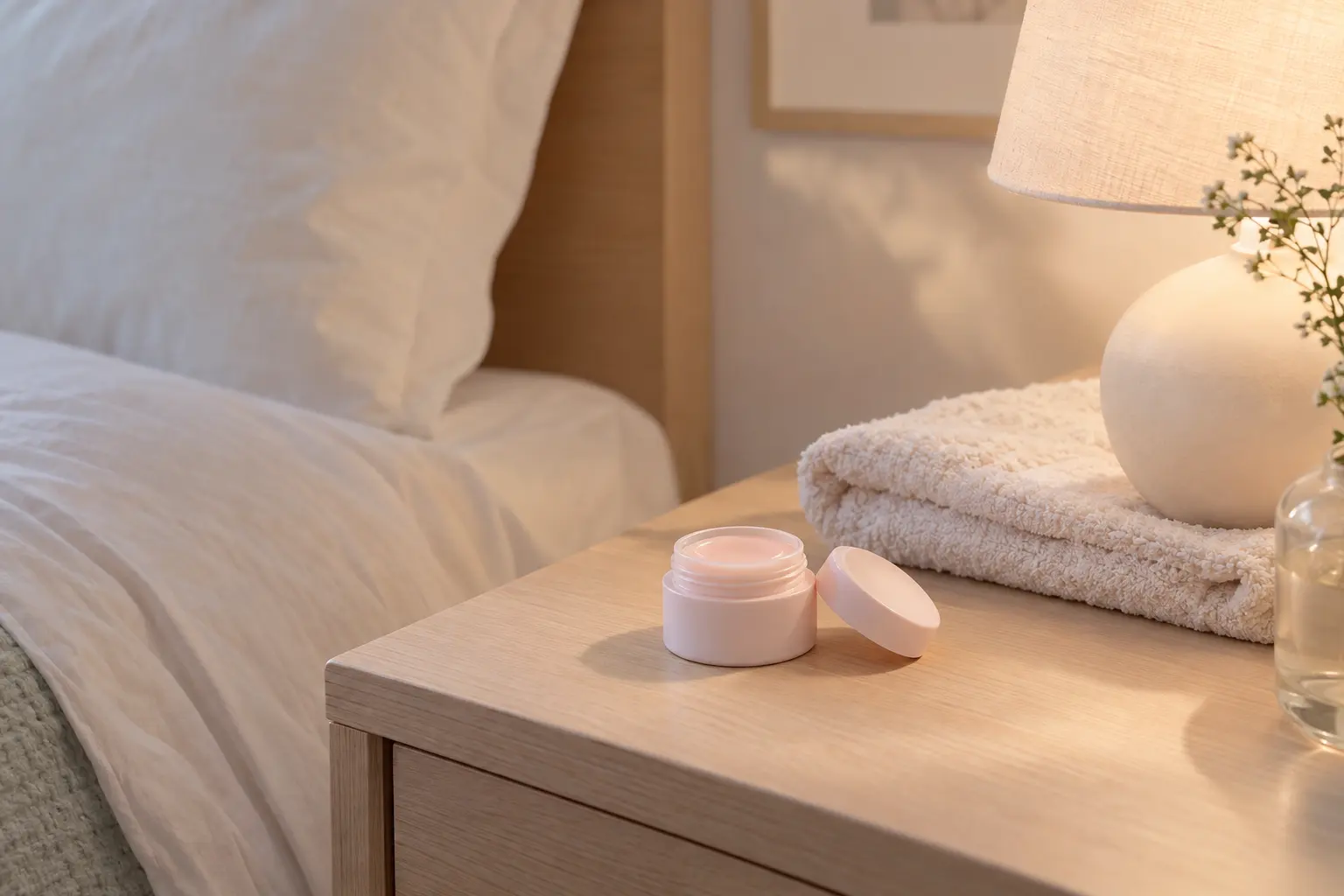
A good routine is short enough to repeat and gentle enough that it does not create a new problem. The AAD recommends a non-irritating lip moisturizer before bed and several times during the day[1]. The mask is one way to handle the bedtime step; it does not require an elaborate preparation ritual.
A practical evening sequence
- Assess your lips. If they are very dry and cracked, consider the AAD’s suggestion of a thick ointment such as white petroleum jelly rather than assuming a fragranced mask is the right first choice[1].
- Apply the selected product as directed. ETUDE’s catalog says to apply a generous layer before bed and leave it on overnight; NEEDLY’s listing says to apply it to dry lips[3].
- Leave the skin alone. The AAD advises against licking, biting and picking, all of which can worsen dryness or irritation[1].
- Notice discomfort. Stop using a product that burns, stings or tingles; the AAD identifies those sensations as irritation rather than proof that a product is working[1].
There is no requirement to scrub before a mask. For lips with visible flakes, the instinct to remove every loose piece can be tempting, but picking and biting can irritate them and interfere with healing[1]. A leave-on product is a more appropriate starting point than treating flaking as a reason to increase friction.
Keep the rest of the routine straightforward. If you are introducing a lip product alongside several other new products, it may be harder to work out what is causing discomfort. A simpler sequence makes it easier to notice how your lips respond, without requiring you to assign credit to a particular ingredient.
There is also no need to assume that more layers mean a more useful routine. The bedtime product should have a clear purpose: provide the lip care you want in a formula that feels comfortable. Adding an unrelated treatment simply because you own it makes the routine more complicated without establishing an extra benefit.
The next morning and outdoors
A night mask does not replace sun protection. The AAD recommends a non-irritating lip balm with SPF 30 or higher before going outdoors and reapplying every two hours while outside[1]. Neither featured listing establishes an SPF claim, so make that a separate step rather than treating the overnight mask as daytime protection.
If you wear lip color, let the condition of your lips guide the rest of your routine rather than trying to cover discomfort with more layers. Our comparison of glossy and water-stain lip tints helps with the separate decision of finish and wear; a tint’s appearance is not evidence that it can replace lip care or SPF.
Finally, consider your environment as well as your product. The AAD suggests a bedroom humidifier, particularly for people who breathe through their mouths at night[1]. That is a practical complement to a tolerable lip moisturizer, not proof that a particular mask will last until morning.
Fragrance, beeswax and sensitive lips: read the whole formula
When lips are already uncomfortable, ingredient tolerance matters more than the attractiveness of a formula’s headline ingredients. The AAD recommends fragrance-free and hypoallergenic products for chapped lips and advises avoiding fragrance, flavorings such as cinnamon, citrus and mint, menthol and several other potential irritants during chapping[1]. A fragrance-free label is useful, but a complete ingredient list is still important if you have specific allergies.
ETUDE’s published list includes fragrance and beeswax, while NEEDLY’s includes beeswax and lavender flower extract[2][3]. Those facts do not mean everyone will react to either product. They do mean that a person with a relevant known sensitivity has a concrete reason to examine the formula before applying it to their lips.
Artificial fragrance is not the same claim as fragrance-free
ETUDE’s listing says it is free of artificial fragrance, yet the same page lists fragrance as an ingredient[2]. For someone trying to avoid fragrance altogether, a claim about artificial fragrance is not enough to resolve the question. The ingredient list gives the more useful signal here.
NEEDLY’s listing states that a skin irritation test was completed, but the retrieved description does not explain the test design[3]. Without those details, the claim cannot tell you whether the mask will suit a particular person, especially someone with a known allergy to one of its ingredients.
Korea’s Ministry of Food and Drug Safety states that designated fragrance allergens must be named on cosmetic packaging rather than included only under the general term fragrance[7]. That can help someone match a known allergen to a label, but it does not mean everyone reacts to those substances or that an ingredient list predicts every individual’s experience.
Why a known allergy changes the recommendation
A small clinical patch-test series identified fragrance mixes and propolis among positive reactions in patients with suspected allergic contact cheilitis; the authors also describe propolis as a potential contaminant of beeswax[6]. This is a selected patient group, not a measure of how often ordinary shoppers react. Its value here is narrower: beeswax can be relevant when someone already knows they have a propolis allergy.
For example, if you have been told to avoid propolis, neither mask is an uncomplicated choice because both published formulas contain beeswax. If you are avoiding fragrance while your lips are chapped, ETUDE’s listed fragrance is a reason to choose a different approach. If you have a known botanical allergy, compare its specific name with NEEDLY’s full list rather than treating all plant extracts as interchangeable.
Use the package as the final reference because ingredient lists and formula versions can change. If you develop discomfort after applying a product, stop using it; if the problem persists, a dermatologist can help determine whether an allergy or another cause is involved[1].
That distinction matters when shopping for someone else, too. A label that sounds reassuring cannot tell you which ingredients another person has been advised to avoid. If you do not know their sensitivities, avoid presenting either mask as a universally safe gift.
When to reassess dry lips and make your next choice
Give a sensible routine enough time to judge without treating an overnight promise as a deadline. The AAD says most people should see noticeable improvement in two to three weeks with its recommended self-care and advises seeing a dermatologist if chapped lips do not heal in that time[1]. A product may make lips feel more comfortable sooner, but a morning-after impression is not the same as evidence that the underlying problem has resolved.
Persistent dryness can have more than one cause. The AAD notes that an allergic reaction, yeast infection or actinic cheilitis can make lips dry and uncomfortable, so symptoms that do not improve deserve assessment rather than an endless rotation of new balms[1]. A dermatologist can help identify the cause; a shopping comparison cannot diagnose it.
Three useful questions before repurchasing
- Did the formula feel comfortable? If applying it caused burning, stinging or tingling, stop rather than treating the sensation as a sign of effectiveness[1].
- Did it meet your actual routine need? A product you wanted for both day and night should fit both uses, while daytime outdoor care still needs SPF.
- Can you obtain the same product again? One listing describes NEEDLY as discontinued, making current stock and package details worth confirming before you depend on it[4].
Suppose your lips are occasionally dry, you tolerate fragrance and beeswax, and you prefer one thick product for bedtime that is also described for daytime use. ETUDE is the more directly supported match to that set of preferences. Its ginger name is secondary to the stated layer and the full formula.
Suppose instead that you want a formula listing panthenol and ceramide NP, do not require a vegan finished product, and know the botanical and beeswax ingredients are acceptable for you. NEEDLY is the closer ingredient match if you can find the current product. Neither scenario establishes which mask works better in a comparative sense.
If your lips are actively cracked or you are avoiding one of the ingredients in both products, the sensible next decision may be to choose neither. The AAD’s non-irritating ointment advice is more relevant than forcing a match from two cosmetically appealing options[1]. You can revisit a mask later if it meets your needs and its ingredient list suits you.
For routine planning beyond the lips, the masks and treatments category is a separate place to explore. Keep the jobs distinct: an overnight lip product addresses your lip-care routine, while face masks and other treatments should be selected for their own intended use.
The final test is practical, not promotional: a product earns its place if it is comfortable, fits your routine and does not conflict with ingredients you need to avoid. If those conditions are not met, a simpler approach is a better decision than a more elaborate mask.
When your lips do improve, consider what actually made the routine workable: a product you tolerated, a step you remembered to use, or a change in habits. That assessment is more useful for your next purchase than assuming the most prominently advertised ingredient was responsible.
Frequently Asked Questions
Can I use an overnight lip mask during the day?
ETUDE describes Ginger Sugar Overnight Lip Mask as suitable for use as a daytime lip balm as well as overnight[2]. That can make it convenient if the formula suits you and you want one product for both steps. It is not a substitute for a lip product with SPF 30 or higher when you are outdoors[1].
Should I exfoliate my lips before applying a sleeping mask?
No exfoliation step is required to use either featured mask. The AAD advises against picking or biting lips because doing so can irritate them and interfere with healing[1]. Apply your chosen non-irritating product according to its directions rather than trying to remove every flake first.
Is NEEDLY Sleeping Lip Mask vegan?
The listing highlights fermented vegan oils, but its published ingredient list includes beeswax[3]. A claim about some ingredients is different from a claim about the entire finished formula. If you avoid animal-derived ingredients, this mask is not a suitable choice based on that list.
Does an overnight lip mask replace lip balm with SPF?
No. Neither featured product listing establishes an SPF claim. The AAD recommends a non-irritating lip balm with SPF 30 or higher before going outdoors and reapplication every two hours while outside[1].
Why are my lips still dry after using a mask?
A mask may not address the cause of persistent dryness, and a product that irritates your lips can make the routine less helpful. The AAD recommends seeing a dermatologist if chapped lips do not heal after two to three weeks of appropriate self-care[1]. Possible causes include an allergic reaction or another condition that needs assessment[1].