
Sunscreen selection is not a ranking of “most nourishing” formulas. The essential questions are whether the exact product provides appropriate broad-spectrum protection, can be applied in an adequate amount, fits the planned exposure, and remains comfortable enough for consistent use.
This guide removes raw editor code and obsolete Shopify product blocks from the original page. It uses three current Korean sunscreens to show how water resistance, finish, UV filters, size and routine fit change the decision.
SPF, PA and broad-spectrum language
SPF is a laboratory rating focused mainly on protection against sunburn-causing UVB under defined test conditions. It is not a percentage of all sunlight blocked and does not tell the whole UVA story.
U.S. broad-spectrum labeling indicates protection across UVA and UVB requirements. Korean products commonly display a PA grade for UVA protection. Compare the exact market package rather than translating one rating system into an unofficial numerical equivalent.
A high label number cannot compensate for missed areas, too little product or failure to reapply during ongoing exposure.
Three current sunscreen examples
| Product | Current label position | Best comparison question |
|---|---|---|
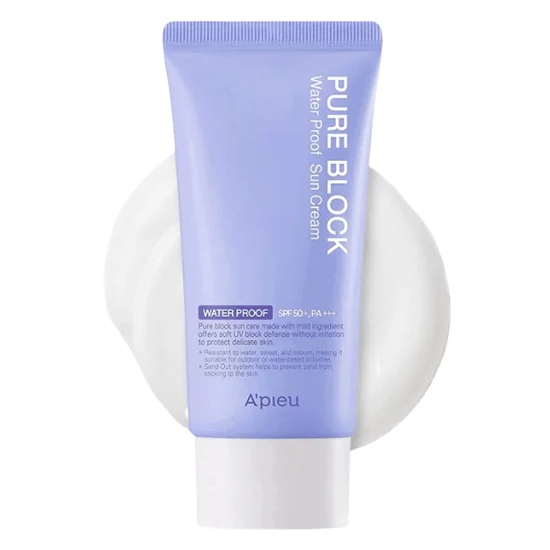
| A’PIEU Pure Block Natural Waterproof Sun Cream | SPF50+ PA+++, matte/fast-absorbing, waterproof name | What water-resistance duration does the current label state? |
| Anua Heartleaf Silky Moisture Sun Cream | SPF50+ PA++++, lightweight lotion-like finish | Does the moisture finish work under the planned makeup? |
| DEWYTREE Derma Panthenol 5 Moist Barrier Sun | SPF50+ PA++++, zinc-oxide physical/mineral position | Is white cast acceptable at the required amount? |
Marketing descriptions are starting points. The received package and its directions are authoritative for use.
A’PIEU Pure Block Waterproof: activity first
A’PIEU Pure Block Natural Waterproof Sun Cream 50ml is currently listed as SPF50+ PA+++ with a lightweight, matte position. “Waterproof” appears in the product name, but no sunscreen is literally impervious indefinitely.
Check the current package for tested water-resistance duration and reapplication instructions. Swimming, sweating, toweling and friction can remove product. Reapply after those events even when the finish still looks intact.
Anua Heartleaf Silky Moisture: daily texture fit
Anua Heartleaf Silky Moisture Sun Cream 50ml is currently listed as SPF50+ PA++++ with a lotion-like, makeup-compatible finish and heartleaf/panthenol positioning.
Botanical soothing language does not guarantee tolerance for sensitive skin. Evaluate the full ingredient list and current directions. A pleasant texture helps adherence, but sunscreen remains protective product first.
DEWYTREE Panthenol 5: zinc oxide and visible cast
DEWYTREE Urban Shade Derma Panthenol 5 Moist Barrier Sun 40ml is currently listed as SPF50+ PA++++ with zinc oxide, 5% panthenol and a physical/mineral sunscreen position.
Zinc oxide can create visible cast depending on formula, amount and skin tone. “Reduced white cast” is not “no cast.” Test at the full intended amount and under natural light.
How much sunscreen?
A rating is measured at a specified application density. Consumer shortcuts such as two fingers can be useful estimates for some face-and-neck combinations, but finger size, product ribbon and covered area vary.
Follow the exact label and apply enough to cover all exposed skin evenly. AAD describes approximately one ounce—enough to fill a shot glass—for an adult’s exposed body under common swimwear conditions, though body size and clothing change the area.
Apply in sections so ears, hairline, neck, chest, hands and tops of feet are not forgotten. Lips need an appropriate SPF lip product.
When to apply before exposure
FDA and AAD consumer guidance commonly advises applying sunscreen about 15 minutes before going outdoors. The exact product label takes priority. The original article’s broad “15–30 minutes” rule should not replace current directions.
Applying before dressing can help cover edges around straps, sleeves and necklines. Allow the film to settle before makeup or clothing friction.
If exposure has already started, apply rather than waiting for a perfect schedule, then follow reapplication directions.
Reapplication is exposure-dependent
AAD recommends reapplying approximately every two hours while outdoors and after swimming or sweating. Toweling, rubbing, masks and clothing can disturb the film sooner.
Indoor days vary. Window exposure, commute, outdoor breaks and seating matter. A rigid timer without considering exposure is less useful than a plan based on where the person will be.
Powder, mist or cushion SPF may be convenient for makeup touch-ups, but these formats may be difficult to apply at the tested amount. They should not automatically replace adequate cream or lotion reapplication.
Water resistance is not waterproof
In the United States, sunscreen water resistance is labeled for a tested duration such as 40 or 80 minutes. Other markets have their own rules. Read the market package and do not infer duration from an English product name alone.
No sunscreen remains fully protective through unlimited swimming or sweating. Reapply after the stated duration, immediately after towel drying, and as otherwise directed.
For sports or beach use, prioritize tested water resistance and secure coverage over a purely elegant cosmetic finish.
Organic, chemical, mineral and hybrid filters
“Chemical” and “physical” are common retail categories but can encourage fear-based conclusions. Organic UV filters absorb UV energy; mineral filters such as zinc oxide and titanium dioxide also interact with UV through absorption and scattering. Neither category is universally safer or better.
Choose an authorized product whose filters, finish and directions work for the user. Mineral formulas can cast; organic-filter formulas can sting some eyes; hybrids combine approaches.
Known allergies, pregnancy questions, medical conditions and use on young children require appropriate label and professional guidance.
Sunscreen and makeup order
Use prescribed treatment according to directions, moisturizer if needed, then sunscreen as the final skincare protection layer. Apply makeup after the sunscreen film settles.
Pilling can come from excess skincare, incompatible textures, rubbing or insufficient settling time. Simplify layers and press makeup gently. Do not reduce sunscreen amount to rescue an elaborate base.
Foundation or cushion SPF is supplementary. Typical makeup application may be thinner and less even than sunscreen testing requires.
Shade, tinted sunscreen and visible light
Tinted sunscreen can reduce visible cast and may provide iron-oxide pigments relevant to visible-light-associated pigmentation for some users. Not every beige or tone-up formula offers the same pigment composition or shade match.
Verify whether a tint matches at the required amount. A too-light or too-pink sunscreen is unlikely to be applied generously and consistently.
Blue-light marketing needs a specified wavelength, test method and endpoint. Screen light and solar visible light are not equivalent exposures.
Eyes, lips, scalp and often-missed areas
Use sunglasses and a brimmed hat in addition to sunscreen. Apply around the orbital bone only as the product permits and avoid direct eye contact. A formula that repeatedly stings the eyes may be a poor fit.
Use SPF lip balm and reapply after eating or drinking. For a thinning part or exposed scalp, use a suitable scalp product or hat. Ears, back of neck and hands need attention.
Clothing coverage is often more reliable than trying to reach every area with a cosmetic amount.
Sunscreen for different skin concerns
Oily or acne-prone skin may prefer lightweight or non-comedogenic-labeled products, but no label guarantees zero breakouts. Dry skin may prefer a moisturizing base. Sensitive skin still needs full-formula review.
Dark skin tones deserve full-dose cast testing. Fragrance sensitivity, eye stinging and active dermatitis can determine suitability more than a marketed skin type.
Persistent acne, rash or pigment change should not be self-treated by cycling through “nourishing” sunscreens. Seek qualified care while maintaining appropriate protection.
Storage, expiry and product integrity
Heat can affect sunscreen stability. Do not leave a tube in a hot car or direct sun. Keep the cap clean and closed, follow expiry and period-after-opening information, and do not dilute the product.
Discard sunscreen after unusual separation, odor, color, texture, foreign material or a significant reaction. Replace lost caps and damaged packages rather than exposing the formula.
Use enough product before expiry; an oversized stockpile is not economical when protection degrades or dates pass.
A practical protection plan
- Check forecast, UV exposure, activity and covered areas.
- Select broad-spectrum SPF30+ and water resistance appropriate to activity.
- Apply generously and evenly according to the label before exposure.
- Add shade, clothing, hat and sunglasses.
- Carry enough product for reapplication.
- Reapply about every two hours outdoors and after water, sweat or toweling.
- Review missed areas and skin response at day’s end.
The best sunscreen is not a universal “top pick.” It is an authorized, current product that offers the needed protection, can be applied in the tested spirit, fits the activity and is used consistently with other sun-protective measures.
After a full-dose trial, record whether the formula creates eye sting, cast, pilling, dryness, excess shine or staining on clothing. Test it during the real activity rather than only indoors. A product that looks elegant in a thin swatch but becomes uncomfortable at protective use amounts is not the right daily match.
Keep a separate activity sunscreen when ordinary daily texture cannot meet swimming or heavy-sweat needs. One product does not have to solve office wear, sport, beach exposure and sensitive-eye application equally well.
Sources
- FDA: Sunscreen—How to Help Protect Your Skin
- American Academy of Dermatology: How to Apply Sunscreen
- AAD: Practice Safe Sun
- Current A’PIEU Pure Block Waterproof Sun Cream listing
- Current Anua Heartleaf Silky Moisture Sun Cream listing
- Current DEWYTREE Panthenol 5 Moist Barrier Sun listing
Frequently Asked Questions
How much sunscreen should I apply?
Follow the exact current label and cover exposed skin generously and evenly. AAD uses roughly one ounce for an adult’s exposed body under common swimwear conditions; face-and-neck shortcuts vary by product and area.
How often should sunscreen be reapplied?
Reapply approximately every two hours while outdoors and after swimming, sweating or towel drying, or more often when the current label directs. Exposure and film disruption matter.
Can makeup with SPF replace sunscreen?
Usually no. Makeup is often applied more thinly and unevenly than the amount used for sunscreen testing. Apply dedicated sunscreen first and treat makeup SPF as supplementary.
Is mineral sunscreen better for sensitive skin?
Not universally. Mineral filters may suit some users but can cast or feel drying; organic filters may sting some eyes. Evaluate the full formula, label, known allergies and individual response.
Does waterproof sunscreen need reapplication?
Yes. No sunscreen is permanently waterproof. Check the tested water-resistance duration and reapply after that period, after towel drying, swimming or sweating, and as directed.