
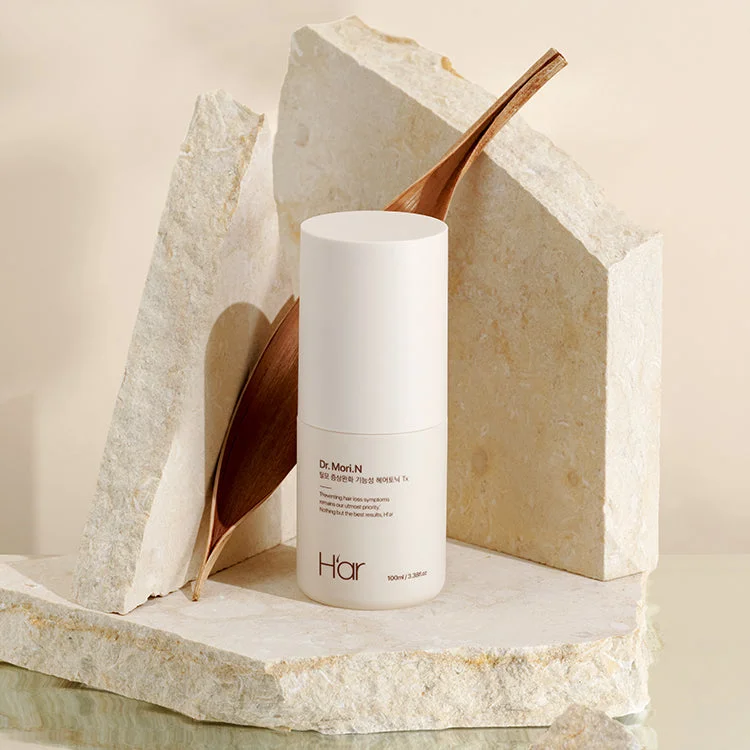
H’ar Dr. Mori N is a scalp tonic, not a universal answer to thinning hair. Its most useful role is as a repeatable leave-on scalp-care step: the silicone comb tip parts hair, places liquid closer to the scalp and adds a brief massage. Whether that routine is appropriate depends on the scalp condition and the cause of shedding.
The former article said the tonic penetrates deep into hair roots, rebuilds hair from within, maximizes ingredient uptake and heralds long-term healing and growth. It treated a cooling sensation, peptides, hydrolyzed protein and a third-party grade as proof of regrowth. Those conclusions were not established. This guide explains the product without converting cosmetic language into medical promises.
Current product identity
The current H’ar official listing and Empress Korea catalog identify Dr. Mori N as a 100mL scalp tonic. The EK listing names l-menthol, salicylic acid and dexpanthenol as MFDS-listed functional actives and shows a curved silicone massaging applicator. The official brand FAQ explains that the middle section twists until it clicks to open the applicator.
Confirm the bottle size and exact “Dr. Mori N” identity because similarly named H’ar shampoos, supplements and scalp products have different formats and directions. A bundle quantity does not change the formula’s evidence.
What a Korean functional cosmetic means
MFDS describes cosmetics as products with mild action used to clean, beautify or maintain and improve skin or hair health. Its functional-cosmetic categories include products that help relieve hair-loss symptoms, excluding products that only make strands look physically thicker.
That is a regulated cosmetic function, not a diagnosis and not a guarantee that dormant or miniaturized follicles will produce new terminal hair. Brand FAQ language is appropriately narrower: Dr. Mori N is a functional cosmetic, not a hair-loss medicine.
| Observation or claim | What it can mean | What it does not prove |
|---|---|---|
| Cooling after application | Menthol sensory effect | Greater blood flow or regrowth |
| Cleaner-feeling scalp | Oil, scale or residue feels reduced | The cause of shedding is treated |
| Less hair in the drain | Possible change or normal daily variation | Higher follicle density |
| Short “baby hairs” | Regrowth, breakage or miniaturized hairs | Permanent recovery without examination |
| Functional-cosmetic status | Reviewed cosmetic claim boundary | Drug equivalence or cure of alopecia |
Hair shedding, breakage and thinning differ
Hair in a brush can come from a full-length shed hair or a broken fiber. A widening part can reflect pattern hair loss, while sudden diffuse shedding may follow illness, surgery, childbirth, weight loss or another stressor. Patchy loss, traction, infection, thyroid disease and inflammatory or scarring alopecia require different responses.
A tonic cannot identify which process is present. Record onset, distribution, symptoms, medications, recent health events, diet changes and styling tension before deciding that a cosmetic is working or failing.
l-Menthol: sensation is not efficacy
Menthol creates a cooling sensation through sensory receptors. That can make an oily or warm scalp feel refreshed and may improve the experience of a leave-on routine. Cooling does not demonstrate nutrient delivery to follicles, stronger roots or increased hair count.
The brand FAQ notes that menthol cooling can feel irritating depending on scalp condition. Burning that persists, worsening redness or itching is not a sign that the formula is “working.” Rinse or discontinue and seek advice when symptoms do not settle.
Salicylic acid: scalp surface first
Salicylic acid is keratolytic: in scalp products it can help loosen surface scale and reduce buildup. A clearer surface may make application more comfortable, but it does not by itself correct androgen sensitivity, autoimmune attack, iron deficiency or scarring inflammation.
Overlapping the tonic with strong exfoliating scalp products can increase dryness and irritation. A person with cracked, infected or highly inflamed skin should not use the desire for “deep cleansing” as a reason to add more acid.
Dexpanthenol: conditioning is not follicle rescue
Dexpanthenol is a provitamin B5 ingredient used for moisture and conditioning support. Better-conditioned scalp and hair can feel less dry and strands may look smoother. Those cosmetic changes are valuable but should not be described as reversing follicle miniaturization or rebuilding a hair bulb.
An ingredient’s general function is also not the same as evidence for the exact finished formula. Concentration, vehicle, contact time, stability and use frequency shape the result.
Peptides and hydrolyzed protein need context
The old article treated five peptides as architects rebuilding hair from within and cited a protein percentage as nourishment for “starving roots.” Hair shafts above the scalp are nonliving fibers. Hydrolyzed proteins can coat or condition those fibers, but fiber feel is separate from biological follicle growth below the skin.
Peptide names on an ingredient list do not establish scalp penetration, dose or clinical hair-density improvement. Look for a controlled finished-product study with an exact formula, comparator, participant count and objective endpoint before making a growth claim.
The silicone applicator changes placement
The curved silicone teeth can help move through hair and deliver tonic to the scalp rather than coating lengths. This is a practical packaging advantage, not a penetration technology. Pressing harder does not send ingredients deeper and may scratch an irritated scalp or pull fragile hair.
Open the bottle as directed, place the tip against selected part lines, dispense a modest amount and move gently. Use fingertips for a brief light spread if the label permits. Avoid aggressive circular rubbing and repeated passes over the same tender area.
A low-risk first-use method
- Read the Korean label and seller translation for the exact bottle.
- Inspect the scalp for cuts, crusting, infection or severe inflammation.
- Test a small accessible area and observe for delayed irritation.
- Part dry or label-directed hair so the tip contacts scalp, not only strands.
- Use the smallest amount that covers target part lines without dripping.
- Keep the first routine separate from a new shampoo, dye or exfoliant.
A small-area test cannot predict every allergy and does not prove long-term compatibility. Stop if the scalp becomes progressively red, swollen, painful, blistered or intensely itchy.
Applicator hygiene matters
The tip repeatedly contacts scalp oils, flakes and hair products. Wipe it after use according to package directions and allow it to dry before closing. Do not immerse the bottle, dilute the contents or introduce water through the applicator.
Do not share a direct-contact applicator, especially when either person has scalp lesions. Replace a damaged, cracked or heavily contaminated tip rather than relying on stronger cleaning that may alter the material or formula.
Scalp comfort and hair growth are separate endpoints
A less greasy, less flaky or more comfortable scalp can improve quality of life and make a routine easier to follow. It is still possible for pattern hair loss to progress while scalp comfort improves. Conversely, a medicine may help a diagnosed hair-loss condition without creating an instantly refreshing feel.
Track the outcome you actually want. For comfort, record itch, scale, oil and burning. For hair status, use consistent photographs, part width and clinician measurements rather than relying on coolness or tingling.
How to photograph progress
Choose front hairline, both temples, center part and crown. Use the same camera, distance, dry-hair state, part, room, lighting and time after washing. Photograph at baseline and at spaced intervals such as monthly; daily images amplify lighting and styling noise.
Do not count every short hair as new growth. Broken fibers have variable ends, and miniaturized hairs may remain short. A dermatologist can use dermoscopy and standardized measurements when the distinction matters.
When a tonic is a reasonable add-on
Dr. Mori N may suit someone who wants a leave-on scalp-care step, tolerates the formula and values the targeted applicator. It can be an adjunct to gentle cleansing, conditioning and an evidence-based plan. It is not necessary for everyone with normal shedding.
Do not postpone diagnosis while buying repeated bottles. If a clinician recommends a treatment, ask whether this tonic’s alcohol, menthol, salicylic acid or other ingredients are compatible with the prescribed regimen.
Minoxidil is a different category
Topical minoxidil is a medication with clinical evidence for selected non-scarring alopecias, including pattern hair loss. A systematic review identifies it as a first-line therapy for male and female androgenetic alopecia. It has its own directions, contraindications, side effects and need for continued use.
A functional cosmetic should not be presented as interchangeable with minoxidil, and minoxidil should not be started solely because hair appeared in the shower. Diagnosis, health history and pregnancy plans can change the appropriate treatment.
Hair-care changes still matter
AAD recommends gentle shampooing, conditioning, reduced heat, careful detangling and avoiding continuously tight styles for fragile or thinning hair. These steps reduce breakage and traction but do not cure every follicle disorder.
Supplements are not an automatic companion to a tonic. AAD warns that excess nutrients can worsen hair loss; iron, zinc or biotin should not be used as deficiency treatment without evidence that a deficiency exists.
Referral signs
Arrange a dermatology assessment for rapid loss, discrete bald patches, eyebrow or eyelash loss, scalp pain, pus, heavy scale, broken hairs with inflammation, shiny scar-like areas or a receding inflamed hairline. Seek evaluation when shedding follows a new medicine or comes with systemic symptoms.
Early assessment matters because some scarring alopecias permanently destroy follicles. A tonic’s refreshing sensation must never mask worsening inflammation.
Current Empress Korea listing
The listing below is the exact 100mL H’ar Dr. Mori N Anti-Hair Loss Tonic Tx. Confirm the current ingredient list, directions, expiry or period-after-opening information and seller return terms on the live product page before ordering.
A practical buying checklist
- Your goal is scalp comfort or adjunct care, not an undiagnosed cure.
- The exact label is compatible with your allergies and current treatments.
- You can apply gently and clean the direct-contact silicone tip.
- You have a baseline and a date for reassessment.
- You know which symptoms will trigger discontinuation or medical review.
- You are not using review counts or before-and-after lighting as clinical proof.
The measured verdict
H’ar Dr. Mori N is best understood as a targeted functional scalp cosmetic with a convenient applicator. Its legitimate claim boundary is hair-loss symptom relief, not guaranteed growth. Menthol, salicylic acid and dexpanthenol explain sensory, surface and conditioning roles; they do not identify the cause of thinning.
Use it gently, track separate scalp and hair endpoints and judge it as an adjunct. If thinning is progressive, sudden, patchy or inflamed, the most valuable next product is not another bottle but an accurate diagnosis.
Sources
- H’ar official Dr. Mori N product page
- H’ar product FAQ
- MFDS cosmetics policy and functional-cosmetic scope
- American Academy of Dermatology: causes of hair loss
- American Academy of Dermatology: diagnosis and treatment
- American Academy of Dermatology: hair-loss care tips
- Systematic review of topical minoxidil for non-scarring alopecia
Frequently Asked Questions
Is H’ar Dr. Mori N a hair-loss medicine?
No. The brand describes it as a Korean functional cosmetic that helps relieve hair-loss symptoms. That category is distinct from a medicine intended to diagnose or treat a specific alopecia.
Do menthol and a cooling feeling mean the tonic is growing hair?
No. Menthol creates a cooling sensory effect. Cooling can make the scalp feel refreshed but does not prove increased follicle activity, blood flow or hair count.
What does salicylic acid do in a scalp tonic?
It can help loosen surface scale and buildup. It does not by itself treat genetic, autoimmune, nutritional, infectious or scarring causes of hair loss.
How should I use the silicone applicator?
Open it according to the label, part the hair, place a modest amount on scalp part lines and move gently without scratching or pulling. Wipe and dry the contact tip after use as directed.
When should thinning hair be assessed by a dermatologist?
Seek assessment for sudden or rapid shedding, bald patches, pain, heavy scale, pus, inflammation, eyebrow loss, shiny scar-like skin or steadily widening thinning despite routine changes.