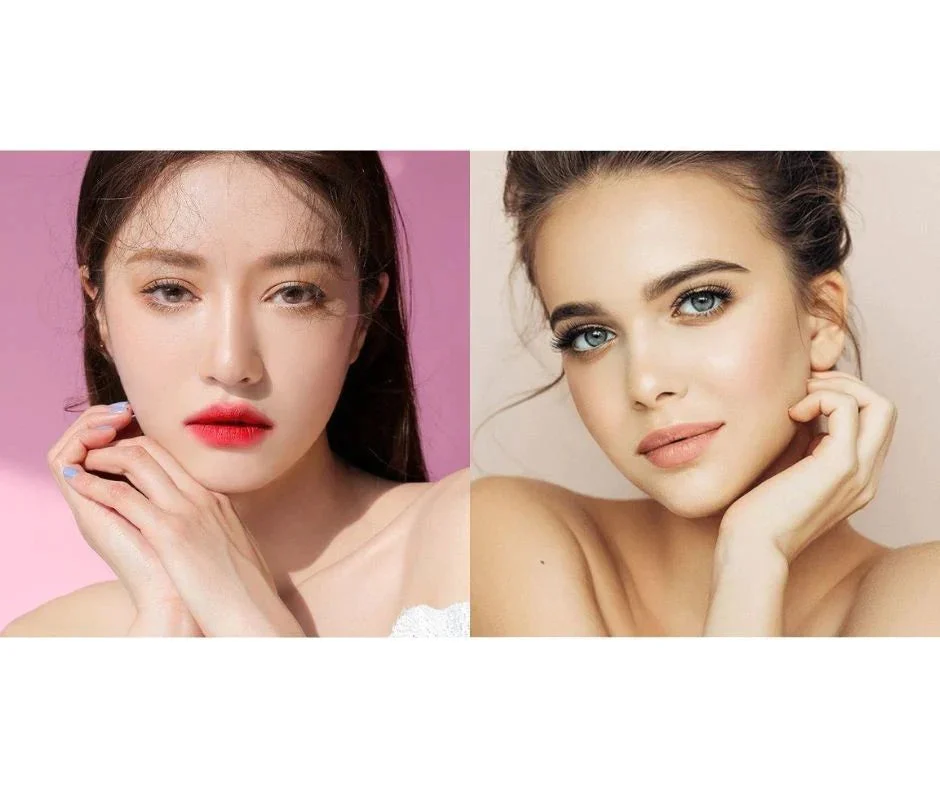
“K-Beauty versus Western skincare” is often presented as a clean split: Korea prevents while the West corrects; Korea uses natural ingredients while the West uses synthetic actives; Korea layers ten gentle steps while the West applies a few strong products. This is memorable, but it is not a reliable description of either market.
South Korea, North America and Europe contain many brands, price levels, regulatory systems, product categories and consumer routines. Korean companies sell high-strength retinol and exfoliating acids. Western companies sell barrier creams, botanical essences and elaborate routines. The product—not the map—determines how it should be evaluated.
The original comparison fails four tests
| Stereotype | Why it fails | Better comparison |
|---|---|---|
| Korea prevents; West corrects | Both markets sell sunscreen, moisturizer and targeted treatments | Product role and claim |
| Korea is natural; West is synthetic | Finished formulas commonly combine plant-derived and manufactured ingredients | Full formula, concentration and safety |
| Korea is complex; West is simple | Routine length varies by person and brand | Necessary steps and duplication |
| Korea massages; West applies quickly | Technique comes from directions, texture and preference | Exact application instructions |
A good comparison names an exact cleanser, sunscreen, retinoid or moisturizer. A continent-scale personality cannot be tested on skin.
Prevention and correction are not opposites
Daily sun protection is preventive, while acne medication or a retinoid may target an existing concern. The same person can use both. A moisturizer can reduce dryness caused by weather or treatment while also supporting an ordinary daily routine.
Korean brands sell products positioned for wrinkles, pores, acne and pigmentation. North American and European brands sell sunscreen and barrier care. The categories overlap because skin needs overlap.
Choose a routine goal: cleanse, moisturize, protect, or treat a defined concern. Do not buy a “preventive philosophy” or “corrective philosophy” as if either were a complete formula.
Korean skincare includes potent retinoids
IOPE Retinol Expert 0.3% Wrinkle Corrector 20ml is a current Korean product centered on stabilized 0.3% retinol. That alone disproves the idea that K-Beauty avoids concentrated, corrective actives.
Retinol use requires exact directions, cautious introduction, sun protection and attention to irritation. Do not combine it casually with multiple unfamiliar exfoliants. Pregnancy or nursing questions and medical skin conditions require professional guidance.
The country of manufacture does not make 0.3% retinol gentle. Concentration, vehicle, frequency, other actives and individual response matter.
Korean skincare also includes exfoliating acids
Beauty of Joseon Green Plum Refreshing Toner AHA+BHA 150ml is a Korean exfoliating toner. AHA and BHA are not uniquely “Western” ingredients, and a toner is not automatically only hydrating.
Read the current acid types, concentration, pH where supplied, directions and warnings. “Daily” on marketing does not require every person to use it daily. Dryness, retinoid use, other acids, shaving and skin conditions can reduce tolerance.
Exfoliation is optional. Already peeling, burning or irritated skin may need simplification and moisturizer rather than another acid step.
Barrier care is not uniquely Korean either
CURECODE Double Barrier Cream 80ml is a current Korean moisturizer positioned for dry and sensitive skin. Its role—reducing moisture loss and improving comfort—is found across global skincare.
Judge a barrier cream by texture, formula, fragrance, occlusion, current directions and individual comfort. A “barrier” name does not diagnose a damaged barrier or guarantee that every reactive user will tolerate it.
Likewise, ceramides, cholesterol, fatty acids, panthenol, glycerin and petrolatum are not culturally exclusive ingredients. They are formulation tools used in many markets.
Natural versus synthetic is a false safety shortcut
A cosmetic formula can contain water, botanical extracts, fermentation products, minerals, silicones, emulsifiers, preservatives and laboratory-made actives together. Processing and synthesis do not automatically make an ingredient harsh; plant origin does not automatically make it gentle.
FDA states that the source of an ingredient does not determine cosmetic safety. Plants can contain allergens or toxic substances. Finished-product safety depends on formulation, purity, exposure, preservation, manufacturing and intended use.
Replace “natural or chemical?” with specific questions: What is the ingredient? What function and concentration does it have? Is the formula stable and preserved? What do the directions and evidence support?
Fermentation and traditional ingredients need context
Ginseng, rice, green tea, mugwort and fermented materials can express Korean history, agriculture and brand identity. They can also be studied as cosmetic ingredients. Cultural relevance and technical evidence are both valuable when described accurately.
Neither traditional use nor fermentation proves potency, absorption or suitability. The exact material, extraction, fermentation organism, concentration and finished vehicle matter. A food tradition is not automatically topical clinical evidence.
Western brands similarly use botanicals and heritage stories. The evidence boundary should be the same regardless of origin.
The ten-step routine is not a rule
Double cleanse, toner, essence, treatment, sheet mask, eye cream, moisturizer, sunscreen and other steps can be combined in a long routine, but nobody needs ten steps simply because products are Korean.
AAD recommends a simple foundation: gentle cleansing, treatment as directed, moisturizer and/or sunscreen, then makeup if desired. Too many products can irritate skin and make it difficult to identify the cause.
Use a longer routine only when each step has a distinct role and remains tolerable. A short Korean routine is still Korean skincare; a long Western routine is still possible.
Application technique follows the formula
Massage can help spread some cleansers or create a preferred ritual. Aggressive rubbing does not prove better absorption and can irritate. Retinoids, acids, sunscreen, masks and cleansers each have different contact, amount and removal instructions.
Patting, pressing and layering are optional techniques unless the label specifies them. Apply evenly and gently. More pressure or longer massage does not compensate for an unsuitable product.
For sunscreen, correct amount, coverage and reapplication matter more than a national application style.
Regulation depends on the selling market
Cosmetics are regulated under different legal frameworks in South Korea, the United States, the European Union and other destinations. Product classification, permitted claims, ingredient restrictions, sunscreen status and label requirements can differ.
A product authorized or labeled in Korea may have a different package or availability elsewhere. U.S. sunscreen is regulated as an over-the-counter drug, while the EU treats sunscreen within its cosmetics framework under applicable requirements. Do not assume one label travels unchanged.
Check the exact market package and seller. Regulatory difference is not a simple ranking of stricter versus weaker; it changes the questions that must be verified.
Innovation should be demonstrated, not presumed
Korean beauty companies have contributed fast product cycles, distinctive formats and global category influence. MFDS export data documents the industry’s substantial international reach. Market success is real, but it does not prove every launch is innovative or effective.
Western laboratories and brands also develop delivery systems, UV filters, retinoids, biologic research and packaging. Innovation happens across borders and often through shared suppliers and international research.
Ask what changed: active, delivery, stability, texture, package, manufacturing or evidence. “Innovative K-Beauty” without a specific improvement is positioning.
How to compare two exact products
- Match category and intended role.
- Verify current name, generation, size and option.
- Compare active type and concentration where disclosed.
- Read the full ingredient list, directions and warnings.
- Check finished-product evidence and footnotes.
- Consider texture, fragrance, packaging and hygiene.
- Calculate usable amount and final cost.
- Choose the formula you can use correctly and consistently.
This method works for a Korean and French sunscreen, two Korean retinoids, or an American and Korean moisturizer. Geography becomes one piece of identity rather than the verdict.
Build a mixed routine without conflict
There is no reason every step must come from one country. A routine can combine products when their roles, actives and textures are compatible.
Begin with gentle cleansing, moisturizer and sun protection. Add prescribed treatment according to instructions. Introduce one optional leave-on product at a time and avoid duplicating strong actives.
If irritation develops, simplify while preserving necessary medical care. Record product, frequency and timing rather than blaming an entire regional philosophy.
A better conclusion than “East versus West”
K-Beauty is worth studying as an industry, design language, export force and collection of products. Western skincare is also a broad collection of distinct markets. Neither is a single routine or ingredient ideology.
Country of origin can help verify manufacturer, culture, market package and regulation. It cannot replace formula analysis. The useful question is not which side wins, but which exact current product serves the need with understandable evidence and acceptable risk.
Compare products, not stereotypes. That approach respects Korean beauty’s actual diversity instead of reducing it to “natural, gentle and ten steps.”
When a comparison article uses regional labels, check whether it names representative products, dates its market evidence and acknowledges counterexamples. If the conclusion would remain unchanged no matter which formulas are examined, the piece is describing a stereotype rather than conducting a comparison. Product-level evidence should be able to change the answer.
Sources
- American Academy of Dermatology: Product Order and Routine Simplicity
- FDA: Using Cosmetics Safely
- FDA: Cosmetics Labeling Claims
- European Commission: Cosmetic Products
- Korean Ministry of Food and Drug Safety: Cosmetics Export Results
- Current IOPE Retinol Expert 0.3% listing
- Current Beauty of Joseon AHA+BHA Toner listing
- Current CURECODE Double Barrier Cream listing
Frequently Asked Questions
Is K-Beauty always gentler than Western skincare?
No. Korean brands sell retinoids, exfoliating acids and other potent actives, while Western brands sell gentle cleansers and barrier moisturizers. Gentleness depends on the exact formula, concentration, frequency and individual response.
Does K-Beauty require a ten-step routine?
No. Routine length is optional. Begin with gentle cleansing, moisturizer as needed and sun protection, while following prescribed treatment. Add a step only when it serves a distinct purpose.
Are natural Korean ingredients safer than synthetic ingredients?
Not automatically. FDA states that ingredient source does not determine safety. Plant materials can cause allergy or irritation, and synthetic ingredients are not harmful by definition. Evaluate the finished formula.
Can I mix Korean and Western skincare products?
Yes, when their roles, actives, directions and textures are compatible. Introduce one main leave-on product at a time, avoid unnecessary active overlap and simplify after persistent irritation.
How should I compare a Korean product with a Western product?
Match category, current identity, active type and concentration, full formula, directions, warnings, evidence, texture, packaging, price and market regulation. Do not decide from geography alone.