
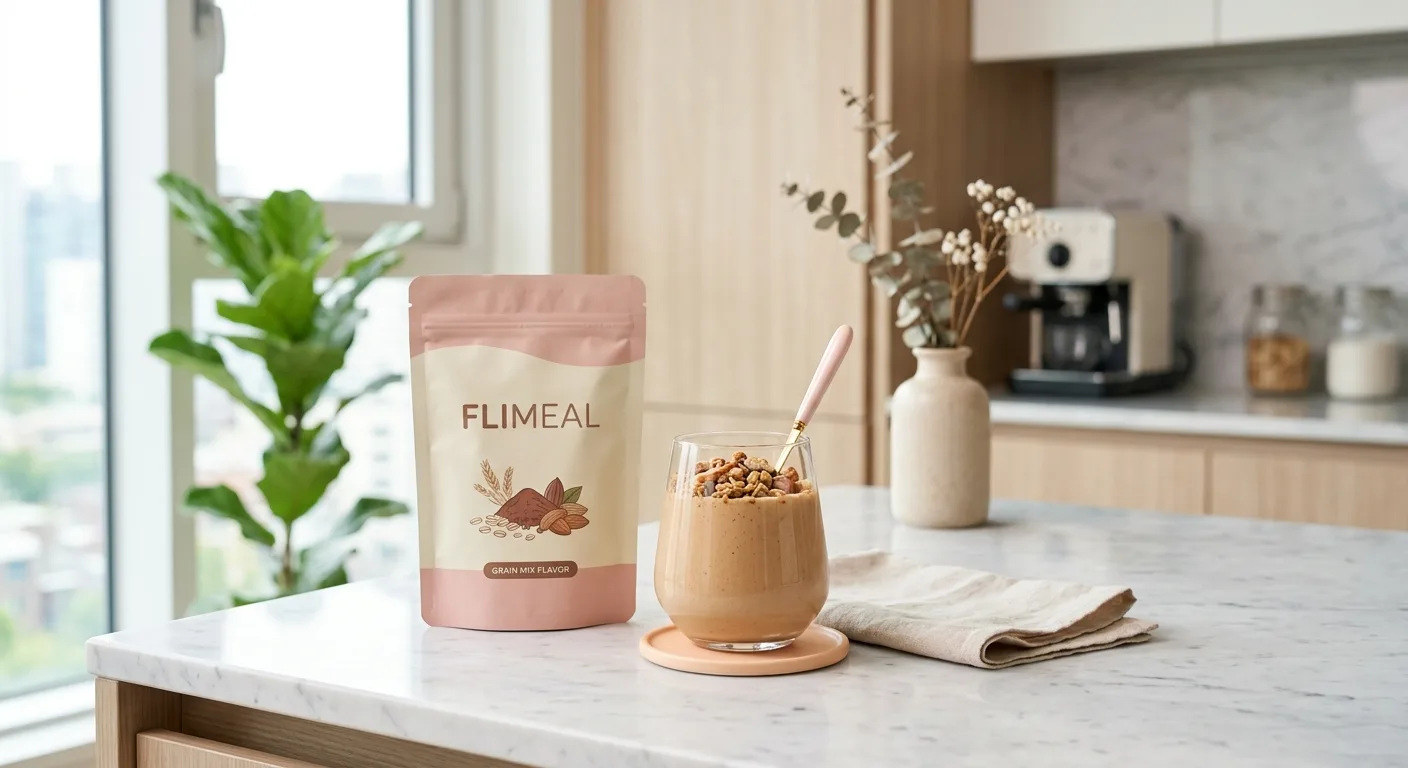
Flimeal (플라이밀) is the Korean protein shake that made “chewable” a selling point. Each 45 g pouch mixes into a latte-textured drink carrying roughly 20 g of protein and 150 to 180 kcal, with crunchy inclusions such as protein balls, oat pieces or brown rice puffs that give a liquid meal something to bite. It is sold under the tagline “Full and Light,” and the distributor’s product pages publish complete nutrition panels for every flavor, which is rare in the category and makes the product unusually easy to evaluate.
This guide does that evaluation properly. It documents what is in a Flimeal pouch and how the flavors differ on the label, explains how a shake of this composition fits a calorie-controlled diet, summarizes what randomized trials say meal replacements can and cannot achieve, and sets realistic expectations for weight loss. It replaces an earlier article that described Flimeal as a “secret” and repeated unverifiable sales figures; nothing below depends on those claims.
What Flimeal actually is
Flimeal is distributed by F&L Corporation in Seoul and manufactured by contract producers in Korea; the single-serve Choco pouch label names Sports Biotech as manufacturer and Flimeal Co. as distributor. The Korean label classifies the product as 기타가공품, “other processed food,” a general food category. That single line matters more than any slogan: it tells you Flimeal is neither a health functional food with an MFDS-reviewed function claim nor a product in Korea’s specific weight-control formulated-food category, and that its nutrition panel, not its marketing, is what you are buying.
The formula’s logic is consistent across flavors. Protein comes from isolated soy protein, which the company states is sourced from a large U.S. manufacturer, blended with whey protein concentrate and, in some flavors, milk protein. Sweetness comes from erythritol, stevia extract, allulose, D-xylose and, in some flavors, sucralose, which keeps sugar to a few grams per pouch. Digestion-resistant maltodextrin provides fiber. Lactase is added to break down the lactose that arrives with whey concentrate, and bromelain or papain, enzymes from pineapple and papaya, are included as protein-digesting aids. The directions are to mix one pouch, about two spoonfuls, with 150 ml of water and shake well, once a day.
The flavor lineup, flavor by flavor
The official store lists fourteen flavors, from the misugaru-style Brown to newer dessert profiles. The table below reproduces the per-45 g nutrition panel published by the distributor for the large-format tubs; single-serve pouches made by a different contract manufacturer can differ slightly, so the Choco pouch, for example, is labeled 161 kcal rather than 150.
| Flavor | kcal | Protein (g) | Sugar (g) | Fat (g) | Sodium (mg) | Fiber (g) |
|---|---|---|---|---|---|---|
| Brown (mixed grain) | 166 | 20 | 1 | 3.5 | 207.6 | 2.6 |
| Black (black sesame) | 160 | 22 | 2 | 3.5 | 200 | 4.5 |
| Chocolate | 150 | 22 | 3.6 | 2.7 | 216.9 | 5.6 |
| Green (Boseong matcha) | 155 | 21 | 2.8 | 3.7 | 240 | 5.7 |
| Sweet Potato | 148 | 19 | 3.7 | 2.6 | 257 | 4.3 |
| Dolce Latte | 150 | 20 | 3.6 | 2.5 | 233 | 4.3 |
| Corn Cereal | 153 | 20 | 3.9 | 2.4 | 315 | 5.6 |
| Strawberry | 147 | 19 | 2.5 | 2.1 | 239 | 4 |
| Peanut Butter | 179 | 24 | 1.2 | 6 | 250 | 3.3 |
| Cookie & Cream | 173 | 20.3 | 2.8 | 4.3 | 228.6 | 3 |
| Banana | 173 | 20.4 | 2.3 | 3.9 | 202.2 | 3 |
| Pistachio | 169 | 20.8 | 2.4 | 5.3 | 259.9 | 2.4 |
| Real Chocolate | 159 | 23.7 | 1.2 | 2.6 | 205.1 | 3.9 |
| Blueberry Yogurt | 166 | 21 | 1.2 | 3.7 | 140 | 6.8 |
Read across the rows and a few patterns emerge. The savory grain flavors, Brown and Black, are the lowest in sugar and closest to a traditional Korean misugaru drink. Chocolate, Green and Blueberry Yogurt carry the most fiber, which supports fullness. Peanut Butter and Real Chocolate deliver the most protein per pouch but Peanut Butter also has the most fat and calories. Corn Cereal is the sodium outlier at 315 mg, while Blueberry Yogurt is the lowest at 140 mg. None of the flavors exceeds 4 g of sugar.
Is 20 g of protein enough for a meal?
The International Society of Sports Nutrition’s position stand sets the practical benchmark: 20 to 40 g of high-quality protein per serving, or about 0.25 g per kilogram of body weight, reliably stimulates muscle protein synthesis, and each dose should carry 700 to 3,000 mg of leucine with servings spread every three to four hours. A Flimeal pouch at 20 to 24 g sits at the lower edge of that range, which is appropriate for a meal replacement in a diet, less so for a post-training recovery meal for a large, heavily trained person, who may want to add a second protein source.
The whey-and-soy blend is a reasonable choice for quality. The same position stand ranks whey first for acute stimulation of muscle protein synthesis because of its leucine density, with soy stimulating synthesis more than casein but less than whey. Blending isolated soy with whey concentrate gives a complete amino-acid profile at a lower cost than whey isolate alone; the trade-off is that whey concentrate brings lactose, which is exactly why Flimeal adds lactase.
Why the crunch is more than a gimmick
Flimeal’s inclusions, protein choco balls, oat crunch, brown rice puffs, protein milk chips, exist to make a drink feel like food. The scientific rationale is that protein-rich meals are more satiating than carbohydrate- or fat-matched meals, and that satiety from a meal depends partly on sensory and oral-processing cues as well as on the amino acids delivered. A review of dairy-protein trials in Advances in Nutrition reports that satiety appears once the protein concentration of a meal crosses a threshold and that whey is more satiating than casein in the short term. Chewing something in the shake will not change its calorie count, but for many people it changes whether they feel they have eaten, which is what determines whether the next snack happens.
How Flimeal fits a calorie deficit
Weight loss requires that energy intake fall below energy expenditure over weeks. A shake helps only when it replaces a higher-calorie meal. Replacing a 600 kcal lunch with a 160 kcal Flimeal pouch saves about 440 kcal; drinking the same pouch as a mid-afternoon snack adds 160 kcal. The company’s own “cuts about 550 calories” framing for the Choco flavor is a comparison of that kind and only holds if the meal being replaced was actually eaten before.
The strongest evidence on this pattern comes from a 2019 systematic review and meta-analysis in Obesity Reviews of 23 randomized controlled trials with 7,884 adults. It defined a meal replacement as a discrete food or drink used to replace at least one meal a day while at least one conventional meal is kept. Diets including meal replacements produced 1.44 kg more weight loss at one year than food-only diets; with support in both arms the difference was 2.22 kg; and meal replacements with enhanced support beat conventional diets with regular support by 6.13 kg. The authors concluded that programs incorporating meal replacements should be considered a valid option for managing overweight and obesity, while noting that only two trials reported adverse events and that long-term follow-up was sparse.
The message for a Flimeal user is precise: the shake is a vehicle for portion control and adherence. Its benefit scales with the structure you build around it, meaning planned meals, a protein target for the day, and ideally some resistance training, which the ISSN identifies as the combination that protects lean mass while fat is lost.
Realistic expectations for weight loss
Replacing one meal a day with a Flimeal pouch typically creates a deficit of 300 to 450 kcal on that day, which, if the other meals stay unchanged, corresponds to roughly 0.3 to 0.4 kg of fat loss per week in theory and usually somewhat less in practice as appetite and activity adjust. That is consistent with the modest but real advantages seen in the trials. A “four-week reset” that replaces two meals a day will move faster, but it also doubles sodium intake from shakes, narrows dietary variety and is the sort of intensive regimen the trials paired with professional support. Anyone planning more than one shake a day for more than a few weeks should do so with dietitian or physician guidance.
Two further limits deserve stating plainly. First, no food switches the body between “burning carbohydrate” and “burning fat” on demand; substrate use follows energy balance and activity, not a product. Second, Flimeal carries no MFDS-reviewed claim for weight management, so phrases on packaging or in social media about body-fat reduction are advertising, not evidence. The evidence is in the trials of meal replacements generally, and it supports gradual, structured use.
Sodium, sugar alcohols and other label details
Sodium per pouch runs from 140 to 315 mg. Against the U.S. Daily Value of less than 2,300 mg, that is 6% to 14% per serving, moderate by the FDA’s own thresholds of 5% for low and 20% for high, but worth tracking if you drink two savory-grain shakes a day. Erythritol and allulose are well tolerated by most people, though sugar alcohols can loosen stools in larger amounts. Allergens are the most important line: Flimeal contains milk, soy and, depending on flavor, wheat, buckwheat or peanuts, and the pouches are produced in facilities handling many other allergens. Whey-based formulas are unsuitable for people with milk allergy regardless of the lactase.
How to prepare it, and how to choose a flavor
The label directions are simple: one pouch with 150 ml of water, shaken well, once a day. Because the powder already contains milk solids, water produces a creamy result; adding 200 ml of milk instead adds roughly 100 kcal and defeats the purpose during a deficit. Add the liquid first when using a shaker bottle to prevent clumping, and shake long enough to distribute the crunchy pieces. Single-serve pouches need no refrigeration and travel well; the 630 g tubs are cheaper per serving for home use.
Choose the flavor by the job. For the lowest sugar and a traditional taste, Brown or Black. For maximum fullness per calorie, the high-fiber Chocolate, Green or Blueberry Yogurt. For the most protein per pouch, Real Chocolate, which also keeps fat low, or Peanut Butter if the extra fat and calories fit your day. For a coffee-shop breakfast substitute, Dolce Latte, which uses Colombian coffee and is decaffeinated. Rotating two or three flavors is a practical way to keep a daily habit going, which, according to the trial evidence, is what produces results.
Who should not rely on it
Children, adolescents, pregnant and breastfeeding women, people with kidney disease, and anyone with a history of disordered eating should not use shakes to restrict calories without professional supervision. People taking medication for diabetes should discuss any meal-pattern change with their physician, since replacing meals affects glucose. A Flimeal pouch is a portion-controlled food, useful for the ordinary adult who wants a reliable, low-sugar 20 g protein meal in two minutes, and it should be treated as exactly that.
For a broader comparison of Korean protein shakes, including whey-versus-soy quality and how other brands measure up, see our guide to Korean protein shakes for dieting; the full Flimeal range and other options are in the food and beverage collection.
Sources
- Flimeal official store: 630 g protein shake nutrition facts by flavor, ingredients and directions
- Pilly: Flimeal Choco single-serve pouch label, manufacturer, food type and allergens
- Obesity Reviews: A systematic review and meta-analysis of the effectiveness of meal replacements for weight loss
- Journal of the International Society of Sports Nutrition: Position stand on protein and exercise
- Advances in Nutrition: Effect of dairy proteins on appetite, energy expenditure, body weight and composition
- U.S. Food and Drug Administration: Sodium in your diet
Frequently Asked Questions
How many calories and how much protein are in a Flimeal pouch?
Per 45 g pouch, the distributor’s panels range from 147 kcal and 19 g protein for Strawberry to 179 kcal and 24 g for Peanut Butter, with most flavors near 150 to 166 kcal and 20 to 22 g. Sugar stays between 1 and 3.9 g. Single-serve pouches from a different contract manufacturer can differ slightly; the Choco pouch, for example, lists 161 kcal.
Do I need milk to make Flimeal taste creamy?
No. The powder already contains milk solids and whey, so 150 ml of water produces a latte-like texture as directed on the label. Using 200 ml of milk instead adds roughly 100 kcal, which undoes much of the saving from replacing a meal. Unsweetened plant milks are a middle option if you prefer a thicker drink.
Is Flimeal suitable for lactose intolerance?
The formula includes lactase, the enzyme that breaks down lactose, specifically to reduce bloating from the whey protein concentrate, and many lactose-intolerant users tolerate it well. It is not suitable for people with a true milk allergy, because whey and milk protein are core ingredients, and the label also declares soy and, by flavor, wheat, buckwheat or peanuts.
How much weight can I expect to lose with one shake a day?
Replacing one meal with a roughly 160 kcal pouch usually creates a 300 to 450 kcal daily deficit, which corresponds to a gradual loss of a few hundred grams per week if other meals stay unchanged. Randomized trials show meal-replacement programs beat food-only diets by about 1.4 kg at one year, more when combined with structured support and exercise.
Can I replace two or three meals a day with Flimeal?
The trial evidence is built on replacing at least one meal while keeping at least one conventional meal daily. Two shakes a day is a more intensive regimen that doubles sodium from shakes and narrows nutrient variety, and the studies that used it paired it with professional support. Replacing every meal should only be done under medical or dietitian supervision.
Is Flimeal a health functional food in Korea?
No. Its label classifies it as 기타가공품, a general processed food, rather than a health functional food with a Ministry of Food and Drug Safety reviewed claim or a weight-control formulated food. That means statements about weight management on packaging or social media are marketing, and the nutrition panel is the reliable basis for judging the product.