Soft autumn makeup is less about adding “autumn” colors and more about controlling contrast. The palette usually favors softened pinks, beige-browns, caramel, cocoa, olive, and muted gold over icy pastels, stark black, or highly saturated orange. The finish can include pearl, but the overall effect stays blended rather than sharply reflective.
This article rebuilds Ameli’s older Soft Autumn look with products that are currently identifiable in the EmpressKorea catalog. Two shades from the original 2021 combination are no longer available under the same product names, so they are not presented as current purchase options. The goal is a reproducible color relationship, not a claim that one seasonal palette suits every complexion.
What “soft autumn” means in makeup
Personal-color systems use seasonal names as styling tools. “Soft” usually points to lower chroma: colors appear mixed with beige, gray, or brown rather than fully saturated. “Autumn” usually points toward warm or warm-neutral relationships. Neither word is a medical or scientific diagnosis, and neither can replace seeing a color on your own skin in ordinary light.
A soft-autumn look often succeeds when the darkest point is brown instead of black, the blush is muted instead of candy-bright, and the lip has some warmth without becoming neon orange. The transitions matter as much as the shades. Hard eyeliner, a bright white inner-corner highlight, or an opaque lip edge can raise contrast even when every product is technically brown or pink.
Skin depth changes the result. A mid-brown may act as a complete eye look on light skin and as a transition shade on deeper skin. A muted pink may look like blush on one person and a subtle brightener on another. Treat the palette as a direction, then adjust depth and opacity.
The four color roles
| Role | Color direction | Placement | Adjustment |
|---|---|---|---|
| Soft pink | Muted rose rather than blue-white pastel | Lid wash or restrained cheek color | Sheer out if it looks separate from the skin |
| Mid-brown | Balanced brown without strong red | Crease, lash line and outer eye | Build depth in thin layers |
| Pearl brown | Brown reflect rather than icy silver | Center lid or lower-eye accent | Skip when texture or shine feels distracting |
| Warm brown lip | Chocolate-caramel with controlled red warmth | Blurred or softly defined lip | Tap on for less depth; layer for more |
This framework keeps the look portable. You can change the exact products while preserving the relationship: one softened pink, one useful brown, one optional light-catching accent, and one lip that connects the warmth across the face.
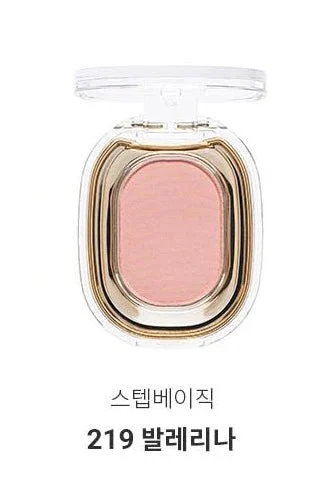
Step Basic 219 Ballerina: the softened pink
Ameli Step Basic 219 Ballerina is currently described in the catalog as a soft vintage rose or milky calm rose. The listing positions it as a multi-use powder for shadow, blush, highlight, or shading. For this look, its most useful role is a thin veil of pink that prevents the brown palette from becoming flat.
On the eyes, use a small amount from the mobile lid up toward—but not necessarily into—the full crease. Keep the outer edge translucent. If the pink appears chalky or too cool, reduce the area rather than adding more brown on top. On cheeks, place it where a natural flush would sit and connect the edge softly toward the temple.
Avoid treating the catalog’s broad multi-use description as a universal instruction. Use a product only on areas permitted by its current label, keep applicators clean, and stop if irritation occurs.
Step Basic 220 Feel So Brown: the structure
Ameli Step Basic 220 Feel So Brown is currently described as a reddish-free mid-tone brown with a subtle gold hint. In a soft-autumn arrangement, it supplies structure without requiring a black or very dark charcoal shadow.
Start along the upper lash line, then blend the remaining color outward and slightly upward. Add a second thin layer at the outer third only if the eye needs more definition. On the lower eye, keep the brown close to the lash line; a wide band can make the look heavier and reduce the softness.
For brows or hairline use, follow the exact product directions and test the shade carefully. A brown that works on the eyelid may be too warm, cool, light, or dark for brows. The seasonal palette does not override facial contrast or hair color.
Optional pearl: Sweet Dia 125 Luxury Brown
The original 2021 look named Sweet Dia 167 Saddle Brown, but that exact current product is not available in the catalog. It should not be silently replaced as if the shades were identical. Ameli Sweet Dia 125 Luxury Brown is a separate currently available product, described as a rich brown pearl shadow with a high-gloss finish.
Use it only as an optional texture choice. Press a small amount onto the center of the upper lid, or place a narrow accent near the lower lash line where the eye naturally catches light. Avoid sweeping it over the entire pink-and-brown gradient; a concentrated point of reflection preserves the soft, diffused structure.
If visible eyelid texture, contact-lens sensitivity, or personal preference makes pearl uncomfortable, skip it. Matte and satin finishes can still create a complete soft-autumn look. Shine is a styling tool, not a required sign of polish.
Air Lips 823 Tasty Brown: the current lip option
The older article named Plat Lips 923 Tasty Brown. The currently available product is Ameli Air Lips 823 Tasty Brown, with a different product line and shade number. It is not responsible to present 823 as the same item; it is the current warm-brown option being used to rebuild the color story.
The catalog describes 823 as a chocolate and caramel brown with subtle red warmth and an airy, powdery finish. For lower contrast, tap color onto the center of the lips and blur outward with a clean finger or brush. For stronger definition, apply another thin layer while keeping the border soft rather than drawing a hard dark outline.
Brown lip color shifts with natural lip pigment. On a deeper or cooler lip, the shade may read less caramel and more neutral. Evaluate it in daylight and with the cheek color already applied; a lip can look disconnected when tested alone but balanced within the full face.
A complete placement sequence
- Prepare the base lightly. Keep natural dimension visible instead of building a flat, high-coverage canvas solely for the seasonal concept.
- Place Ballerina as the soft field. Use a sheer layer on the mobile lid and, if desired, a restrained amount on the cheeks.
- Build Feel So Brown at the edges. Concentrate it near lashes and the outer eye, then diffuse the border.
- Add Luxury Brown only as a light point. Press, do not sweep, and skip it when a matte look fits better.
- Apply Tasty Brown in thin layers. Blur the lip edge for low contrast or add a second layer for more presence.
- Review the whole face. If one feature jumps forward, soften that feature before adding more product elsewhere.
Use clean tools for each product. The U.S. Food and Drug Administration advises not to share makeup, to keep containers clean and closed, and to use products near the eyes only when they are intended for the eye area. Discard eye makeup after an eye infection and stop using a cosmetic after an unexpected reaction.
Lighting, camera and clothing change the palette
Warm indoor lighting can make a balanced brown appear more orange and can hide grayness in a muted pink. Cool phone screens can make the same look appear mauve. Check the finished makeup near a window or under a neutral light before deciding whether a shade relationship works.
Camera processing also changes saturation and skin tone. Beauty filters may smooth texture, brighten the eye area, and cool or warm the image. Use photographs to record placement, not as the only proof of color. A mirror in ordinary light remains more useful for real-world wear.
Clothing can shift perception. Cream, camel, soft olive, cocoa, muted teal, or dusty rose may support the palette, while an optic-white shirt or saturated blue can make the makeup seem warmer or duller by comparison. This does not mean those clothes are forbidden; it explains why the same makeup changes with context.
How to adapt the look without losing it
- If the pink is too pale, keep it on the cheek and use a deeper muted rose on the eyes.
- If the brown disappears, add depth at the lash line rather than expanding it across the whole lid.
- If the lip is too deep, tap it over balm or use a smaller amount at the center.
- If pearl overwhelms the look, remove it from the lower eye or skip it entirely.
- If warm brown turns orange, choose a more neutral cocoa while keeping the same low-contrast placement.
A useful seasonal guide gives you levers to adjust. It should not tell you that a color is objectively wrong for your face. The best result is the one that preserves the soft pink-and-brown relationship while matching your skin depth, features, and preferred level of contrast.
Sources
- Ameli Step Basic 219 Ballerina — current catalog listing
- Ameli Step Basic 220 Feel So Brown — current catalog listing
- Ameli Sweet Dia 125 Luxury Brown — current catalog listing
- Ameli Air Lips 823 Tasty Brown — current catalog listing
- U.S. Food and Drug Administration: Using Cosmetics Safely
Frequently Asked Questions
What colors define soft autumn makeup?
Soft autumn makeup usually uses muted warm or warm-neutral colors such as dusty rose, beige-brown, caramel, cocoa, soft olive, and restrained gold. The key is lower contrast and softened saturation rather than a mandatory list of shades. Adjust depth to your skin and features.
Can cool-toned skin wear a soft autumn look?
Yes, because a seasonal palette can be used as a styling direction rather than an identity rule. Reduce orange warmth, choose neutral cocoa and muted rose, and keep the same diffused placement. Judge the complete look in ordinary light instead of relying on a label.
Is Ameli Air Lips 823 the same as Plat Lips 923?
No. They are different product-line and shade-number identities. The older article named Plat Lips 923 Tasty Brown, while the current catalog carries Air Lips 823 Tasty Brown. This guide uses 823 as a present warm-brown option and does not claim the formulas or shades are identical.
Do I need shimmer for soft autumn makeup?
No. Pearl can add a controlled point of light, but matte and satin textures can create a complete soft-autumn look. Skip shimmer when it emphasizes texture, feels uncomfortable, or raises the contrast more than you want.
How do I keep brown makeup from looking muddy?
Use thin layers, preserve some clean skin or pink between brown areas, and concentrate the deepest shade near the lashes. Check the look under neutral light. If it appears muddy, reduce coverage or choose a clearer neutral brown rather than adding more brightness everywhere.