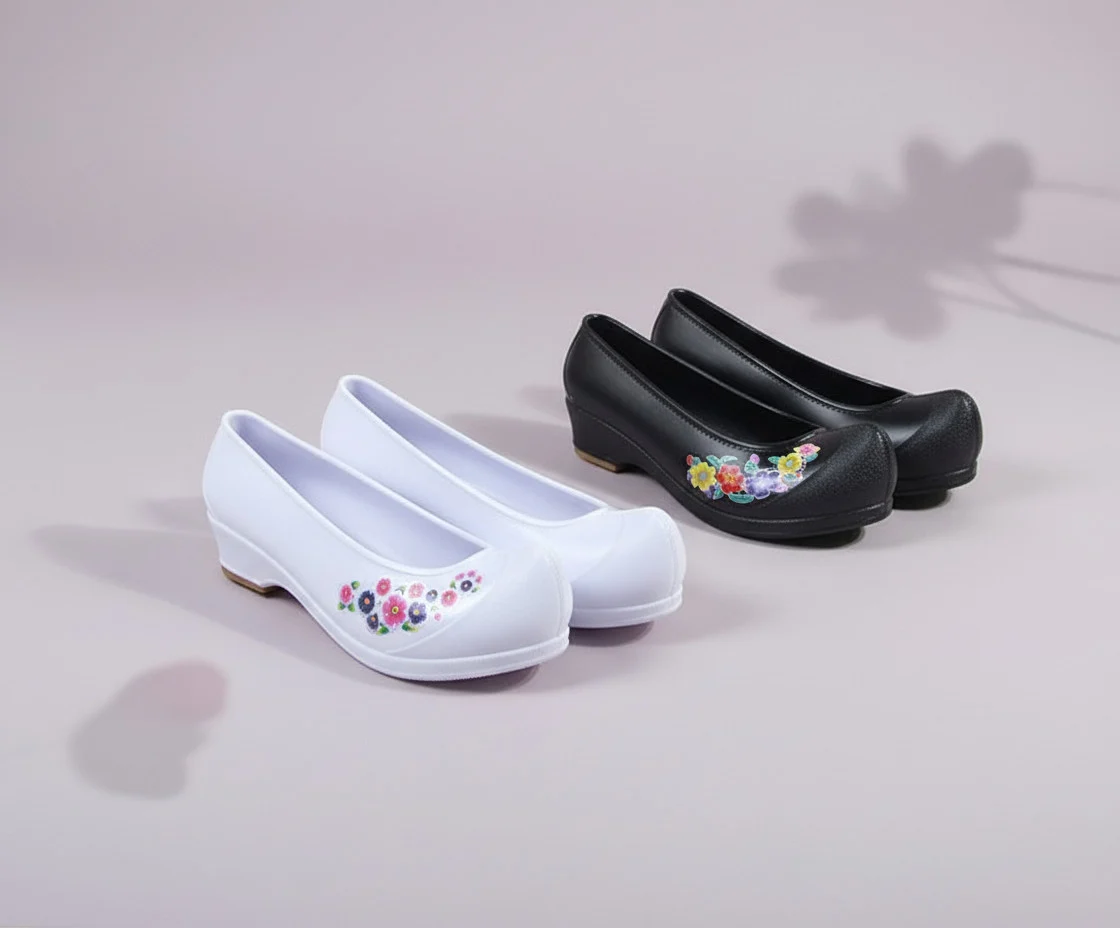
You want a pair of Korean rubber shoes, maybe to finish a hanbok, maybe because you saw them at a hanok cafe in Seoul, and the listings blur together. Some call every Korean shoe with an upturned toe a “gomusin,” others sell embroidered silk pairs under the same word, and the sizes are in millimeters you have never used.
The short answer: gomusin are a 20th-century rubber (today usually PVC) shoe modeled on older Korean leather footwear. They are the practical, washable choice for everyday wear, temple visits, house shoes and casual hanbok. For a wedding or a formal hanbok photo, an embroidered kkotsin-style shoe is the better match. Size by your foot length in millimeters, and decide on socks before you decide on size.
What gomusin are, and what they are not
Gomusin (고무신) literally means “rubber shoes.” They are a wide, low-heeled slip-on with a gently upturned toe, and they are often mistaken for the oldest form of Korean footwear. They are not.
Korea’s older shoemaking tradition is leather and silk. Joseon-era footwear was divided into hwa, shoes that rise above the ankle like boots, and hye, low shoes that stop below it [1]. These were made by specialist craftsmen, and shoemakers were once divided into separate makers for each type [1]. Today the craft is protected as a National Intangible Cultural Heritage, and its holder, shoemaker Hwang Hae-bong, has said that people often wrongly assume traditional Korean shoes are rubber [1][5].
Rubber shoes arrived in the 1920s, during the Japanese colonial period [1]. Hwang has described them as cheap and practical, which is why they won out [5]. So the honest description is this: gomusin are a modern Korean classic that borrowed a traditional silhouette. That does not make them less Korean. For roughly half a century they were the shoes most Koreans actually wore [4].
If you are new to the outfit itself, our hanbok guide covers the structure, colors and occasions before you choose shoes.
A short history: from Joseon leather to the people's shoe
Footwear in Joseon Korea signaled rank. Leather gatsin were originally worn only by the yangban nobility and royal families, while commoners wore straw shoes or wooden clogs [1]. Commoners were allowed leather shoes at their weddings, which is one reason embroidered shoes are still tied to marriage today [1]. Royal-court records show around 30 shoemakers serving the court at the dynasty’s height [2].
Rubber changed that. Shoemaker Hwang Hae-bong has called gomusin cheap and practical [5], although rubber itself was a costly material when they first appeared in the 1920s [4]. They could be worn in the rain and were far easier to keep clean than silk danghye or straw jipsin [7]. Their shape was taken from the leather shoes of the nobility: men’s pairs followed gatsin and women’s pairs followed danghye [7]. In a 2020 interview, Yu Zu-hyung, CEO of the Seoul cafe chain Onion, which reissued gomusin, described them as “the shoes of the people” for about 50 years, with demand fading after the 1960s [4].
Two more dates are worth knowing. From 1938 to 1945 the colonial government restricted national dress, including gomusin, and after 1945 the shoes became very popular again [7]. Rubber also pushed the hand-sewn leather shoe aside: traditional shoes gave way to rubber in the 1920s and to Western-style shoes in the 1930s [1], and gomusin largely replaced them in everyday life [7].
Why does this matter when you shop? Because the word “traditional” on a listing can mean three different things: a 1920s-style rubber slip-on, a modern embroidered flower shoe, or a handmade leather piece by a heritage craftsman. They differ in look, comfort, care and price by a wide margin. Knowing which one you actually want saves you from ordering a plain rubber shoe for a wedding or a delicate silk shoe for a rainy garden.
Where you still see gomusin in Korea
Walk through a temple or a countryside home and you will still see them lined up at the step. Today they are most often worn by Buddhist monks inside temples and by older Koreans at home in the countryside [4].
They have also had a small revival with visitors. At a cafe set inside a hanok in central Seoul, staff put out gomusin so guests could step down from the raised wooden floor to the courtyard; foreign visitors photographed themselves wearing them often enough that the owner commissioned an illustrated version [4]. That is a good picture of how gomusin work best in modern life: shoes you slip on and off at a threshold.
That use pattern explains their design. No laces, a wide opening and a smooth, washable surface make sense for houses and temples where shoes come off at the door. It also explains their limits: they are not built for long city walks.
Gomusin vs. kkotsin and other hanbok shoes
Most confusion comes from mixing up rubber gomusin with embroidered flower shoes. Kkotsin are floral embroidered shoes with a slight heel and upturned toes, descended from the flat, hand-sewn danghye once worn by royal women for ceremonies; by the 19th century they had become part of formal hanbok for ordinary people [3]. Kim Yong-ik’s story “Wedding Shoes,” published in Harper’s Bazaar in 1956, was later translated into Korean as “Ggotsin” and widely read, and today these shoes are also called ggotsin [5].
| Shoe | Material | Look | Best for | Not ideal for |
|---|---|---|---|---|
| Gomusin | Rubber or PVC | Plain white or black, wide, low heel | Daily wear, temple and house use, casual hanbok, rain | Formal wedding photos, long walks |
| Kkotsin (flower shoes) | Fabric or silk-look upper, embroidered | Floral embroidery, upturned toe, small heel | Weddings, holidays, formal hanbok | Wet ground, everyday errands |
| Hwahye (handmade leather) | Leather sole, silk or cloth upper | Museum-grade, made to order | Ceremonies, collectors | Casual use; slow and costly to make |
| Modern sneaker or flat | Mixed | Western | Walking tours in hanbok | A traditional look in photos |
Handmade leather hwahye sit at the far end of that table. A single pair can involve dozens of steps and typically takes an artisan up to a week, and some couples, including celebrities, have had authentic-style pairs made for their weddings [2]. For most readers, the realistic choice is between a plain gomusin and a ready-made embroidered shoe. Our Korean shoes collection carries both.
The classic pair: white or black PVC gomusin
If you want the shoe most Koreans picture when they hear the word, start with a plain pair. Our Traditional Korean Rubber Shoes (Hanbok Gomusin) are made in Korea from PVC, with a heel of about 3 cm and a width of about 7.5 cm at size 235 mm. They come in white and black, in 5 mm steps from 225 to 255 mm.
White is the traditional everyday color and looks clean with light hanbok and summer linen. Black hides scuffs, suits darker outfits and is the easier choice for regular outdoor use. Both wipe clean.
The 3 cm heel is the detail people underestimate. It is low enough for stairs and temple steps, but it gives a little lift under a long chima skirt so the hem clears the ground. The width figure is worth checking against your own foot: measure across the widest part of your forefoot and compare it with 7.5 cm before you order. If you are buying for someone else as a gift, black in a 5 mm larger size is the safer guess, since a little extra length is easier to live with in a slip-on than a pinched toe.
Who it is not for: if your feet are wider than about 7.5 cm at the ball, or you need arch support for all-day walking, a simple PVC shell will feel flat. Treat it as a slip-on, not a walking shoe. If you are larger than 255 mm, this pair will not fit; the Shoes City rubber shoes below run from 225 to 280 mm in Gold and Silver, and the Silver pair is the quieter choice for men or anyone with a bigger foot. The embroidered flower shoes further down stop at 260 mm.
Playful and statement options
Gomusin have become a nostalgia item in Korea, and some makers lean into it. The Shoes City Korea Rubber Shoes use a gold-colored pigment on waterproof, flexible PVC. They make sense as a fun gift, a matching couple pair, or a beach and pool shoe that can get wet without worry.
Who it is not for: anyone who wants the quiet, traditional look for a hanbok photo. The shine reads as modern and playful. For a more classic outfit, stay with white or black.
As a gift, a statement pair works best for someone who already likes Korean culture and has a sense of humor about it: a K-drama fan, a friend back from a Korea trip, or parents who remember rubber shoes from childhood. Pair it with a card that explains the 1920s story above and it becomes more than a novelty.
If you liked the cafe-in-a-hanok idea, a novelty pair at the door of a Korean-themed room or a tea corner works the same way: shoes guests can step into without bending down.
For weddings and formal hanbok: embroidered flower shoes
For a wedding, a first-birthday party or formal holiday photos, plain rubber can look underdressed next to silk. This is where flower shoes earn their place, and it matches history: embroidered shoes have long been connected with marriage and formal dress [1][3].
The Korean Traditional Hanbok Shoes with plum blossom embroidery are a practical entry point. The listing describes white, handmade-in-Korea shoes with a 4 cm heel and a padded insole, in sizes 225 to 260 mm. That padded insole and the extra 5 mm of size range are useful differences from plain PVC.
Who it is not for: wet days and daily errands. Fabric uppers and embroidery do not tolerate puddles the way PVC does. Brides who want color rather than white can look at the handmade Sipjangsaeng flower shoes, whose longevity motifs come in black, red and ivory.
A simple rule for families: the couple wears the most formal shoes, and parents and guests can wear embroidered or plain pairs depending on the venue. Outdoor ceremonies on grass or gravel are the one place where a plain PVC gomusin can be the smarter choice for older relatives, because it will not be ruined by damp ground and it slips off easily for a traditional bow.
Socks, sizing and fit
Korean shoe sizes are written as foot length in millimeters, usually in 5 mm steps, and our listings ask you to measure your foot length and choose from that. Stand on paper, mark heel and longest toe, measure in millimeters, and round up to the next 5 mm step.
Then decide on socks. Traditional beoseon date back to the Three Kingdoms period and were normally white cotton; today they are mostly worn with hanbok on holidays and at weddings [6]. Padded versions exist for warmth [6]. They are deliberately snug and structured, so they change how a shoe fits.
- Barefoot or thin socks: use your measured length, rounded up.
- Beoseon or padded socks: measure while wearing them, or go up one 5 mm step.
- Between sizes in PVC: size up. Rubber does not stretch the way leather does.
Our cotton-spandex beoseon add a little stretch, which makes them easier to put on than plain cotton, but the listing is clear that they still feel firm. If you want modern-sock comfort, they are not for you. There is more on the fit in our beoseon guide.
How to wear gomusin outside a hanbok
Gomusin are slip-ons first, costume second. They work best where shoes come on and off often:
- House and garden: by the back door, for a quick trip outside without lacing anything.
- Temple stays and retreats: the shoe monks still use, and easy to remove at every hall [4].
- Rain and beach: PVC does not mind water; rinse and dry in shade.
- Casual outfits: wide-leg linen trousers, a long skirt or cropped pants show off the toe line.
Keep expectations realistic. Gomusin are relatively heavy and not shaped for long periods of walking [7]. For a full day sightseeing in hanbok, wear walking shoes and change into gomusin or flower shoes for photos.
Finishing the look with accessories? A norigae tassel from our hanbok accessories collection does more for a photo than any shoe.
Care and storage
PVC gomusin need very little. The care steps on our listing are simple:
- Wipe with a soft cloth dampened with soapy water.
- Dry in the shade after washing.
- Keep them away from heaters, car dashboards and other heat sources, which can deform the material.
- Store at moderate temperature and humidity.
- Take care on oily or slippery floors, where a smooth sole can slide.
Embroidered shoes need gentler handling: brush off dust, spot-clean only, keep them out of rain, and store them in a box with tissue so the toe keeps its shape.
Frequently Asked Questions
Are gomusin the traditional Korean shoe?
They are traditional in shape, not in age. Rubber gomusin arrived in the 1920s and copied the silhouette of older leather shoes; the older craft tradition is hand-sewn leather and silk hwa and hye.
What size gomusin should I order?
Measure your foot length in millimeters and round up to the next 5 mm. If you will wear padded beoseon socks, measure with them on or add one 5 mm step. Do not convert from a US size chart alone.
Can I wear gomusin every day?
For short trips, house and garden use, rain and casual outfits, yes. For long walks they are flat and fairly heavy, so a supportive walking shoe is better.
What shoes should I wear with hanbok to a wedding?
Embroidered flower shoes (kkotsin) look more formal than plain rubber. White or ivory suits a bride; colored embroidery suits guests and family. Keep plain gomusin for casual hanbok and outdoor events.
How do I clean rubber shoes without damaging them?
Wipe them with a soft cloth and mild soapy water, then dry them in the shade. Avoid direct heat and hot cars, which can warp PVC.