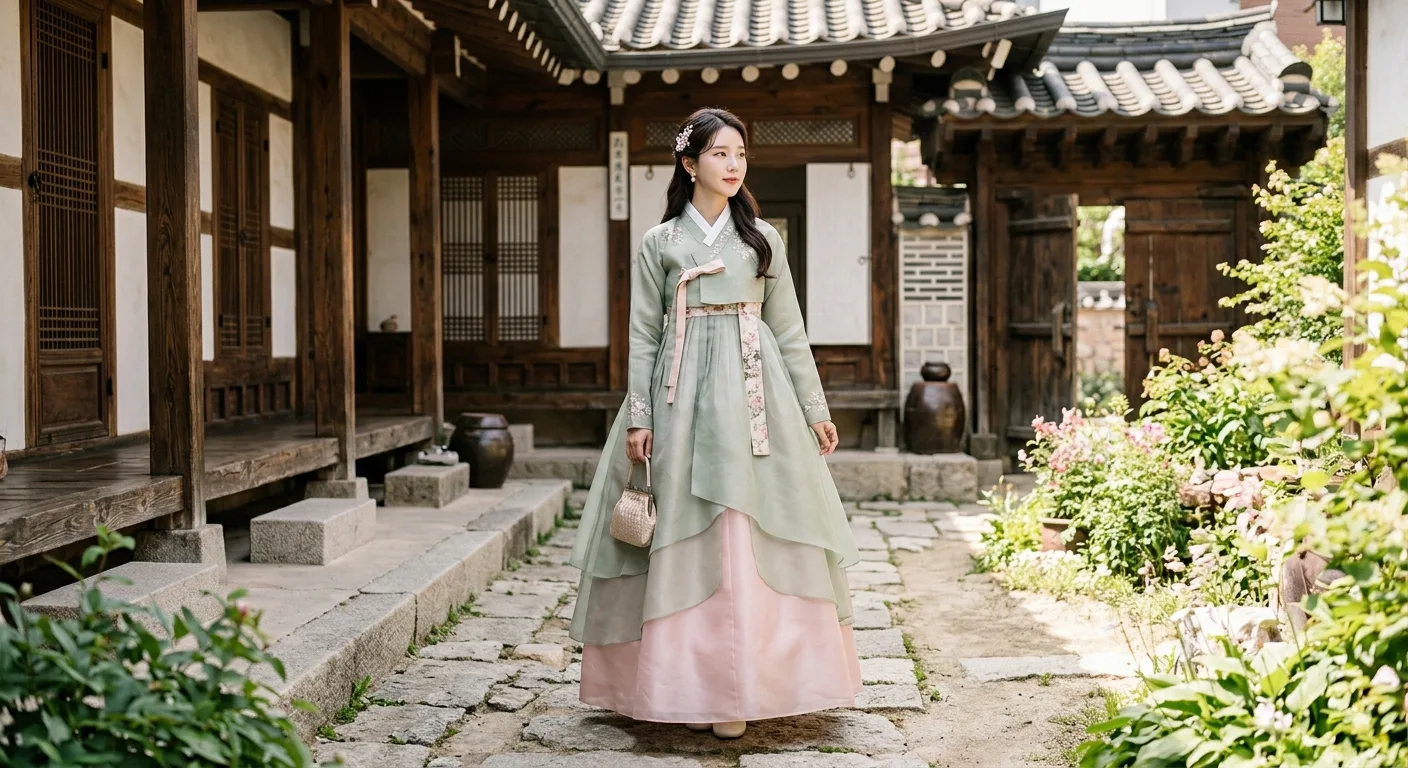
Hanbok is the traditional dress of Korea, and it is one of the few national costumes whose basic form has survived from antiquity into everyday modern life. A short wrap jacket called the jeogori, worn over trousers (baji) for men and a full, high-waisted skirt (chima) for women, has been the structure of Korean clothing since the Three Kingdoms period, roughly the first century BCE to the seventh century CE. What changed over two thousand years was proportion, fabric, color and who was allowed to wear what; what did not change was the silhouette.
This guide explains that structure garment by garment, traces the history behind the modern look, decodes the fabrics and the traditional color system, sets out which hanbok is worn for which occasion, and gives practical advice on sizing, buying and caring for a hanbok ordered from Korea. It also records a recent change in Korean law: since 2026, 21 October is a statutory Hanbok Day, and the week around it is Hanbok Culture Week. The article replaces an earlier version that leaned on trend labels rather than sources.
The anatomy of a hanbok
Every hanbok begins with the jeogori, which the National Folk Museum of Korea describes as the most basic upper garment that everyone, young and old, men and women, always wore. It is a short jacket that wraps left over right and closes with a pair of long ribbons called goreum, tied in a single loop at the chest. Along the neckline runs the git, a band of collar, edged with a removable strip of white paper-backed fabric called the dongjeong that frames the face and can be replaced when it soils. The front panels overlap at the seop, and the sleeves, somae, are cut in a gentle curve so the arm hangs in a soft line.
Women wear the jeogori over the chima, a skirt that the museum describes as becoming wider toward the bottom and naturally forming pleats. The chima is not a tube: it is a wide rectangle of pleated fabric attached to a bodice or waistband that wraps around the body, so it is adjustable and creates the characteristic bell shape when worn over petticoats. Men wear baji, loose trousers gathered at the ankle with tie strings called daenim, and often a jokki vest and a magoja jacket over the jeogori.
Outer layers complete the look. The durumagi is an overcoat worn by both men and women; the museum notes it takes its name from being closed on all four sides. Joseon scholars wore the dopo, a stiff-collared, wide-sleeved coat with an extra back train. Men’s outdoor dress was finished with the gat, a black horsehair hat that, the museum records, only grown adults were allowed to wear, while indoors scholars wore the mountain-shaped jeongjagwan. On the feet go beoseon, padded white socks that keep the feet warm and give them a neat shape, and shoes such as fabric or leather taesahye for men or embroidered kkotsin for women; the rubber gomusin became the everyday shoe in the twentieth century.
Because hanbok has no pockets, accessories carry both function and meaning. Women hung a joomeoni pouch, embroidered with wishes for happiness, and a norigae pendant from the goreum or the skirt waist, made from gold, silver, jade or amber in single-tassel (danjak) or three-tassel (samjak) forms.
Two thousand years of the same silhouette
The fundamental structure of hanbok, the jeogori with baji and chima, was established during the Three Kingdoms period, between 57 BCE and 668 CE, and Goguryeo tomb murals of the fourth to sixth centuries already show it clearly. The Victoria and Albert Museum notes that the sixth century saw the beginning of the left-to-right frontal fold, which later became a staple design feature of all later hanbok. That closure direction, left panel over right, remains the rule for every hanbok made today, and a garment that wraps the other way is either a costume error or a burial dress.
The proportions modern eyes recognize come from the Joseon dynasty (1392 to 1910). Over those five centuries the women’s jeogori shortened dramatically: the museum records that it slowly shrank from about 60 cm to only 20 cm by the early twentieth century, which is why a formal women’s jeogori today ends just below the bust. As the jacket shortened, the chima rose to the chest and grew fuller, and more voluminous skirts were reserved for women of higher rank. Men’s dress changed less; the long coats, hats and headbands of the scholar class remained the markers of status.
Colonial rule from 1910 to 1945 and post-war industrialization moved hanbok out of daily wear and into ceremony. Then the direction reversed. Designers began breaking down the neo-Confucian gender, rank and status codes embedded in the garment, keeping its visual language and dropping its social rules, and the word “hanbok” entered the Oxford English Dictionary in 2021. The modern-hanbok movement that followed is why a wrap jeogori over a knee-length skirt or trousers can now be worn to an office, a wedding or a museum without looking like costume.
Fabric: silk, ramie, hemp and cotton
The four traditional hanbok fibers are silk, hemp, ramie and cotton. Silk was the ceremonial and upper-class fabric; the Victoria and Albert Museum notes that cloth with intricately woven patterns or made from the highest-quality silk was reserved for the royal family. Ramie, an extremely finely woven and delicate cloth, and hemp were the summer fabrics, prized for a crisp, translucent hand that lets air through. Cotton, adopted widely from the late Goryeo period, became the year-round fabric of ordinary people and the material for padded winter garments.
Modern hanbok makers add synthetics and blends for practicality. “Water-based silk,” a term Korean ateliers use for washable silk-like polyester, allows a modern hanbok dress to be laundered at home; premium bridal sets still use silk blends. When you shop, the fabric line tells you both how the garment will drape and how it must be cared for.
Color: obangsaek and the meaning of white
Traditional Korean color sense is organized by obangsaek, the five directional colors: blue for east, red for south, yellow for the center, white for west and black for north. The scheme derives from the East Asian theory of the five elements, and it governed court dress, ritual objects and children’s clothing. The most visible example is saekdong, the striped multicolor sleeves sewn from bands of the five colors and worn by children on their first birthday and at New Year to invite good fortune. Adult ceremonial hanbok combined the colors deliberately: a red chima with a yellow or green jeogori for a bride, deep blues and jade for older women, and undyed white for mourning and for everyday.
White has a particular history. While court officials wore vivid colors, ordinary Koreans dressed so consistently in undyed ramie, hemp and cotton that the nation was known as the white-clad people, and the museum records that white deepened into a symbol of resistance during the Japanese colonial period. That is why a plain white jeogori still reads, to Korean eyes, as dignified rather than unfinished.
Which hanbok for which occasion
Hanbok remains the formal dress of Korean family life. The table below summarizes the principal occasions and what is traditionally worn, drawing on the National Folk Museum’s descriptions of ceremonial dress.
| Occasion | Who wears hanbok | Traditional elements | Modern practice |
|---|---|---|---|
| Dol (first birthday) | The child | Girls in a saekdong jeogori with a scarlet skirt and gulle hat; a doltti waistband embroidered with longevity symbols or blessings | Rented or purchased child’s set; parents often in modern hanbok |
| Wedding | Bride, groom, both mothers | Bride in a jokduri coronet with ribbons and a honseon fan; groom historically presented a pair of wooden wild geese as a pledge of fidelity | Western gown for the ceremony, hanbok for the pyebaek family rite; mothers in silk hanbok |
| Seollal and Chuseok | Families, especially children | Formal hanbok for ancestral rites and the sebae bow to elders | Children in bright sets; adults increasingly in modernized hanbok |
| Hwangap (60th birthday) and family banquets | The honoree and close family | Rich silk in deep colors for elders | Often replaced by a formal dinner, hanbok retained for the honoree |
| Palace visits and Hanbok Day | Anyone | None prescribed | Rental hanbok for palace outings; free admission to royal palaces for visitors in hanbok |
Hanbok Day and Hanbok Culture Week
Korea’s Ministry of Culture, Sports and Tourism has promoted hanbok as living culture for more than a decade. Its 2023 press release describes Hanbok Culture Week, organized with the Korea Craft and Design Foundation, as running from 16 to 22 October around Hanbok Day on 21 October, with exhibitions, fashion shows and participation programs to bring hanbok into daily life. What had been an administrative custom became law in 2026: the Hanbok Culture Industry Promotion Act, first proposed in 2013 and repeatedly allowed to lapse, passed the National Assembly plenary on 31 March 2026. It designates 21 October each year as Hanbok Day, mandates that the surrounding week be run as Hanbok Culture Week, and requires the ministry to draw up a five-year master plan with annual implementation, industry surveys, professional training, start-up support and research funding.
For overseas buyers the practical effect is that the hanbok industry now has policy backing for standardization, training and export, which should mean more consistent sizing and more makers offering international sales in the years ahead.
Sizing and choosing a hanbok
Traditional hanbok is cut generously and adjusted by wrapping and tying, so exact body measurements matter less than for Western tailoring, but they still matter. Korean makers size women’s jeogori by bust and by the length from the back neck to the desired hem, size the chima by bust (it wraps at the chest, not the waist) and by length from underbust to floor with the intended shoes on, and size men’s baji by waist and inseam. Custom sets typically ask for height, weight and heel height and are made to those numbers; children’s hanbok is sized by height.
- Decide the role first. A ceremonial set for a wedding or dol should be silk or a silk blend in traditional proportions; a modern hanbok for daily wear or travel can be a washable dress with a simplified wrap.
- Measure in the shoes you will wear. Chima length is the measurement most often wrong; a skirt that drags on the floor is the classic error.
- Allow for the undergarments. A traditional chima needs a sokchima petticoat to hold the bell shape; without it the skirt collapses. Modern dresses usually have the volume built in.
- Check the closure. Hanbok wraps left over right and the goreum ties in a single loop with the tails to the right; a maker’s photos should show this correctly.
- Buy the small pieces with the set. Beoseon socks, a norigae and appropriate shoes finish the look and are easy to forget.
Caring for a hanbok
Silk hanbok should be dry-cleaned by a cleaner who has handled Korean dress, and stored flat or loosely folded along the original creases in breathable fabric, never in plastic. Ramie and hemp are washed cold by hand and ironed damp to restore their crispness. Cotton and washable modern hanbok can be machine-washed on a delicate cycle inside a mesh bag and dried in shade. Two habits protect any hanbok: replace the dongjeong collar strip when it discolors rather than scrubbing the jacket, and untie the goreum fully before storage so the ribbons do not crease permanently. Rubber gomusin are simply wiped clean and dried away from direct sun.
Wearing hanbok as a visitor
Visitors to Korea are welcome to wear hanbok, and doing so is treated as an appreciation of Korean culture rather than an intrusion. Seoul’s royal palaces have long admitted visitors in hanbok free of charge, and rental shops near Gyeongbokgung and Bukchon dress guests in minutes. Rental “themed” hanbok, with lace, gold foil and stiff hoop skirts, are designed to photograph well rather than to be historically accurate; if authenticity matters, choose a natural-fiber set in traditional proportions. Etiquette is simple: wrap left over right, keep the goreum tied, and avoid bare feet in beoseon-style shoes.
Explore current hanbok garments, shoes, socks and traditional accessories in our Hanbok and Accessories collection, including cotton-padded beoseon socks and a traditional single-layer gat.
Sources
- Victoria and Albert Museum: Hanbok, traditional Korean dress
- National Folk Museum of Korea, Korean Culture Box: Information cards on hanbok, dol and wedding dress
- National Folk Museum of Korea, Korean Culture Box: Women’s hanbok
- National Folk Museum of Korea, Korean Culture Box: Men’s hanbok
- Ministry of Culture, Sports and Tourism: 2023 Hanbok Expo and Hanbok Culture Week press release
- Seoul Economic Daily: South Korea designates October 21 as Hanbok Day as promotion law passes parliament
Frequently Asked Questions
What are the main parts of a hanbok?
The jeogori is the wrap jacket worn by everyone, closed with goreum ribbons and edged with a white dongjeong collar strip. Women pair it with the chima, a full pleated skirt that wraps at the chest; men wear baji trousers tied at the ankle with daenim, often with a jokki vest. The durumagi overcoat, beoseon socks, shoes and a norigae pendant complete a formal outfit.
How old is the hanbok?
The jeogori, baji and chima structure was established in the Three Kingdoms period, between 57 BCE and 668 CE, and appears in Goguryeo tomb murals. The left-over-right front closure dates from the sixth century. The proportions seen today, a very short women’s jeogori over a high, full chima, developed during the Joseon dynasty between 1392 and 1910.
What do hanbok colors mean?
Traditional colors follow obangsaek, the five directional colors: blue for east, red for south, yellow for the center, white for west and black for north. Children’s saekdong sleeves combine them to invite good fortune, brides traditionally wear red skirts with yellow or green jackets, and undyed white was the everyday dress of ordinary Koreans, later becoming a symbol of national identity.
When is Hanbok Day in Korea?
Hanbok Day is 21 October. Korea’s Ministry of Culture, Sports and Tourism had marked it administratively with Hanbok Culture Week in mid-October, and in March 2026 the National Assembly passed the Hanbok Culture Industry Promotion Act, which fixes the date in law, mandates the surrounding week as Hanbok Culture Week and requires a five-year national plan for the hanbok industry.
How do I choose the right hanbok size?
Women’s jeogori is sized by bust and back length, and the chima by bust, because it wraps at the chest, and by length from underbust to floor measured in the shoes you will wear. Men’s baji is sized by waist and inseam. Custom makers usually ask for height, weight and heel height; children’s hanbok is sized by height. A traditional chima also needs a petticoat to hold its shape.
Is it appropriate for a non-Korean to wear hanbok?
Yes. Wearing hanbok is welcomed as an appreciation of Korean culture, and Seoul’s royal palaces admit visitors in hanbok free of charge. Wrap the jeogori left over right, keep the goreum tied and choose a natural-fiber set in traditional proportions if authenticity matters; rental themed hanbok with lace and gold foil are designed for photographs rather than historical accuracy.