
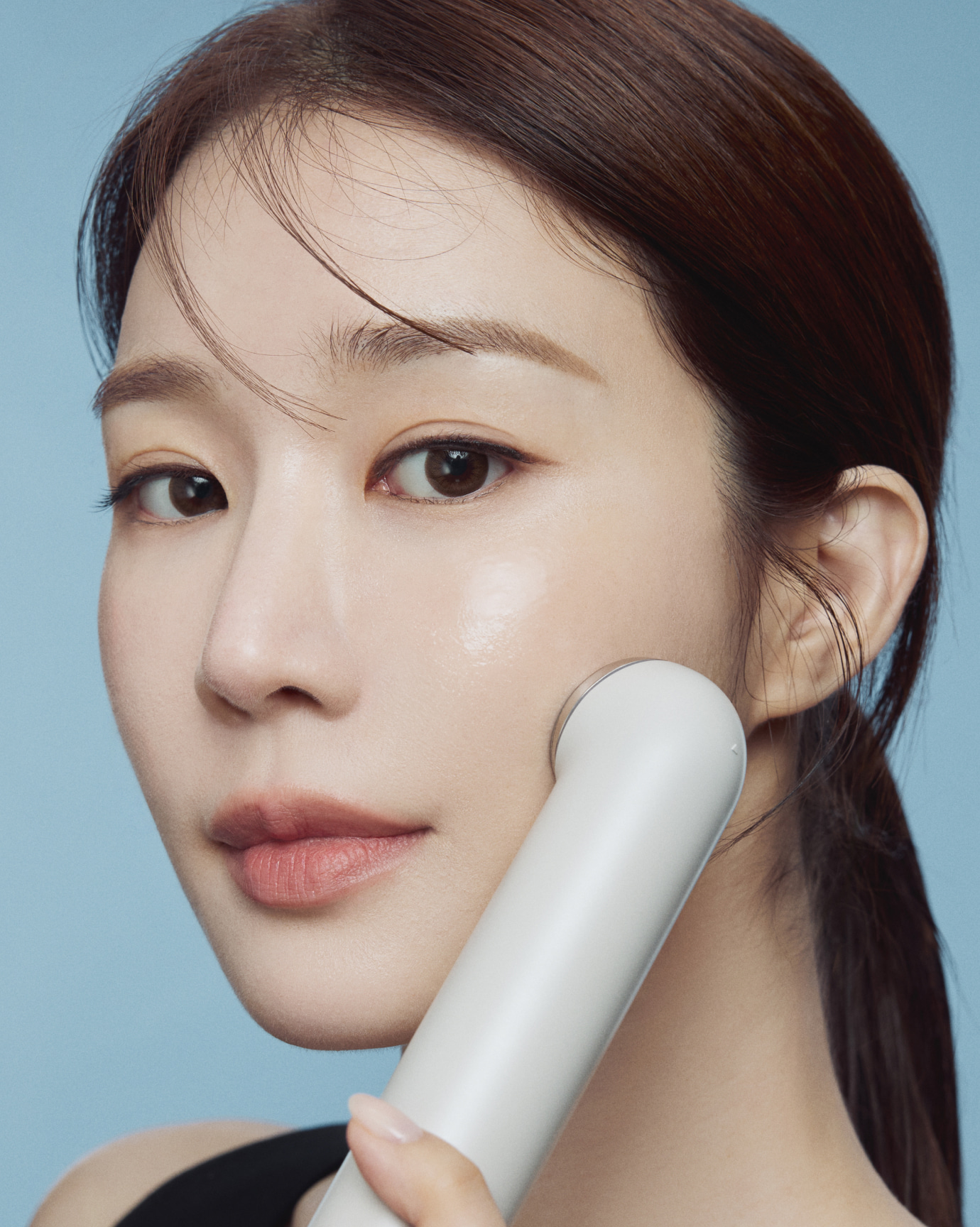
Home beauty devices are expensive, and the claims around them are loud. THOME THE GLOW TLDM-12 is a good example: a compact Korean ultrasound device sold on the promise of salon-style glow, hydration and firmness in 12 minutes. Before spending that kind of money, it is fair to ask what the device physically does, what the numbers on the box are based on, and whether it suits your skin and routine.
The short answer: THE GLOW is a cosmetic ultrasound device that combines two high frequencies, 3MHz and 10MHz, and is used with an ampoule or gel. The brand’s own test data reports improvements in glow, moisture and elasticity, but those are internal results, and the wider research on high-frequency ultrasound for skin is modest. It is a well-designed tool for people who already have a steady routine and want a ritual that helps products feel more effective. It is not a treatment for skin conditions or a substitute for a clinic.
What THOME THE GLOW Actually Is
THOME is a Seoul beauty device brand, and THE GLOW was recognized in the Red Dot Product Design awards in 2025, credited to an in-house design team [2]. Red Dot describes it as an at-home facial device using targeted, high-density ultrasound, fully waterproof for cleaning [2].
The TLDM-12 model sold in our beauty tools and devices range is small and light. The listing gives a weight of 137g, dimensions of 32 by 37 by 180mm, a 30mm head and an angled 110-degree design for contact with the face [1]. It runs on a 1400mAh battery that charges fully in about three hours, carries KC certification and is made in Korea [1].
Most important for a buyer: this is a cosmetic device. It is not sold to diagnose or treat any skin condition, and nothing in this guide should be read that way.
How the Three Modes Work
THOME calls its technology TLDM with a Dual Wave Complex, which means it combines two ultrasound frequencies [1]. The Smart F.I.T. system arranges them into three 12-minute programs [1]:
- Focus mode, positioned for radiance: 10MHz for 6 minutes, then 3MHz plus 10MHz for 6 minutes [1].
- Inner mode, positioned for hydration: 3MHz plus 10MHz for the full 12 minutes [1].
- Tension mode, positioned for firmness and elasticity care: 3MHz for 6 minutes, then 3MHz plus 10MHz for 6 minutes [1].
The pattern is easy to read: the radiance program leads with 10MHz alone, the firmness program leads with 3MHz alone, and the hydration program runs both together the whole time. The brand frames each mode around a cosmetic goal rather than a skin condition, and the listing notes that effects are temporary and vary by individual [1].
Operation is simple. Hold the power button for two seconds to start, which opens in Focus mode; tap to switch modes; touch the back of the head to adjust intensity; and double-press to pause [1].
What the Brand's Numbers Mean, and What They Do Not
The listing reports striking figures. After a single 12-minute use, it cites glow up 173%, moisture up 145% and elasticity up 1.24 times [1]. After 12 days of use, it cites glow up 3.78 times, moisture 1.58 times and elasticity 2.25 times [1]. The same listing states that these are based on internal test data and that results may vary by individual [1].
Read those numbers carefully:
- They are relative changes in instrument readings. A large percentage change in a glow or moisture meter does not translate directly into how different your skin looks in a mirror.
- They were measured with a product on the skin. The brand recommends using the device over an ampoule [1], so part of any moisture change comes from the ampoule itself.
- They are not a published trial. Internal tests are useful signals from a manufacturer, but they have not been through independent peer review.
None of this means the device does nothing. It means the honest expectation is a pleasant, hydrating routine with a visible short-term glow for many users, not a guaranteed multiple of your current skin.
What Research Says About Ultrasound on Skin
Ultrasound on skin has a long research history, mostly in drug delivery. The process is called sonophoresis or phonophoresis. A review in the Journal of Controlled Release explains that high-frequency sonophoresis, at 0.7MHz and above, has been studied since the 1950s, while low-frequency sonophoresis, at 20 to 100kHz, has been investigated more recently [3]. Both increase the penetration of substances into skin, but by different mechanisms, and the extent to which each can raise skin permeability is quite dissimilar [3].
The key point for a home device buyer is where the strongest effect sits. A review of low-frequency sonophoresis states that the enhancement is particularly significant at low frequencies below 100kHz [4]. Home facial devices such as THE GLOW work in the megahertz range [1], which is the gentler, less permeabilizing end.
Researchers also flag measurement problems. A review in the Journal of Pharmacy and Pharmacology noted that sonophoresis research often suffers from poor calibration of the ultrasound energy emitted, and that long-term safety still needed to be established [5].
Home devices more broadly have a mixed evidence base. A 2022 systematic review of home-based dermatology devices covered intense pulsed light, laser diodes, radiofrequency, LED and UVB phototherapy, found favorable safety profiles, and recommended several of them for specific uses [6]. Ultrasound devices were not among the categories reviewed [6], and the authors noted a limited number of randomized trials and a lack of long-term data [6].
Which Ampoule or Gel to Use With It
Ultrasound needs a medium to travel from the device head into the skin. Air blocks it, which is why every ultrasound device asks for a gel or a viscous ampoule. THOME recommends its own Hyaluronic Spicule Skin Booster or any suitable ampoule or gel, applied before you start [1].
What makes a good pairing:
- Slip and staying power. The product should keep the head gliding for the full 12 minutes. Add more if the skin starts to feel dry or the head drags.
- Simple, hydrating formulas. Hyaluronic acid serums and gels are a natural match for a hydration-focused routine. The Torriden DIVE-IN low molecular hyaluronic acid skin booster is a simple hydrating option, and our hyaluronic acid serum guide explains how to choose among them.
- Caution with strong actives. Retinoids, exfoliating acids and spicule products can sting on their own. If you want to use them with a device, patch-test first and follow the device manual.
After the session, the brand suggests patting the remaining product into the skin [1]. Follow with your usual moisturizer, and sunscreen in the morning.
How to Use THE GLOW Safely
Cosmetic ultrasound is low-energy, but it is still energy. The FDA notes, in its guidance on ultrasound imaging, that ultrasound waves can heat tissue slightly and in some cases produce small pockets of gas in tissue, called cavitation [7]. Home devices are designed with that in mind, and sensible use keeps you well inside their comfort zone.
- Start at Level 1. The brand recommends beginners start at the lowest intensity [1]. Increase only if the session feels comfortable.
- Keep it moving. Glide slowly over each area for about three to five minutes, for a 12-minute total [1]. Do not hold the head still in one spot.
- Use enough gel. Reapply product whenever the glide gets dry.
- Skip irritated skin. Avoid broken skin, active breakouts, sunburn and any area with a rash.
- Read the manual’s exclusions. If you are pregnant, have an implanted electronic device, have had a recent cosmetic procedure or have a diagnosed skin condition, check with your doctor before using any energy-based device.
Stop if you feel heat, pain or tingling that does not settle, and let any redness calm fully before the next session.
THE GLOW Compared With Other Home Devices
Ultrasound is only one of several technologies sold for home use. The right device depends on what you want it to do.
| Device | Technology | Positioned for | Weigh this first | Best fit |
|---|---|---|---|---|
| THOME THE GLOW TLDM-12 | Ultrasound, 3MHz and 10MHz [1] | Glow, hydration, elasticity care | Brand data is internal; needs gel every session | Simple, quiet hydration ritual |
| medicube AGE-R Booster Glow | Ultrasound, 1MHz, 3MHz and 10MHz [8] | Glow, firmness, pores, calming modes | More modes to learn | People who want more program choice |
| MIXSOON Derma Booster Pro | Ultrasound, EMS, LED and high frequency | Glow, elasticity and contouring modes | Several technologies in one head; more variables | Users who want one device for several goals |
| bepro:cell facial massager | Radiofrequency, galvanic, EMS and LED | Absorption, firmness feel | Electrical stimulation is not for everyone | Lower-cost entry to multi-function devices |
| CELL RETURN LED Mask Platinum | Red, near-infrared and blue LED | Hands-free light sessions | Large, hands-free mask, highest price tier | People who prefer to lie back during sessions |
One distinction matters. LED and low-power radiofrequency had the stronger evidence base in the 2022 home-device review [6], while ultrasound devices were not assessed. Ultrasound devices win on simplicity and a gentle, sensation-free session.
The Closest Alternative: medicube AGE-R Booster Glow
If you are deciding between THE GLOW and another ultrasound device, the medicube AGE-R Booster Glow is the most direct comparison. It combines 1MHz, 3MHz and 10MHz frequencies with a 30mm treatment head, the same head size as THE GLOW [8][1]. Its modes target glow, firmness, pores and calming routines [8].
Its listing also reports brand testing: in Glow mode, a test with 23 adults recorded a 293% improvement in skin radiance after four weeks of use with the brand’s PDRN booster gel [8]. As with THOME’s figures, these are manufacturer results with a paired product, not an independent trial.
Choose the medicube if you like more programs and a calming mode. Choose THOME if you want three clearly separated 12-minute routines and a very light device. Our medicube AGE-R device guide covers the rest of that range.
Who THE GLOW Suits, and Who Should Skip It
It suits you if:
- You already follow a steady skincare routine and want a ritual that makes your serum step feel more deliberate.
- Your goal is a hydrated, fresh look before events or after long days, rather than correcting a specific concern.
- You prefer a gentle device without electrical muscle stimulation or visible light.
- You will actually use it: 12 minutes, several times a week, with gel every time.
Skip it or ask a doctor first if:
- You want to treat acne, rosacea, melasma, scarring or another skin condition. That is a job for a dermatologist.
- You expect results like an in-clinic procedure. Home cosmetic devices work at far lower energy.
- You are pregnant, have an implanted electronic device, or have very reactive or currently irritated skin.
- You are unlikely to use it regularly. A good hydrating serum and daily sunscreen deliver more for most people than a device left in a drawer.
Care, Charging and Getting Your Money's Worth
A device at this price should last. A few habits help.
- Clean the head after every session. Wipe off leftover gel before it dries. Red Dot describes THE GLOW as fully waterproof for cleaning [2], but follow the manual’s instructions on rinsing and charging.
- Charge before it runs flat. A full charge takes about three hours [1], so build it into the same evening routine.
- Store it dry. Keep the original box for storage and any warranty claim.
- Track honestly. Take a photo in the same light before you start and after four weeks of regular use. Decide on what you see, not on how the session feels.
If you are building a full device routine, browse our beauty tools and devices and pair whichever device you choose with a simple serum and daily sunscreen. Those two steps remain the foundation any device builds on.
Frequently Asked Questions
What does THOME THE GLOW do?
It is a home cosmetic ultrasound device that combines 3MHz and 10MHz frequencies in three 12-minute modes, Focus, Inner and Tension, positioned for radiance, hydration and elasticity care. It is used over an ampoule or gel.
Are THOME's glow and moisture results proven?
The figures on the listing come from the brand's internal tests, and THOME notes that results vary by individual. They have not been published as an independent trial, so treat them as manufacturer data rather than a guarantee.
How often should I use THOME THE GLOW?
Each session lasts 12 minutes. Follow the frequency in the device manual, start at Level 1, and give your skin a break if it becomes red or irritated. Consistency over several weeks matters more than long sessions.
Is home ultrasound safe for sensitive skin?
Cosmetic ultrasound runs at low energy, and home devices in general show favorable safety in reviews, but avoid broken or irritated skin, start at the lowest level and keep the device moving. If your skin is very reactive or you have a skin condition, ask a dermatologist first.
Can I use THE GLOW with retinol or acids?
Use a simple hydrating gel or serum as the glide product. Strong actives such as retinoids, exfoliating acids or spicule products can sting on their own, so patch-test and check the device manual before combining them.