Multifunctional products, skinimalism and AI personalization solve different problems. A multi-balm can make application portable. A shorter routine can reduce duplication. A recommendation system can narrow a catalog. None automatically makes a product more effective, affordable or medically personalized.
The original article treated all three as an inevitable “new era” without sources, privacy limits or failure conditions. This guide turns them into decisions that can be tested.
Three ideas, three success tests
| Idea | Success test | Common failure |
|---|---|---|
| Multifunctional product | Replaces named steps without compromising dose or use | Several claims but no actual routine reduction |
| Skinimalism | Fewer products with equal or better adherence and comfort | Necessary sunscreen or treatment is removed |
| AI personalization | Validated, explainable recommendation improves decision quality | Unvalidated “diagnosis” from a selfie and excess data collection |
What multifunctional should mean
“Multi” can describe one format used on several areas, one formula with multiple cosmetic claims, or a set containing several distinct products. These are different.
A tinted sunscreen may combine color and sun protection when applied at its tested sunscreen amount. A moisturizer with niacinamide may hydrate and support a cosmetic brightening claim. A balm used on lips and dry facial areas offers portability but may not replace full-face moisturizer.
Write a replacement statement: “This product replaces X under Y conditions.” If that sentence cannot be completed, the product is an additional step.
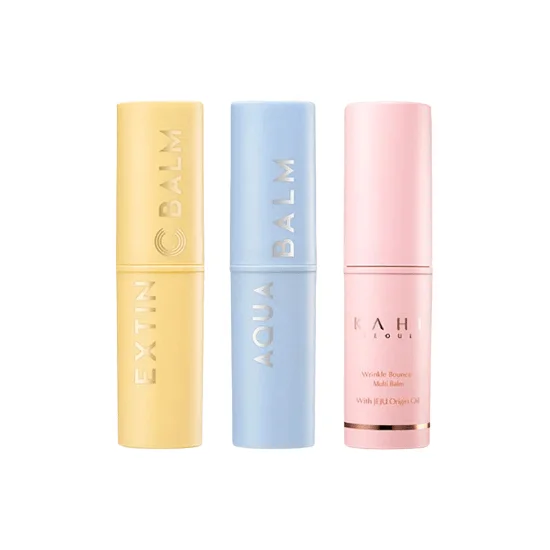
KAHI Wrinkle Bounce Multi Balm: portable, not universal
KAHI Wrinkle Bounce Multi Balm 9g is currently listed as a portable balm for targeted moisture, glow and the appearance of lines. It is not the same product as the KAHI UV Aqua Balm.
The stick format can reduce mess and support touch-ups, but repeated application over unclean skin or makeup raises hygiene and pilling questions. Keep the surface clean and follow the current label.
“Wrinkle” in the name does not make it a medical treatment or prove structural change after one use. Immediate smoothing can reflect emollience and light reflection.
KAHI UV Aqua Balm: sunscreen is a separate role
KAHI UV Aqua Balm 9g is a separate SPF50+ PA++++ sunscreen stick. Its protection depends on adequate, even application and reapplication—not simply sharing a balm shape with the multi-balm.
Sticks can be convenient for targeted reapplication, but counting passes does not guarantee the tested amount across every face. Use the current directions and inspect missed areas.
A non-SPF multi-balm underneath or above it does not inherit the UV rating.
ROUND LAB sunscreen: single-purpose clarity can be valuable
ROUND LAB Birch Juice Moisture Sunscreen 50ml is a lotion-format SPF50+ PA++++ product. It also has moisturizing positioning, but its primary job is clear: sunscreen.
A dedicated product can be easier to dose and audit than a “does everything” item. Multifunctionality is not automatically superior to role clarity.
Claim compatibility matters
Two benefits can require incompatible use amounts. Foundation may look heavy at the quantity needed for sunscreen testing. A strong exfoliant may be unsuitable for repeated moisturizing touch-ups.
Check area, amount, frequency, contact time, removal and warnings for each claimed role. If the instructions conflict, one formula cannot reliably serve both at once.
Also separate cosmetic appearance from drug claims. “Looks smoother” differs from treating disease or changing body structure/function.
Value requires price per replaced function
A multi-product can cost less when it truly replaces two purchases and is fully used before expiry. It can cost more when the user still buys the original steps or dislikes one of its functions.
Compare usable amount, dose, frequency, packaging loss and set contents. A 9g balm and 50ml lotion are not equivalent because both mention moisture.
Inflation may influence shopping, but the original article offered no data tying economic conditions to every multifunctional purchase. Measure behavior rather than inventing motive.
Skinimalism is a routine audit
Skinimalism means keeping the smallest routine that meets actual needs. It is not a fixed product count and does not require hybrid products.
A practical foundation is gentle cleansing, prescribed treatment as directed, moisturizer if needed and sun protection for outdoor daylight exposure. Makeup is optional. One additional product can target a defined concern.
AAD notes that too many products, especially multiple anti-aging items, may irritate skin. Removing duplication can improve both tolerance and interpretability.
How to remove a step safely
- List every product, role, active and frequency.
- Mark prescribed and protective steps that should not be casually removed.
- Identify two products serving the same role.
- Pause one optional product while keeping the rest stable.
- Track comfort, dryness, irritation and the target concern.
- Keep the simpler routine only if it performs as well or better.
Do not stop medication or essential sun protection because a trend celebrates fewer steps.
Personalization begins without AI
Useful personalization can come from a short questionnaire: skin feel, known allergies, current routine, fragrance preference, texture, budget, shade, climate and primary goal.
Rules can exclude incompatible products and explain why. A transparent rule such as “avoid this fragrance because you reported fragrance allergy” may be more useful than an opaque score.
Personalization should reduce choices, not manufacture certainty. The user still needs label directions and a cautious introduction.
A selfie is not a diagnosis
Lighting, camera processing, distance, makeup, angle and skin tone affect facial images. A consumer camera cannot automatically distinguish dryness, pigment, shadow, redness, acne type, allergy or disease.
AI output should be framed as a limited cosmetic observation or catalog recommendation when that is all it supports. Persistent rash, changing lesion, infection, severe acne or sudden pigment change needs qualified care.
Do not claim “skin diagnosis” merely because a model draws boxes or generates a numerical age.
Validation across people and conditions
NIST’s AI Risk Management Framework emphasizes valid and reliable, safe, secure, transparent, explainable, privacy-enhanced and fair systems with harmful bias managed.
A beauty model should be tested across skin tones, ages, sexes, devices, lighting, makeup, facial hair and relevant conditions. Report error rates by subgroup, not only one average accuracy.
Evaluate recommendation outcomes: unsuitable suggestions, missed warnings, return rate and user override. A visually impressive scan is not proof of better decisions.
Explainability and human oversight
Tell the user which inputs drove the recommendation, what was not assessed and how to challenge or correct an output. Do not present a confidence score without explaining its meaning.
Human review needs a defined role and authority to disagree. NIST warns that adding a human “in the loop” does not automatically solve opacity or bias.
Escalate uncertain or high-risk outputs rather than forcing a product recommendation.
Minimize face and health data
FTC mobile health-app guidance advises collecting and retaining only necessary information, limiting permissions, protecting data and deleting it when no legitimate need remains.
A product quiz may not need a face image, exact birth date, contacts, location or medical history. If on-device processing can produce the result, do not upload the image by default.
Separate required input from optional personalization and advertising data. Consent should be affirmative and specific, not buried in general terms.
Biometric and health-data boundaries
Face images and derived templates can create biometric privacy risk even when a service is marketed as beauty. Skin concerns and treatment history may be health information.
Explain whether images are stored, used to train models, shared with vendors or linked to purchases. Provide retention limits, deletion controls and a process for revoking consent.
FTC’s Health Breach Notification Rule may apply to certain non-HIPAA health apps and related entities. Legal scope must be reviewed before launch, not after a breach.
Third-party SDKs and vendors
Analytics, cloud vision, advertising and authentication SDKs can receive data. Inventory every recipient, purpose, field, region, retention period and contractual control.
Do not assume a platform or vendor provides security. Use encryption, least privilege, authentication, logging, vulnerability management and incident response appropriate to sensitivity.
When a vendor changes terms or model behavior, reassess consent and accuracy.
Recommendation versus manipulation
A recommender can optimize for suitability, margin, inventory, sponsored placement or engagement. Disclose commercial ranking factors that materially affect the result.
Do not exploit a generated “skin age” or flaw score to create anxiety and sell more steps. Avoid absolute language and before/after simulations that imply guaranteed results.
Offer “none” and simple-routine outcomes. A trustworthy system sometimes recommends no additional product.
A governance checklist
- Define the cosmetic decision and explicitly excluded diagnoses.
- Document training/evaluation data and subgroup performance.
- Minimize inputs, permissions, storage and vendors.
- Obtain specific consent and provide access/deletion controls.
- Explain recommendation factors and sponsored influence.
- Provide human correction and high-risk escalation.
- Monitor errors, complaints, drift, breaches and model changes.
- Retire the system if benefit does not exceed risk.
The future of beauty is not automatically more claims, fewer bottles or more AI. Better beauty systems make each product role clear, make a short routine genuinely sufficient, and use the minimum data necessary to improve a decision without pretending to diagnose the person.
Sources
- NIST: AI Risk Management Framework 1.0
- FTC: Mobile Health App Developer Best Practices
- FTC: Health Breach Notification Rule
- FDA: Cosmetics Labeling Claims
- American Academy of Dermatology: Product Order and Overload
- Current KAHI Wrinkle Bounce Multi Balm listing
- Current KAHI UV Aqua Balm listing
- Current ROUND LAB Birch Juice Sunscreen listing
Frequently Asked Questions
What makes a beauty product truly multifunctional?
It must replace defined steps under compatible amounts and directions. Several marketing claims do not make a product multifunctional if the original cleanser, moisturizer or sunscreen is still required.
What is skinimalism?
It is a routine audit that removes duplication while retaining necessary cleansing, prescribed treatment, moisturizer and sun protection as appropriate. It is not a fixed number of products.
Can an AI selfie tool diagnose my skin?
Do not assume so. Consumer images are affected by lighting, camera, makeup and skin tone. A cosmetic recommender should state its limits and refer concerning symptoms to qualified care.
What data should an AI beauty service collect?
Only data necessary for a defined function. It should explain purpose, sharing, retention and training use; obtain specific consent; protect the data; and provide access, correction and deletion controls.
Does KAHI Multi Balm include sunscreen?
KAHI Wrinkle Bounce Multi Balm and KAHI UV Aqua Balm are separate current products. Do not transfer SPF50+ PA++++ from the UV Aqua Balm to the non-SPF multi-balm.