































































Description
book introduction
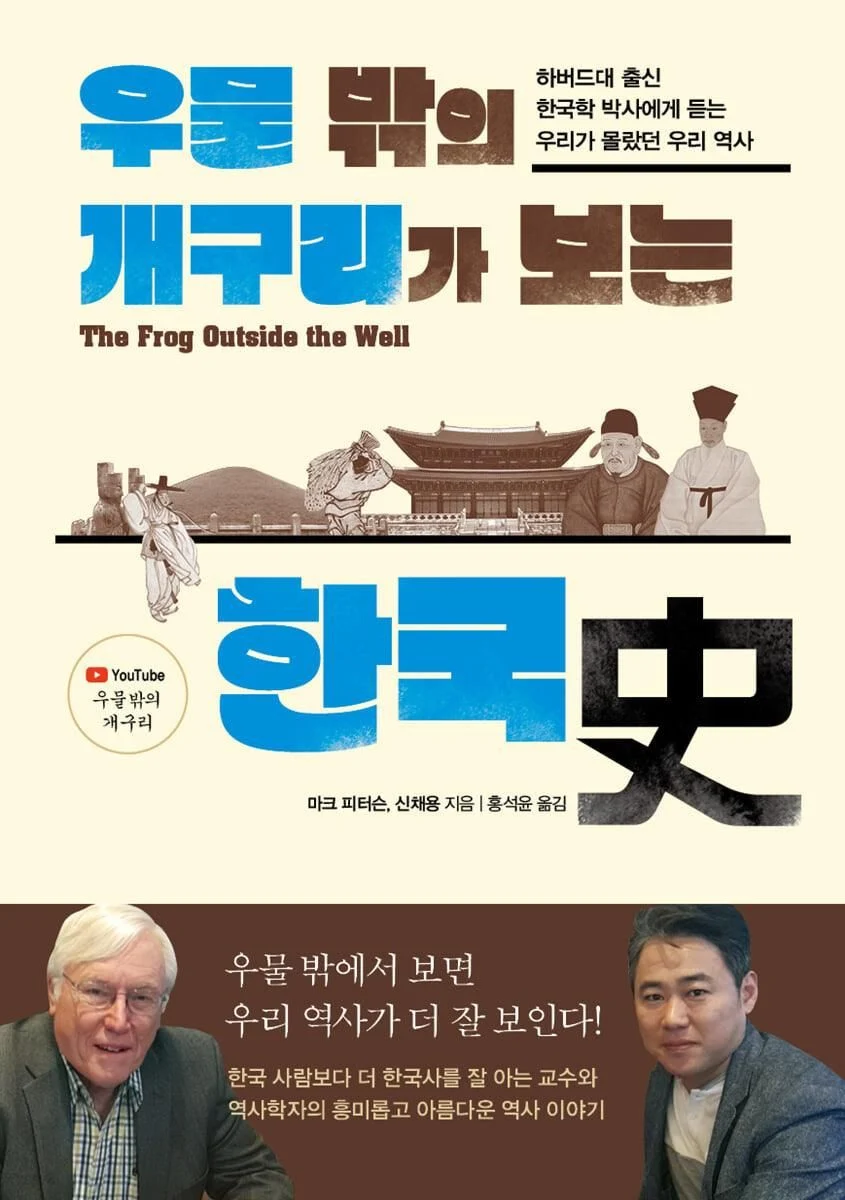
look outside the well
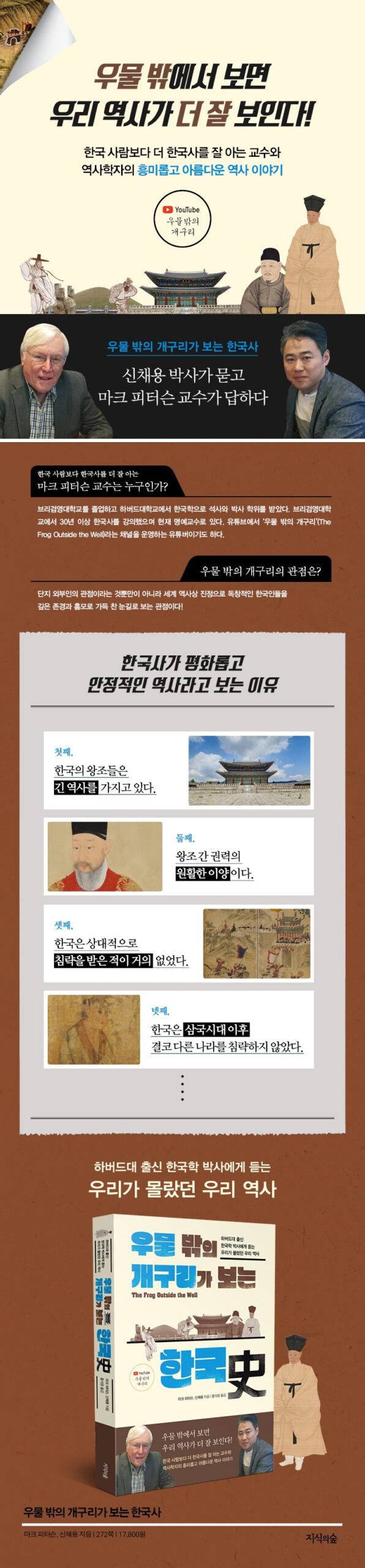
A better view of our history!
A professor who knows Korean history better than Koreans
An interesting and beautiful historical story from a historian
Why are there so many people in Korea with the surname Kim?
Korean history is a peaceful and stable history!
Dr. Shin Chae-yong asks and Professor Mark Peterson answers
Mark Peterson, professor emeritus at Brigham Young University in the US, is an expert in Korean studies and a YouTuber who runs a YouTube channel called “The Frog Out of the Well” (currently has about 140,000 subscribers). This book helps us to understand our history in a more world-historical and objective way by looking at our history from the perspective of a foreigner and an expert in Korean studies. Dr. Shin Chae-yong, a historian, asks, and Professor Mark Peterson answers. Let’s listen to interesting and beautiful history stories of a professor who knows Korean history better than Koreans and a Korean historian.
index
prologue | The Frog Out of the Well’s Relationship with Korea, an Opportunity to Study Korean History
Introduction | View of the Korean history of the frog outside the well
chapter 1
Korea with a peaceful and stable history
Chapter 1 | Korea has not suffered many invasions!
Chapter 2 Stable Korean history seen through major surnames such as Kim, Lee, and Park
Chapter 3 A Thousand-Year Border, Yalu River
Chapter 4 Ondol Culture, Symbol of Peace and Stability
Chapter 5 Korean tombs were not robbed
Chapter 6 Why there is no feudal system in Korean history
Chapter 7 Han? Koreans are an exciting nation!
Part 2
Confucianism in Korea is different from Confucianism in China.
Chapter 1 Free and Open Confucianism in Korea
Chapter 2 History through genealogy
Chapter 3 Ojukheon is the house Shin Saimdang inherited from her mother
Chapter 4 Daughters also held ancestral rites!
Chapter 5 Changes in the Quantum System
Part 3
Munchi and scholar culture, the beauty of Korean history
Chapter 1 | Korea, the country of Munchi
Chapter 2 Seonbi culture different from samurai
Chapter 3 The Great Alphabet, Hangeul
Chapter 4 There is also a genealogy of eunuchs!
Chapter 5 History of Korea’s Nobi System
Chapter 6: Can Genealogies Be Trusted?
Chapter 7 Korean Sijo, Contributing to World Literature
Chapter 8 『Heungbujeon』 is resistance literature
epilogue | Request to Koreans
picture source
into the book
At first, I was very worried that YouTube viewers would be offended. I thought it would be right to call myself “the frog out of the well,” but that would be relatively the same as referring to all of you as “the frog in the well,” meaning that you don’t see a problem in the broader light. But in fact, in a sense, that’s exactly what I’m trying to say. Fortunately, this comment was not taken as arrogant or insulting. Rather, there are many comments on my YouTube channel supporting and cheering my idea of explaining the perspective of a frog outside the well as a non-Korean. They readily accepted my idea.
—Excerpted from “Prologue: The Frog Out of the Well’s Relationship with Korea, the Reason for Studying Korean History”
My most basic view of Korean history is that most Koreans generally have a very distorted view of Korean history. It has been distorted by long years of poverty and oppression, and by external influences, especially Japan, sometimes intentionally and sometimes unknowingly. I think the general description of South Korea as a victim is very wrong. It is true, of course, that Korea was a victim of Japan in the late 19th century and most of the first half of the 20th century. This perception did not end even after liberation from Japan. The division of Korea, which caused more damage than Japan’s colonial occupation, became a factor in the sense of victimization that still exists today. It is clear that sacrifice is a powerful theme in Korean history, but it is not the only theme in Korean history.
—Excerpted from “Introduction: The Korean History of Frogs Outside the Well”
Why did so many people have the surname Kim Lee Park? A key clue to understanding this problem came to me when I met a student from Japan a few years ago. She said her own surname was her Fujiwara (藤原). I knew that the surname belonged to a family that held power during the Heian period in Japan. So she told her that she knew that the name was an aristocratic class name from the Heian period, almost contemporaneous with her Silla period in Korea.
—From 「Chapter 2 Stable Korean History through Major Surnames such as Kim, Lee, and Park」
Publisher Reviews
Frog’s point of view out of the well
This book explains Korean history from the perspective of a frog outside the well. Of course, I won’t cover all the history. This book is not a comprehensive cover of Korean history from the beginning to the present. Rather, it covers only a few themes drawn from Korean history and culture. Of course, among them are literature and language. Readers can start and end any topic at any point they wish. You can read it backwards from the end if you want, or you can jump from topic to topic anywhere in the middle. However, there is a common theme or thread running through all the themes in this book. It is not just an outsider’s point of view, but a point of view full of deep admiration and admiration for the truly original people (Koreans) in the history of the world.
Major themes running through Korean history
In this book, it is argued that the main theme running through Korean history is peace and stability. This is the opposite of what is often said and taught about Korean history as a “history of sacrifice.” To this end, we will compare Korean history with Japanese history a lot. For example, one chapter pays tribute to the Korean tradition of hiring government officials through written examinations (the past system) for more than a thousand years. Compare this to Japan’s samurai history. They inherited the position at the expense of others, and when that failed, they committed suicide. Japanese history is only a story of life and death, murder and seizure of power. The one who seizes power in Japan is the one who has most successfully killed a rival. The daimyo who occupied the largest territory finally controlled the emperor. Japanese history is full of bloody stories. On the other hand, power in Korea goes to the best student who passed the first place in the past exam with the best writing skills and learning. Comparing Japan and Korea, in Korea the pen was literally mightier than the sword.
The monarchy collapsed as the traditional order collapsed and democratization, westernization and modernization began. Then the Japanese returned to the samurai spirit of the past, and this led to a world war as they fought to build the Japanese Empire. On the other hand, similarly, when the traditional world collapsed, Koreans, unlike Japan, returned to the spirit of scholars and immersed themselves in their studies again. And they finally built a powerful nation based on intelligence, not power or natural resources. The education of Korean intelligence is the key to understanding the dynamics of Korea today. You will see the flow of these themes through each chapter. In it, you will see the power for Korea to prosper, not just to survive, but to prosper.
Reasons for viewing Korean history as a peaceful and stable history
First, Korean dynasties have a long history.
Second, it is a smooth transfer of power between dynasties.
Third, Korea was relatively rarely invaded.
Fourth, Korea has never invaded another country since the Three Kingdoms period.
Fifth, the Yalu River(압록강), which kept Korea’s borders safe, can be cited.
Sixth, Korean royal tombs were not robbed.
Seventh, scholars have continued to exist in Korean history for the past thousand years.
Eighth, control over the military.
Ninth, although not a good example, Korea has a long chain of slave ownership.
Tenth, in Korea, many people have a few surnames.
Publication date: 05 November 2022
Number of pages, weight, size
272 pages | 454g | 148*210*17mm






























![TWICE-7th Mini Album FANCY YOU [Random delivery among 3 types A/B/C] - EmpressKorea](https://cdn.empresskorea.com/2025/05/C_-_EmpressKorea-332776-600x600.webp)
































곰이 김 (verified owner) –
I suggest that it should be noted that the peaceful period in Korean history lasted much longer than the war period. Also, I suggest that we now move away from the idea of sacrifice that Koreans suffered in the early and mid-20th century. Looking at the long history of a peaceful civil society, the period of sacrifice in Korean history is much shorter than the period of peace and prosperity. (p.53)
What I learned from reading history books and recording what I felt was that I gradually came to like unsentimental sentences. This is not the case with essays, but at least in history books, it is because I feel that I can feel more and get objective information when it is a sentence without emotion. Maybe that’s why, I found this book attractive from the title. ‘Korean history seen by a frog outside the well’. Even before I opened the book, I was very curious about what kind of enlightenment this book would give to the tadpoles in the well.
The writer’s sentences are overflowing with emotions, but I was fascinated by the author from the part where he recorded ‘the view of the frog outside the well’s Korean history’. It was because he suggested a direction that was very consistent with my thoughts of wanting to study and look at our country from a subjective standpoint of our history, without being caught up in the victim mentality anymore. Maybe it’s difficult for us to do because of mixed emotions, but I think it’s a change in perspective that must be done someday. How about looking at our history again from the perspective that the bleak time of the 20th century cannot make the entire 2,000 years dark?
From the era of the Three Kingdoms to the Korean Empire, what we have seen as a time of struggle to steal and take away the kingship was actually unfamiliar to us as a ‘transfer of kingship’ or ‘succession’. However, I was surprised by the artist’s meticulous enumeration of the fact that the dynasty had been absorbed as it was even after the fall of the dynasty. How would you feel if you had been deceived by Japan’s attempt to disparage our history and believed that ‘the history of Korea, which had few revolutions’, was not progressing? I nodded my head involuntarily because his story was so strong that Korean surnames, such as Kim, Lee, and Park, which are not many, are evidence that disproves the peaceful and stable history of the Korean Peninsula. Throughout the book, I was even grateful to the author for discovering Korea’s peaceful and stable temperament even in the ondol culture and royal tombs that were not robbed. This book is full of sentences that would not have come out without affection for Korea.
Personally, the part that impressed me the most was the part about Korean culture. The part that talks about the greatness of Hangeul and Sijo was read and chewed over and over again, and in the part that talks about our scholarly culture and genealogy, I thought deeply about how we view Korean history from a distorted perspective. . Perhaps, because we were looking inside the well, we were not looking at our country’s history objectively and were ‘borrowing others’ eyes’.
As I read the book in a question-and-answer format, I met the questions I always had, and also met questions I had never had before. In the process, it can be said that the solidity of our history, which I had vaguely thought of, was somewhat embodied. What I have clearly gained through this book is the desire to have a more loving perspective on our history. Even outside the well, we have this kind of affectionate gaze, but it was a pity that we wondered why we couldn’t have a deeper affection inside the well.
To sum up my impressions after reading the book, it is a very well-organized book based on the results of effort and learning brought about by the limitation of ‘non-orthodox’ (I wonder if our opinion is orthodox that we have only nationality) that the author says is not Korean. I think it is. Of course, there were some ‘doubts (?) with a bit of backlash’ because I was Korean, but it was clear that the ‘different perspective’ of Korea’s history was filled with ‘same resolution’ affection. To be honest, I seem to have come to like Korea more after reading this book. I wanted to know our history in more detail, and I wanted to be the one who seduced our history no matter who asked. May the day come when we sing the beautiful history of Korea both inside and outside the well!
Ananya Verma from Bangalore, India –
What a breath of fresh air! Viewing history through an unconventional lens exposes deeper connections, inviting every reader to ponder identities anew. A whimsical exploration crafted with thoughtfulness and intellect.
Martín Romero from Buenos Aires, Argentina –
Este libro es una ventana a un pasado que desconocíamos. Las historias profundas se presentan de manera accesible, llevándonos lejos de los prejuicios y el ruido diario.
Emilia Schreiber from Berlin, Deutschland –
Dieses Buch eröffnet überraschende Perspektiven auf die koreanische Geschichte, gesehen durch die Augen eines erfahrenen Ausländers. Mark Petersons Gedanken inspirieren zur Reflexion und entblättern tiefere Wahrheiten über Kultur.
優花 岩佐 from 東京, 日本 –
最近、『井の外の蛙』という本を読んだよ!すごく面白かった。ハーバード出身の博士が韓国史について独特な視点から教えてくれる。外国人にしてみれば、自分たちには知られてない歴史ってけっこうあったりするんだね。そして、何で「キム」という名字がそんなに多いかとか、本当に興味深い内容ばかり。でも普通じゃなくてもっと大きな世界観で語る感じも好きだったわ。
Luís Costa from Lisbon, Portugal –
Este livro revela uma nova perspectiva sobre a história coreana através de um olhar externo e inquisitivo. Mark Peterson traz leveza à pesquisa histórica.
Marisol Reygadas from Queretaro, Mexico –
Breathtaking revelations emerge as layers of our past unfold. Through a unique lens, Dr. Shin Chae-yong invites readers to navigate Korea’s untold stories—a poetic journey awaits within these pages.
Eveline Jansen from Utrecht, Nederland –
Als ik buiten de put kijk, zie ik het verleden van Korea niet enkel als feiten. Dr. Shin en professor Mark openen een nieuwe wereld vol emoties en verhalen die vaak verborgen blijven. Prachtig! Een must-read voor elke liefhebber.