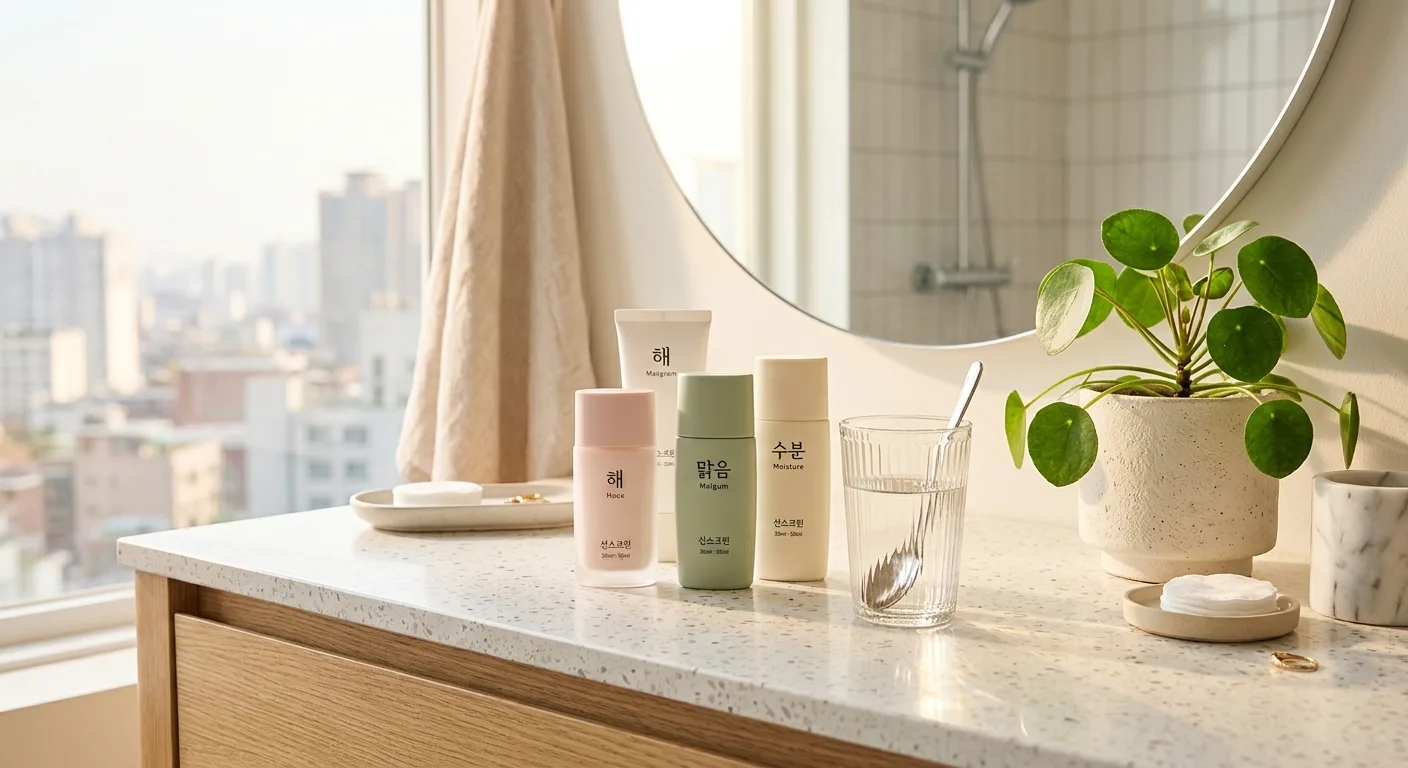
Korean sunscreen has become a category in its own right, recommended by dermatologists outside Korea and searched for by shoppers who have never bought another Korean product. The enthusiasm is easy to find; the reasons behind it are less often explained. Some are chemistry, some are regulation, and some are simply habit design: Korean brands build sunscreens that people are willing to apply in the amount that works.
This article sets out what can be verified. It covers the evidence that daily sunscreen changes how skin ages, the UV filter chemistry that Korean and European formulators can use and American formulators mostly could not until 2026, how Korea’s functional-cosmetic rules back the numbers on the tube, where Korean sunscreens genuinely fall short, and how to choose one for your own skin and climate.
What daily sunscreen actually does: the evidence
The strongest single piece of evidence for daily sunscreen as an anti-aging habit comes from Nambour, Australia. Hughes and colleagues randomized 903 adults under 55 to daily sunscreen use or discretionary use and followed them for four and a half years, grading photoaging from silicone skin casts. The daily-use group showed no detectable increase in skin aging over the period, and 24 percent less aging overall than the discretionary group. Beta-carotene supplements, tested in the same trial, made no difference.
Two details of that trial matter for how you shop. First, the sunscreen was an ordinary broad-spectrum SPF 15+, not a premium product; the variable that mattered was daily use. Second, the outcome was measured on the back of the hand, a site that most people protect poorly. The lesson is that the best sunscreen is the one that gets onto the skin, in enough quantity, every day, including on the neck, hands and ears. Korean sunscreens are popular precisely because they lower the friction of doing that.
Ultraviolet A is the wavelength band most responsible for that aging: it reaches the dermis, degrades collagen and elastin, and passes through clouds and window glass. Ultraviolet B is the burning band that SPF describes. A label that only reports SPF says nothing about UVA; this is why the East Asian PA grade and the European UVA-circle mark exist, and why Korean products almost always print both numbers.
The filter chemistry Korean brands can use
A sunscreen is only as good as its UV filters and how stable they stay under the sun. Korea’s permitted filter list closely follows Annex VI of the European cosmetics regulation, which allows more than twenty-five filters with defined maximum levels. The workhorses of modern Korean sunscreens are photostable triazine and benzotriazole absorbers: bemotrizinol (Tinosorb S, up to 10 percent), bisoctrizole (Tinosorb M, up to 10 percent), diethylamino hydroxybenzoyl hexyl benzoate (Uvinul A Plus, up to 10 percent), ethylhexyl triazone (Uvinul T 150, up to 5 percent) and iscotrizinol (Uvasorb HEB, up to 10 percent).
These molecules matter for three practical reasons. They absorb strongly, so a formula needs less total filter to reach SPF50+, which leaves room for water, humectants and light emollients. They are photostable, so protection does not decay over the morning the way unstabilized avobenzone does. And several, notably bemotrizinol and DHHB, cover long-wave UVA without the heavy, occlusive feel of older combinations, which is where the “lightweight” reputation comes from.
The United States regulates sunscreens as over-the-counter drugs under a monograph that, until 2026, listed sixteen active ingredients unchanged since 1999. Its only strong non-mineral UVA absorber, avobenzone, breaks down in light unless paired with stabilizers such as octocrylene, which add weight and can sting. In June 2026 the FDA finalized an order adding bemotrizinol at up to 6 percent for ages six months and older, the first new filter in about twenty years, noting its broad UVA and UVB protection and low skin absorption. An editorial in JAAD International points out that eight further filters submitted under the 2014 Sunscreen Innovation Act remain unapproved because US testing requirements were not harmonized with international standards. Until that catches up, the filter gap is the most concrete reason a Korean sunscreen feels different from a drugstore American one.
Regulation: why the numbers on a Korean tube are tested
In Korea, any product claiming UV protection is a functional cosmetic under the Cosmetics Act, alongside whitening and wrinkle-improvement claims. A brand cannot print SPF or PA until the product has either passed a review by the Ministry of Food and Drug Safety or been notified using approved filters at approved levels, and the label values must be supported by human application tests. That is why Korean product pages routinely publish measured results such as “SPF 50.2 plus or minus 5.7, PA 17.2 plus or minus 1.5” rather than only the rounded label.
The same regulator has been candid about the limits of the numbers. In June 2026 guidance, the MFDS said that higher SPF and PA do offer more protection but that above SPF 50 the practical difference is small, which is why labels are capped at SPF50+; it advised applying a sufficient amount at least fifteen minutes before exposure, reapplying with sweat and prolonged sun, and treating “water-resistant” as meaning that at least half of the protection remains after one hour in water, or two hours for “very water-resistant”. It also warned that very high SPF and PA products can be more irritating for some skin, a reminder that the right choice is not automatically the highest grade.
Many Korean sunscreens carry two or three functional claims at once, for example UV protection plus brightening with niacinamide plus wrinkle improvement with adenosine. Each claim is separately notified. That is a regulatory convenience rather than proof that a sunscreen will visibly brighten your skin; treat the secondary claims as ingredient disclosures, and buy on the sun-protection numbers and the texture.
Texture engineering: the reason people actually reapply
The SPF on the label is measured at 2 milligrams per square centimeter, about a quarter teaspoon for an adult face. Consumer studies repeatedly find that people apply between a quarter and a half of that, and because protection falls faster than the film thins, a half-dose SPF50+ can deliver protection closer to the teens. The American Academy of Dermatology’s shot-glass rule for the body and its advice to reapply every two hours exist because under-application, not weak products, is the usual cause of sunburn.
Korean brands attack this problem with texture. Essence and gel bases built on water and light esters, with photostable filters that need no heavy stabilizer, let people apply the full two-finger amount without shine or cast. Sun sticks and cushions let them reapply over makeup by pressing rather than rubbing. The categories that have spread from Korea, sun essence, sun serum, sun fluid, tone-up sun cushion and matte sun stick, are all answers to the same question: how do you make a full dose comfortable enough to repeat?
| Format | Typical filter system | Best for | Reapplication | Trade-off |
|---|---|---|---|---|
| Sun essence or serum | Organic, photostable triazines and DHHB | Daily wear under makeup, oily to normal skin | Easy at home; awkward over makeup | Usually not water-resistant |
| Sun cream or sun moisturizer | Organic or hybrid with a small mineral booster | Dry and sensitive skin, winter | Same as essence | Slightly heavier finish |
| Mineral sun cream | Zinc oxide and titanium dioxide | Reactive skin, children, post-procedure | Same as cream | Possible cast on medium to deep skin |
| Sun stick | Organic, often with matte powders | Reapplication over makeup, sport, commuting | Very easy | Thinner deposit per pass; use two passes |
| Sun cushion | Organic or hybrid, sometimes tinted | Midday top-ups on a made-up face | Very easy | Sponge hygiene; low SPF delivered if patted lightly |
The MERZY V Hyaluron Moisture Sun Cream shows how far the value end has come: SPF50+ PA++++, ten hyaluronic acid weights for slip and moisture, vegan certified, and a soft-focus finish designed not to pill under base makeup. At this price a full two-finger dose every morning is affordable, which is the point.
The HYGGEE Relief Sun Moisturizer is the “sunscreen as moisturizer” approach: SPF50+ PA++++, a 37 percent cypress water base with ceramide and a calming complex, and a published 0.00 irritation index. For dry or sensitive skin it can replace the morning moisturizer entirely, removing one reason to skip.
Where Korean sunscreens fall short
Water resistance. Most everyday Korean sunscreens are not water-resistant and are meant to rinse off with a single cleanse. That is comfortable for a commute and inadequate for a beach day. Choose a labeled water-resistant or sport formula for swimming, and reapply after towel-drying.
Eye stinging. Watery essences with water-soluble filters or high humectant loads can migrate into the eyes with sweat. Cream textures and sticks are better around the orbital area; a dedicated sun stick for the eye zone is a common Korean workaround.
Tone-up confusion. “Tone-up” means added pigment. On light skin it reads as brightening; on medium-deep and deep skin it reads as a grey or pink cast. Read the label for the word before assuming a Korean sunscreen will be invisible; our no-white-cast guide explains which filter systems are transparent by chemistry.
Marketing claims. Blue-light, fine-dust and infrared claims appear on many Korean sunscreens. The test methods behind them are not standardized the way SPF and PA are, so treat them as secondary. Antioxidants such as tocopherol, ferulic acid or carnosine are plausible additions but are not a substitute for filter level.
Heat and shelf life. Organic filters and emulsions degrade with heat. A sunscreen left in a hot car or used two summers after opening is not the product that was tested.
For oily skin, the LEBELAGE High Protection Daily No Sebum Sun Cream illustrates the hybrid-finish category: SPF50+ PA++++ with silica and charcoal to absorb sebum, a 0.00 irritation index and CPNP notification for the European market, which means its formula also meets Annex VI limits. Our guide to Korean sunscreens for oily skin compares more matte options.
The Banobagi 4 Defense Sun Stick Matte Fit is a reapplication tool with real numbers behind it: tested SPF 50.2 and a UVA factor of 17.2, sebum-absorbing soft-focus powder, and instructions to tap rather than rub over makeup. Raise the stick only a few millimeters and make two slow passes on each zone to compensate for the thinner deposit.
How to choose a Korean sunscreen for your skin and climate
- Start with the grade. SPF50+ PA++++ for daily wear in sunny climates or for anyone treating pigmentation; SPF30 to 50 with PA+++ is acceptable for short indoor-heavy days.
- Pick the base by skin type. Essence or gel for oily and combination skin, cream or sun moisturizer for dry skin, mineral or hybrid for reactive skin, fragrance-free if you are sensitive.
- Check the filters. Organic-filter formulas are invisible on all skin tones; look for bemotrizinol, bisoctrizole, DHHB or ethylhexyl triazone high on the list. Titanium dioxide near the top means a mineral or tone-up finish.
- Decide about water. For sport or swimming, only a labeled water-resistant product counts.
- Plan reapplication. Add a stick or cushion if you wear makeup; reapply every two hours outdoors and at least once at midday indoors by windows.
- Use the UV index. The EPA recommends protection from a UV index of 3, so check the forecast rather than the weather; cloudy spring days often exceed it.
Application and removal, briefly
Apply as the last skincare step, at least fifteen minutes before going out, two finger-lengths for the face and neck, and do not forget the ears, hairline and backs of the hands, the site where the Australian trial measured its result. Let serums dry before applying to avoid pilling. At night, non-water-resistant Korean sunscreens rinse off with a mild foam; water-resistant and stick formulas need an oil cleanse first, as described in our cleansing oil versus foam cleanser guide. For a broader walkthrough of picking a texture you will keep using, see Sunscreen smarts, and browse the current range in our Korean sunscreen collection.
The honest summary is that Korean sunscreens are not magic; they are well-regulated products built on a better filter palette and designed around human behavior. That combination is why they work in practice, and why the habit they make easy is the one the evidence supports.
Sources
- Hughes, Williams, Baker and Green, Annals of Internal Medicine 2013: Sunscreen and prevention of skin aging: a randomized trial
- U.S. Food and Drug Administration, June 2026: FDA expands sunscreen options for the first time in 20 years
- JAAD International 2026: Bemotrizinol and the modernization of US sunscreen regulation
- Seoul Economic Daily, June 2026: Higher SPF isn’t always better, Korea’s drug safety agency says
- ChemLinked: South Korea functional cosmetic regulation
- Regulation (EC) No 1223/2009 on cosmetic products, Annex VI: List of UV filters allowed in cosmetic products
- American Academy of Dermatology: How to apply sunscreen
- U.S. Environmental Protection Agency: UV Index scale
Frequently Asked Questions
Are Korean sunscreens actually stronger than American or European ones?
Not in the sense of a higher lab number. A Korean SPF50+ PA++++ and a European SPF50+ UVA-circle product are tested to comparable in vivo standards and deliver similar protection when applied at 2 milligrams per square centimeter. The difference is in the filter choices, which allow lighter, more photostable formulas, and in daily wearability. A sunscreen you apply generously every morning outperforms a technically stronger one you avoid.
What does PA++++ mean and does it matter?
PA is the UVA protection grade used in Korea and Japan, based on the persistent pigment darkening method. PA++++ corresponds to a UVA protection factor of 16 or higher, the highest grade. It matters because UVA penetrates deeper, passes through window glass and drives most photoaging, while SPF only describes protection from UVB-driven sunburn. For daily wear, PA+++ or PA++++ is the useful threshold.
Why are some Korean UV filters not approved in the United States?
The US regulates sunscreens as over-the-counter drugs and had not added a new active ingredient since the late 1990s. Filters such as bemotrizinol, bisoctrizole and DHHB were approved in Europe and Asia decades ago, but the FDA's testing expectations were not harmonized with international standards. That changed in June 2026, when the FDA finalized bemotrizinol as generally recognized as safe and effective at up to 6 percent; other filters remain under review.
Do I need sunscreen indoors or on cloudy days?
UVA passes through clouds and untinted window glass, so a desk by a window or a long commute still adds daily UVA exposure that contributes to pigmentation and photoaging. The EPA advises protection whenever the UV index reaches 3 or more, which covers most daylight hours in spring through autumn at mid-latitudes. A single morning application is reasonable for indoor days; reapply if you go outside at midday.
How much Korean sunscreen should I apply to my face?
Two finger-lengths squeezed along the index and middle fingers, roughly a quarter teaspoon, approximates the 2 milligrams per square centimeter used in SPF testing for an adult face and neck. Most people apply a quarter to half of that and get far less than the labeled protection. Korean brands print the two-finger rule because the light textures make a full dose comfortable.
Is a Korean sunscreen enough on its own for the beach?
Only if it is labeled water-resistant and you reapply every two hours and after swimming. Most everyday Korean essences and sun creams are designed for comfort and single-cleanse removal and lose protection quickly in water. For the beach, choose a water-resistant sport formula or a stick, and combine it with shade, a hat and UV-protective clothing, which no sunscreen replaces.